Have you ever come across two English words that look almost the same but have completely different meanings? This happens more often than you might think. One common example is innate vs enate. These words differ by only one letter, but using the wrong one can change the meaning of a sentence.
The word innate is commonly used in everyday English. It describes something natural or inborn, such as a person’s ability, talent, instinct, or personal quality. For example, someone may have an innate talent for music or an innate curiosity about the world.
On the other hand, enate is a rare and specialized English word. It describes relationships connected through the mother’s side of a family. You may find it in genealogy, anthropology, and discussions about family history.
Understanding innate vs enate can help you avoid spelling mistakes and improve your vocabulary. Although both words are correct, they cannot be used interchangeably. In this guide, you will learn their meanings, grammar rules, differences, examples, and common mistakes so you can use each word correctly. Nor Do I or Neither Do I | Hail vs Hale | Cuss Words or Curse Words
Quick Answer: Innate vs Enate
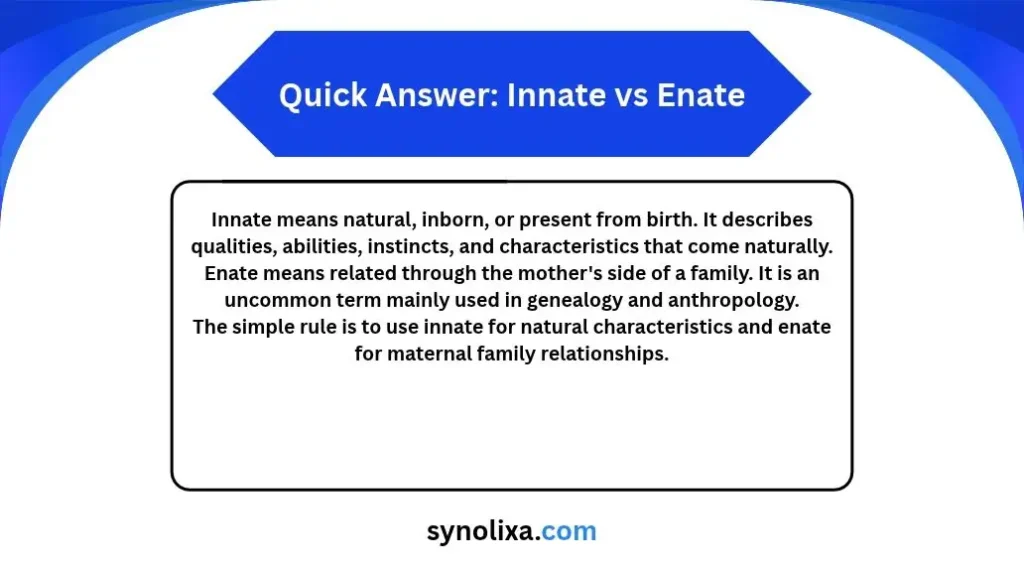
Innate means natural, inborn, or present from birth. It describes qualities, abilities, instincts, and characteristics that come naturally.
Enate means related through the mother’s side of a family. It is an uncommon term mainly used in genealogy and anthropology.
The simple rule is to use innate for natural characteristics and enate for maternal family relationships.
Understanding the Basics of Innate vs Enate
Understanding the basic meanings of these words is the first step toward using them correctly. Although their spellings are similar, their purposes are different.
One word describes natural qualities, while the other describes family connections.
What Does Innate Mean?
The word innate is an adjective that means natural, inborn, or existing from birth. It describes something that a person or animal has naturally rather than gaining entirely through education or experience.
It is commonly used when discussing abilities, instincts, talents, and personal qualities.
Examples:
- She has an innate talent for singing.
- Children often show an innate curiosity about the world.
- His innate ability helped him understand difficult problems.
- Some animals have innate behaviors that support survival.
- The artist displayed an innate sense of creativity.
In these examples, innate describes something that comes naturally.
For example:
Sentence: She has an innate talent for painting.
- Subject: She
- Verb: Has
- Adjective: Innate
- Noun: Talent
- Meaning: She has a natural ability to paint.
The word explains that her talent seems to come naturally.
What Does Enate Mean?
The word enate is an adjective that describes a relationship through the mother’s side of a family.
It is not commonly used in everyday conversation. Instead, it appears in specialized writing about family history, ancestry, and kinship.
Examples:
- The historian studied the family’s enate relationships.
- The researcher documented several enate connections.
- The genealogist traced the enate family line.
- The report examined enate relatives across generations.
For example:
Sentence: The researcher studied the family’s enate relationships.
- Subject: The researcher
- Verb: Studied
- Adjective: Enate
- Noun: Relationships
- Meaning: The researcher examined family connections through the mother’s side.
In everyday English, you can replace enate relationships with relationships through the mother’s side of the family.
Innate vs Enate Comparison Table
| Form | Type | Meaning | Example | Correct/Incorrect |
|---|---|---|---|---|
| Innate | Adjective | Natural or inborn | She has an innate talent. | Correct |
| Enate | Adjective | Related through the mother’s side | They studied enate relatives. | Correct |
| Innate | Adjective | Maternal family relationship | He studied innate relatives. | Incorrect for this meaning |
| Enate | Adjective | Natural ability | She has an enate talent. | Incorrect for this meaning |
| Innate | Adjective | Natural characteristic | His innate curiosity helped him learn. | Correct |
| Enate | Adjective | Maternal family connection | The family traced its enate line. | Correct |
The main difference is simple: innate describes something natural, while enate describes a maternal family connection.
Correct Meanings and Uses of Innate vs Enate
Both words have different uses. Learning these uses will help you choose the correct word in everyday, academic, and professional writing.
1. Using Innate for Natural Abilities
One of the most common uses of innate is to describe a natural ability or talent.
An innate ability is a skill or capacity that seems to come naturally rather than being developed entirely through formal training.
Examples:
- She has an innate talent for dancing.
- The young boy showed an innate ability to solve puzzles.
- He has an innate understanding of mathematics.
- The musician demonstrated an innate sense of rhythm.
Sentence breakdown:
She has an innate talent for dancing.
The adjective innate describes the noun talent. It tells readers that her ability appears natural.
You should not use enate in these examples because they are not about family relationships.
2. Using Innate for Personal Qualities
The word innate can also describe personal characteristics and natural tendencies.
Examples:
- His innate kindness makes people feel welcome.
- She has an innate sense of fairness.
- The child’s innate curiosity encourages learning.
- Her innate confidence helps her speak publicly.
These sentences describe qualities that appear to come naturally.
However, remember that not every personal characteristic is necessarily present at birth. Some qualities develop through education, family, and life experiences.
3. Using Innate in Science and Psychology
The word innate is also common in scientific and psychological writing.
Researchers use it to discuss natural characteristics, biological processes, instincts, and behavioral tendencies.
Examples:
- The study examined innate human behavior.
- Scientists investigated innate responses to environmental changes.
- The research explored whether the behavior was innate or learned.
- The article discussed the innate immune system.
In biology, the innate immune system is the body’s rapid first line of defense against many harmful substances and organisms.
In psychology, researchers may study whether a behavior comes naturally or develops through experience.
4. Using Enate for Maternal Family Relationships
The word enate describes relationships connected through the mother’s side of a family.
It is mainly used in technical discussions of family connections and ancestry.
Examples:
- The genealogist recorded the family’s enate relationships.
- The historian studied several enate connections.
- The document described the family’s enate relatives.
- The research examined enate ancestry across generations.
In these examples, the word identifies a maternal family connection.
For ordinary readers, maternal relatives may be a clearer alternative.
5. Using Enate in Genealogy
Genealogy is the study of family history and ancestry. In this field, enate can help describe relationships traced through the maternal side.
Examples:
- The genealogist examined the family’s enate line.
- The researcher recorded enate connections in the family tree.
- The historical records mentioned several enate relatives.
The term can be useful when researchers need precise vocabulary to describe family relationships.
6. Using Enate in Anthropology
Anthropologists study human societies, family structures, and cultural relationships.
In specialized discussions of kinship, enate may describe relationships connected through the mother’s side.
Examples:
- The anthropologist documented enate kinship ties.
- The study examined enate relationships in an ancient community.
- The report discussed maternal family connections.
Remember that enate describes a maternal relationship. It does not automatically explain a family’s inheritance system or every aspect of its social structure.
Innate vs Enate: Practical Sentence Examples
Examples make the difference between these words easier to understand.
Innate Examples
- She has an innate love of music.
Meaning: Music comes naturally to her. - The child showed an innate interest in animals.
Meaning: The child naturally likes learning about animals. - His innate confidence helped him succeed.
Meaning: He has a natural sense of confidence. - The student displayed an innate ability to recognize patterns.
Meaning: Recognizing patterns comes naturally to the student. - Her innate creativity made her a talented artist.
Meaning: She has a natural creative quality.
Enate Examples
- The historian examined the family’s enate relationships.
Meaning: The historian studied maternal family connections. - The genealogist traced the enate line.
Meaning: The genealogist followed relationships through the mother’s side. - The research documented enate relatives.
Meaning: The research recorded relatives connected through the maternal side. - The report discussed enate kinship.
Meaning: The report examined maternal family relationships. - The family records included several enate connections.
Meaning: The records showed connections through the mother’s side.
These examples demonstrate that the words have different meanings even though their spellings look similar.
Case Study: Innate vs Enate in Real-Life Writing
Imagine that a student named Daniel is preparing two university assignments.
The first assignment is about human abilities and natural behavior. The second assignment is about family history.
While writing the first assignment, Daniel writes:
“The child showed an enate interest in solving puzzles.”
His teacher marks the sentence as incorrect.
Why?
Daniel wants to describe a natural interest. Therefore, the correct word is innate.
Correct sentence:
“The child showed an innate interest in solving puzzles.”
Now Daniel begins his family history assignment. He writes:
“The researcher studied the family’s innate connections through the mother’s side.”
This sentence is incorrect for the intended meaning because Daniel is discussing maternal family relationships.
Correct sentence:
“The researcher studied the family’s enate connections through the mother’s side.”
What Does This Case Study Teach Us?
The examples show why understanding innate vs enate is important.
- Use innate when describing natural abilities or qualities.
- Use enate when describing relationships through the mother’s side.
- Use simple alternatives when writing for readers who may not know specialized vocabulary.
Before choosing a word, identify the meaning of your sentence.
Grammar Rules for Innate vs Enate
Both words are adjectives, but they have different meanings and grammatical uses.
The following rules can help you avoid common errors.
Rule 1: Use Innate for Inborn Characteristics
Use innate when describing a natural ability, quality, tendency, or characteristic.
Common expressions include:
- Innate ability
- Innate talent
- Innate curiosity
- Innate instinct
- Innate quality
- Innate potential
- Innate capacity
- Innate response
Examples:
- The athlete has an innate ability to move quickly.
- His innate curiosity encourages him to explore.
- The child displayed an innate talent for music.
Rule 2: Use Enate for Maternal Relationships
Use enate when referring to family connections through the mother’s side.
Examples of expressions include:
- Enate relatives
- Enate relationships
- Enate connections
- Enate kinship
- Enate line
Example:
“The researcher documented the family’s enate relationships.”
This is suitable in a specialized family-history context.
Rule 3: Do Not Use Innate and Enate Interchangeably
These words are not alternative spellings.
Incorrect: She has an enate ability to learn quickly.
Correct: She has an innate ability to learn quickly.
Incorrect: The historian studied the family’s innate relationships through the maternal line.
Correct: The historian studied the family’s enate relationships through the maternal line.
Rule 4: Check the Dictionary Meaning
When you are unsure about a word, consult a reliable dictionary such as Merriam-Webster.
Check the definition, pronunciation, part of speech, and example sentences.
For innate, look for meanings related to natural or inborn characteristics.
For enate, look for the specialized meaning related to maternal family relationships.
This habit can prevent spelling and vocabulary mistakes.
Rule 5: Remember That Both Words Are Adjectives
Both words can describe nouns.
Examples:
- An innate ability
- An innate quality
- Enate relatives
- Enate connections
They can also appear after linking verbs when the sentence structure allows it.
Example:
“The ability appears innate.”
Here, innate describes the ability.
Common Mistakes With Innate vs Enate
Writers often confuse these words because their spellings are similar.
However, several other factors can cause mistakes.
1. Confusing Similar Spellings
Some people believe that innate and enate are alternative spellings of the same word.
This is incorrect.
The words have separate meanings, and choosing the wrong one can change the message.
2. Fast Typing
Typing quickly can cause missing letters, repeated letters, and incorrect word choices.
For example:
Incorrect: He has an enate gift for drawing.
Correct: He has an innate gift for drawing.
Always review your sentences before publishing or sending them.
3. Autocorrect Problems
Autocorrect can identify spelling mistakes, but it cannot always understand the meaning of a sentence.
A correctly spelled word can still be incorrect in context.
For example, a spelling checker may accept enate even when the sentence requires innate.
Read the complete sentence instead of depending entirely on automatic correction.
4. Lack of Vocabulary Knowledge
Some writers know the word innate but have never encountered enate.
Others may recognize both words but fail to understand their different meanings.
Learning definitions with examples is one of the easiest ways to improve vocabulary.
5. Using Unnecessary Technical Words
Although enate is a valid word, it may not be suitable for every audience.
Instead of writing:
“The family invited its enate relatives.”
You can write:
“The family invited its relatives from the mother’s side.”
The second sentence is easier to understand.
Similar Grammar Confusions
| Words | Difference | Example |
|---|---|---|
| Innate vs Enate | Natural quality vs maternal family connection | Innate talent |
| It’s vs Its | It is vs possession | It’s raining. |
| Your vs You’re | Belonging to you vs you are | You’re reading your book. |
| Their vs There | Belonging to them vs a place | Their house is there. |
| Affect vs Effect | Influence vs result | Sleep affects health. |
| Principal vs Principle | Main or school leader vs rule | The principal explained the principle. |
| Compliment vs Complement | Praise vs something that completes | Your shoes complement your outfit. |
| Inborn vs Learned | Natural vs acquired through experience | Some behaviors are inborn. |
Usage of Innate vs Enate in Different Contexts
The right word also depends on your writing situation.
1. Everyday Conversation
In everyday English, innate is much more common.
Examples:
- She has an innate talent for cooking.
- He has an innate sense of humor.
- Children often show innate curiosity.
The word enate is rarely needed in ordinary conversations.
Instead of saying “my enate relatives,” most people would say “my relatives on my mother’s side.”
2. Professional Writing
Professional writing requires clear and accurate vocabulary.
Use innate when describing natural abilities or characteristics.
Example:
“The candidate demonstrated an innate ability to solve difficult problems.”
Use enate when discussing maternal family connections in a suitable technical context.
Example:
“The report documented enate relationships in the historical records.”
If your readers are unfamiliar with the term, explain it in simple language.
3. Academic Writing
Both words may appear in academic writing, but in different subjects.
In psychology, biology, and behavioral studies, innate can describe natural characteristics and biological processes.
Examples:
- The study examined innate behavioral responses.
- The researchers investigated innate abilities.
- The paper discussed the difference between innate and learned behavior.
In genealogy and anthropology, enate may describe maternal kinship.
Example:
“The research examined enate connections across several generations.”
4. Creative Writing
Creative writers can use innate to describe characters and their natural qualities.
Examples:
- The detective had an innate ability to notice small details.
- Her innate kindness made people trust her.
- The young artist possessed an innate sense of creativity.
The word enate may also appear in historical fiction or family stories involving ancestry.
However, simple expressions may be more effective for general readers.
5. Social Media and Texting
Social media users often write quickly, which can increase spelling mistakes.
Incorrect: She has an enate talent for photography.
Correct: She has an innate talent for photography.
For family-related posts, expressions such as “my mother’s side of the family” are usually clearer than technical vocabulary.
Even in casual messages, using the correct word makes communication easier.
Why Understanding Innate vs Enate Matters
Learning the difference between these words can improve your writing in several ways.
1. Clear Communication
Correct vocabulary helps readers understand your message.
Consider these examples:
- He has an innate ability to solve problems.
- He has enate relatives who live nearby.
The first sentence describes a natural ability. The second describes maternal family relationships.
Using the wrong word can confuse readers.
2. Professionalism
Correct word choices make articles, assignments, emails, and reports more reliable.
When you understand the difference between innate vs enate, you can avoid unnecessary vocabulary errors.
3. Better Digital Communication
Online writing often involves quick messages and short deadlines.
A small spelling or vocabulary mistake can change the meaning of a sentence.
Proofreading helps you identify these errors before publishing.
4. Stronger Vocabulary
Learning similar-looking words improves your vocabulary and reading skills.
It also helps you understand academic articles and specialized discussions.
Remember this useful quote:
“Choose words for their meaning, not just their spelling.”
Special Exceptions and Less Common Uses
There are a few additional points to remember when comparing innate vs enate.
1. Innate Does Not Always Mean Fully Developed at Birth
The word innate often refers to something natural or inborn, but it does not mean that a skill is completely developed from birth.
Example:
“She has an innate ability to understand complex ideas.”
This means she appears to have a natural aptitude. It does not mean she never needs practice or education.
2. Enate Is a Rare but Correct Word
The word enate is uncommon in everyday English.
It is mainly useful when describing maternal family connections.
For general readers, maternal relatives is often a better choice.
3. Do Not Confuse Enate With Enact
These words have different meanings.
- Enate: Related through the mother’s side of a family.
- Enact: To make a law official or put a proposal into action.
Examples:
“The historian studied enate relationships.”
“The government decided to enact the new law.”
4. Do Not Confuse Innate With Inherent
These words are similar, but they are not always interchangeable.
- Innate: Natural or inborn.
- Inherent: An essential or permanent characteristic of something.
Examples:
“The child has an innate interest in science.”
“The system has inherent limitations.”
Understanding these differences helps you select more precise vocabulary.
Quick Recap Checklist: Innate vs Enate
Use this table whenever you are unsure which word belongs in your sentence.
| Question | If Yes → Use |
|---|---|
| Are you describing a natural ability? | Innate |
| Are you discussing an inborn characteristic? | Innate |
| Are you describing natural curiosity? | Innate |
| Are you talking about a maternal family relationship? | Enate |
| Are you discussing relatives through the mother’s side? | Enate |
| Are you writing for general readers unfamiliar with technical terms? | Use a simpler phrase for enate |
Easy Memory Trick
Remember these simple definitions:
- Innate = Inborn.
- Enate = Maternal family connection.
Think of innate when discussing natural abilities and enate when discussing family ancestry through the mother.
Practice Examples
Choose the correct word to complete each sentence.
1. The young musician showed an ______ talent for playing the piano.
Correct answer: Innate.
Explanation: The sentence describes a natural musical ability.
2. The genealogist studied the family’s ______ relationships.
Correct answer: Enate.
Explanation: The sentence discusses maternal family connections.
3. His ______ curiosity encouraged him to explore new ideas.
Correct answer: Innate.
Explanation: Curiosity is described as a natural tendency.
Bonus Practice
Choose the correct word in each sentence.
- The student has an (innate/enate) ability to understand mathematics.
- The historian examined the family’s (innate/enate) connections through the maternal line.
- Her (innate/enate) creativity helped her become a successful artist.
Answers:
- Innate
- Enate
- Innate
FAQs
1. What Is the Difference Between Innate and Enate?
Innate means natural or inborn, while enate means related through the mother’s side of a family. The first word describes natural qualities and abilities. The second describes maternal family relationships.
2. Is Enate a Correct English Word?
Yes. Enate is a correct but uncommon English adjective. It is mainly used in genealogy, anthropology, and specialized discussions of maternal family relationships.
3. Is Innate the Correct Word for Natural Talent?
Yes. Innate is the correct word for a natural or inborn ability.
Example: “She has an innate talent for music.”
4. Can Innate and Enate Be Used Interchangeably?
No. They have different meanings. Use innate for natural characteristics and enate for maternal family relationships.
5. What Are Some Synonyms for Innate?
Depending on the context, synonyms for innate include natural, inborn, inherent, and instinctive. However, these words may have slightly different meanings.
6. What Is Another Way to Say Enate Relatives?
You can say maternal relatives, relatives on the mother’s side, or family members connected through the mother. These phrases are easier for most readers to understand.
Conclusion
Understanding innate vs enate is important for choosing the correct word in English writing. Although these words look similar, their meanings are completely different. Innate describes something natural, inborn, or present from birth. It is commonly used for abilities, talents, instincts, and personal characteristics. For example, someone may have an innate talent for music or an innate curiosity about the world.
On the other hand, enate describes family relationships connected through the mother’s side. It is a specialized term mainly used in genealogy and anthropology.
Both words are correct, but they cannot replace each other. Always consider the meaning of your sentence before choosing one.
Remember the simple rule: Innate means inborn, while enate means connected through the mother’s side. Once you understand this difference, you can use both words accurately and confidently.

Hi, I am Noah Harrison. I work at Synolixa as an English language editor, reviewing and creating helpful content to make English learning easier and clearer.

[…] also learn how to remember the correct form and avoid confusion in professional and casual writing. Innate vs Enate | Nor Do I or Neither Do I | Hail vs […]
[…] spelling in everyday conversations, professional writing, and online content. Awoke vs Woke | Innate vs Enate | Nor Do I or Neither Do […]