Have you ever written a word that sounded correct but did not fit the meaning of your sentence? English has many words that sound alike but have different meanings and spellings. One common example is hail vs hale. These two words are pronounced the same way, but they serve different purposes in writing. Understanding their meanings can help you avoid spelling mistakes and communicate more clearly.
The word hail has several meanings. It can refer to small balls of ice that fall from the sky during a storm. It can also mean calling out to someone, greeting a person, praising an achievement, or describing where someone comes from. In contrast, hale is an adjective that means healthy and strong. It often describes older people who remain physically active and well.
Because hail and hale sound identical, even experienced writers can confuse them. A spell-checking tool may not catch the mistake because both words are spelled correctly. The key is understanding the meaning of the sentence.
In this guide, you will learn the difference between hail vs hale, explore their meanings, review grammar rules, and practice using each word correctly. These simple explanations will help you choose the right word in everyday conversations, professional documents, and online articles. Cuss Words or Curse Words | Trawling vs Trolling | In the Store or At the Store
Quick Answer: Hail vs Hale
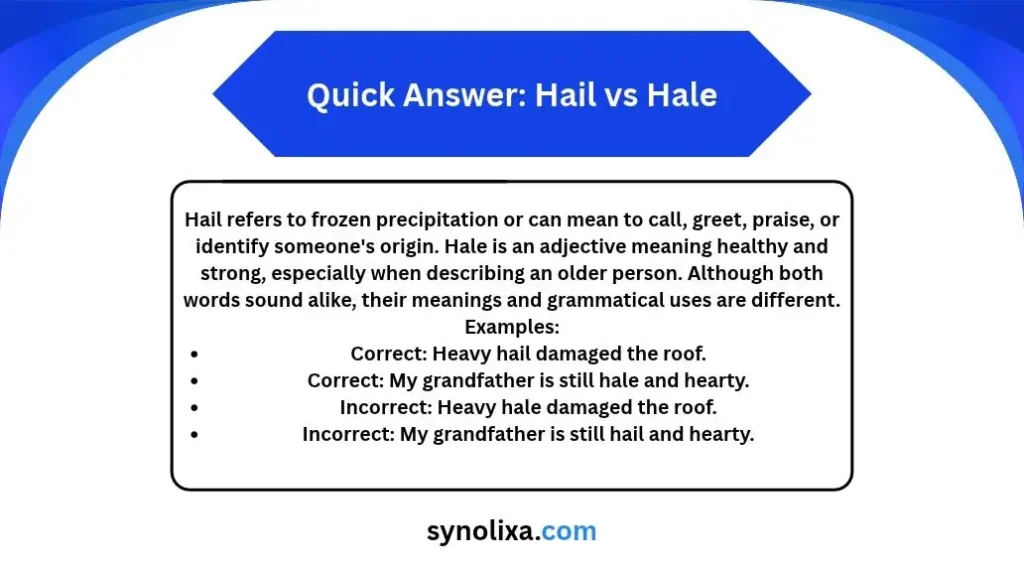
Hail refers to frozen precipitation or can mean to call, greet, praise, or identify someone’s origin. Hale is an adjective meaning healthy and strong, especially when describing an older person. Although both words sound alike, their meanings and grammatical uses are different.
Examples:
- Correct: Heavy hail damaged the roof.
- Correct: My grandfather is still hale and hearty.
- Incorrect: Heavy hale damaged the roof.
- Incorrect: My grandfather is still hail and hearty.
Easy rule: Use hail for ice and its related verb meanings. Use hale when describing health and strength.
Understanding the Basics of Hail vs Hale
The main difference between hail vs hale is their meaning and grammatical function. Learning this distinction makes it easier to identify the correct spelling when writing.
Hail can function as a noun or a verb. As a noun, it refers to frozen precipitation that falls from storm clouds. As a verb, it can mean calling to someone, greeting someone, praising someone, or identifying a person’s place of origin.
Hale functions as an adjective in its standard use. It describes someone who is healthy, strong, and physically well.
Hail vs Hale Comparison Table
| Form | Type | Meaning | Example | Correct/Incorrect |
|---|---|---|---|---|
| Hail | Noun | Small balls of ice falling from clouds | Hail damaged the car. | Correct |
| Hail | Verb | To call or signal someone | She hailed a taxi. | Correct |
| Hail | Verb | To greet or welcome | The crowd hailed the winner. | Correct |
| Hail | Verb | To praise or recognize | Critics hailed the film as a success. | Correct |
| Hail | Verb | To come from a place | She hails from Texas. | Correct |
| Hale | Adjective | Healthy and strong | The hale farmer worked outdoors. | Correct |
| Hale and hearty | Expression | Healthy, strong, and energetic | Grandpa is hale and hearty. | Correct |
| Hale | Adjective | Frozen precipitation | Hale covered the road. | Incorrect |
| Hail | Noun or verb | Healthy and strong | He is hail and hearty. | Incorrect |
Why Hail vs Hale Causes Confusion
Hail and hale are homophones. Homophones are words that have the same pronunciation but different meanings and spellings.
Since these words sound identical, pronunciation alone cannot tell you which spelling to use. You must consider the sentence’s meaning.
Compare these examples:
- The hail damaged several windows.
- The hale gentleman walked through the park.
In the first sentence, hail refers to frozen precipitation. In the second sentence, hale describes a healthy and strong man.
The surrounding words help you identify the correct meaning.
Correct Meanings and Uses of Hail
To understand hail vs hale, you must first learn the different meanings of hail. This word appears in weather reports, everyday conversations, news articles, and professional writing.
1. Hail as a Noun for Frozen Ice
The most familiar meaning of hail is small, hard pieces of ice that fall from storm clouds.
Hail usually forms during strong thunderstorms. Water droplets move into freezing areas of a cloud, where they freeze and grow. When the ice particles become too heavy for the air currents to support, they fall to the ground.
Examples:
- The hail damaged the roof during the storm.
- Large hail covered the garden.
- We moved the car into the garage to protect it from hail.
- The weather report warned residents about possible hail.
- The storm produced hailstones that broke several windows.
Sentence Breakdown
Consider this sentence:
“The hail damaged the roof.”
- The: An article introducing the noun.
- Hail: The noun referring to frozen precipitation.
- Damaged: The verb describing the action.
- The roof: The object affected by the hail.
The sentence is correct because hail can damage buildings, vehicles, plants, and other objects.
Using hale in this sentence would be incorrect because hale describes health and physical strength.
2. Hail as a Verb for Calling Someone
Another meaning of hail is to call out to someone or signal someone to attract attention.
This use often appears when a person tries to stop a taxi, get someone’s attention, or call to another person from a distance.
Examples:
- She hailed her friend from across the street.
- The traveler hailed a taxi outside the hotel.
- The officer hailed the driver and asked him to stop.
- He hailed the waiter to request another glass of water.
- I hailed my brother when I saw him near the entrance.
Sentence Breakdown
“She hailed a taxi.”
- She: The subject performing the action.
- Hailed: The past-tense form of the verb hail.
- A taxi: The object of the action.
The sentence means that she signaled a taxi to stop.
In this context, hale would be incorrect because it does not mean to call or signal someone.
3. Hail as a Verb for Greeting Someone
Hail can also mean to greet, welcome, or acknowledge someone. This meaning is often used in formal writing, historical stories, and descriptions of public events.
Examples:
- The crowd hailed the champion as he entered the stadium.
- The villagers hailed the returning soldiers.
- Supporters hailed the visiting leader.
- The audience hailed the singer with loud applause.
In these sentences, hail describes the act of greeting or welcoming someone.
Sentence Breakdown
“The crowd hailed the champion.”
- The crowd: The group performing the action.
- Hailed: The verb describing the greeting.
- The champion: The person receiving the greeting.
The sentence does not describe the champion’s health. It describes how the crowd welcomed him.
4. Hail as a Verb for Praising an Achievement
Hail can mean praising or recognizing someone or something as important, successful, or impressive.
This meaning is common in news reports, business articles, film reviews, and discussions of major achievements.
Examples:
- Critics hailed the movie as a masterpiece.
- The company hailed the new product as a success.
- Experts hailed the discovery as a major breakthrough.
- Fans hailed the athlete as a national hero.
- The organization hailed the project as an important achievement.
Sentence Breakdown
“Experts hailed the discovery as a breakthrough.”
- Experts: The people making the judgment.
- Hailed: The verb expressing praise.
- The discovery: The subject receiving recognition.
- As a breakthrough: The description applied to the discovery.
Hail is correct because the sentence describes positive recognition.
Hale would not express the intended meaning.
5. Hail as a Verb for Describing Origin
The expression “hail from” means to come from a particular place. It can identify someone’s hometown, country, or general background.
Examples:
- She hails from Chicago.
- The musician hails from Nashville.
- Our new teacher hails from California.
- The team hails from a small town in Ohio.
- The writer hails from a family of teachers.
Sentence Breakdown
“The writer hails from Boston.”
- The writer: The person being discussed.
- Hails: The present-tense verb.
- From Boston: The phrase identifying the person’s origin.
A helpful test is to replace “hails from” with “comes from.”
“The writer comes from Boston.”
Both sentences express a similar idea.
Test Tip: If you mean “comes from,” choose hail rather than hale.
Correct Meanings and Uses of Hale
Understanding the meaning of hale is essential when learning hail vs hale. Unlike hail, hale is an adjective that describes health and strength.
The word is particularly common in the expression “hale and hearty.” It may sound formal or old-fashioned in some everyday conversations, but it remains a valid English word.
1. Hale as an Adjective for Good Health
Hale means healthy, robust, and physically strong. It often describes an older person who remains active and well.
Examples:
- My grandfather is still hale at eighty-five.
- The hale farmer continued working outdoors.
- Despite his age, he remained hale and active.
- The elderly woman looked hale after her recovery.
- The hale gentleman walked several miles without difficulty.
Sentence Breakdown
“My grandfather is hale.”
- My grandfather: The subject.
- Is: A linking verb.
- Hale: An adjective describing the subject.
The adjective tells readers that the grandfather is healthy and strong.
In this sentence, hail would be incorrect because the sentence describes a person’s physical condition rather than ice or an action such as greeting someone.
2. Hale in the Expression “Hale and Hearty”
One of the most familiar uses of hale is the expression “hale and hearty.”
This expression describes someone who is healthy, strong, energetic, and feeling well. It often refers to older people who remain physically active.
Examples:
- My great-grandmother is hale and hearty at ninety.
- The retired teacher remains hale and hearty.
- Everyone was pleased to see the old sailor hale and hearty.
- The farmer stayed hale and hearty well into his later years.
- Despite his age, he was still hale and hearty.
The expression combines two related ideas:
- Hale: Healthy and physically strong.
- Hearty: Energetic, vigorous, and full of life.
Together, the words emphasize a person’s good health and vitality.
Sentence Breakdown
“The old sailor is hale and hearty.”
- The old sailor: The subject.
- Is: The linking verb.
- Hale and hearty: Two adjectives describing the sailor.
Writing “hail and hearty” would be incorrect because hail does not mean healthy and strong.
3. Hale in Descriptive and Creative Writing
Writers may use hale to describe a character who remains physically strong despite age or difficult circumstances.
The word can create a traditional, formal, or literary tone.
Examples:
- The hale old gardener worked in the village every morning.
- She remembered her grandmother as a hale woman with a cheerful spirit.
- The hale traveler continued his journey across the countryside.
- The story introduced a hale farmer who rarely complained about hard work.
- The hale sailor climbed the stairs without assistance.
Hale can help readers imagine a person who is strong and healthy.
However, writers should consider their audience. In simple English, “healthy and strong” may be easier to understand.
Test Tip: If you can replace hale with “healthy and strong” without changing the intended meaning, hale is probably correct.
For example:
“The elderly man remained hale.”
“The elderly man remained healthy and strong.”
Both sentences are correct.
Hail vs Hale: A Real-Life Workplace Case Study
Imagine that an office employee is preparing a newsletter about a community event. The newsletter includes a weather report and a short description of a respected local resident.
The employee writes:
“Heavy hale damaged several cars during the storm. Later, the community honored Mr. Adams, who remains hail and hearty at the age of eighty.”
The newsletter contains two word-choice errors.
Mistake 1: Using Hale for Weather
Incorrect: “Heavy hale damaged several cars during the storm.”
The problem is that hale describes health and physical strength. It does not refer to frozen precipitation.
Correct: “Heavy hail damaged several cars during the storm.”
Hail is correct because the sentence describes ice falling during a storm.
Mistake 2: Using Hail for Health
Incorrect: “Mr. Adams remains hail and hearty at the age of eighty.”
The expression requires hale, which describes good health and physical strength.
Correct: “Mr. Adams remains hale and hearty at the age of eighty.”
The corrected sentence describes Mr. Adams as healthy and energetic.
What This Case Study Teaches Us
This example shows why understanding hail vs hale matters in professional writing.
Before submitting a document, ask yourself:
- Does the sentence discuss weather or frozen ice?
- Does the word mean calling, greeting, praising, or identifying someone’s origin?
- Does the sentence describe a person’s health and strength?
- Does the word fit the meaning of the complete sentence?
These questions can help you identify incorrect word choices before publishing your work.
Grammar Rules for Hail vs Hale
The grammar rules for hail vs hale become easier when you understand their meanings and parts of speech.
Rule 1: Use Hail for Frozen Precipitation
When discussing small pieces of ice that fall from storm clouds, use hail.
Correct examples:
- Hail damaged the greenhouse.
- The storm produced large hailstones.
- We waited inside until the hail stopped.
Incorrect examples:
- Hale damaged the greenhouse.
- The storm produced large halestones.
The incorrect examples use a word that does not describe frozen precipitation.
Rule 2: Use Hail for Calling, Greeting, or Praising
When the intended meaning involves calling to someone, welcoming someone, or praising an achievement, use hail.
Correct examples:
- She hailed a cab.
- The crowd hailed the winner.
- Critics hailed the movie as a success.
Incorrect examples:
- She haled a cab.
- The crowd haled the winner.
- Critics haled the movie as a success.
In these sentences, hale cannot replace hail because it does not carry the intended meanings.
Rule 3: Use Hail in the Expression “Hail From”
Use hail from when describing someone’s origin.
Correct examples:
- He hails from Denver.
- The actress hails from Florida.
- They hail from a small coastal town.
Incorrect examples:
- He hales from Denver.
- The actress hales from Florida.
The correct present-tense form for he or she is hails.
Rule 4: Use Hale to Describe Health
When describing someone as healthy and strong, choose hale.
Correct examples:
- My grandfather is hale.
- The hale woman walked through the park.
- He remained hale and hearty.
Incorrect examples:
- My grandfather is hail.
- The hail woman walked through the park.
- He remained hail and hearty.
The incorrect examples confuse the meaning of hail with the adjective hale.
Rule 5: Consider the Sentence Structure
Hail can function as a noun or a verb, while hale is an adjective in its standard use.
Compare these examples:
- Noun: The hail was unusually large.
- Verb: We hailed a taxi.
- Adjective: The hale gentleman greeted us.
Sentence structure can help you identify the correct form. However, meaning is also important because hail has several different uses.
What Standard Dictionaries Say About Hail vs Hale
Standard American English dictionaries, including Merriam-Webster, distinguish hail from hale by their meanings and grammatical uses.
Hail includes meanings related to frozen precipitation, calling out, greeting, praising, and origin. Hale is an adjective meaning healthy and strong.
These definitions explain why the words are not interchangeable, even though their pronunciation is identical.
When you encounter an unfamiliar word or expression, consulting a standard dictionary can help you confirm its spelling, meaning, and grammatical role.
Common Mistakes With Hail vs Hale
Writers often confuse hail and hale because the words sound identical. Their different spellings may not be obvious during conversation, so it is important to understand the context.
1. Confusing Words That Sound Alike
A common mistake is choosing a word based only on pronunciation.
Incorrect: “The hail gentleman walked into the room.”
Correct: “The hale gentleman walked into the room.”
Hale is correct because the sentence describes a healthy and strong gentleman.
2. Making Errors While Typing Quickly
Fast typing can cause spelling mistakes, especially when you write without reviewing your work.
For example, a writer might type “hail and hearty” without noticing that the expression requires hale.
Solution: Read your writing carefully before submitting or publishing it. Pay special attention to words that sound alike.
3. Depending Too Much on Autocorrect
Autocorrect may not detect a homophone error because both hail and hale are correctly spelled English words.
For example, a spell-checking tool may accept “The hale damaged the roof” because hale is a real word.
However, the sentence is incorrect when the writer means frozen precipitation.
Solution: Check the meaning of the word instead of relying only on a spelling checker.
4. Not Knowing the Meaning of Each Word
Some writers have not learned the difference between hail and hale. They may use the words interchangeably because they sound identical.
Solution: Memorize a simple example for each word.
- Hail: Hail damaged the car.
- Hale: My grandfather is hale and hearty.
These sentences demonstrate the main difference.
5. Misusing a Familiar Expression
The expression “hale and hearty” may be unfamiliar to some writers. As a result, they may mistakenly write “hail and hearty.”
Solution: Remember that hale describes health and physical strength. The expression refers to someone who is healthy, energetic, and feeling well.
Commonly Confused English Words
| Words | Meaning | Correct Example | Common Mistake |
|---|---|---|---|
| Hail / Hale | Frozen ice or calling; healthy and strong | Hail fell, and the hale farmer went inside. | Using the words interchangeably |
| It’s / Its | It is or it has; belonging to it | It’s cold outside. | Using its when meaning it is |
| Your / You’re | Belonging to you; you are | You’re holding your book. | Writing “Your holding your book.” |
| There / Their / They’re | A place; belonging to them; they are | They’re leaving their bags there. | Confusing the three words |
| To / Too / Two | Direction; also or excessively; number 2 | Two people came, too. | Using to instead of too |
| Weather / Whether | Atmospheric conditions; expressing a choice or possibility | I don’t know whether the weather will improve. | Confusing their meanings |
| Principal / Principle | A school leader or main person; a rule or belief | The principal explained the principle. | Using principle for a school leader |
| Affect / Effect | Usually a verb meaning influence; usually a noun meaning result | The change affected us. | Confusing their common grammatical roles |
Learning these distinctions can improve your spelling and grammar in many situations.
Hail vs Hale in Different Writing Contexts
The correct word depends on the message you want to communicate. Understanding hail vs hale will help you choose the right spelling in conversations, professional documents, creative writing, and digital communication.
1. Everyday Conversation
In everyday conversation, hail commonly appears when people discuss storms, call for a taxi, or talk about someone’s background.
Examples:
- “Did you see the hail last night?”
- “I hailed a cab near the station.”
- “She hails from a small town.”
Hale is less common in casual speech, but it appears in the expression “hale and hearty.”
Example:
“My grandfather is still hale and hearty.”
In ordinary conversation, “healthy and strong” may sound more natural to many speakers.
2. Professional Writing
Professional writing requires accurate word choice because spelling errors can affect credibility.
Examples:
- “The storm brought hail that damaged the company’s vehicles.”
- “The report hailed the new system as a major improvement.”
- “The biography describes the retired executive as hale and active.”
The first sentence discusses weather damage. The second describes praise for a system. The third describes someone’s physical condition.
Each word has a different purpose.
3. Creative Writing
Creative writers can use hail and hale to describe scenes, actions, and characters.
Examples:
- “Hail struck the windows as the travelers searched for shelter.”
- “The hale old sailor climbed the narrow stairs without assistance.”
- “The villagers hailed their returning hero.”
Hail can create a dramatic weather scene or show a character receiving recognition. Hale can describe a character’s strength and vitality.
Using the correct word helps readers understand the intended meaning.
4. Social Media and Texting
People often type quickly when writing comments, captions, and messages. This increases the chance of choosing the wrong homophone.
Examples:
Correct: “The hail was so heavy that we stayed indoors.”
Correct: “Grandpa is still hale and hearty!”
Incorrect: “Grandpa is still hail and hearty!”
A short message can still contain a spelling error that changes its meaning.
Tip: Before posting, check whether the word refers to ice, an action such as greeting or praising, or someone’s physical health.
Why Hail vs Hale Matters in Clear Communication
Understanding hail vs hale is more than a spelling exercise. Correct word choice helps people communicate clearly and confidently.
1. Clarity in Communication
The wrong word can confuse readers or make a sentence difficult to understand.
For example:
“The hale damaged the windows.”
This sentence does not correctly describe frozen precipitation because hale refers to health and strength.
The correct sentence is:
“The hail damaged the windows.”
Choosing the right word removes unnecessary confusion.
2. Professionalism and Credibility
Correct spelling matters in emails, reports, website articles, school assignments, and business documents.
A writer who chooses words accurately demonstrates attention to detail. Repeated mistakes may cause readers to question the quality of the writing, even when the main ideas are strong.
For bloggers and content writers, accurate word choice helps create a better reading experience.
3. Accuracy in Digital Communication
Online writing moves quickly. Social media posts, website articles, messages, and newsletters are often published without careful editing.
Because hail and hale are both legitimate words, a basic spell-checking tool may not flag an incorrect choice.
Writers should review both spelling and meaning before publishing.
4. Better Vocabulary and Reading Skills
Learning the difference between hail and hale helps you understand how English uses sound, spelling, and context.
It also builds vocabulary that can be useful when reading books, news reports, weather updates, and biographies.
Remember: “The right word makes the meaning clear.”
Special Exceptions and Less Common Uses of Hail vs Hale
Although hail and hale have different meanings, several details deserve attention.
1. Hail Has Several Meanings
Hail is not limited to weather.
Depending on the context, it may mean:
- Frozen precipitation.
- Calling out to attract attention.
- Greeting or welcoming someone.
- Praising or recognizing a person or achievement.
- Coming from a particular place.
For example:
“The critics hailed the performance.”
Here, hail has nothing to do with weather. It means that the critics praised the performance.
2. Hail in Traditional Expressions
The phrase “Hail Mary” is associated with Christian tradition. In this expression, hail carries a sense of greeting or addressing someone respectfully.
The phrase also appears in American football. A “Hail Mary pass” is a long pass attempted with a low probability of success, often near the end of a game.
These uses differ from the weather-related meaning of hail.
3. Hale Is Less Common in Modern Conversation
Hale remains a valid English word, but it is less common than healthy or strong in everyday speech.
For example:
Formal or literary: “The hale gentleman walked to the village.”
More common: “The healthy gentleman walked to the village.”
Both sentences communicate a similar idea.
4. Hale in Names and Proper Nouns
Hale may appear as a surname, place name, or part of a business name.
When a word is used as a proper name, its spelling depends on the established name rather than its ordinary dictionary meaning.
For example, a person whose surname is Hale should retain that spelling regardless of the surrounding sentence.
This is a naming consideration, not a change in the standard meaning of the adjective.
5. Hail and Hale Cannot Replace Each Other
Even though hail and hale are homophones, they do not have the same meaning.
You should not replace one with the other simply because the sentence sounds correct when spoken.
Always consider the intended meaning and grammatical role.
Quick Recap Checklist for Hail vs Hale
Use this checklist whenever you are unsure which word belongs in your sentence.
| Question | If Yes → Use |
|---|---|
| Are you talking about small balls of ice falling during a storm? | Hail |
| Do you mean calling out to someone or signaling a vehicle? | Hail |
| Are you describing a person or achievement being praised? | Hail |
| Are you identifying where someone comes from? | Hail |
| Are you describing someone as healthy and strong? | Hale |
| Are you using the expression “___ and hearty”? | Hale |
| Are you writing a person’s surname or an official place name? | Follow the established proper-name spelling |
An Easy Way to Remember Hail vs Hale
Use these two simple examples:
- Hail = Ice: Hail fell from the sky.
- Hale = Health: The hale man remained strong.
The first example connects hail with weather. The second connects hale with physical well-being.
You can also remember the expression “hale and hearty.” It is a useful clue when describing someone who is healthy and energetic.
Practice Examples for Hail vs Hale
Choose the correct word in each sentence.
1. The storm brought heavy (hail / hale) to the area.
Correct answer: Hail.
Explanation: The sentence describes frozen precipitation.
2. My grandfather is still (hail / hale) and hearty.
Correct answer: Hale.
Explanation: The expression describes someone who is healthy and strong.
3. The newspapers (hailed / haled) the discovery as a major achievement.
Correct answer: Hailed.
Explanation: Hailed means praised or recognized positively.
4. The new teacher (hails / hales) from Boston.
Correct answer: Hails.
Explanation: Hails from means comes from.
5. The (hale / hail) farmer continued working despite his age.
Correct answer: Hale.
Explanation: Hale describes the farmer as healthy and strong.
FAQs
1. What is the difference between hail and hale?
Hail can refer to frozen precipitation or mean to call, greet, praise, or identify someone’s origin. Hale is an adjective meaning healthy and strong. The correct choice depends on the meaning of the sentence.
2. Is it “hail and hearty” or “hale and hearty”?
The correct expression is “hale and hearty.” It describes someone who is healthy, strong, and energetic, often despite being older.
Example: “My great-grandfather is still hale and hearty at ninety.”
3. Is hail a noun or a verb?
Hail can be both a noun and a verb. As a noun, it refers to frozen precipitation. As a verb, it can mean calling out to someone, greeting someone, praising someone, or identifying where someone comes from.
Examples:
- Noun: Hail covered the lawn.
- Verb: She hailed a taxi.
4. What does hale mean in simple English?
Hale means healthy and strong. It is often used to describe older people who remain physically well and active.
Example: “The hale woman enjoyed walking every morning.”
5. Why do hail and hale sound the same?
Hail and hale are homophones. They share the same pronunciation but have different spellings and meanings. English contains many homophones, which is why context is important when choosing the correct word.
6. Can I use hail instead of hale in formal writing?
No. Hail and hale are not interchangeable in standard English. Use hail when referring to frozen precipitation or its other verb meanings. Use hale when describing someone as healthy and strong.
For example, “The storm produced hail” and “The man remained hale” are both correct.
Conclusion
Understanding hail vs hale is a simple but valuable way to improve your English grammar and spelling. Although the two words sound the same, their meanings are different, and they cannot be used interchangeably.
Use hail when referring to frozen precipitation, calling out to someone, greeting someone, praising an achievement, or describing where a person comes from. Use hale when describing someone as healthy, strong, and physically well. The expression “hale and hearty” is one of the clearest examples of the correct use of hale.
Remember that spelling checkers may accept both words because each is spelled correctly. The important question is whether the word matches the meaning of your sentence.
With regular practice, you can recognize these differences quickly and avoid common mistakes in emails, articles, assignments, and everyday messages.
Final rule: Hail is associated with ice and actions such as greeting or praising, while hale describes health and strength. Choose the word that expresses your intended meaning, and your writing will be clearer and more accurate.

Hi, I am Clara Anderson. I work at Synolixa as a vocabulary writer, focusing on synonyms, word meanings, and easy-to-understand English learning content.


[…] nor do I or neither do I. By the end, you will know when and how to use each expression correctly. Hail vs Hale | Hail vs Hale | Trawling vs […]