Have you ever wondered whether to write modelling vs modeling? You may have seen both spellings in books, websites, school assignments, and professional documents. Although they look slightly different, both words are correct. The main difference comes from the type of English you are using.
In American English, modeling is the preferred spelling. In British English, modelling is the standard form. Both words come from the verb “model,” which means to create, represent, or demonstrate something. The extra letter “l” does not change the meaning or pronunciation.
This spelling difference can confuse students, writers, bloggers, and people who communicate with international audiences. Choosing the wrong version for your audience may make your writing look inconsistent.
In this guide, you will learn the difference between modelling and modeling, understand their meanings, explore grammar rules, and see practical examples. You will also discover how to choose the correct spelling in everyday conversations, professional writing, and online content. Awoke vs Woke | Innate vs Enate | Nor Do I or Neither Do I
Quick Answer: Modelling vs Modeling
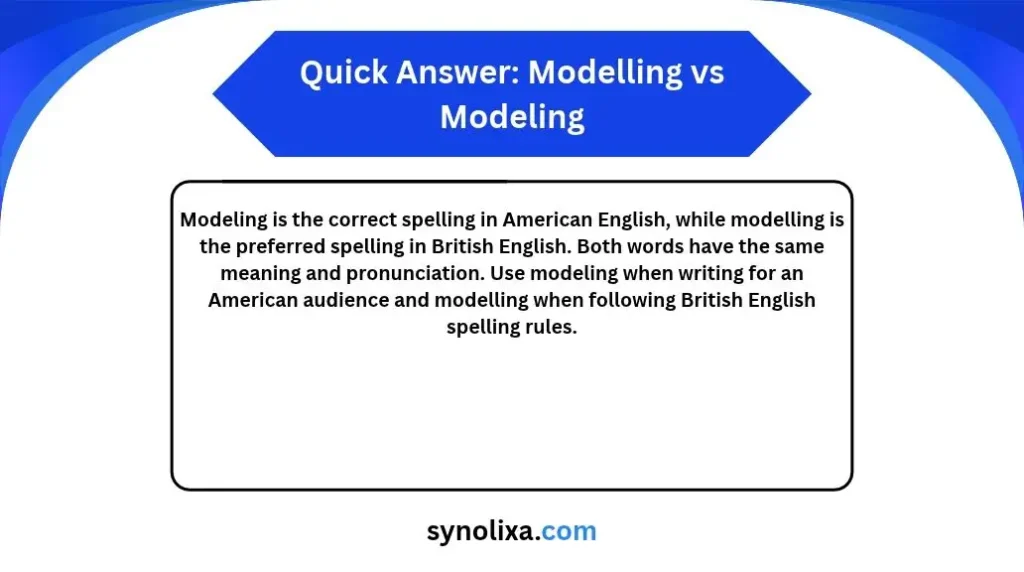
Modeling is the correct spelling in American English, while modelling is the preferred spelling in British English. Both words have the same meaning and pronunciation. Use modeling when writing for an American audience and modelling when following British English spelling rules.
Understanding the Basics of Modelling vs Modeling
The difference between these two words is simple. It depends on regional spelling conventions rather than grammar or meaning.
American and British English sometimes use different spelling patterns. One common difference involves doubling the final consonant when adding a suffix.
When Americans add “-ing” to “model,” they usually keep one “l.” British writers generally double the final “l.”
What Does Modeling Mean?
Modeling is the American English spelling of the word. It describes the act of creating, presenting, or using a model.
A model can be a person, an example, a design, a representation, or a system.
Examples:
- She is modeling a new dress.
- The company is modeling its future business growth.
- Scientists are modeling climate changes.
- He enjoys modeling miniature cars.
In each example, modeling describes an activity or process.
What Does Modelling Mean?
Modelling is the British English spelling of the same word. It has exactly the same meaning as modeling.
It is commonly used in the United Kingdom, Australia, New Zealand, and other places that follow British spelling conventions.
Examples:
- She is modelling a beautiful wedding dress.
- The researchers are modelling different situations.
- He started modelling when he was young.
- The architect is modelling a new building.
The meaning does not change when the spelling changes.
Modelling vs Modeling: Comparison Table
| Form | Type | Meaning | Example | Correct/Incorrect |
|---|---|---|---|---|
| Modeling | American English | Creating or presenting a model | She is modeling a dress. | Correct in US English |
| Modelling | British English | Creating or presenting a model | She is modelling a dress. | Correct in UK English |
| Model | Base verb | To create or represent something | They model new products. | Correct |
| Modelled | British past tense | Created or represented something | She modelled the design. | Correct in UK English |
| Modeled | American past tense | Created or represented something | She modeled the design. | Correct in US English |
Important: Neither spelling is universally incorrect. The right choice depends on your intended English variety.
Correct Meanings and Uses of Modeling and Modelling
Both spellings can be used in several situations. Understanding these meanings will help you choose the correct word in different contexts.
1. Modeling or Modelling in Fashion
One common use of this word relates to the fashion industry.
Fashion modeling involves presenting clothes, shoes, accessories, and other products. Models often work for designers, photographers, and advertising companies.
Examples:
- She started modeling at the age of eighteen.
- He is interested in modelling for fashion brands.
- The agency is looking for new models.
- They are modeling the latest clothing collection.
Sentence breakdown:
“She started modeling at the age of eighteen.”
- She: Subject.
- Started: Past-tense verb.
- Modeling: Activity or action.
- At the age of eighteen: Additional information about time.
The sentence explains when she began working as a model.
2. Modeling or Modelling in Science
Scientists use modeling to understand complicated processes. They create mathematical, computer-based, or physical representations of real-world situations.
Examples:
- Scientists are modeling the weather.
- The team is modeling the spread of a disease.
- Researchers use computer modeling to study the environment.
- The experiment involves modelling different conditions.
Scientific modeling helps researchers examine possibilities without testing every situation in the real world.
3. Modeling or Modelling in Business
Businesses use modeling to understand performance, estimate costs, and make future plans.
For example, financial modeling helps companies estimate revenue, expenses, and profits.
Examples:
- The accountant is modeling the company’s future expenses.
- Our team uses financial modeling to make better decisions.
- The manager is modelling a new business strategy.
- The company is modeling customer behavior.
This type of modeling can help businesses reduce risks and plan their activities.
4. Modeling or Modelling in Art and Design
Artists and designers also use modeling to create three-dimensional objects, digital designs, and visual representations.
Examples:
- He enjoys 3D modeling.
- The designer is modeling a new product.
- Digital modeling makes product development easier.
- She is learning clay modelling.
In this context, the word describes the process of creating or shaping something.
5. Modeling or Modelling in Education
Teachers sometimes use modeling to demonstrate how students should complete a task.
For example, a teacher may solve a mathematics problem before asking students to solve similar problems.
Examples:
- The teacher is modeling the correct writing technique.
- Students learn through observation and modeling.
- The instructor is modelling how to complete the experiment.
This process helps learners understand what they need to do.
Test Tip: How to Choose Between Modeling and Modelling
Use this simple test:
- Are you writing in American English? Choose modeling.
- Are you writing in British English? Choose modelling.
- Are you writing for an international audience? Follow the spelling style used throughout your document.
- Are you unsure about the audience? Choose one spelling convention and remain consistent.
Remember that both forms are correct in their respective English varieties.
Modelling vs Modeling: A Real-Life Case Study
Imagine that a marketing company is preparing a website for an international fashion brand.
The company has two writers:
- Sarah writes in American English.
- James writes in British English.
Both writers need to describe a fashion campaign.
Sarah writes:
“Our new campaign features talented models modeling the latest collection.”
James writes:
“Our new campaign features talented models modelling the latest collection.”
Both sentences are correct.
However, problems may occur when the writers mix spelling styles.
For example:
“Our new campaign features talented models modelling the latest collection. We are also modeling new products.”
This paragraph uses both spelling forms without a clear reason.
A better approach is to choose one style.
American English version:
“Our new campaign features talented models modeling the latest collection. We are also modeling new products.”
British English version:
“Our new campaign features talented models modelling the latest collection. We are also modelling new products.”
The lesson is simple: consistency makes professional writing easier to read and understand.
Grammar Rules Behind Modelling vs Modeling
The spelling difference comes from a common English spelling rule involving final consonants.
When adding “-ing” to a verb, writers sometimes double the final consonant. However, this depends on the spelling convention and the structure of the word.
Why Does American English Use Modeling?
American English generally keeps one final “l” when adding “-ing” to words such as “model.”
Therefore:
- Model + ing = Modeling
- Travel + ing = Traveling
- Cancel + ing = Canceling
- Label + ing = Labeling
These are common American English spellings.
Why Does British English Use Modelling?
British English commonly doubles the final “l” in these words when adding a suffix.
Therefore:
- Model + ling = Modelling
- Travel + ling = Travelling
- Cancel + ling = Cancelling
- Label + ling = Labelling
The doubled consonant is a spelling convention. It does not create a different meaning.
What Do Grammar Authorities Say?
Merriam-Webster, a well-known American dictionary, uses the spelling “modeling” in its American English entries.
British dictionaries, such as the Oxford English Dictionary, recognize the British spelling “modelling.”
These dictionary conventions demonstrate that both forms are established English spellings.
Is Modeling a Verb or a Noun?
Modeling can function as a noun or as the present participle of the verb “model.”
As a noun:
- Modeling is an interesting career.
- Computer modeling requires technical knowledge.
As a present participle:
- She is modeling a new dress.
- Scientists are modeling possible outcomes.
The same distinction applies to the British spelling “modelling.”
Common Mistakes With Modelling vs Modeling
Many writers make spelling mistakes because they do not understand regional English differences.
Here are some common reasons.
1. Following the Wrong English Style
A writer may use American spelling in one sentence and British spelling in another.
For example:
Incorrect for consistent American English:
“She is modelling a dress while her brother is traveling.”
Better American English:
“She is modeling a dress while her brother is traveling.”
The issue is not the meaning. It is the inconsistent spelling style.
2. Fast Typing
People sometimes type quickly without checking their spelling. They may use whichever version comes to mind first.
This is especially common when writing emails, blog posts, and social media captions.
3. Autocorrect
Autocorrect can automatically change a correctly spelled word into another regional spelling.
For example, someone writing in American English may type “modeling,” but a British English keyboard setting may suggest “modelling.”
Always review automatic corrections before publishing.
4. Lack of Knowledge
Some people believe that the extra “l” makes one spelling grammatically incorrect.
This is not true. The difference is based on regional spelling preferences.
5. Mixing American and British English
Mixing spelling conventions can make an article or document look unprofessional.
For example:
- Modeling
- Travelling
- Color
- Favourite
This combination mixes American and British conventions.
Choose one spelling style for your complete document.
Similar Grammar Confusions
| Word Pair | American English | British English |
|---|---|---|
| Modeling / Modelling | Modeling | Modelling |
| Traveling / Travelling | Traveling | Travelling |
| Canceling / Cancelling | Canceling | Cancelling |
| Labeling / Labelling | Labeling | Labelling |
| Color / Colour | Color | Colour |
| Favorite / Favourite | Favorite | Favourite |
| Center / Centre | Center | Centre |
| Organize / Organise | Organize | Organise |
These examples show that regional spelling differences are common in English.
Usage of Modelling vs Modeling in Different Contexts
The correct spelling depends on your audience and the type of writing you are doing.
1. Everyday Conversation
In everyday conversations, people use both forms depending on their location and English preferences.
American speakers generally write “modeling,” while British speakers usually write “modelling.”
Examples:
- “My sister is modeling for a clothing company.”
- “My cousin is modelling in London.”
- “Are you interested in modeling?”
- “She wants to start modelling next year.”
Both spellings communicate the same idea.
2. Professional Writing
Professional documents should follow a consistent spelling style.
If you are preparing a business report for an American company, use modeling.
If you are writing for a British organization, use modelling.
Examples:
American English:
“Our company is modeling future sales growth.”
British English:
“Our company is modelling future sales growth.”
The choice should match the organization’s preferred style guide.
3. Creative Writing
Authors can use either spelling depending on the setting and intended audience.
For example, an American novel may use “modeling,” while a British novel may use “modelling.”
Examples:
- She dreamed of modeling in New York.
- He imagined himself modelling for a famous designer.
Creative writers should maintain consistency unless a character’s dialogue or another specific reason requires a different spelling.
4. Social Media and Texting
Social media users often write quickly. They may use either spelling without considering regional differences.
Examples:
- “Starting my modeling journey today!”
- “Excited about my new modelling project!”
- “Learning 3D modeling is fun.”
- “I love digital modelling.”
Both spellings are understandable.
However, if you manage a professional social media account, use the spelling that matches your target audience.
Why the Difference Between Modelling and Modeling Matters
You may wonder whether one extra letter really matters. The answer is yes, especially in professional and educational writing.
1. Clarity in Communication
Using the expected spelling helps readers understand your writing style.
Although the difference does not change the meaning, consistent spelling makes communication smoother.
2. Professionalism
Businesses, schools, agencies, and websites often follow specific style guides.
Using the correct regional spelling shows attention to detail.
3. Writing Accuracy
Correct spelling helps writers produce clear and polished documents.
For example, students should understand the difference before submitting assignments. Bloggers should also check their spelling before publishing articles.
4. Digital Communication
Search engines and readers can recognize both spellings. However, using the spelling your audience expects can make your content feel more natural.
For example, a US-focused website should generally use “modeling” in its headings, paragraphs, and metadata.
A Short Quote
“Consistency is the key to clear communication.”
This simple idea applies to spelling, grammar, and professional writing.
Special Exceptions and Important Notes
Although the difference between modelling and modeling is mainly regional, a few special situations are worth understanding.
1. Brand Names
Some companies, organizations, or products may use a particular spelling in their official names.
Always preserve the official spelling of a brand or organization, even if it differs from your document’s usual style.
2. Technical Writing
Some technical fields use specific terminology and style guides.
For example, computer modeling, 3D modeling, and mathematical modeling are common expressions in American English.
British publications may write computer modelling, 3D modelling, and mathematical modelling.
3. Academic Writing
Universities and academic publishers may have their own spelling requirements.
Always check the institution’s preferred style guide before submitting a paper.
4. Search Engine Optimization
If you are writing an article for an American audience, use “modeling” as your main spelling.
For British audiences, use “modelling.”
Do not repeatedly insert both spellings into every paragraph just to target search engines. Natural language and consistency are more important than keyword repetition.
Quick Recap Checklist: Modelling vs Modeling
Use this table to remember the correct spelling.
| Question | If Yes → Use |
|---|---|
| Are you writing for an American audience? | Modeling |
| Are you following British English? | Modelling |
| Is your document using American spelling throughout? | Modeling |
| Is your document using British spelling throughout? | Modelling |
| Are you following a British company’s style guide? | Modelling |
| Are you following an American company’s style guide? | Modeling |
Practice Examples
Test your understanding with these sentences.
Example 1:
She is ______ for a famous clothing brand in New York.
Answer: Modeling
Reason: The sentence follows American English.
Example 2:
The scientist is ______ different weather conditions.
Answer: Modelling
Reason: The sentence follows British English.
Example 3:
My brother wants to start ______ next year.
Answer: Modeling or Modelling
Reason: Both forms are correct. The choice depends on the regional spelling style.
FAQs
1. Is it modeling or modelling?
Both spellings are correct. “Modeling” is the preferred American English spelling, while “modelling” is the standard British English spelling. Both have the same meaning.
2. Is modeling incorrect in British English?
No. British readers can understand “modeling,” but “modelling” is the standard British spelling. Writers following British English conventions should generally use the doubled “l.”
3. Why does American English use one L in modeling?
American English generally uses one final “l” when adding “-ing” to certain words, including “model.” This creates the spelling “modeling.”
4. Does modelling have a different meaning from modeling?
No. Both words have exactly the same meaning. They describe creating, presenting, or using a model. The only difference is regional spelling.
5. Which spelling should I use in an American English article?
Use “modeling.” It is the preferred spelling in American English and is appropriate for US-focused websites, academic writing, and professional documents.
6. Is 3D modeling or 3D modelling correct?
Both forms are correct. “3D modeling” is preferred in American English, while “3D modelling” is preferred in British English. The meaning is the same.
Conclusion
Understanding the difference between modelling vs modeling is easy once you know the regional spelling rule. Both words are correct, and neither changes the meaning of a sentence. The main difference is that American English uses “modeling,” while British English prefers “modelling.”
If you are writing for American readers, choose modeling. If your audience follows British English, choose modelling. The most important rule is to remain consistent throughout your writing.
These spelling differences appear in many English words, including traveling and travelling, labeling and labelling, and canceling and cancelling.
Remember that good writing is not only about choosing the right words. It is also about using them consistently and making your message easy to understand.
One simple rule to remember: American English uses one L, while British English uses two Ls in modeling and modelling.

Hi, I am Clara Anderson. I work at Synolixa as a vocabulary writer, focusing on synonyms, word meanings, and easy-to-understand English learning content.