Have you ever agreed with someone who says something negative and wondered whether to reply with “nor do I” or “neither do I”? Both expressions are common in English, and both can help you show that you share another person’s negative statement. However, choosing the right expression can sometimes feel confusing, especially when you are writing emails, having conversations, or learning English grammar.
The confusion between nor do I and neither do I comes from their similar meanings. Both expressions communicate that something is not true for you either. For example, if someone says, “I do not like cold weather,” you can respond with “Neither do I” or “Nor do I.” Both responses are grammatically correct in the right context.
However, they are not always interchangeable. Their sentence structures and natural usage can be different. Understanding these small differences will help you speak and write more confidently.
In this guide, you will learn the meanings, grammar rules, examples, common mistakes, and practical uses of nor do I or neither do I. By the end, you will know when and how to use each expression correctly. Hail vs Hale | Hail vs Hale | Trawling vs Trolling
Quick Answer: Nor Do I or Neither Do I
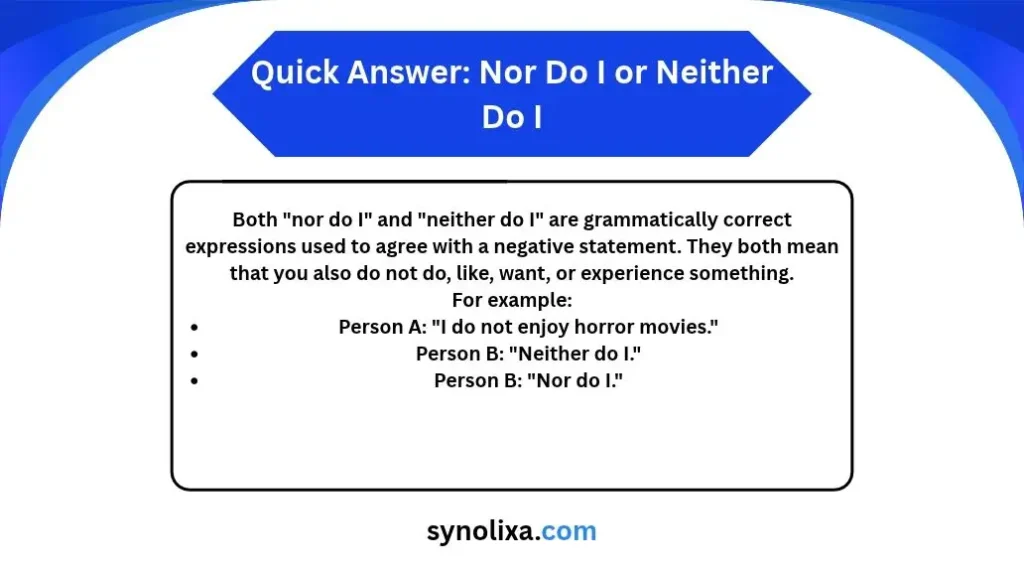
Both “nor do I” and “neither do I” are grammatically correct expressions used to agree with a negative statement. They both mean that you also do not do, like, want, or experience something.
For example:
- Person A: “I do not enjoy horror movies.”
- Person B: “Neither do I.”
- Person B: “Nor do I.”
Both responses are correct. However, “neither do I” is generally more common as a short, standalone response in everyday American English.
Understanding the Basics of Nor Do I or Neither Do I
To understand nor do I or neither do I, you first need to understand how English speakers respond to negative statements.
When someone makes a negative statement, you may want to show that you feel the same way. English has several expressions for this purpose, including:
- Neither do I.
- Nor do I.
- I don’t either.
- I don’t, either.
These expressions communicate agreement with a negative idea.
For example:
“I don’t drink coffee.”
You can respond:
“Neither do I.”
This means that you also do not drink coffee.
You can also say:
“Nor do I.”
The meaning is almost the same, but the expression may sound slightly more formal or emphatic depending on the situation.
Comparison Table: Nor Do I or Neither Do I
| Form | Type | Meaning | Example | Correct/Incorrect |
|---|---|---|---|---|
| Neither do I | Negative agreement | I also do not | Neither do I like coffee. | Correct |
| Nor do I | Negative agreement | I also do not | Nor do I like coffee. | Correct |
| I don’t either | Negative agreement | I also do not | I don’t like coffee either. | Correct |
| Neither I do | Incorrect word order | Incorrect structure | Neither I do like coffee. | Incorrect |
| Nor I do | Incorrect word order | Incorrect structure | Nor I do like coffee. | Incorrect |
| Neither do me | Incorrect pronoun | Incorrect structure | Neither do me. | Incorrect |
The most important rule is that “neither do I” and “nor do I” use subject-auxiliary inversion. The helping verb comes before the subject.
Correct Meanings and Uses of Nor Do I or Neither Do I
Both expressions have similar meanings, but understanding their individual uses makes it easier to choose the right one.
1. When to Use Neither Do I
“Neither do I” is a common expression used to agree with a negative statement.
It tells someone that you share the same feeling, opinion, habit, or experience.
Examples:
- Person A: “I don’t like spicy food.”
- Person B: “Neither do I.”
- Person A: “I don’t watch television.”
- Person B: “Neither do I.”
- Person A: “I don’t understand this question.”
- Person B: “Neither do I.”
In each example, the second speaker agrees with the first speaker’s negative statement.
Sentence breakdown:
Neither = Also not.
Do = Helping verb.
I = Subject.
Together, “neither do I” means that the negative statement is also true for the speaker.
You can use this expression in:
- Everyday conversations.
- Professional discussions.
- Classroom conversations.
- Friendly messages.
- Formal and informal writing.
It is especially natural when you want to give a short and clear response.
2. When to Use Nor Do I
“Nor do I” is another correct expression used to agree with a negative statement.
It has almost the same meaning as “neither do I.” However, it often sounds more formal, literary, or emphatic.
Examples:
- Person A: “I don’t believe that story.”
- Person B: “Nor do I.”
- Person A: “I don’t support this decision.”
- Person B: “Nor do I.”
- Person A: “I don’t want to leave early.”
- Person B: “Nor do I.”
Sentence breakdown:
Nor = And not.
Do = Helping verb.
I = Subject.
The expression connects your negative position with the negative statement made by another person.
You may see “nor do I” in:
- Formal conversations.
- Professional discussions.
- Books and articles.
- Speeches.
- Written arguments.
It is also correct in everyday speech, although “neither do I” may sound more natural to many American English speakers.
3. Nor Do I or Neither Do I in Everyday Agreement
Both expressions work when you want to agree with someone who uses a negative sentence.
Consider this conversation:
Person A: “I don’t enjoy waking up early.”
Person B: “Neither do I.”
You can also write:
Person B: “Nor do I.”
Both sentences communicate the same general idea.
However, there is a small difference in tone. “Neither do I” is a familiar, natural response. “Nor do I” can sound more deliberate or formal.
4. Nor Do I or Neither Do I With Different Helping Verbs
One important grammar rule is that you should choose the helping verb that matches the original statement.
Do not use “do” in every situation.
Examples:
With do:
Person A: “I don’t eat meat.”
Person B: “Neither do I.”
With am:
Person A: “I’m not ready.”
Person B: “Neither am I.”
With have:
Person A: “I haven’t finished my work.”
Person B: “Neither have I.”
With can:
Person A: “I can’t swim.”
Person B: “Neither can I.”
With will:
Person A: “I won’t attend the meeting.”
Person B: “Neither will I.”
The same pattern can be used with “nor.”
For example:
“I can’t drive.”
“Nor can I.”
The helping verb must match the grammatical structure of the original negative statement.
5. Nor Do I or Neither Do I in Short Conversations
Short responses are one of the most common places where these expressions appear.
Examples:
Conversation 1
A: “I don’t like waiting.”
B: “Neither do I.”
Conversation 2
A: “I haven’t visited New York.”
B: “Nor have I.”
Conversation 3
A: “I’m not interested in that movie.”
B: “Neither am I.”
Conversation 4
A: “I can’t solve this problem.”
B: “Nor can I.”
These examples show why it is important to understand the helping verb instead of memorizing only one expression.
Test Tip: How to Choose Between Nor Do I or Neither Do I
Use this simple test:
- Check whether the original statement is negative.
- Identify its helping verb.
- Use the same helping verb in your response.
- Put the helping verb before “I.”
For example:
Original: “I don’t play football.”
Correct response: “Neither do I.”
Original: “I am not tired.”
Correct response: “Neither am I.”
Remember that the helping verb changes according to the original sentence.
Case Study: Nor Do I or Neither Do I in a Workplace Conversation
Imagine that two coworkers are discussing their daily work routine.
Sarah: “I don’t enjoy working late at night.”
David: “Neither do I.”
Sarah: “I also don’t like attending unnecessary meetings.”
David: “Nor do I.”
Sarah: “I haven’t completed the new report yet.”
David: “Neither have I.”
This conversation shows how both expressions can be used naturally in a professional environment.
Notice that David changes the helping verb according to Sarah’s original statement.
- “Don’t enjoy” becomes “Neither do I.”
- “Don’t like” becomes “Nor do I.”
- “Haven’t completed” becomes “Neither have I.”
This is an important part of correct English grammar.
In professional communication, these expressions can make conversations shorter and more natural. They allow people to agree without repeating the entire negative statement.
Grammar Rules Explanation: Nor Do I or Neither Do I
Understanding the grammar behind nor do I or neither do I will help you avoid sentence structure mistakes.
1. The Rule of Subject-Auxiliary Inversion
Both expressions generally follow a structure called subject-auxiliary inversion.
In normal statements, the subject comes before the helping verb.
Example:
“I do not like coffee.”
The structure is:
Subject + Helping Verb + Negative Word + Main Verb.
However, when you use “neither” or “nor” at the beginning of an agreeing response, the helping verb comes before the subject.
Correct:
“Neither do I.”
“Nor do I.”
Incorrect:
“Neither I do.”
“Nor I do.”
This is why word order matters.
2. The Rule for Negative Agreement
Use “neither” or “nor” to agree with a negative statement.
Examples:
- “I don’t like rain.” — “Neither do I.”
- “I cannot dance.” — “Nor can I.”
- “I haven’t eaten.” — “Neither have I.”
- “I’m not hungry.” — “Nor am I.”
Both expressions help avoid repeating the entire negative sentence.
3. The Rule of Matching Helping Verbs
Your response should use the appropriate auxiliary verb from the original statement.
| Original Statement | Correct Response |
|---|---|
| I don’t cook. | Neither do I. |
| I am not ready. | Neither am I. |
| I haven’t slept. | Neither have I. |
| I can’t drive. | Nor can I. |
| I won’t go. | Nor will I. |
| I wasn’t invited. | Neither was I. |
This rule applies to both expressions.
4. What Do Grammar Authorities Say?
Standard English grammar references, including Merriam-Webster, recognize “neither” and “nor” as negative coordinating or correlative expressions with related but distinct grammatical functions.
In traditional grammar, “neither” is commonly used to introduce a negative alternative or a negative agreement response. “Nor” commonly introduces an additional negative idea.
For example:
“Neither do I.”
“Nor do I.”
Both forms are accepted in standard English. The choice often depends on sentence structure, tone, and context.
The important point is not to treat one expression as grammatically wrong simply because the other is more common in everyday conversation.
Common Mistakes With Nor Do I or Neither Do I
Many English learners confuse these expressions because they have similar meanings.
However, some mistakes happen because people do not understand the correct word order or helping verb.
1. Using the Wrong Word Order
Incorrect: “Neither I do.”
Correct: “Neither do I.”
Incorrect: “Nor I can.”
Correct: “Nor can I.”
The helping verb must come before the subject in these negative agreement responses.
2. Using the Wrong Helping Verb
Incorrect:
Person A: “I am not hungry.”
Person B: “Neither do I.”
Correct:
Person A: “I am not hungry.”
Person B: “Neither am I.”
The original statement uses “am,” so the response should also use “am.”
3. Using Both Negative Expressions Together
Incorrect: “Neither nor do I.”
Correct: “Neither do I.”
Correct: “Nor do I.”
Do not combine the two expressions in this short response.
4. Confusing Negative Agreement With Positive Agreement
If someone makes a positive statement, “neither do I” is usually not the correct response.
Example:
Person A: “I like chocolate.”
Incorrect response: “Neither do I.”
Correct response: “So do I.”
Use “so do I” to agree with positive statements.
5. Common Grammar Confusions
| Confusing Words | Correct Meaning | Example |
|---|---|---|
| Its / It’s | Possession / It is | It’s a nice day. |
| Your / You’re | Belonging to you / You are | You’re very helpful. |
| Their / There | Possession / A place | Their house is there. |
| Neither / Either | Not one or the other / One of two | Neither answer is correct. |
| Nor / Or | Additional negative / Alternative | I don’t want tea or coffee. |
| Too / To | Also or excessively / Direction or infinitive | I want to go, too. |
Why Do These Mistakes Happen?
There are several reasons why people make mistakes with nor do I or neither do I.
Fast typing
People often type quickly when sending messages. They may forget the correct word order or choose the wrong helping verb.
Autocorrect
Autocorrect sometimes changes words or suggests expressions that do not fit the sentence.
Lack of knowledge
Some learners memorize phrases without understanding the grammar behind them. As a result, they may use “do” even when the original sentence requires “am,” “have,” or “can.”
The best solution is to understand the sentence structure and practice with different examples.
Usage of Nor Do I or Neither Do I in Different Contexts
Both expressions can be used in different situations. However, their tone may change depending on the context.
1. Everyday Conversation
“Neither do I” is especially common in everyday conversations.
Examples:
- “I don’t like rainy weather.” — “Neither do I.”
- “I don’t eat fast food.” — “Neither do I.”
- “I don’t enjoy crowded places.” — “Nor do I.”
These expressions make conversations simple and natural.
2. Professional Writing
In professional communication, both expressions can be useful.
Examples:
- “I don’t agree with the proposed changes.” — “Neither do I.”
- “I haven’t received the updated documents.” — “Nor have I.”
- “I’m not available on Friday.” — “Neither am I.”
For business emails, you can also use complete sentences when additional clarity is needed.
Example:
“I also haven’t received the updated documents.”
This sounds natural and professional.
3. Creative Writing
Writers can use both expressions in dialogue and storytelling.
Example:
“I don’t believe he will return,” Daniel said.
“Nor do I,” replied Sarah.
Another example:
“I have never seen such a beautiful place.”
“Neither have I,” she answered.
“Nor do I” may create a slightly more formal or dramatic tone in dialogue.
4. Social Media and Texting
Both expressions are acceptable in online conversations.
Examples:
- “I don’t like Monday mornings.” — “Neither do I 😂”
- “I can’t wait for the weekend.” — “Nor can I!”
- “I haven’t watched that show.” — “Neither have I.”
You can also use shorter expressions such as “Same here” or “Me neither.”
These alternatives are common in casual digital communication.
Why Nor Do I or Neither Do I Matters
Learning the difference between nor do I or neither do I may seem like a small grammar lesson, but it can improve your communication.
1. Clarity in Communication
Using the correct expression makes your meaning clear.
When you respond with “neither do I,” people understand that you share the same negative feeling or experience.
It prevents confusion and makes conversations easier to follow.
2. Professionalism
Correct grammar creates a positive impression in professional communication.
Whether you are writing an email, participating in a meeting, or speaking with coworkers, using correct sentence structures shows attention to detail.
3. Writing Accuracy in Digital Communication
People communicate through emails, social media, online meetings, and text messages every day.
Correct grammar helps make digital communication more accurate and easier to understand.
4. Better English Confidence
Understanding expressions like these helps you become more confident when speaking English.
You do not need to memorize every sentence. Once you understand the grammar pattern, you can create your own correct responses.
As a simple reminder:
“Good grammar makes clear communication easier.”
Special Exceptions and Important Usage Notes
There are a few additional points to remember when choosing between nor do I or neither do I.
1. Neither Do I Is Often More Natural as a Standalone Response
Both expressions are correct, but “neither do I” is generally a familiar choice in everyday American English.
Example:
A: “I don’t like loud music.”
B: “Neither do I.”
This is a natural, direct response.
2. Nor Do I Can Connect Negative Ideas
“Nor” is especially useful when adding another negative statement.
Example:
“I don’t enjoy crowded places, nor do I like noisy restaurants.”
Here, “nor do I like noisy restaurants” adds another negative idea.
3. Use Me Neither in Informal Conversation
“Me neither” is a common informal alternative to “neither do I.”
Example:
A: “I don’t like cold weather.”
B: “Me neither.”
This expression is natural in casual American English.
However, “neither do I” is a more explicit subject-auxiliary structure.
4. Use Neither Am I With the Verb Be
Do not automatically use “neither do I” with every negative statement.
Example:
A: “I’m not worried.”
B: “Neither am I.”
Not:
“Neither do I.”
The helping verb must match the original sentence.
5. Neither and Nor Can Appear in Longer Sentences
Both words can also appear in more complex grammatical structures.
Example:
“She neither called nor sent a message.”
In this sentence, “neither” and “nor” connect two negative alternatives.
This is different from the short response “Neither do I.”
Quick Recap Checklist: Nor Do I or Neither Do I
Use the following checklist to remember the main grammar rules.
| Question | If Yes → Use |
|---|---|
| Are you agreeing with a negative statement? | Neither do I / Nor do I |
| Does the original sentence use “am”? | Neither am I / Nor am I |
| Does the original sentence use “have”? | Neither have I / Nor have I |
| Does the original sentence use “can”? | Neither can I / Nor can I |
| Are you agreeing with a positive statement? | So do I |
| Are you speaking casually? | Me neither |
| Are you adding another negative idea? | Nor |
Practice Examples
Test your understanding with these examples.
Example 1
Person A: “I don’t like swimming.”
Which response is correct?
A. Neither do I.
B. Neither I do.
Correct answer: A. Neither do I.
Example 2
Person A: “I’m not interested in sports.”
Which response is correct?
A. Nor do I.
B. Neither am I.
Correct answer: B. Neither am I.
Example 3
Person A: “I haven’t finished my homework.”
Which response is correct?
A. Nor have I.
B. Nor do I.
Correct answer: A. Nor have I.
Remember to match the helping verb and maintain the correct word order.
FAQs
1. Is It Nor Do I or Neither Do I?
Both “nor do I” and “neither do I” are grammatically correct. They are used to agree with negative statements. However, “neither do I” is generally more common as a standalone response in everyday American English.
2. What Is the Difference Between Nor Do I and Neither Do I?
Both expressions communicate negative agreement. “Neither do I” is commonly used as a direct response, while “nor do I” often sounds more formal or connects another negative idea to the previous statement.
3. Can I Say Nor Do I in Everyday Conversation?
Yes. “Nor do I” is grammatically correct in everyday conversation. However, “neither do I” may sound more natural and familiar in many casual situations.
4. Is Neither Do I More Correct Than Nor Do I?
No. Neither expression is automatically more correct than the other. Both follow standard English grammar when used in the right context. The best choice depends on the sentence structure and intended tone.
5. Can I Use Me Neither Instead of Neither Do I?
Yes. “Me neither” is a common informal expression used to agree with a negative statement. For example, if someone says, “I don’t like coffee,” you can respond, “Me neither.”
6. Should I Use Neither Do I or So Do I?
Use “neither do I” to agree with a negative statement. Use “so do I” to agree with a positive statement.
Examples:
- “I don’t like coffee.” — “Neither do I.”
- “I like coffee.” — “So do I.”
Remember that positive and negative agreement require different expressions.
Conclusion
Understanding nor do I or neither do I is important for speaking and writing correct English. Both expressions are grammatically correct and help you agree with someone who makes a negative statement.
“Neither do I” is generally more common as a standalone response in everyday American English, while “nor do I” can sound more formal or emphatic. Both expressions follow the same important grammar pattern: the helping verb comes before the subject.
Remember to match the helping verb with the original sentence. For example, use “neither am I” with a sentence containing “am,” and use “neither have I” when the original sentence uses “have.”
With regular practice, choosing between these expressions becomes much easier.
The simple rule to remember is this: Use neither do I or nor do I to agree with a negative statement, and always keep the helping verb in the correct position.

Hi, I am Ethan Parker. I work at Synolixa as a grammar and writing specialist, helping readers understand English grammar and improve their writing skills.

[…] grammar rules, differences, examples, and common mistakes so you can use each word correctly. Nor Do I or Neither Do I | Hail vs Hale | Cuss Words or Curse […]
[…] remember the correct form and avoid confusion in professional and casual writing. Innate vs Enate | Nor Do I or Neither Do I | Hail vs […]