
Have you ever wondered whether to say cuss words or curse words? You may have heard both expressions in movies, everyday conversations, social media posts, or discussions about bad language. Both phrases are common in American English, but many people are unsure whether they mean the same thing or whether one is more correct than the other.
The good news is that both cuss words and curse words are correct expressions. They generally refer to offensive, vulgar, or inappropriate words that people use to express anger, frustration, surprise, or other strong emotions. However, there are small differences in their tone, history, and usage.
The expression curse words is widely understood and works well in both formal and informal discussions. In contrast, cuss words is especially common in American English and often sounds more conversational or informal. Both expressions can describe swearing, profanity, and other types of strong language.
In this article, you will learn the meanings of cuss words and curse words, understand their differences, explore examples, and discover which expression works best in different situations. By the end, you will know how to use both phrases naturally and accurately. Trawling vs Trolling | In the Store or At the Store | Nighttime or Night-Time
Quick Answer: Cuss Words or Curse Words
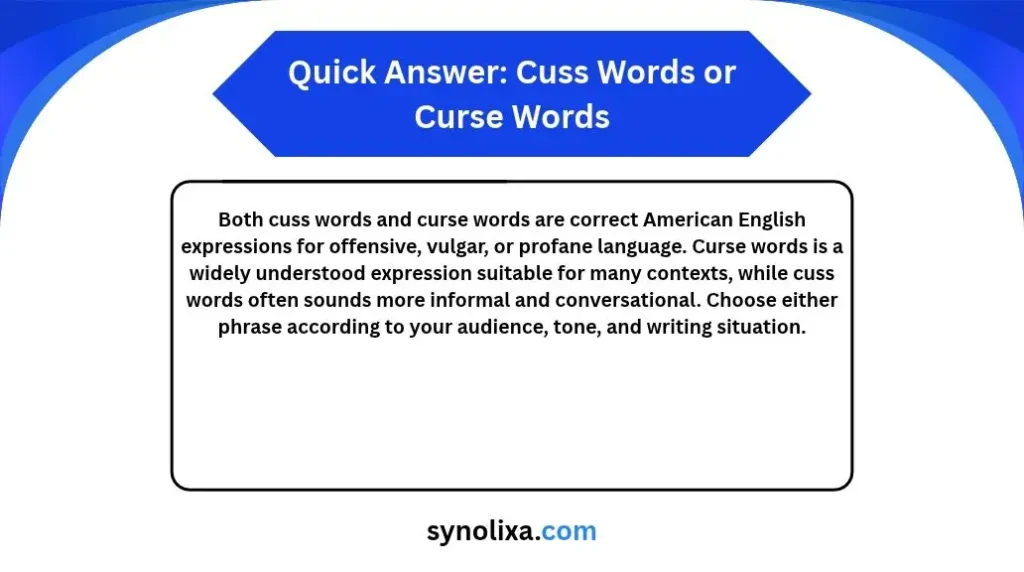
Both cuss words and curse words are correct American English expressions for offensive, vulgar, or profane language. Curse words is a widely understood expression suitable for many contexts, while cuss words often sounds more informal and conversational. Choose either phrase according to your audience, tone, and writing situation.
Understanding the Basics of Cuss Words or Curse Words
The main difference between cuss words and curse words is their tone rather than their basic meaning.
A cuss word is an offensive or vulgar word, often used when someone is angry, frustrated, surprised, or upset. A curse word generally refers to the same kind of language, although the word curse can also refer to a statement wishing harm or misfortune on someone.
In everyday American English, people frequently use these expressions interchangeably.
Comparison Table: Cuss Words vs. Curse Words
| Form | Type | Meaning | Example | Correct/Incorrect |
|---|---|---|---|---|
| Cuss words | Informal noun phrase | Offensive or vulgar words | Please do not use cuss words in class. | Correct |
| Curse words | Noun phrase | Offensive or profane words | The movie contains several curse words. | Correct |
| Cuss word | Singular noun phrase | One offensive or vulgar word | He accidentally used a cuss word. | Correct |
| Curse word | Singular noun phrase | One offensive or profane word | She avoided every curse word in her speech. | Correct |
| Cusses | Verb or plural noun, depending on context | Uses profanity or refers to instances of cursing | He cusses when he gets angry. | Correct |
| Curses | Verb or plural noun, depending on context | Uses profanity, expresses a curse, or refers to curses | He curses when he loses a game. | Correct |
| Cusswords | Usually nonstandard as a closed compound in ordinary edited American English | An informal spelling sometimes encountered | The article discusses cuss words. | Prefer cuss words |
| Cursewords | Usually nonstandard as a closed compound in ordinary edited American English | A spelling sometimes encountered | The film contains curse words. | Prefer curse words |
The most important point is simple: both cuss words and curse words are correct. You do not need to choose one because the other is grammatically wrong.
Correct Meanings and Uses of Cuss Words or Curse Words
To use these expressions correctly, it helps to understand how they work in sentences.
1. What Does Cuss Words Mean?
Cuss words refers to offensive or vulgar words that people use in everyday speech. The phrase is particularly familiar in American English.
People may use cuss words to express strong emotions, including anger, disappointment, excitement, or surprise. They may also use them casually with friends, although whether this is appropriate depends on the people and situation.
Examples:
- My little brother repeated some cuss words from a movie.
- The teacher asked the students not to use cuss words.
- Some people use cuss words when they feel frustrated.
- The television show contains several cuss words.
Sentence breakdown:
Consider this sentence:
“The teacher asked the students not to use cuss words.”
- The teacher: The person giving the instruction.
- Asked: The action.
- The students: The people receiving the instruction.
- Not to use cuss words: The behavior the teacher wants them to avoid.
Here, cuss words functions as a noun phrase. It identifies the type of language the students should not use.
The phrase is natural in casual American conversation. It is also understandable in general writing, although a more formal document might use profanity or offensive language.
2. What Does Curse Words Mean?
Curse words refers to offensive, vulgar, or profane words. The expression is common in conversations about language, entertainment, education, and behavior.
The word curse has a broader meaning than simply using offensive language. It can also refer to expressing a wish that harm or misfortune will come to someone.
For example:
- The movie contains several curse words.
- Parents often discuss curse words with their children.
- He apologized for using curse words during the argument.
- The school has rules about curse words in the classroom.
Sentence breakdown:
Consider this sentence:
“The movie contains several curse words.”
- The movie: The subject.
- Contains: The verb describing what the movie includes.
- Several curse words: The noun phrase identifying the language present in the movie.
The phrase curse words describes the movie’s language. It is grammatically correct and suitable for many everyday and informational contexts.
3. Is Cuss Words More Informal Than Curse Words?
Generally, yes. Cuss words often sounds more casual and conversational, especially in American English.
For example:
- “My parents do not allow cuss words at home.”
- “The report examines the use of curse words in television.”
The first sentence sounds like an everyday conversation. The second sounds more neutral and analytical.
However, this is a tendency, not a strict grammatical rule. People also use curse words in casual conversations and cuss words in ordinary written discussions.
Test Tip: Read your sentence aloud. If you are speaking casually, either phrase may work. If you are writing a formal report, consider whether profanity or offensive language would communicate your point more professionally.
4. Can Cuss Words and Curse Words Be Used Interchangeably?
Yes. In most everyday situations, the expressions have the same basic meaning.
For example:
- “Please avoid cuss words during the meeting.”
- “Please avoid curse words during the meeting.”
Both sentences communicate the same instruction.
Another example:
- “The film contains several cuss words.”
- “The film contains several curse words.”
Both sentences are understandable and grammatically correct.
The choice often depends on personal preference, regional habits, and the tone of the conversation.
However, the broader meaning of curse creates an important distinction in some sentences. A curse can be a statement wishing harm or misfortune on someone, even when it does not contain profanity.
For example:
“She placed a curse on the kingdom.”
This sentence describes a supernatural or figurative curse, not a collection of offensive words. Replacing curse with cuss would change the meaning or sound unnatural.
Cuss Words or Curse Words: A Real-Life Case Study
Imagine that a school is preparing a notice for parents about appropriate language in the classroom.
The school administrator drafts this sentence:
“Students must not use cuss words during lessons.”
The sentence is grammatically correct and easy to understand. However, the administrator wants the notice to sound formal and professional.
The administrator considers three alternatives:
Option 1:
“Students must not use curse words during lessons.”
This is also correct. It sounds neutral and remains easy to understand.
Option 2:
“Students must not use profanity during lessons.”
This version sounds more formal and concise. It may be a better choice for an official school policy.
Option 3:
“Students must not use offensive language during lessons.”
This version is broader. It can cover profanity, insults, and other inappropriate language.
What Can We Learn From This Example?
All three sentences can work, but they emphasize slightly different things.
- Cuss words is conversational.
- Curse words is widely understood and neutral.
- Profanity is more formal.
- Offensive language is broader and focuses on inappropriate communication.
The best choice depends on the purpose of the message.
For a casual conversation, cuss words may be perfectly natural. For a formal school policy, profanity or offensive language may be more suitable.
Grammar Rules for Cuss Words or Curse Words
Understanding the grammar behind these phrases makes it easier to use them correctly.
Rule 1: Both Expressions Are Grammatically Correct
There is no general English grammar rule stating that cuss words is incorrect or that curse words must always be used.
Both expressions function as noun phrases.
Examples:
- Cuss words can offend some listeners.
- Curse words can make a conversation uncomfortable.
- The teacher discussed cuss words in class.
- The teacher discussed curse words in class.
Each sentence is grammatically correct.
Rule 2: Use the Plural When Referring to Multiple Words
The word words is plural, so both expressions usually take plural verbs when they function as the subject of a sentence.
Examples:
- Cuss words are inappropriate in this setting.
- Curse words are restricted in the classroom.
The plural noun phrase cuss words or curse words takes the plural verb are.
When referring to one offensive word, use the singular form.
Examples:
- That cuss word was unnecessary.
- That curse word was unnecessary.
Both sentences use the singular verb was because the subject refers to one word.
Rule 3: Understand the Difference Between Cuss and Curse
Cuss is an informal verb meaning to swear or use profanity. It is also used as a noun in expressions such as cuss word.
Curse can function as both a verb and a noun. Depending on the sentence, it may mean to swear, express anger, condemn someone, or wish harm or misfortune on someone.
Examples:
- He cussed after dropping his phone.
- He cursed after dropping his phone.
- The villain placed a curse on the village.
The first two sentences describe swearing. The third uses curse in a different sense.
Rule 4: Follow Standard Spelling
In ordinary American English writing, use these standard forms:
- Cuss word
- Cuss words
- Curse word
- Curse words
Write the two words separately in normal prose. Although closed spellings sometimes appear in informal material, the open forms are the safer choices for general edited writing.
Standard dictionaries, including Merriam-Webster, provide useful guidance on the meanings and grammatical uses of cuss and curse. The key distinction is that cuss is an informal form associated with swearing, while curse has several related meanings.
Rule 5: Choose Words That Match Your Audience
Grammar is not the only factor in good writing. Tone matters, too.
For example:
- A conversation with friends may naturally include cuss words.
- A classroom discussion may use curse words.
- A formal report may prefer profanity.
- A workplace policy may use offensive language.
All these expressions can be appropriate when used in the right context.
Common Mistakes With Cuss Words or Curse Words
Although both expressions are correct, writers sometimes make mistakes when spelling or using them.
Mistake 1: Thinking One Expression Is Always Wrong
Some people believe that cuss words is incorrect because cuss sounds informal.
That assumption is mistaken. Informal expressions can still be grammatically correct.
Incorrect claim: “You must always write curse words because cuss words is grammatically wrong.”
Correct explanation: Both expressions are acceptable. Curse words may be preferable in some contexts, but cuss words is not inherently incorrect.
Mistake 2: Writing the Words as One Word
Writers sometimes combine the terms into cusswords or cursewords.
In standard edited American English, the preferred spellings are cuss words and curse words.
Examples:
- Preferred: The teacher explained why cuss words are inappropriate.
- Preferred: The film contains several curse words.
Using the standard open forms improves consistency and readability.
Mistake 3: Confusing Cursing With Every Kind of Offensive Language
Not every offensive expression is necessarily a curse word.
An insult may be hurtful without containing profanity. A threat may be inappropriate without using a traditional swear word. A rude comment may offend someone even when every word is considered acceptable in isolation.
For example:
“Your work is terrible, and you never do anything right.”
This statement is insulting, but it contains no conventional profanity.
The broader phrase offensive language can describe this type of communication more accurately than curse words.
Mistake 4: Using Informal Language in Formal Writing
Cuss words is common in casual conversation, but some formal documents may benefit from more neutral vocabulary.
For example:
- Casual: The show contains too many cuss words.
- Formal: The show contains frequent profanity.
Neither sentence is automatically wrong. The second simply has a more formal tone.
Mistake 5: Confusing Cuss With Curse in Other Meanings
The verb cuss generally refers to swearing. The word curse can have a wider meaning.
For example:
“According to the legend, the witch placed a curse on the castle.”
Here, curse refers to a supposed supernatural effect. Cuss would not convey the same meaning.
Why Do These Mistakes Happen?
Several everyday habits contribute to language mistakes.
- Fast typing: Writers may combine words or skip spaces when typing quickly.
- Autocorrect: A keyboard may replace a word or alter a phrase unexpectedly.
- Lack of knowledge: Some writers assume informal language is always grammatically incorrect.
- Regional differences: People may hear one expression more often than the other.
- Overthinking: Writers may search for a strict rule even when both expressions are accepted.
A simple review can help you avoid these problems. Check the spelling, consider the intended meaning, and make sure the expression fits your audience.
Table of Similar Grammar Confusions
| Word Pair | Difference | Example |
|---|---|---|
| Cuss words vs. curse words | Both can refer to profanity; curse has additional meanings. | The movie contains curse words. |
| It’s vs. its | It’s means it is or it has; its shows possession. | It’s raining. The dog wagged its tail. |
| Your vs. you’re | Your shows possession; you’re means you are. | You’re holding your book. |
| Their vs. there | Their shows possession; there refers to a place or introduces a statement. | Their bags are over there. |
| Affect vs. effect | Affect is usually a verb; effect is usually a noun. | Noise can affect sleep. The effect was clear. |
| Then vs. than | Then relates to time or sequence; than makes comparisons. | Eat first, then leave. She is taller than me. |
| Advice vs. advise | Advice is a noun; advise is a verb. | I need advice. Please advise me. |
| Every day vs. everyday | Every day means each day; everyday is an adjective meaning ordinary or usual. | I exercise every day. These are everyday shoes. |
These examples show why it is important to understand meaning rather than rely only on how words sound.
Usage of Cuss Words or Curse Words in Different Contexts
The right expression often depends on where and how you are communicating.
1. Everyday Conversation
In everyday American conversation, cuss words and curse words are both natural.
Examples:
- My parents never allowed cuss words at home.
- We watched a movie that contained several curse words.
- Please do not use cuss words around the children.
- He apologized for the curse words he used during the argument.
The choice depends mainly on personal preference and speaking habits.
Cuss words may sound especially casual. Curse words is also common and works in a wide range of everyday situations.
2. Professional Writing
Professional writing usually benefits from precise, neutral language.
For example, an employee handbook might state:
“Employees should avoid profanity and other offensive language in workplace communications.”
This sentence is suitable for a formal policy because it clearly identifies the expected behavior.
In a professional report, consider these alternatives:
- Profanity
- Offensive language
- Abusive language
- Inappropriate language
- Vulgar expressions
These terms are not perfect synonyms in every situation. For example, abusive language often suggests language intended to threaten, intimidate, or harm someone. Choose the term that best describes the behavior.
3. Creative Writing
Authors can use either expression in fiction, dialogue, screenplays, and other creative work.
For example:
“Grandpa shook his head. ‘I don’t want to hear any cuss words at the dinner table.'”
This line sounds conversational and may suit a character who speaks informal American English.
Another example:
“She warned him that the room was not a place for curse words.”
This sentence also works, although its tone may feel slightly more neutral.
In creative writing, word choice can help establish a character’s personality, background, mood, or relationship with other characters.
A character who speaks casually might prefer cuss words. A narrator discussing language objectively might prefer curse words.
Neither choice is universally better.
4. Social Media and Texting
Social media users often favor short, conversational language.
Examples:
- This movie has way too many cuss words.
- I was surprised by how many curse words were in the video.
- Please keep the comments free of profanity.
The first two sentences are natural for informal online discussions. The third sounds more like a moderation rule.
Remember that online messages can reach a wider audience than expected. A phrase that seems harmless among friends may not suit a public account, school group, or professional page.
When writing for a broad audience, profanity and offensive language can help communicate the point without sounding overly casual.
Why Correct Usage of Cuss Words or Curse Words Matters
Choosing the right expression may seem like a small detail, but it can improve communication.
1. Clarity in Communication
Clear word choice helps readers understand exactly what you mean.
If you are discussing profanity in a movie, cuss words or curse words may communicate the idea clearly.
If you are discussing insults, threats, and disrespectful comments more broadly, offensive language may be more accurate.
The goal is not to choose the longest or most formal word. The goal is to express the intended meaning.
2. Professionalism
Professional communication requires attention to tone and audience.
In a workplace email, a phrase such as “The presentation contains profanity” may sound more appropriate than “The presentation has too many cuss words.”
Both expressions are understandable, but the first is more neutral.
Using suitable vocabulary helps maintain a professional tone without changing the message’s meaning.
3. Writing Accuracy and Digital Communication
Correct spelling makes writing easier to read. Using standard forms such as cuss words and curse words also helps maintain consistency across articles, reports, and online posts.
Writers should avoid combining the words into nonstandard forms when preparing polished content.
Before publishing, check for:
- Correct spelling.
- Appropriate word choice.
- Consistent tone.
- Clear sentence structure.
- Suitable language for the intended audience.
A Short Quote About Word Choice
“Clear words make clear communication.”
This simple reminder captures an important principle: good writing depends on choosing words that accurately express your meaning.
Special Exceptions and Important Distinctions
Although cuss words and curse words are interchangeable in many situations, some related expressions have different meanings.
1. The Broader Meaning of Curse
The word curse does not always refer to profanity.
It can describe a statement wishing harm or misfortune on someone, or a supposed supernatural influence.
Examples:
- The villagers believed the forest was under a curse.
- He cursed his bad luck after missing the train.
- The character placed a curse on the kingdom.
In the first and third sentences, curse refers to a supposed supernatural effect. In the second, cursed describes an expression of frustration.
These meanings show why curse has a wider range of uses than cuss.
2. Cuss as a Verb
Cuss can also function as a verb.
Examples:
- He started to cuss when his computer stopped working.
- The driver cussed after getting stuck in traffic.
- She told him not to cuss in front of the children.
In these sentences, cuss means to swear or use profanity.
The verb is informal but accepted in American English.
3. Cuss as a Noun
The word cuss can also refer informally to a person, especially in expressions such as a stubborn old cuss.
For example:
“He’s a stubborn old cuss, but everyone likes him.”
Here, cuss refers to a person, not an offensive word.
This usage is informal and may sound old-fashioned or regionally marked.
4. Profanity, Swearing, and Cursing
These related terms overlap, but their meanings are not identical in every context.
- Profanity: Language considered irreverent, vulgar, or offensive.
- Swearing: The act of using swear words or making an oath.
- Cursing: The act of using profane language or expressing a curse.
- Cuss words: Informal American English for offensive or vulgar words.
- Curse words: A widely understood term for offensive or profane words.
The appropriate term depends on what you want to describe.
5. Regional and Cultural Differences
English varies by region, community, and individual speaker.
Some American speakers use cuss words frequently, while others prefer curse words. Other English-speaking communities may favor expressions such as swear words or bad language.
These differences do not necessarily indicate that one expression is grammatically wrong.
When writing for a specific audience, consider the vocabulary that audience is most likely to recognize.
Quick Recap Checklist: Cuss Words or Curse Words
Use this checklist to choose the right expression.
| Question | If Yes → Use |
|---|---|
| Are you referring to offensive or vulgar words in casual American conversation? | Cuss words or curse words |
| Do you want an informal, conversational tone? | Cuss words |
| Do you want a neutral expression for everyday writing? | Curse words |
| Are you writing a formal report or workplace policy? | Profanity or offensive language, when appropriate |
| Are you describing a supernatural or figurative curse? | Curse |
| Are you referring to one offensive word? | Cuss word or curse word |
| Are you describing several offensive words? | Cuss words or curse words |
| Are you preparing polished, edited writing? | Write the words separately |
Practice Examples
Test your understanding with these examples.
Example 1
The movie contains several ______.
A. cuss words
B. cussword’s
Correct answer: A. cuss words
The plural phrase refers to multiple offensive words. The apostrophe in cussword’s is unnecessary, and the closed spelling is not preferred in standard edited prose.
Example 2
The employee handbook prohibits ______ in workplace communications.
A. profanity
B. profanities language
Correct answer: A. profanity
Profanity is a suitable general term for a formal workplace policy. The second option is not a standard expression.
Example 3
According to the story, the wizard placed a ______ on the castle.
A. cuss
B. curse
Correct answer: B. curse
Here, curse refers to a supposed supernatural effect. Cuss would not express the intended meaning.
FAQs
1. Is It Cuss Words or Curse Words?
Both cuss words and curse words are correct expressions. They generally refer to offensive, vulgar, or profane words. Cuss words often sounds more informal in American English, while curse words works in a wide range of everyday contexts.
2. Are Cuss Words and Curse Words the Same Thing?
In most everyday conversations, yes. Both phrases can refer to offensive language or swear words. However, curse has additional meanings, including a statement wishing harm or misfortune on someone. In those contexts, curse and cuss are not interchangeable.
3. Is Cuss Words Grammatically Correct?
Yes. Cuss words is a grammatically correct plural noun phrase in American English. It is informal, but informal language is not automatically grammatically incorrect. You can use it naturally in casual conversation and suitable informal writing.
4. Which Expression Is More Formal: Cuss Words or Curse Words?
Curse words often sounds more neutral than cuss words, although both are widely understood. For formal reports, school policies, or workplace documents, profanity or offensive language may be more appropriate.
5. Should Cuss Words Be Written as One Word?
In standard edited American English, write cuss words as two separate words. The same applies to curse words. These open forms are the preferred choices for articles, reports, and other polished writing.
6. What Is Another Word for Cuss Words or Curse Words?
Common alternatives include swear words, profanity, bad language, and offensive language. These expressions have slightly different meanings. Profanity often suits formal writing, while swear words is common in everyday conversation.
Conclusion
The difference between cuss words and curse words is mainly about tone and meaning, not grammatical correctness. Both expressions are acceptable in American English and generally refer to offensive, vulgar, or profane words. Cuss words often sounds more informal, while curse words is widely understood and suitable for many everyday situations.
However, remember that curse has additional meanings. It can refer to a statement wishing harm or misfortune on someone or to a supposed supernatural influence. In those situations, cuss is not an interchangeable substitute.
For formal writing, consider using profanity or offensive language when those terms communicate your meaning more precisely. For casual conversations, either cuss words or curse words works well.
The most important rule is simple: both expressions are correct, but the best choice depends on your meaning, audience, and tone. Choose words that communicate your message clearly, and your writing will be more natural, accurate, and effective.

Hi, I am Ava Mitchell. I work at Synolixa as an English content writer, creating simple and useful resources about synonyms, vocabulary, and English usage.
[…] you choose the right word in everyday conversations, professional documents, and online articles. Cuss Words or Curse Words | Trawling vs Trolling | In the Store or At the […]
[…] Understanding innate vs enate can help you avoid spelling mistakes and improve your vocabulary. Although both words are correct, they cannot be used interchangeably. In this guide, you will learn their meanings, grammar rules, differences, examples, and common mistakes so you can use each word correctly. Nor Do I or Neither Do I | Hail vs Hale | Cuss Words or Curse Words […]