
Accent vs ascent vs assent is a common English word-choice confusion because these three words look and sound very similar, yet they have completely different meanings. Have you ever written a sentence and suddenly wondered which spelling you should use? You are not alone. Choosing the wrong word can change the meaning of an otherwise clear sentence.
The confusion is especially common with ascent and assent, because they are pronounced the same in standard American English. Accent is easier to distinguish when spoken because its first syllable is stressed, but its spelling can still cause problems when you are typing quickly.
The easiest way to understand accent vs ascent vs assent is to connect each word with one central idea. Accent is mainly about speech, pronunciation, stress, or emphasis. Ascent is about moving upward or rising. Assent is about agreement or approval. Once these three meanings become familiar, choosing the correct spelling becomes much easier.
This guide explains each word in simple US English, shows how each one works in sentences, and gives you practical memory tricks to avoid mistakes. 📝 Gluing or Glueing | Imbed vs Embed | Comma Before or After For Example
Quick Answer: Accent vs Ascent vs Assent
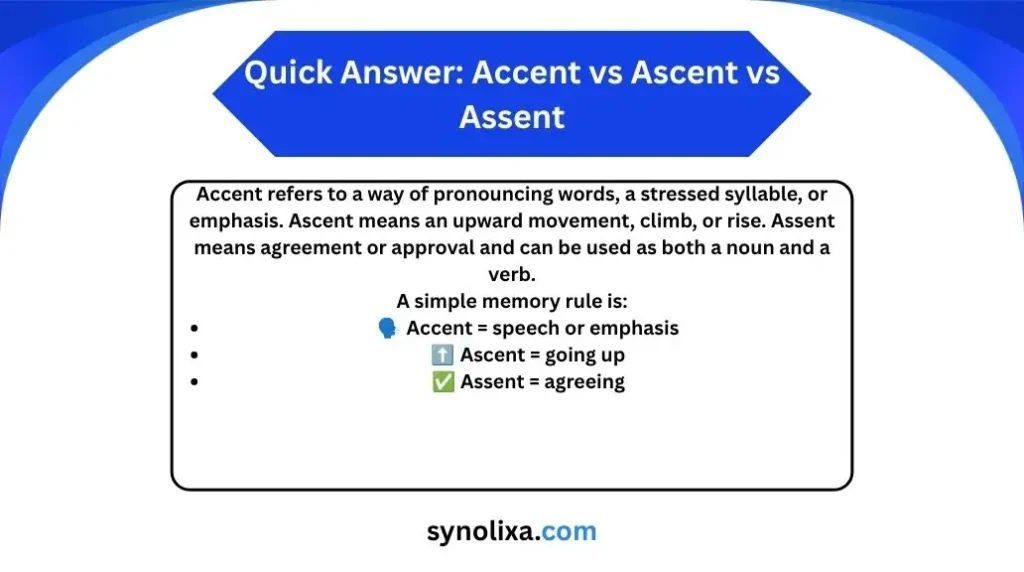
Accent refers to a way of pronouncing words, a stressed syllable, or emphasis. Ascent means an upward movement, climb, or rise. Assent means agreement or approval and can be used as both a noun and a verb.
A simple memory rule is:
- 🗣️ Accent = speech or emphasis
- ⬆️ Ascent = going up
- ✅ Assent = agreeing
Understanding the Basics of Accent vs Ascent vs Assent
The three words have similar spellings, but their meanings are separate.
| Word | Form | Type | Meaning | Example | Correct/Incorrect |
|---|---|---|---|---|---|
| accent | Noun/verb | Vocabulary word | Speech pattern, stress, emphasis, or highlighting | “She has a noticeable accent.” | ✅ Correct |
| ascent | Noun | Vocabulary word | Movement upward, climbing, or advancement | “The ascent was difficult.” | ✅ Correct |
| assent | Noun/verb | Vocabulary word | Agreement, approval, or acceptance | “The board gave its assent.” | ✅ Correct |
| accent for agreement | Noun | Wrong word choice | Does not mean approval | “The board gave its accent.” | ❌ Incorrect |
| assent for climbing | Noun | Wrong word choice | Does not mean upward movement | “The hikers began their assent.” | ❌ Incorrect |
| ascent for speech | Noun | Wrong word choice | Does not describe pronunciation | “He has a strong ascent.” | ❌ Incorrect |
The key is meaning, not spelling.
Accent: Speech, Stress, and Emphasis
Accent is the most flexible of the three words.
As a noun, it can describe the way someone pronounces words. For example:
“She speaks English with a French accent.”
Here, accent refers to the pronunciation pattern associated with the speaker.
Accent can also refer to stress placed on a particular syllable. For example:
“The accent falls on the first syllable.”
It can also mean emphasis or prominence:
“The designer used bright lighting to accent the artwork.”
In this sentence, accent is a verb meaning to emphasize or highlight.
Therefore, think of accent whenever the subject involves:
- pronunciation
- speech patterns
- syllable stress
- emphasis
- highlighting
- distinctive features
Ascent: Going Up
Ascent is a noun that refers to upward movement. It can describe physically climbing or moving higher.
For example:
“The hikers began their ascent before sunrise.”
The hikers are moving upward, so ascent is correct.
It can also describe an aircraft:
“The plane’s ascent was smooth.”
The plane is moving upward.
Ascent can also be used figuratively. Someone can have an ascent to power, an ascent in status, or an ascent through a career. In these cases, the person is not physically climbing, but the idea of moving to a higher position remains.
Think:
Ascent = upward movement.
Assent: Agreement or Approval
Assent means agreement or approval. Unlike ascent, it has nothing to do with climbing.
As a noun:
“The committee gave its assent to the proposal.”
The committee approved or agreed to the proposal.
As a verb:
“The committee assented to the proposal.”
The committee agreed to it.
Standard dictionaries identify assent as both a noun and a verb meaning agreement or expressing agreement.
Think:
Assent = agreement.
Correct Meanings and Uses
What Does Accent Mean?
Accent has several related meanings.
The most common meaning concerns pronunciation:
“His accent changed after he moved to another country.”
Here, accent describes the speaker’s way of pronouncing words.
Another meaning concerns emphasis:
“The speaker placed an accent on the final word.”
As a verb, accent can mean to emphasize:
“The curtains accent the color of the walls.”
So, while pronunciation is a common meaning, accent is not limited to speech.
Examples of Accent
- “She has a strong Southern accent.”
- “I could immediately recognize his accent.”
- “Which syllable receives the accent?”
- “The lighting accents the painting.”
- “The blue details accent the room.”
All of these examples involve pronunciation, stress, emphasis, or highlighting.
What Does Ascent Mean?
Ascent is a noun connected with going upward.
Examples include:
“The ascent of the mountain took six hours.”
“The balloon began its ascent.”
“The steep ascent made the hike challenging.”
The word can also describe figurative advancement:
“Her rapid ascent in the company surprised everyone.”
The person is moving upward in terms of professional status.
The related verb is ascend:
- Noun: ascent
- Verb: ascend
Compare:
“The hikers began their ascent.”
“The hikers began to ascend the mountain.”
Both sentences communicate upward movement, but they use different grammatical forms.
What Does Assent Mean?
Assent means agreement or approval.
As a noun:
“We need the manager’s assent before proceeding.”
As a verb:
“The manager assented to the proposal.”
The verb is generally used with to when introducing the thing or idea being agreed to:
“She assented to the plan.”
This construction is also recognized by major dictionary sources.
Examples of Assent
- “The board gave its assent to the plan.”
- “She nodded in assent.”
- “The director assented to the request.”
- “They waited for the owner’s assent.”
- “He assented to the terms.”
Test Tip: Ask One Question
When you are unsure which word to use, ask:
What does my sentence mean?
- Is it about speech or emphasis? → accent
- Is it about going upward? → ascent
- Is it about agreement? → assent
This meaning-based test is more reliable than trying to remember the spelling alone.
Accent vs Ascent vs Assent Pronunciation
Pronunciation is one reason these words are confusing.
In standard American English, accent is commonly pronounced with stress on the first syllable:
ACC-ent
By contrast, ascent and assent are pronounced with stress on the second syllable:
uh-SENT
The latter two are homophones in standard American English: they sound alike but have different spellings and meanings.
This creates an important writing problem.
If someone says:
“The board gave its assent.”
You cannot determine the spelling from the sound alone. You need to understand the meaning.
Likewise:
“The climbers began their ascent.”
The pronunciation alone does not tell you whether the speaker means ascent or assent. Context does.
Accent vs Ascent vs Assent in Grammar
Another useful way to separate these words is to look at their grammatical forms.
Accent as a Noun
“Her accent is easy to recognize.”
Here, accent is a noun.
Accent as a Verb
“The dark frame accents the painting.”
Here, accent is a verb meaning to emphasize or highlight.
Ascent as a Noun
“The ascent was exhausting.”
Ascent is a noun.
Its related verb is ascend:
“They ascended the mountain.”
Do not use ascent as the verb.
Assent as a Noun
“The proposal received their assent.”
Here, assent means agreement or approval.
Assent as a Verb
“They assented to the proposal.”
Here, assented means agreed.
This gives you a useful grammar pattern:
| Word | Noun? | Verb? | Related Idea |
|---|---|---|---|
| accent | Yes | Yes | Speech/emphasis |
| ascent | Yes | No | Going upward |
| assent | Yes | Yes | Agreement |
Case Study: A Workplace Conversation
Imagine that a manager sends an email about a new project.
The manager writes:
“We need everyone’s assent before we begin.”
This means everyone must agree to the plan.
Now imagine a different email:
“The aircraft’s ascent was delayed by weather.”
Here, ascent describes the aircraft moving upward.
Now consider a third sentence:
“The speaker’s accent was easy to recognize.”
This sentence concerns pronunciation.
These three examples demonstrate why context matters.
One Situation, Three Words
You can even use all three words in a connected situation:
“After giving their assent to the climbing plan, the hikers began their ascent. During the trip, they enjoyed listening to their guide’s distinctive accent.”
Each word has a different job:
- assent = agreement
- ascent = upward climb
- accent = speech pattern
This is an excellent example of why similar-looking words should not be treated as interchangeable.
Grammar Rules for Accent, Ascent, and Assent
The main rule is simple:
Choose the word according to its meaning, not according to how it sounds.
Major dictionary references distinguish these words by meaning. Ascent refers to rising or moving upward, while assent refers to agreement. Standard dictionary sources also recognize accent in connection with pronunciation, stress, emphasis, and related meanings.
Rule 1: Use Accent for Speech or Emphasis
Correct:
“She has a noticeable accent.”
Incorrect:
“She has a noticeable ascent.”
The second sentence changes the meaning completely and does not describe pronunciation.
Rule 2: Use Ascent for Upward Movement
Correct:
“The plane began its ascent.”
Incorrect:
“The plane began its assent.”
The plane is moving upward, so ascent is required.
Rule 3: Use Assent for Agreement
Correct:
“The committee gave its assent.”
Incorrect:
“The committee gave its ascent.”
The committee is agreeing, not climbing.
Rule 4: Use Ascend as the Verb Related to Ascent
Correct:
“The hikers ascended the trail.”
Correct:
“The hikers began their ascent.”
Incorrect:
“The hikers assented the trail.”
Remember:
ascent = noun
ascend = verb
Rule 5: Assent Can Be a Verb
Correct:
“She assented to the proposal.”
This is different from ascent, which is a noun.
Common Mistakes With Accent, Ascent, and Assent
Why do people confuse these words?
There are several common reasons.
1. They Look Similar
All three contain similar letters:
- accent
- ascent
- assent
When typing quickly, it is easy to choose the wrong spelling.
2. Ascent and Assent Sound the Same
This is the biggest source of confusion.
Because ascent and assent are homophones, listening alone cannot tell you which spelling is correct.
3. Fast Typing
People often type based on sound rather than meaning. If you know that a word sounds like “uh-sent,” your fingers may produce whichever spelling comes to mind first.
4. Autocorrect
Autocorrect can sometimes reinforce an incorrect word choice because both ascent and assent are legitimate English words.
For example, if you intended to type:
“The committee gave its assent.”
Your keyboard might not flag ascent as a spelling error because ascent is also a correctly spelled word.
5. Lack of Vocabulary Knowledge
If you have not learned the meanings of these words separately, the spelling differences can seem arbitrary.
Learning the central idea of each word is much more effective than memorizing three spellings without context.
Similar Grammar Confusions
Accent, ascent, and assent are part of a much larger group of commonly confused words.
| Confusing Words | Correct Difference |
|---|---|
| it’s / its | “It’s” = it is; “its” = possessive |
| your / you’re | “Your” = possession; “you’re” = you are |
| there / their / they’re | Place / possession / they are |
| to / too / two | Direction/infinitive / also or excessive / number |
| accept / except | Receive or agree / excluding |
| affect / effect | Usually verb / usually noun |
| than / then | Comparison / time or sequence |
| principal / principle | Person or main item / rule or belief |
| ascent / assent | Upward movement / agreement |
| accent / ascent | Speech or emphasis / upward movement |
These mistakes happen for similar reasons: sound, spelling, fast typing, and uncertainty about meaning.
Usage in Different Contexts
Everyday Conversation
Accent is common in everyday speech:
“I love her accent.”
Ascent is more likely to appear when talking about climbing, travel, or physical movement:
“The ascent was harder than I expected.”
Assent is somewhat more formal:
“He gave his assent.”
In everyday conversation, people may more commonly say agreement, approval, or yes instead of assent.
Professional Writing
All three words can appear in professional writing.
Examples:
“The speaker’s accent was clearly audible.”
“The aircraft began its ascent.”
“The proposal requires the client’s assent.”
In business, legal, academic, or formal contexts, precise word choice matters because small differences can affect interpretation.
Creative Writing
Writers can use these words to create specific images.
For example:
“The slow ascent toward the summit tested their patience.”
This gives the reader a clear sense of upward movement.
Or:
“Her accent immediately reminded him of home.”
Here, accent helps establish character and setting.
Assent can create a formal or deliberate tone:
“After a moment of silence, she gave her assent.”
Social Media and Texting
Social media posts and text messages often use informal language, but the same distinctions apply.
You might write:
“I love your accent! 🗣️”
Or:
“The ascent was worth the view! ⛰️”
Or:
“They finally gave their assent. ✅”
Even in casual writing, choosing the right word keeps your message clear.
Why Accent vs Ascent vs Assent Matters
Correct word choice is not only about passing a grammar test. It helps readers understand exactly what you mean.
1. Clarity in Communication
Consider:
“The hikers received the guide’s assent.”
This means the guide agreed.
Now:
“The hikers began the guide’s ascent.”
This means something completely different.
A single letter can change the meaning.
2. Professionalism
Correct vocabulary makes professional writing easier to understand.
If you are writing an email, report, application, or formal document, using the correct word shows careful attention to language.
3. Accuracy in Digital Communication
Digital communication moves quickly. Messages are often written without much editing.
Because ascent and assent are both legitimate words, spell-checking may not catch a wrong choice.
That means understanding the meaning is more important than relying entirely on spell-check tools.
4. Better Reading Comprehension
Knowing these words also helps you understand books, articles, reports, and other written material.
You can recognize immediately whether an author is discussing:
- speech
- upward movement
- agreement
A useful principle is:
“Similar sounds do not guarantee similar meanings.”
That simple idea applies to many English homophones.
Special Exceptions and Edge Cases
There is no special spelling exception that makes accent, ascent, and assent interchangeable. They remain distinct words.
However, accent has a broader range of meanings than the other two. It can describe pronunciation, syllable stress, emphasis, or something that visually highlights another feature.
For example:
“The red flowers accent the garden.”
Here, accent does not refer to speech.
Similarly, ascent can be used figuratively:
“Her ascent to leadership was rapid.”
The person is not physically climbing. Instead, ascent describes advancement toward a higher position or status. Dictionary sources recognize both literal upward movement and figurative advancement.
Assent can also be used in formal situations where someone agrees to a statement, proposal, or course of action. It functions as both a noun and a verb.
Quick Memory Tricks
Accent = How You Speak 🗣️
Think:
Accent → speech
Example:
“She has a British accent.”
Ascent = Going Up ⬆️
Think:
Ascent → ascend → up
Example:
“The hikers began their ascent.”
Assent = Agreeing ✅
Think:
Assent → agreement
Example:
“The committee gave its assent.”
A Three-Word Formula
Remember:
Accent = Talk
Ascent = Climb
Assent = Agree
If you remember those three verbs, you can usually select the correct spelling immediately.
Quick Recap Checklist
Use this checklist whenever you are unsure.
| Question | If Yes → Use |
|---|---|
| Is the sentence about pronunciation or the way someone speaks? | Accent |
| Is it about syllable stress or emphasis? | Accent |
| Is something moving upward? | Ascent |
| Is someone climbing a mountain or rising to a higher level? | Ascent |
| Is someone agreeing with an idea or proposal? | Assent |
| Does the sentence mean approval or agreement? | Assent |
| Do you need the verb meaning “to agree”? | Assent |
| Do you need the verb meaning “to move upward”? | Ascend, not ascent |
Practice Examples
1. “The hikers started their ___ at sunrise.”
Answer: ascent ⛰️
They are moving upward.
2. “The committee gave its ___ to the proposal.”
Answer: assent ✅
The committee agreed to the proposal.
3. “I could tell where she was from because of her ___.”
Answer: accent 🗣️
The sentence is about pronunciation.
Accent vs Ascent vs Assent: More Example Sentences
Accent Examples
- “His accent became less noticeable after several years abroad.”
- “The actor practiced the regional accent for the role.”
- “The teacher explained which syllable receives the accent.”
- “The bright colors accent the room.”
- “Her accent made her easy to identify over the phone.”
Ascent Examples
- “The mountain’s ascent was steep.”
- “The aircraft began its ascent shortly after takeoff.”
- “The hikers prepared for a difficult ascent.”
- “The company’s rapid ascent attracted attention.”
- “Their ascent to the summit took several hours.”
Assent Examples
- “The plan cannot proceed without the owner’s assent.”
- “The board gave its assent to the proposal.”
- “She nodded in assent.”
- “He assented to the terms.”
- “The members expressed their assent.”
Accent vs Ascent vs Assent in One Sentence
It is useful to see all three words together:
“After giving their assent to the expedition, the climbers began their ascent while listening to their guide’s distinctive accent.”
Break it down:
- assent → they agreed to the expedition.
- ascent → they climbed upward.
- accent → the guide had a distinctive way of speaking.
This single sentence captures the entire distinction.
FAQs
1. What is the difference between accent, ascent, and assent?
Accent relates mainly to pronunciation, speech, stress, or emphasis. Ascent means upward movement or climbing. Assent means agreement or approval.
2. Are ascent and assent pronounced the same?
Yes. In standard American English, ascent and assent are pronounced the same way, making them homophones. Their meanings and spellings are different.
3. Is ascent a noun or a verb?
Ascent is a noun. It means upward movement, climbing, or advancement. The related verb is ascend.
For example:
“The ascent was difficult.”
But:
“They ascended the mountain.”
4. Is assent a noun or a verb?
Assent can be both a noun and a verb.
As a noun:
“We received their assent.”
As a verb:
“They assented to the proposal.”
Dictionary sources recognize both uses.
5. How can I remember the difference between ascent and assent?
Use the memory trick:
Ascent = up.
It is related to ascend, which means to move upward.
Assent = agreement.
Think of it as saying yes to an idea, proposal, or statement.
6. Which word should I use for someone’s way of speaking?
Use accent.
For example:
“She speaks with a distinctive accent.”
Do not use ascent or assent when you mean pronunciation.
Conclusion
Understanding accent vs ascent vs assent is much easier when you stop focusing on how similar the words look and start focusing on what they mean. Accent is connected with speech, pronunciation, stress, emphasis, and highlighting. Ascent describes upward movement, climbing, or advancement. Assent means agreement or approval and can function as both a noun and a verb.
Remember the simplest rule: accent = speech 🗣️, ascent = going up ⬆️, and assent = agreement ✅.
When you are unsure, read the whole sentence and identify the idea first. If someone is speaking in a particular way, choose accent. If something is rising or climbing, choose ascent. If someone agrees to something, choose assent.
Similar sounds do not mean similar meanings. Once you connect each word with its central idea, this confusing trio becomes simple, clear, and easy to remember.

Hi, I am Ava Mitchell. I work at Synolixa as an English content writer, creating simple and useful resources about synonyms, vocabulary, and English usage.


[…] rules, examples, common mistakes, and practical usage so you can use both words confidently. ✍️ Accent vs Ascent vs Assent | Gluing or Glueing | Imbed vs […]