Have you ever typed a word that looked almost right, only to wonder whether you chose the correct spelling? Emersion vs. immersion is one of those confusing word pairs. The two terms look and sound similar, but they do not mean the same thing. In fact, one is a relatively uncommon noun, while the other is a common English word used in everyday, academic, professional, and creative writing.
The main difference is simple: emersion means the act of emerging or coming out, while immersion means the act of being placed into something, especially liquid, or becoming deeply involved in an activity or experience. Merriam-Webster defines emersion as “an act of emerging,” while immersion refers to the act or state of being immersed and can also describe deep involvement or complete submersion in water.
Because both words share similar sounds and spelling patterns, it is easy to confuse them when writing quickly. This guide explains emersion vs. immersion in clear US English, with definitions, examples, grammar tips, comparisons, common mistakes, and practical usage rules. Fairing or Faring | Performed vs Preformed | 50 Powerful Synonyms for Appreciate
Quick Answer: Emersion vs Immersion
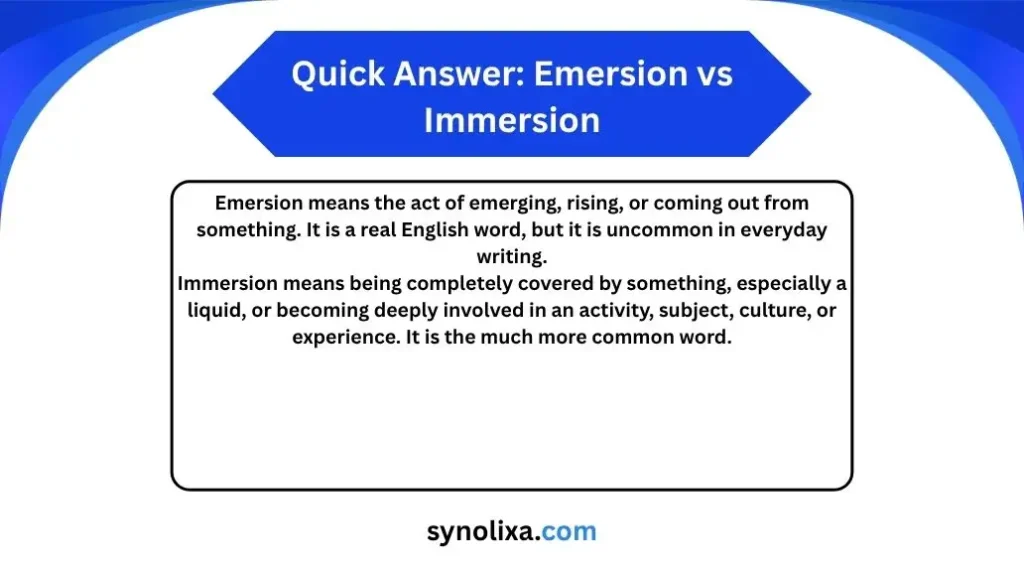
Emersion means the act of emerging, rising, or coming out from something. It is a real English word, but it is uncommon in everyday writing.
Immersion means being completely covered by something, especially a liquid, or becoming deeply involved in an activity, subject, culture, or experience. It is the much more common word.
Easy rule: If you mean going out or emerging, use emersion. If you mean going into something or becoming deeply involved, use immersion.
Understanding the Basics of Emersion vs Immersion
The easiest way to understand these words is to focus on their direction and meaning.
Emersion is connected with the idea of emerging. Something comes out, rises, or becomes visible.
Immersion is connected with the idea of being immersed. Something goes into, becomes surrounded by, or becomes deeply involved in something else.
Emersion
Emersion is a noun. Merriam-Webster defines it as an “act of emerging” and traces the word to Latin emersus, the past participle of emergere. Its first known use is recorded as 1633.
Examples:
- The plant’s emersion above the water was gradual.
- The telescope recorded the moon’s emersion from the shadow.
- The scientist observed the emersion of the object from the liquid.
The word is legitimate, but it is relatively specialized. In many ordinary situations, writers would choose emergence instead.
Immersion
Immersion is also a noun. It describes the act of immersing something or the state of being immersed. It can refer to physical submersion or deep mental involvement.
Examples:
- The immersion of the object in water was brief.
- She studied Spanish through immersion.
- The movie created a feeling of complete immersion.
- His immersion in the project lasted several months.
Merriam-Webster also identifies immersion as a term for extensive exposure in language instruction and as a term for baptism by complete submersion.
Emersion vs Immersion Comparison Table
| Form | Type | Meaning | Example | Correct/Incorrect |
|---|---|---|---|---|
| Emersion | Noun | The act of emerging or coming out | The emersion of the object was visible. | Correct |
| Immersion | Noun | The act of putting something into or becoming deeply involved in something | Her immersion in the language improved her skills. | Correct |
| Emersion | Noun | Deep involvement in a subject | His emersion in history was impressive. | Incorrect for this meaning |
| Immersion | Noun | Emerging or coming out | The immersion of the moon from the shadow was observed. | Incorrect for this meaning |
| Emergence | Noun | The process of becoming visible, known, or developed | The emergence of new ideas changed the field. | Often preferable to emersion |
| Immerse | Verb | To put into something or become deeply involved | She immersed herself in the project. | Correct |
| Emerge | Verb | To come out or become visible | The bird emerged from the nest. | Correct |
Correct Meanings and Uses
Understanding the individual words is more useful than simply memorizing their spellings.
What Does Emersion Mean?
Emersion refers to an act of emerging. In simple terms, something that was hidden, covered, submerged, or otherwise out of sight comes out or becomes visible.
Think:
emersion → emergence → coming out
For example:
The emersion of the moon from the shadow was carefully observed.
Here, emersion describes the point at which the moon emerges from an obscuring shadow.
Another example is:
The plant’s emersion above the water occurred after several days.
The noun describes the process or act of becoming visible above the water.
Why Is Emersion Uncommon?
Although emersion is a legitimate dictionary word, it is not common in ordinary conversation. Most people are more likely to say emergence, appearance, rising, or coming out, depending on the context.
For example:
- Less common: The emersion of the object was sudden.
- More familiar: The emergence of the object was sudden.
This does not make emersion incorrect. It simply means that the context should justify the more specialized word.
What Does Immersion Mean?
Immersion has several common meanings.
The first is physical. Something is placed completely under a liquid or another surrounding substance.
The immersion of the equipment in water lasted five minutes.
The second meaning is figurative. A person can become deeply involved in an activity, subject, culture, or experience.
Her immersion in the new language helped her communicate more naturally.
This figurative use is extremely common in education, travel, business, entertainment, and technology.
Immersion in Language Learning
One of the best-known uses of immersion is language education.
A learner may study a language through immersion, meaning that they receive extensive exposure to the language in relevant surroundings or conditions. Merriam-Webster specifically includes extensive exposure to a language as one meaning of immersion.
For example:
The students learned French through immersion.
The sentence means that the students learned through extensive exposure to French rather than relying only on isolated vocabulary or grammar lessons.
Cambridge similarly defines immerse as becoming completely involved in something and gives language learning as an example of immersion.
Immersion in Work or Study
Immersion can also describe intense concentration.
She became completely immersed in her research.
Here, nobody is being placed in water. The word is figurative. It means she became deeply involved in her research.
Other examples include:
- He was immersed in his studies.
- The team became immersed in the project.
- I became immersed in the novel.
- They were immersed in the local culture.
Test Tip: The “In or Out” Test
When you are unsure about emersion vs. immersion, ask yourself one question:
Is the idea about coming out or going in?
- Coming out → emersion
- Going in or becoming deeply involved → immersion
For example:
The bird’s ___ from the water was easy to see.
The idea is coming out, so emersion can fit.
Her ___ in the new culture changed her perspective.
The idea is deep involvement, so immersion is correct.
This simple test will solve most cases.
Emersion vs Immersion in a Real-Life Case Study
Imagine that a manager sends this email to a team:
“Our new employees will spend their first week in complete emersion with the customer-support team.”
At first glance, the sentence may look reasonable. However, the intended meaning is that the employees will become deeply involved with the customer-support environment.
The correct sentence is:
“Our new employees will spend their first week in complete immersion with the customer-support team.”
Even better, the manager could write:
“Our new employees will spend their first week immersed in the customer-support team.”
Why?
Because the employees are entering deeply into an experience, not emerging from one.
Now consider a different context:
“The astronomers observed the emersion of the celestial object from the shadow.”
Here, emersion can be appropriate because the object is emerging from an obscuring area.
This case study shows why spelling alone cannot determine the correct word. Meaning determines the choice.
Grammar Rules for Emersion vs Immersion
Both emersion and immersion are nouns, but their meanings are different.
The Verb Behind Emersion
The related verb is emerge.
- emerge → emersion
- emerge → emergence
The basic idea is movement outward or becoming visible.
Example:
The swimmer emerged from the water.
A noun referring to that act can be emersion, although emergence is often more natural depending on context.
The Verb Behind Immersion
The related verb is immerse.
- immerse → immersion
- immersed → immersion
Merriam-Webster defines immerse as plunging something into something that surrounds or covers it and also as becoming engrossed or absorbed.
Examples:
The teacher immersed the students in the language.
The students immersed themselves in the language.
Their immersion in the language improved their confidence.
Cambridge also explains that immerse yourself in something means to become completely involved in it.
Why the Words Are Easy to Confuse
The words share several features:
- Both are nouns.
- Both contain similar letters.
- Both have related ideas involving movement or involvement.
- Both can appear in technical writing.
- Both are pronounced similarly.
However, the initial letters provide a useful memory clue:
E = emerge = out
I = immerse = in
That is not a complete linguistic rule, but it is an effective memory aid.
Common Mistakes With Emersion vs Immersion
Confusion usually happens because writers remember the sound but not the meaning.
Mistake 1: Using Emersion for Deep Involvement
Incorrect:
She showed great emersion in her studies.
Better:
She showed great immersion in her studies.
The student is becoming deeply involved in the subject, so immersion is correct.
Mistake 2: Assuming Emersion Is a Misspelling
It is not.
Emersion is a legitimate dictionary word. Merriam-Webster lists it as a noun meaning an act of emerging.
The problem is usually not spelling. The problem is using a real word in the wrong context.
Mistake 3: Replacing Every Use With Emergence
Although emergence is often more familiar than emersion, the two words are not always interchangeable.
Emergence commonly refers to becoming known, visible, developed, or established.
Emersion has a more specific sense of emerging, including specialized uses involving something coming out from concealment or an obscuring medium.
So, do not automatically replace emersion with emergence. Check the intended meaning first.
Why These Errors Happen
Common causes include:
- Fast typing: Writers type what sounds right.
- Autocorrect: Software may change or suggest a familiar word.
- Lack of vocabulary knowledge: Uncommon words are easier to misuse.
- Similar pronunciation: The words can sound very close.
- Context confusion: Writers remember the general idea but not the exact meaning.
Similar Grammar Confusions to Watch
The emersion vs. immersion problem is part of a larger pattern in English: words can look or sound similar while having different meanings.
| Confusing Pair | Correct Difference | Example |
|---|---|---|
| It’s / Its | It’s = it is; its = possessive | It’s cold. The dog wagged its tail. |
| You’re / Your | You’re = you are; your = possessive | You’re ready. Your book is here. |
| They’re / Their / There | Different grammatical functions | They’re here with their bags. |
| Affect / Effect | Usually verb vs. noun, depending on context | The news affected her. The effect was strong. |
| Then / Than | Time vs. comparison | We ate, then left. She is taller than me. |
| Elicit / Illicit | Draw out vs. unlawful | The question elicited a response. |
| Emigrate / Immigrate | Leave a country vs. enter a country | He emigrated from one country and immigrated to another. |
| Emersion / Immersion | Emerging vs. being submerged/deeply involved | The emersion was visible. Her immersion was complete. |
The best way to avoid these mistakes is to learn the meaning and grammatical function of each word rather than relying only on pronunciation.
Emersion vs Immersion in Different Contexts
Everyday Conversation
In casual speech, immersion is much more likely to appear.
Examples:
- “I love total immersion in a good book.”
- “The class uses language immersion.”
- “The museum offers an immersive experience.”
Emersion is uncommon in everyday conversation.
Instead, people usually say:
- coming out
- emerging
- appearing
- rising
- becoming visible
Professional Writing
Professional writing may use both words, but context matters.
Immersion is common in:
- education
- training
- technology
- research
- marketing
- workplace development
Example:
The company introduced an immersive training program.
Emersion may appear in specialized scientific or technical contexts.
Example:
Researchers recorded the object’s emersion from the shadow.
If your audience is general, consider whether a simpler word such as emergence would communicate the idea more clearly.
Creative Writing
Writers may use immersion to create a sense of depth.
The novel drew readers into complete immersion in its fictional world.
Emersion can also appear when a writer wants to describe something emerging.
At dawn, the emersion of the mountains from the morning mist created a dramatic scene.
Creative writing gives authors more flexibility, but the underlying meanings remain the same.
Social Media and Texting
In social media posts, immersion is far more likely.
Examples:
- “Fully immersed in this weekend. 🌿”
- “Nothing beats total immersion in a great story. 📚”
- “I am completely immersed in this new hobby.”
Emersion is unlikely to be needed unless someone is discussing a specialized topic.
Why the Difference Between Emersion and Immersion Matters
Choosing the correct word is not just about passing a grammar test. It is about making your meaning clear.
Clarity in Communication
Imagine reading:
“The team’s emersion in the new project was impressive.”
A reader may pause because emersion does not normally express deep involvement. The intended word is immersion.
Correct word choice removes that confusion:
“The team’s immersion in the new project was impressive.”
Professionalism
In emails, reports, essays, applications, and business documents, precise vocabulary makes your writing easier to trust.
A specialized word such as emersion should be used only when its specific meaning is intended.
Digital Communication
Online writing moves quickly. People often type on phones, use predictive text, and rely on autocorrect. These tools can increase spelling errors when two words look similar.
A quick meaning check can prevent many mistakes.
A Useful Reminder
Clear words make clear ideas.
That principle is especially important when choosing between similar terms.
Special Exceptions and Edge Cases
There is an important point about emersion: it is not simply a “wrong version” of immersion. It is a valid word with its own meaning.
Merriam-Webster records emersion as meaning an act of emerging and gives its first known use as 1633.
The word can appear in specialized contexts, including descriptions of something emerging from an obscuring body or surface.
There are also related forms that can cause confusion.
Emersed
Emersed is an adjective meaning standing out of or rising above a surface, such as a fluid. Merriam-Webster gives aquatic plants as an example of something that can be described as emersed.
Example:
The emersed leaves extended above the water.
Immerge
Immerge is another uncommon word. Merriam-Webster defines it as a verb meaning to plunge into or immerse oneself in something.
However, immerse is far more familiar and useful in modern general English.
Immersive
Do not confuse immersion with immersive.
Immersive is an adjective describing something that provides or involves deep absorption in an activity or environment.
Example:
The game offers an immersive experience.
Here, immersive describes the experience.
Quick Recap Checklist for Emersion vs Immersion
Use this table whenever you need a fast answer.
| Question | If Yes → Use |
|---|---|
| Does the word describe coming out or emerging? | Emersion |
| Does it describe being put into liquid? | Immersion |
| Does it describe deep involvement? | Immersion |
| Does it describe language learning through extensive exposure? | Immersion |
| Is the intended meaning simply becoming visible or developing? | Usually emergence |
| Is the word describing something that rises above a fluid’s surface? | Emersed may be appropriate |
| Does the word describe an experience that deeply absorbs someone? | Immersive |
Practice Example 1
The students became completely ___ in the language.
Answer: immersed
Why? They became deeply involved in the language.
Practice Example 2
Scientists observed the ___ of the object from the shadow.
Answer: emersion
Why? The object was emerging from an obscuring area.
Practice Example 3
The museum created an ___ experience for visitors.
Answer: immersive
Why? Immersive is the adjective describing an experience that deeply involves the visitor.
FAQs About Emersion vs Immersion
Is emersion a real word?
Yes. Emersion is a real English noun. Merriam-Webster defines it as an act of emerging. It is less common than immersion and is more likely to appear in specialized contexts.
What is the difference between emersion and immersion?
Emersion means emerging or coming out. Immersion means being placed into something, especially liquid, or becoming deeply involved in an activity, subject, culture, or experience.
Is emersion the opposite of immersion?
In a basic physical sense, the words can describe opposite directions: emersion involves emerging, while immersion involves going into or being covered by something. However, they are not exact opposites in every context because immersion also has figurative meanings such as deep involvement.
Is “immersion in a subject” correct?
Yes. Immersion in a subject is correct when you mean becoming deeply involved with that subject.
For example:
Her immersion in biology helped her understand the topic more deeply.
Should I use immersion or emersion for language learning?
Use immersion. Language immersion involves extensive exposure to and involvement with the language being learned. Both Merriam-Webster and Cambridge recognize this use.
Is “emersion” the same as “emergence”?
They overlap in the general idea of coming out or becoming visible, but they are not always interchangeable. Emersion has a more specific and specialized sense related to emerging, while emergence is much more common and has broader everyday uses.
Conclusion: Emersion vs Immersion
The difference between emersion vs. immersion becomes easy once you focus on the direction of the meaning. Emersion refers to emerging or coming out, and it is a legitimate but relatively uncommon noun. Immersion refers to being placed into something, especially a liquid, or becoming deeply involved in an activity, subject, culture, or experience. Merriam-Webster and Cambridge both support these distinctions.
For everyday writing, you will probably use immersion much more often. You might write about language immersion, immersion in a book, immersion in a culture, or immersion in a project. Use emersion when the specific meaning of emerging or coming out is intended.
The fastest memory trick is simple:
E = Emerge = out.
I = Immerse = in.
When in doubt, stop thinking about how the word sounds and ask what the sentence actually means. Choose the word that matches the idea, and your writing will stay clear, accurate, and professional.

Hi, I am Clara Anderson. I work at Synolixa as a vocabulary writer, focusing on synonyms, word meanings, and easy-to-understand English learning content.
[…] discuss common spelling mistakes, and give you simple tricks for remembering the right spelling. Emersion vs Immersion | Fairing or Faring | Performed vs […]