Have you ever wondered about the difference between awoke vs woke when talking about someone waking up? You are not alone. Many English learners and even native speakers find these two words confusing because they are both forms of the verb “wake.” They look different, but their meanings are closely related.
Understanding the difference between awoke vs woke is important for speaking and writing correctly. Both words describe something that happened in the past, but they can appear in different sentence structures and contexts. They are also connected to the verb “awaken,” which adds another layer of confusion.
The good news is that the difference is easier to understand than it seems. Once you learn the basic forms of the verb and see how each word works in everyday sentences, choosing the right one becomes simple.
In this guide, we will explain their meanings, grammar rules, examples, common mistakes, and practical uses. You will also learn how to remember the correct form and avoid confusion in professional and casual writing. Innate vs Enate | Nor Do I or Neither Do I | Hail vs Hale
Quick Answer: Awoke vs Woke
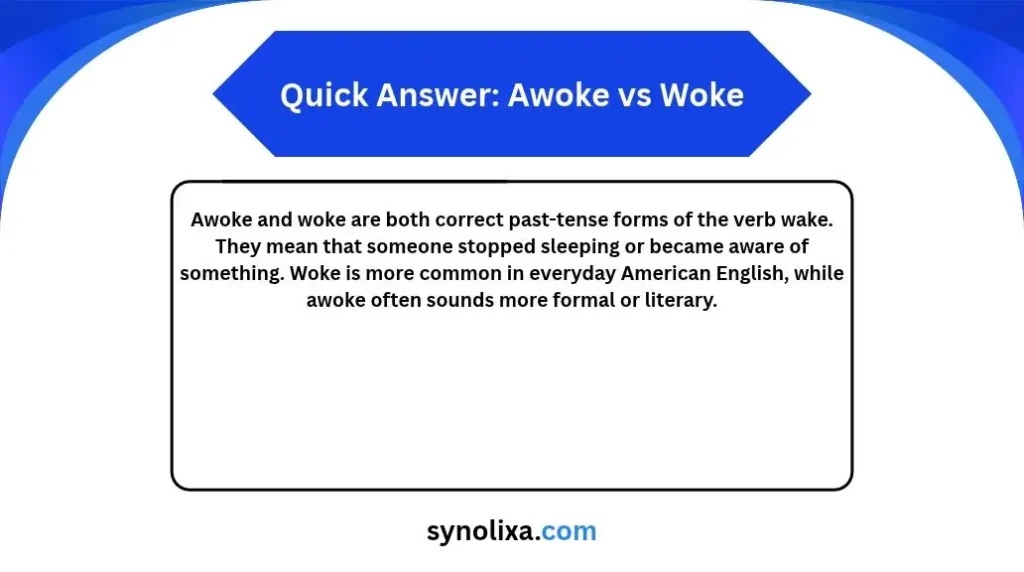
Awoke and woke are both correct past-tense forms of the verb wake. They mean that someone stopped sleeping or became aware of something. Woke is more common in everyday American English, while awoke often sounds more formal or literary.
Understanding the Basics of Awoke vs Woke
The easiest way to understand these words is to look at their original verb: wake.
The verb wake describes the action of stopping sleep or becoming alert. It is an irregular verb, which means its past forms do not follow the regular pattern of adding “-ed.”
Here are its main forms:
- Base form: Wake
- Simple past: Woke or awoke
- Past participle: Woken
- Present participle: Waking
Both past-tense forms are grammatically correct. However, they may sound slightly different depending on the sentence and writing style.
Comparison Table: Awoke vs Woke
| Form | Type | Meaning | Example | Correct/Incorrect |
|---|---|---|---|---|
| Wake | Base verb | Stop sleeping | I wake up early. | Correct |
| Woke | Simple past | Stopped sleeping | She woke early. | Correct |
| Awoke | Simple past | Stopped sleeping | He awoke suddenly. | Correct |
| Woken | Past participle | Already awakened | I have woken up. | Correct |
| Waked | Alternative past form | Stopped sleeping | The child waked early. | Rare but correct in some uses |
| Woke uped | Incorrect form | No standard meaning | She woke uped late. | Incorrect |
The main point is that woke and awoke can both describe an action that happened in the past.
For example:
- She woke at six in the morning.
- She awoke at six in the morning.
Both sentences are correct.
However, woke is generally the more natural choice in everyday American conversation.
Correct Meanings and Uses of Awoke vs Woke
Although these words share a basic meaning, they can be used in different situations.
Understanding their uses will help you choose the right word naturally.
1. When to Use Woke
Woke is the simple past form of wake. It is widely used in everyday American English.
Use it when describing someone who stopped sleeping or became aware of something in the past.
Examples:
- I woke up at seven this morning.
- She woke when the phone rang.
- My brother woke late yesterday.
- They woke before sunrise.
- The baby woke several times during the night.
Sentence breakdown:
Example: “I woke up at seven this morning.”
- Subject: I
- Verb: Woke
- Particle: Up
- Time expression: At seven this morning
The sentence explains that the speaker stopped sleeping at seven.
More examples:
- He woke suddenly because of a loud noise.
- We woke early to prepare for the trip.
- The children woke when their mother entered the room.
In these examples, woke describes a completed action in the past.
2. When to Use Awoke
Awoke is another simple past form of wake. It has the same basic meaning as woke, but it often sounds more formal, descriptive, or literary.
It is common in storytelling, books, formal descriptions, and expressive writing.
Examples:
- She awoke to the sound of birds.
- He awoke from a strange dream.
- The entire family awoke before sunrise.
- I awoke feeling refreshed.
- The traveler awoke in an unfamiliar room.
Sentence breakdown:
Example: “She awoke to the sound of birds.”
- Subject: She
- Verb: Awoke
- Additional phrase: To the sound of birds
The sentence describes a person who stopped sleeping after hearing birds.
More examples:
- The young boy awoke with a smile.
- She awoke suddenly in the middle of the night.
- He awoke to find the room completely dark.
These sentences are grammatically correct. Their style is simply a little more descriptive.
3. Awoke vs Woke in Everyday English
In everyday conversation, woke is usually the easier and more natural choice.
For example:
- I woke up late today.
- My father woke me early.
- She woke up feeling tired.
You can also use awoke in these situations, but it may sound more formal.
Compare:
- I woke up when the alarm rang.
- I awoke when the alarm rang.
Both sentences are correct. The first sounds more conversational, while the second sounds more formal.
4. Awoke vs Woke When Talking About Awareness
The verb wake can also describe becoming mentally or emotionally aware of something.
For example:
- He woke to the truth about his situation.
- She awoke to the importance of education.
- The experience woke him to the problems around him.
The word awoke can also be used:
- He awoke to the reality of his mistakes.
- The event awoke a new interest in science.
These examples use a figurative meaning. The person is not necessarily waking from sleep. Instead, the person is becoming aware of something.
Test Tip
Ask yourself one simple question:
Am I describing something that happened in the past?
If the answer is yes, woke or awoke may be correct.
Then consider the tone:
- Use woke for natural, everyday writing.
- Use awoke for a more formal or literary tone.
Remember that neither word is automatically wrong.
Case Study: Awoke vs Woke in a Workplace Situation
Imagine that an employee needs to explain why they arrived late to an online meeting.
They write the following email:
Example 1: Everyday and Professional
“Good morning,
I apologize for joining the meeting late. I woke up later than expected because my alarm did not ring.
Thank you for your understanding.”
This email uses woke correctly. The language is natural, clear, and professional.
Example 2: More Formal Style
“Good morning,
I apologize for joining the meeting late. I awoke later than expected because my alarm did not ring.
Thank you for your understanding.”
This version is also grammatically correct. However, awoke sounds slightly more formal.
What Can We Learn?
Both versions communicate the same message.
The difference is mainly about style:
- Woke is common and conversational.
- Awoke is more formal and descriptive.
For ordinary workplace emails, woke is usually the better choice because it sounds natural.
Grammar Rules Explanation: Awoke vs Woke
To understand these words completely, you need to learn how irregular verbs work.
1. Both Words Are Simple Past Forms
The verb wake is irregular.
Regular verbs usually form their past tense by adding “-ed.”
For example:
- Walk → Walked
- Talk → Talked
- Clean → Cleaned
However, irregular verbs change their spelling.
For example:
- Go → Went
- Eat → Ate
- See → Saw
- Wake → Woke or Awoke
This is why writing “waked” in ordinary American English is generally less natural than using woke or awoke.
2. Woke and Awoke Do Not Replace Woken in Every Sentence
One important grammar rule is that the simple past and past participle are different verb forms.
The main forms are:
| Verb Form | Correct Word | Example |
|---|---|---|
| Base form | Wake | I wake early. |
| Simple past | Woke | I woke early. |
| Alternative simple past | Awoke | I awoke early. |
| Past participle | Woken | I have woken early. |
| Present participle | Waking | I am waking up. |
Notice that woken is normally used with helping verbs such as have, has, and had.
Correct examples:
- I have woken up.
- She has woken from her dream.
- They had woken before sunrise.
Incorrect examples:
- I have woke up.
- She has awoke from her dream.
- They had woke before sunrise.
In standard American English, use woken after these helping verbs.
3. Why Are Both Forms Correct?
Standard dictionaries, including Merriam-Webster, recognize woke and awoke as past-tense forms of wake.
The difference is not about correctness. It is mainly about frequency, tone, and sentence style.
For most everyday situations, woke is the most natural choice.
For descriptive writing, awoke can add a more formal or literary feeling.
4. Understanding the Difference Between Wake, Awake, and Awaken
These three words are related, but they do not always work in exactly the same way.
Wake
Wake is a verb meaning to stop sleeping.
Example: “I wake up at six every day.”
Awake
Awake can work as a verb or an adjective, although its adjective use is especially common.
Examples:
- The noise awoke the baby. (Verb)
- The baby is awake. (Adjective)
Awaken
Awaken is a verb that means to wake someone or become awake.
Examples:
- The sound awakened the child.
- She awakened before sunrise.
Understanding these related words makes it easier to use woke and awoke correctly.
Common Mistakes With Awoke vs Woke
Many people make mistakes because these words have similar meanings and irregular forms.
Here are some common problems to avoid.
1. Using Woke After Have or Has
Incorrect: “I have woke up early.”
Correct: “I have woken up early.”
Why?
The helping verb have requires the past participle in this construction. The correct form is woken.
2. Using Awoke as the Past Participle
Incorrect: “She has awoke from her dream.”
Correct: “She has woken from her dream.”
Why?
Awoke is a simple past form, not the standard past participle.
3. Adding -Ed to Woke
Incorrect: “He woke-ed up late.”
Correct: “He woke up late.”
Why?
Wake is an irregular verb. You should not add “-ed” to its past form.
4. Confusing Awake With Awoke
Incorrect: “I am awoke now.”
Correct: “I am awake now.”
Why?
Awake is the appropriate adjective in this sentence.
5. Writing the Wrong Verb Form After Had
Incorrect: “They had awoke before the alarm.”
Correct: “They had woken before the alarm.”
Why?
The verb following had should be the past participle woken.
Similar Grammar Confusions
Awoke vs woke is not the only English grammar confusion. Many words look or sound similar but have different grammatical functions.
| Confusing Words | Correct Difference | Example |
|---|---|---|
| It’s / Its | It’s means it is; its shows possession. | It’s a dog with its toy. |
| Your / You’re | Your shows possession; you’re means you are. | You’re holding your book. |
| There / Their | There refers to a place; their shows possession. | Their house is over there. |
| Then / Than | Then refers to time; than makes comparisons. | I was younger then. |
| Lose / Loose | Lose means fail to keep; loose means not tight. | Do not lose your loose keys. |
| Woke / Woken | Woke is simple past; woken is past participle. | I woke early. I have woken early. |
| Awoke / Awake | Awoke is past tense; awake can be an adjective. | He awoke, and now he is awake. |
Why Do These Mistakes Happen?
There are several reasons people confuse these words.
1. Fast Typing
People often write quickly when sending messages or completing online work. They may select the first word that looks familiar without checking its grammatical role.
2. Autocorrect
Autocorrect sometimes changes a word into another form. This can create errors, especially when two words are closely related.
3. Lack of Knowledge
Some learners know that wake has an irregular past tense but do not understand the difference between simple past and past participle.
4. Similar Meanings
Because woke and awoke mean almost the same thing, writers may assume they can use either form after every helping verb. This is not correct.
Usage of Awoke vs Woke in Different Contexts
The choice between these words can depend on the type of writing and the audience.
Let’s explore their use in different situations.
1. Everyday Conversation
In casual conversations, woke is usually the preferred option.
Examples:
- I woke up late today.
- When did you wake up?
- My mother woke me at seven.
- We woke before everyone else.
These sentences sound natural and simple.
Although awoke is also correct, it may sound more formal than necessary in everyday conversation.
2. Professional Writing
Professional writing should be clear and easy to understand.
In emails, reports, and workplace messages, woke is generally the more natural choice.
Examples:
- The employee woke early to prepare for the presentation.
- I woke up before my scheduled meeting.
- The manager woke to an urgent phone call.
You can use awoke in formal reports or descriptive writing, but there is usually no need to choose the more literary form.
3. Creative Writing
Creative writing gives authors more freedom to choose words that create a particular mood.
Awoke can sound descriptive and dramatic.
Examples:
- She awoke to the gentle sound of rain.
- The old king awoke from a troubling dream.
- He awoke to discover that everything had changed.
Woke also works well in stories, especially when the writer wants a natural and direct style.
Examples:
- The boy woke in the middle of the night.
- She woke and looked around the empty room.
Both words can make a story interesting. The best choice depends on the author’s tone.
4. Social Media and Texting
People usually prefer short and simple words when communicating online.
Examples:
- Just woke up!
- I woke up so late today.
- I woke up feeling great.
- Woke up to beautiful weather.
These expressions are common in casual digital communication.
Awoke is also grammatically correct, but it is less common in everyday social media posts.
5. Academic Writing
Academic writing requires accurate grammar and a consistent writing style.
Both forms are acceptable when used correctly.
Examples:
- The participant woke during the experiment.
- The patient awoke after the procedure.
- The child had woken before the scheduled observation.
Choose the form that fits your sentence and maintain consistency throughout your writing.
Why the Difference Between Awoke vs Woke Matters
You may wonder why such a small difference deserves attention.
Although both words are correct, understanding their grammatical forms helps you communicate more effectively.
1. Clarity in Communication
Correct verb forms make sentences easier to understand.
For example:
- Incorrect: “I have awoke early.”
- Correct: “I have woken early.”
The correct version follows standard grammar and communicates the intended meaning clearly.
2. Professionalism
Good grammar creates a positive impression in workplace emails, academic assignments, and business documents.
Using the right verb form shows that you pay attention to detail.
3. Writing Accuracy
English has many irregular verbs. Learning their forms helps you avoid mistakes in articles, reports, essays, and everyday messages.
4. Digital Communication
Online writing happens quickly. People often send messages without reviewing them.
Knowing the difference between woke, awoke, and woken helps you write accurate messages without spending too much time checking every sentence.
Remember this simple quote:
“Clear writing begins with understanding the words you choose.”
Special Exceptions and Interesting Facts About Awoke vs Woke
There are a few interesting details worth knowing about these words.
1. Woke Has a Modern Social Meaning
Apart from its connection to waking up, woke has developed another meaning in modern English.
It can describe awareness of social issues, including discrimination and injustice.
For example:
- She is interested in social issues and considers herself woke.
- The discussion focused on woke culture.
This meaning is different from the ordinary past-tense use of woke.
In this context, woke functions as an adjective rather than simply describing someone who stopped sleeping.
2. Awoke Can Sound Literary
Writers sometimes choose awoke because it creates a more descriptive or traditional tone.
For example:
- “He awoke to a beautiful morning.”
This sentence sounds more literary than:
- “He woke up to a beautiful morning.”
Both are correct, but the first has a slightly different style.
3. Wake Up and Awake Are Not Always Interchangeable
Consider these examples:
- I woke up at six.
- I was awake at six.
The first sentence describes the action of waking. The second describes a state of being alert or not sleeping.
This distinction is useful when choosing between related words.
4. Woken Is the Standard Past Participle
Remember that woken is important when forming perfect tenses.
Examples:
- I have woken up.
- She has woken early.
- They had woken before the storm.
This form is essential for avoiding common grammar mistakes.
Quick Recap Checklist: Awoke vs Woke
Use the following table to check which word belongs in your sentence.
| Question | If Yes → Use |
|---|---|
| Are you describing someone who stopped sleeping in the past? | Woke or Awoke |
| Are you writing an everyday conversation? | Woke |
| Are you writing a descriptive or literary sentence? | Awoke |
| Does your sentence contain have, has, or had? | Woken |
| Are you describing someone’s current state of being alert? | Awake |
| Are you using the base form of the verb? | Wake |
Easy Memory Trick
Remember these simple patterns:
- Yesterday, I woke up early.
- Yesterday, I awoke early.
- I have woken up early.
- I am awake now.
If you remember these four sentences, you will understand the main difference.
Practice Examples
Test your understanding with these examples.
Example 1:
Yesterday, I _____ at five in the morning.
- A. Woke
- B. Woken
Correct Answer: A. Woke
Explanation: The sentence uses simple past tense, so woke is correct.
Example 2:
She has _____ up earlier than usual.
- A. Awoke
- B. Woken
Correct Answer: B. Woken
Explanation: The helping verb has requires the past participle woken.
Example 3:
The child _____ suddenly after hearing a loud noise.
- A. Awoke
- B. Woken
Correct Answer: A. Awoke
Explanation: The sentence describes a completed past action. Awoke is a correct simple past form.
FAQs
1. What is the main difference between awoke and woke?
Awoke and woke are both simple past forms of the verb wake. They have the same basic meaning, but woke is more common in everyday American English, while awoke often sounds more formal or literary.
2. Is woke grammatically correct?
Yes, woke is grammatically correct. It is the simple past tense of wake. For example, “I woke up early yesterday” is a correct sentence.
3. Is awoke a real word?
Yes, awoke is a standard English word. It is an alternative simple past form of wake. For example, “She awoke to the sound of music” is grammatically correct.
4. Should I use woke or awoke in American English?
Use woke in most everyday American English conversations and writing. Use awoke when you want a slightly more formal, descriptive, or literary tone. Both forms are correct.
5. Is it correct to say I have awoke?
In standard American English, the preferred form is “I have woken.” The word woken is the past participle of wake, while awoke is a simple past form.
6. What is the past participle of wake?
The standard past participle of wake is woken. For example, “I have woken up early today.” Do not confuse it with woke, which is the simple past form.
Conclusion
Understanding awoke vs woke is simple once you learn how the verb wake works. Both words are correct simple past forms, and both describe someone stopping sleep or becoming aware of something. The main difference is their style and frequency. Woke is more common in everyday American English, while awoke often sounds more formal or literary.
Remember that woken is the standard past participle used with helping verbs such as have, has, and had. Also, awake can describe someone’s current state of being alert.
The best way to improve your grammar is to practice these forms in real sentences. Keep the basic verb patterns in mind, and you will find it much easier to choose the correct word.
Remember: You woke yesterday, you have woken today, and you are awake now!

Hi, I am Ava Mitchell. I work at Synolixa as an English content writer, creating simple and useful resources about synonyms, vocabulary, and English usage.

[…] to choose the correct spelling in everyday conversations, professional writing, and online content. Awoke vs Woke | Innate vs Enate | Nor Do I or Neither Do […]