Have you ever stopped while writing a sentence and wondered whether to say “she has” or “she have”? You are not alone. This is a common English grammar question because both has and have are forms of the same verb. The correct choice depends mainly on the subject of the sentence and the tense or structure being used.
In standard US English, “she has” is normally correct when has is the main verb in a present-tense statement. For example, we say, “She has a new laptop,” not “She have a new laptop.” However, have can correctly appear with she in certain grammatical structures, especially after helping verbs such as does, will, can, may, and should.
Understanding this small difference can make your writing much clearer. It also helps you avoid a common subject-verb agreement error in emails, schoolwork, workplace communication, social media posts, and everyday conversation.
So, when should you use she has, and when can she have be correct? Let’s break down the rule in a simple way. 👇 Leapt or Leaped | Cartel vs Mafia | My Father and I or My Father and Me
Quick Answer: She Has or She Have?
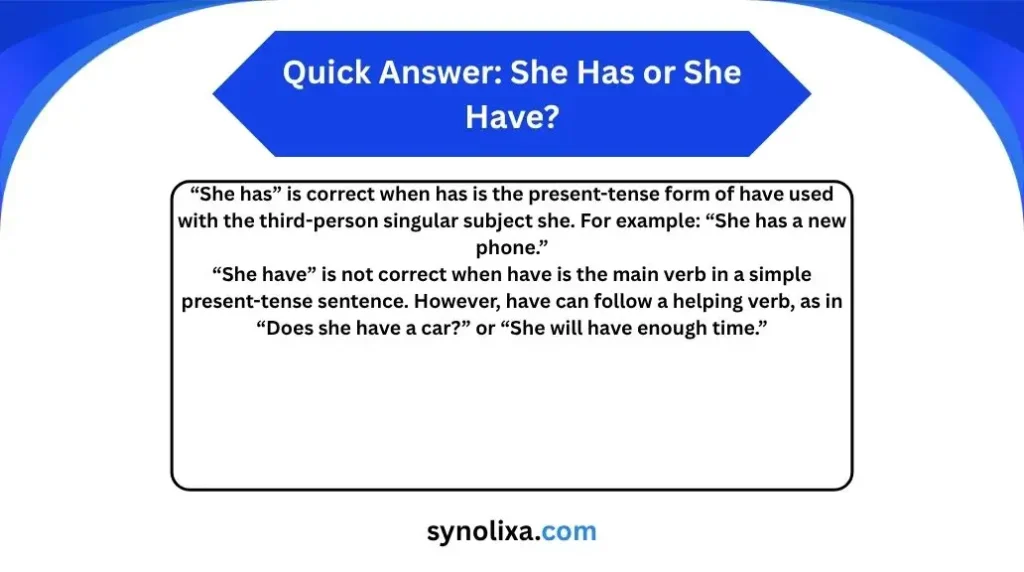
“She has” is correct when has is the present-tense form of have used with the third-person singular subject she. For example: “She has a new phone.”
“She have” is not correct when have is the main verb in a simple present-tense sentence. However, have can follow a helping verb, as in “Does she have a car?” or “She will have enough time.”
Understanding the Basics: She Has or She Have
The main difference between she has and she have is subject-verb agreement.
In the simple present tense, the verb have changes to has when the subject is third-person singular, such as:
- He
- She
- It
- A singular person’s name
- A singular noun
For example:
- She has a dog.
- He has a new job.
- Maria has two brothers.
- The company has a new policy.
With I, you, we, and they, we normally use have:
- I have a question.
- You have a choice.
- We have enough time.
- They have several options.
Comparison Table
| Form | Type | Meaning | Example | Correct/Incorrect |
|---|---|---|---|---|
| She has | Simple present | She possesses, experiences, or is connected to something | She has a car. | ✅ Correct |
| She have | Simple present main verb | Attempts to use the base form with “she” | She have a car. | ❌ Incorrect |
| Does she have? | Question with auxiliary verb | Asks whether she possesses or experiences something | Does she have a car? | ✅ Correct |
| She will have | Future construction | Says she will possess or experience something | She will have more time tomorrow. | ✅ Correct |
| She can have | Modal construction | Says she is able or permitted to have something | She can have some cake. | ✅ Correct |
| She should have | Modal construction | Expresses expectation, advice, or a past-related idea depending on context | She should have enough time. | ✅ Correct |
The key point is simple: “She has” is correct when has is the main verb in a simple present sentence.
But “she have” can appear correctly when another verb controls the grammatical structure.
Correct Meanings and Uses of “She Has”
1. She Has Something
The most common use of she has is to show possession.
Examples:
- She has a new computer.
- She has three sisters.
- She has a blue backpack.
- She has a beautiful house.
Consider:
She has a new computer.
- She = subject
- has = verb
- a new computer = object
Because she is third-person singular, the simple present form is has.
2. She Has a Feeling or Experience
We also use has for experiences, conditions, feelings, or situations.
Examples:
- She has a headache.
- She has a problem.
- She has an idea.
- She has a lot of experience.
- She has a difficult day ahead.
Here, has does not necessarily mean physical ownership. It can describe something that she experiences or possesses in a broader sense.
3. She Has an Obligation
The expression has to is very common.
Examples:
- She has to leave early.
- She has to finish her work.
- She has to study tonight.
- She has to call her manager.
In these sentences, has to expresses necessity or obligation.
Compare:
- She has to work today. ✅
- She have to work today. ❌
However, the form changes when a helping verb is introduced:
- Does she have to work today? ✅
- She will have to work tomorrow. ✅
This is an important pattern.
4. She Has in the Present Perfect
Has is also used as an auxiliary verb in the present perfect tense.
Examples:
- She has finished her homework.
- She has already left.
- She has visited New York.
- She has completed the report.
The structure is:
She + has + past participle
For example:
She has finished the project.
- She = subject
- has = helping verb
- finished = past participle
- the project = object
This is another major reason she has is important in English grammar.
When “She Have” Is Correct
At first glance, she have may look completely wrong. But that is not always true.
The phrase she have can be grammatically correct when have comes after an auxiliary or modal verb.
1. Does She Have?
When forming a simple present question with does, use the base form have.
Correct:
Does she have a car?
Incorrect:
Does she has a car?
Why?
Because does already carries the third-person singular agreement. The main verb returns to its base form.
The pattern is:
Does + she + have + object?
Examples:
- Does she have a passport?
- Does she have a question?
- Does she have enough money?
- Does she have a meeting today?
2. She Will Have
After will, use the base form have.
Examples:
- She will have more time tomorrow.
- She will have a new office.
- She will have another opportunity.
- She will have lunch at noon.
Do not write:
- She will has more time. ❌
The correct form is:
- She will have more time. ✅
3. She Can Have
After modal verbs such as can, the base form have is used.
Examples:
- She can have the last piece.
- She can have another chance.
- She can have some water.
- She can have the document tomorrow.
The modal can is followed by the base form have.
4. She Should Have
The same rule applies after should.
Examples:
- She should have enough time.
- She should have a backup plan.
- She should have the information already.
The construction is:
She + should + have
Not:
She + should + has
5. She May Have and She Might Have
Modal verbs such as may and might are also followed by have.
Examples:
- She may have the answer.
- She may have a different opinion.
- She might have another appointment.
- She might have enough information.
So, the presence of have after she does not automatically make a sentence incorrect. You must look at the complete verb structure.
A Simple Rule to Remember
Here is the easiest way to remember the difference:
She has when “has” is the main present-tense verb.
She have when another helping or modal verb requires the base form “have.”
Compare these examples:
| Sentence | Correct? | Why? |
|---|---|---|
| She has a car. | ✅ | “Has” is the main verb. |
| She have a car. | ❌ | Simple present requires “has.” |
| Does she have a car? | ✅ | “Does” takes the agreement; “have” stays in base form. |
| She will have a car. | ✅ | “Will” takes the base form. |
| She can have a car. | ✅ | “Can” takes the base form. |
| She has bought a car. | ✅ | “Has” forms the present perfect. |
| She has to buy a car. | ✅ | “Has to” expresses obligation. |
| Does she has a car? | ❌ | “Does” should be followed by “have.” |
Test Tip: Use the Helping-Verb Test
When you are unsure, look for another verb before have.
Ask yourself:
Is there a helping or modal verb such as does, will, can, could, should, may, or might?
If yes, have is usually the correct base form.
For example:
- Does she have a ticket? ✅
- Will she have time? ✅
- Can she have another one? ✅
- Should she have more information? ✅
If there is no such helping verb and have is the main verb in a simple present sentence, use has:
- She has a ticket. ✅
- She has time. ✅
- She has another one. ✅
This quick test can prevent many subject-verb agreement mistakes.
Case Study: A Workplace Email
Imagine an employee is writing an email about a meeting.
Incorrect:
“She have a meeting with the client at 2 p.m.”
The corrected version is:
“She has a meeting with the client at 2 p.m.”
Why?
Because has is the main verb in a simple present statement, and she is third-person singular.
Now imagine the employee wants to ask a question:
“Does she have a meeting with the client at 2 p.m.?”
This time, have is correct.
Why?
Because does is the auxiliary verb. The main verb must remain in its base form, have.
This distinction is useful in professional writing because small grammar errors can make otherwise clear messages look less polished.
Grammar Rules: Why “She Has” Is Usually Correct
English verbs often change form depending on the subject.
The verb have is irregular in the present tense. Unlike many regular verbs, its third-person singular form is not created simply by adding -s.
Instead:
- I have
- You have
- We have
- They have
- He has
- She has
- It has
This is called subject-verb agreement.
Standard English grammar uses has with third-person singular subjects in the simple present.
Merriam-Webster’s dictionary and grammar resources distinguish the forms of have, including its present-tense forms. The pronunciation and grammatical treatment of these forms are part of standard English usage.
The important thing to remember is that English does not simply choose a verb form based on the word immediately before it. The entire verb phrase matters.
For example:
She has a book.
Here, has is the main verb.
But:
Does she have a book?
Here, does is the auxiliary verb, so have remains in its base form.
This same principle appears with other verbs:
- She likes coffee.
- Does she like coffee?
Not:
- Does she likes coffee? ❌
The same pattern applies to has/have.
Subject-Verb Agreement in Simple Present Tense
Subject-verb agreement is one of the foundations of English grammar.
Consider this chart:
| Subject | Correct Form |
|---|---|
| I | have |
| You | have |
| We | have |
| They | have |
| He | has |
| She | has |
| It | has |
Examples:
- I have a plan.
- You have a choice.
- We have enough food.
- They have a new teacher.
- He has a new job.
- She has a new job.
- It has a problem.
The pattern is easy once you see it: has is used with third-person singular subjects.
Common Mistakes With “She Has or She Have”
Many learners make mistakes with this pair because have appears in several different grammatical structures.
Mistake 1: “She Have a Car”
Incorrect:
She have a car.
Correct:
She has a car.
The reason is simple: she is third-person singular, and has is required in a simple present statement.
Mistake 2: “Does She Has a Car?”
Incorrect:
Does she has a car?
Correct:
Does she have a car?
Once does appears, use the base form have.
Mistake 3: “She Will Has”
Incorrect:
She will has enough time.
Correct:
She will have enough time.
The modal will is followed by the base form of the verb.
Mistake 4: “She Can Has”
Incorrect:
She can has another one.
Correct:
She can have another one.
Again, can requires the base form.
Why These Mistakes Happen
Fast Typing
When people type quickly, they may write the form that sounds familiar instead of checking the complete sentence.
Autocorrect
Grammar and spelling tools can sometimes suggest changes based on incomplete context. It is better to understand the rule than to rely entirely on automatic corrections.
Lack of Grammar Knowledge
Learners who know that she has is common may still struggle with sentences such as does she have because they have not yet learned how auxiliary verbs affect the main verb.
Speech Habits
In casual conversation, people sometimes speak quickly or reduce sounds. This can make different grammatical forms sound less distinct.
Similar Grammar Confusions
The she has or she have question belongs to a larger group of common English grammar problems.
| Confusion | Correct Forms | Main Rule |
|---|---|---|
| It’s / Its | It’s cold. / The dog wagged its tail. | “It’s” = it is; “its” shows possession |
| Your / You’re | Your book / You’re ready | “You’re” = you are |
| Their / They’re | Their car / They’re here | “They’re” = they are |
| Then / Than | Then we left / Taller than me | Different meanings and functions |
| Affect / Effect | It affected me / The effect was clear | Verb vs. noun in common uses |
| Who’s / Whose | Who’s there? / Whose bag is this? | “Who’s” = who is/who has |
| She has / She have | She has a car | “Has” agrees with she in simple present |
Learning these pairs as patterns rather than isolated words can make English grammar easier.
Usage in Different Contexts
Everyday Conversation
In normal conversation, she has is common.
Examples:
- She has two kids.
- She has a new phone.
- She has a lot of work today.
- She has a doctor’s appointment.
Questions use does:
- Does she have a car?
- Does she have time?
- Does she have your number?
Professional Writing
Professional writing benefits from accurate subject-verb agreement.
Examples:
- She has extensive experience in marketing.
- She has a meeting scheduled for Friday.
- Does she have access to the shared folder?
- She will have the report ready tomorrow.
Correct grammar helps your message look clear and polished.
Creative Writing
Authors may use has in narration:
She has a secret she has never shared.
In dialogue, you may see many forms:
“Does she have the key?”
The grammar still follows standard rules unless the writer intentionally represents a character’s nonstandard speech.
Social Media and Texting
Informal digital communication often contains abbreviations or grammatical shortcuts.
You might see:
- she has no idea 😂
- does she have it?
- she will have to wait
Even when communication is casual, using the correct form can make your meaning easier to understand.
Why It Matters
Correct grammar is not about making every sentence sound overly formal. It is about helping readers understand your meaning quickly.
Using she has correctly matters because it provides:
Clarity
Correct subject-verb agreement makes the sentence easier to process.
Professionalism
In emails, applications, reports, and workplace communication, grammatical accuracy creates a polished impression.
Digital Communication Accuracy
Online messages move quickly. A small grammar mistake can sometimes make a sentence confusing or distract readers from the main point.
Confidence
Understanding the rule means you do not have to stop every time you encounter has or have.
A useful principle is:
Good grammar makes your meaning easier to follow.
Grammar should support communication, not get in its way.
Special Exceptions and Edge Cases
There is no ordinary standard-English situation in which “she have” replaces “she has” as the simple present main verb merely because the subject is she.
However, have can correctly occur after auxiliary or modal verbs.
For example:
- Does she have a passport?
- Will she have enough time?
- Can she have another opportunity?
- Should she have more information?
- Might she have misunderstood?
There can also be nonstandard dialectal varieties of English in which speakers use forms differently. Those patterns are part of linguistic variation, but they do not change the standard US English grammar rule used in formal writing.
Another edge case involves quotations. If a writer is intentionally reproducing someone’s nonstandard speech, a sentence such as “She have a car” could appear as a representation of that speech. In standard edited writing, however, “She has a car” is the expected form.
She Has vs. She Have: Sentence Patterns
Understanding sentence patterns can make the rule much easier.
Pattern 1: Simple Statement
She + has + noun
Examples:
- She has a dog.
- She has a problem.
- She has an idea.
Pattern 2: Simple Question
Does + she + have + noun?
Examples:
- Does she have a dog?
- Does she have a problem?
- Does she have an idea?
Pattern 3: Future
She + will + have + noun
Examples:
- She will have a dog.
- She will have another opportunity.
- She will have enough time.
Pattern 4: Modal Verb
She + modal + have + noun
Examples:
- She can have the seat.
- She may have a question.
- She should have a backup plan.
Pattern 5: Present Perfect
She + has + past participle
Examples:
- She has finished.
- She has arrived.
- She has completed the assignment.
These patterns show why you should examine the whole sentence rather than memorize only one form.
Quick Recap Checklist
Use this checklist whenever you are unsure.
| Question | If Yes → Use |
|---|---|
| Is “have” the main verb in a simple present statement with “she”? | has |
| Is the sentence a simple present question beginning with “does”? | have |
| Does “will” come before the verb? | have |
| Does a modal such as “can” or “should” come before the verb? | have |
| Is “has” helping form the present perfect? | has |
Practice Examples
1. She ___ a new job.
Answer: has
She has a new job.
2. Does she ___ enough time?
Answer: have
Does she have enough time?
3. She will ___ another opportunity.
Answer: have
She will have another opportunity.
The key is not simply to look at she. Look at the entire verb phrase.
More Examples of “She Has”
Here are additional examples to reinforce the rule:
- She has a beautiful voice.
- She has three appointments today.
- She has an important question.
- She has enough experience.
- She has a strong reason.
- She has a new assignment.
- She has two tickets.
- She has a good opportunity.
- She has a meeting tomorrow.
- She has plenty of time.
Each sentence uses has because it is a simple present construction with she.
More Examples of “She Have”
Remember that she have normally does not stand alone as a simple present statement. Instead, it appears within structures containing an auxiliary or modal.
Examples:
- Does she have a passport?
- Does she have a reservation?
- Will she have enough time?
- Can she have another chance?
- Could she have the answer?
- Should she have more information?
- May she have a moment?
- Might she have forgotten?
These examples are grammatically correct because the words does, will, can, could, should, may, and might determine the form that follows.
How to Remember the Difference Easily
Try this simple memory trick:
“She has” = direct statement
Think:
She has something.
Examples:
- She has a book.
- She has a car.
- She has time.
“She have” = usually follows a helper
Think:
Does she have…?
Will she have…?
Can she have…?
Should she have…?
This pattern is much easier to remember than memorizing dozens of separate sentences.
FAQs
1. Is “she has” grammatically correct?
Yes. “She has” is the standard form when has is the main verb in a simple present sentence.
Example: She has a new phone.
2. Is “she have” grammatically correct?
Not as the main verb in a standard simple present statement. However, have can correctly follow an auxiliary or modal verb.
Examples:
- Does she have a car?
- She will have a car.
- She can have a car.
3. Which is correct: “She has a car” or “She have a car”?
“She has a car” is correct in standard US English.
The subject she is third-person singular, so the simple present form is has.
4. Why do we say “Does she have” instead of “Does she has”?
Because does is the auxiliary verb carrying the third-person singular form. The main verb therefore stays in its base form: have.
Correct:
Does she have a car?
Incorrect:
Does she has a car?
5. Can “she have” ever be correct?
Yes. It can be correct when another auxiliary or modal verb comes before have.
Examples include:
- Does she have…?
- Will she have…?
- Can she have…?
- Should she have…?
6. Should I use “has” after “will”?
No. After will, use the base form have.
Correct:
She will have enough time.
Incorrect:
She will has enough time.
Conclusion
The difference between she has or she have becomes much easier once you understand subject-verb agreement and auxiliary verbs.
Use “she has” when has is the main verb in a simple present statement:
- She has a car.
- She has a question.
- She has enough time.
Use “have” after helping or modal verbs that require the base form:
- Does she have a car?
- Will she have enough time?
- Can she have another chance?
- Should she have more information?
The most important point is that she does not always require “has.” The grammatical structure determines the correct form. If she is directly followed by the main verb in a simple present statement, choose has. If an auxiliary or modal verb comes first, have may be required.
Remember this simple rule: She has in a direct present statement; she can have, will have, or does have in supporting structures. Once you recognize the pattern, choosing between has and have becomes quick and natural.

Hi, I am Ava Mitchell. I work at Synolixa as an English content writer, creating simple and useful resources about synonyms, vocabulary, and English usage.
[…] choosing between spatter or splatter depends on the context and the effect you want to communicate. She Has or She Have | Leapt or Leaped | Cartel vs […]