Cartel vs mafia is a common point of confusion because both terms can appear in discussions about organized crime, movies, books, news reports, and everyday conversations. 🤔 Although they are sometimes used loosely as if they mean the same thing, cartel and mafia have different meanings and uses. The word cartel can describe a group or agreement involving separate parties, including businesses that coordinate their activities. In criminal contexts, it can also describe an organized criminal group. The word Mafia, however, has a stronger connection to organized crime and is especially associated with the historical Sicilian Mafia and related criminal organizations.
Understanding cartel vs mafia becomes easier when you focus on context. A cartel generally emphasizes cooperation, coordination, or collective action, while Mafia generally refers to an organized criminal group or tradition. However, the terms can overlap in crime-related discussions, so choosing the right word requires attention to what you are actually describing.
This guide explains the difference between cartel vs mafia, including their meanings, examples, grammar, common mistakes, contextual uses, and practical tips for choosing the correct term in US English. My Father and I or My Father and Me | Giving or Given | Who to Contact or Whom to Contact
Quick Answer: Cartel vs Mafia
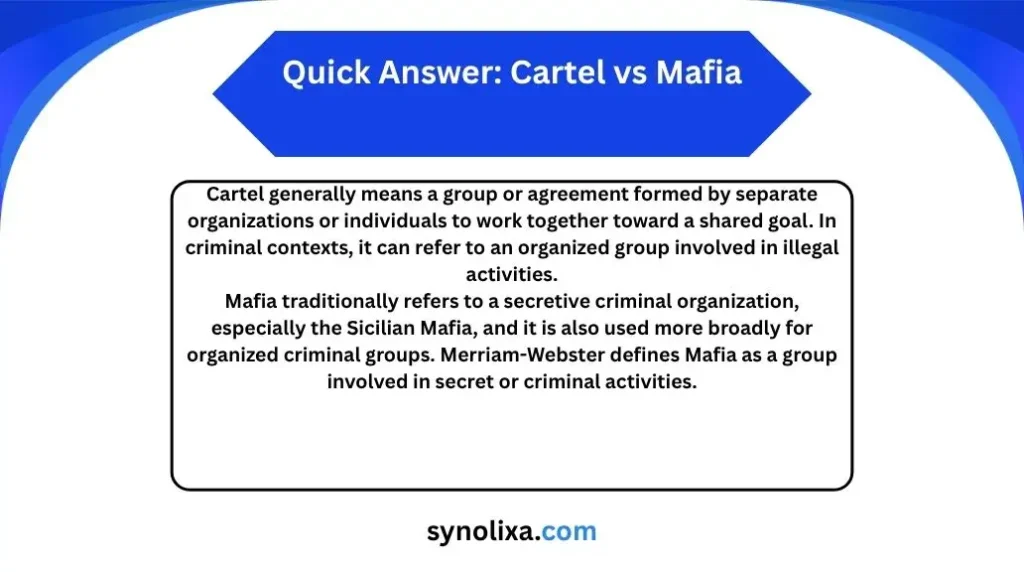
Cartel generally means a group or agreement formed by separate organizations or individuals to work together toward a shared goal. In criminal contexts, it can refer to an organized group involved in illegal activities.
Mafia traditionally refers to a secretive criminal organization, especially the Sicilian Mafia, and it is also used more broadly for organized criminal groups. Merriam-Webster defines Mafia as a group involved in secret or criminal activities.
So, while a cartel can be criminal, cartel and mafia are not interchangeable in every situation.
Understanding the Basics: Cartel vs Mafia
The easiest way to understand cartel vs mafia is to look at their basic meanings.
A cartel focuses on cooperation or coordination among separate parties. In economics, for example, a cartel can involve independent businesses working together to restrict competition or influence prices. The term can also be used for political groups or, in modern crime-related contexts, organized criminal groups.
A mafia generally refers to an organized criminal group characterized by secrecy, internal organization, and illegal activities. The term has historical roots in Sicily and is also used for related organized-crime traditions and groups elsewhere.
Cartel vs Mafia Comparison Table
| Form | Type | Meaning | Example | Correct/Incorrect |
|---|---|---|---|---|
| cartel | Noun | A group or agreement involving cooperation among separate parties | “The companies formed a cartel.” | Correct |
| cartel | Noun | An organized criminal group in certain contexts | “Authorities investigated the criminal cartel.” | Correct |
| mafia | Noun | A secretive or organized criminal group | “The investigation involved the Mafia.” | Correct |
| mafia | Noun | A particular organized-crime tradition or organization | “The Sicilian Mafia has a long history.” | Correct |
| cartel for every criminal group | Noun | Using cartel as a universal synonym for mafia | “Every organized crime group is a cartel.” | Incorrect |
| mafia for every cartel | Noun | Using mafia for every cooperative or criminal cartel | “The business cartel is a mafia.” | Incorrect |
The Core Difference
A useful shortcut is:
Cartel = coordinated group or agreement.
Mafia = organized criminal group or tradition.
This is a general distinction rather than an absolute rule. Context matters because cartel has several meanings.
For example:
- “The companies were accused of forming a cartel.”
- “The investigation focused on the Mafia.”
The first sentence describes coordinated activity between businesses. The second identifies an organized criminal group.
What Does “Cartel” Mean?
The noun cartel has more than one meaning.
In one common sense, a cartel is an arrangement involving independent businesses that cooperate in ways that can reduce competition. Merriam-Webster’s definition includes a combination of independent commercial or industrial enterprises designed to limit competition or fix prices.
The word can also appear in political and historical contexts. In modern reporting, however, many readers associate cartel with organized criminal groups.
Cartel in Business
Consider this example:
“Several companies were accused of forming a cartel.”
Here, cartel refers to businesses coordinating with one another rather than competing normally.
Sentence breakdown:
- Several companies = subject
- were accused = passive verb phrase
- of forming = prepositional phrase with a gerund
- a cartel = noun phrase
The word is grammatically a countable noun in this use.
You can therefore say:
- “a cartel”
- “the cartel”
- “several cartels”
- “cartel members”
Cartel in Criminal Contexts
In crime-related writing, cartel can refer to a structured criminal organization.
For example:
“The documentary discusses the history of a criminal cartel.”
Here, the word does not refer to businesses. The surrounding context makes its meaning clear.
This is why you should not assume that cartel always means business agreement or that it always means criminal organization.
What Does “Mafia” Mean?
Mafia is a noun associated with organized criminal activity. Merriam-Webster lists it as a group involved in secret or criminal activities.
The word is strongly associated with the historical Sicilian Mafia, although English usage has expanded beyond that specific organization.
Mafia as a Historical Term
The word Mafia has a long historical association with Sicily and organized criminal networks. The term later became widely used in English-language discussions of organized crime.
This historical background matters because mafia is not simply another word for any group of criminals.
Mafia in Modern Usage
Today, English speakers may use mafia in several ways.
For example:
“The investigation examined alleged Mafia activity.”
In this sentence, Mafia refers broadly to organized criminal activity associated with a Mafia organization or tradition.
You may also encounter the lowercase form mafia when the word is being used generically rather than as the name of a particular organization.
For example:
“The novel features a fictional mafia.”
Capitalization can therefore depend on whether the writer is referring to a specific named organization or using the word generically.
Cartel vs Mafia: Are They Synonyms?
No. Cartel and mafia can overlap in criminal contexts, but they are not exact synonyms.
A cartel may describe an agreement or coordinated group. A mafia generally refers to an organized criminal group or a broader Mafia tradition.
Think of the relationship this way:
Cartel
→ can be commercial
→ can be political
→ can be criminal
→ usually emphasizes coordination or collective action
Mafia
→ primarily associated with organized crime
→ has strong historical ties to Sicily and Italy
→ can refer to related criminal organizations or traditions
→ emphasizes organized criminal activity
This distinction helps prevent overgeneralization.
Examples of Cartel vs Mafia in Sentences
Examples are one of the easiest ways to understand the difference.
Example 1: Business
“The companies were investigated for allegedly forming a cartel.”
Here, cartel is appropriate because the sentence concerns companies coordinating with one another.
Example 2: Organized Crime
“The book describes the history of the Mafia.”
Here, Mafia is appropriate because the subject is an organized criminal tradition.
Example 3: Criminal Organization
“The report discusses a criminal cartel.”
Here, cartel is appropriate because the writer is specifically using the term for an organized criminal group.
Example 4: Fiction
“The detective investigates a fictional Mafia family.”
Here, Mafia works because the fictional group is modeled on the organized-crime tradition associated with the term.
Example 5: General Cooperation
“Several independent businesses created a cartel.”
Again, cartel is the better word because the sentence describes cooperation between independent businesses.
Test Tip: How to Choose the Right Word
When you are unsure about cartel vs mafia, ask yourself:
What exactly am I describing?
If you mean a coordinated group or agreement between separate parties, cartel may be appropriate.
If you mean a secretive organized criminal group or the Mafia tradition, mafia may be appropriate.
Try replacing the word with a simple explanation.
- If you mean “a coordinated group or agreement”, consider cartel.
- If you mean “an organized criminal group”, consider mafia.
- If you mean “a criminal cartel”, cartel may still be correct.
- If you mean a specific Mafia organization or tradition, use Mafia where appropriate.
The surrounding sentence should determine the choice.
Case Study: Using Cartel vs Mafia in Real Communication
Imagine someone writes this sentence in a workplace report:
“The company was investigated for participating in a mafia.”
This wording creates a problem. If the writer means that several independent companies allegedly coordinated to restrict competition, cartel would be the more precise word.
A clearer version would be:
“The company was investigated for allegedly participating in a cartel.”
Now imagine a history assignment:
“The article examines the development of the cartel in Sicily.”
If the subject is the historical Sicilian organized-crime tradition, Mafia is likely the intended term.
A clearer version could be:
“The article examines the development of the Sicilian Mafia.”
Why Context Matters
The two sentences involve different concepts:
- Business coordination → cartel
- Sicilian organized-crime tradition → Mafia
The mistake is not mainly about verb agreement or punctuation. It is a word-choice problem.
That distinction is important for anyone writing reports, essays, articles, or online content.
Grammar Rules Explanation
From a grammar perspective, cartel and mafia are both nouns.
They can function as:
- subjects
- direct objects
- objects of prepositions
- complements within noun phrases
For example:
“The cartel expanded.”
Cartel is the subject.
“Authorities investigated the cartel.”
Cartel is the direct object.
“The report discusses the Mafia.”
Mafia is the direct object.
Singular and Plural Forms
The singular form is straightforward:
- a cartel
- a mafia
The plural forms are generally:
- cartels
- mafias
However, Mafia is often used as a collective or proper-style term, depending on the intended reference. In many contexts, writers simply refer to “the Mafia” rather than treating it like an ordinary count noun.
Examples:
“Several cartels operate in the region.”
“The history book discusses the Mafia.”
Capitalization
Capitalization is another area that can cause confusion.
When Mafia refers to a specific organization or established tradition, capitalization is common:
“The Sicilian Mafia has been studied extensively.”
When mafia is used generically, lowercase may be appropriate:
“The novel portrays a fictional mafia.”
The exact capitalization can depend on the style guide and intended meaning.
What Merriam-Webster Tells Us
Merriam-Webster’s current entry describes Mafia as a noun for a group involved in secret or criminal activities.
For cartel, dictionary definitions include commercial combinations designed to limit competition or fix prices, as well as other forms of organized cooperation.
This supports the central distinction: the words have overlapping associations in some contexts, but their dictionary meanings are broader and different.
Common Mistakes With Cartel vs Mafia
People often confuse these words because movies, television, social media, and news coverage may use them in similar discussions.
Mistake 1: Treating Them as Perfect Synonyms
Incorrect assumption:
“Cartel and mafia always mean exactly the same thing.”
They do not.
A cartel can be a business arrangement. Mafia has a much stronger association with organized crime.
Mistake 2: Calling Every Business Cartel a Mafia
A group of businesses accused of coordinating prices is not automatically a “mafia.”
The word cartel describes the relevant type of business coordination.
Mistake 3: Calling Every Organized Crime Group a Cartel
Not every organized criminal organization is properly described as a cartel.
The specific organization, structure, activities, and context matter.
Mistake 4: Ignoring Capitalization
Writers sometimes use Mafia and mafia without considering whether they are naming a specific tradition or using a generic noun.
Mistake 5: Assuming Movies Are Grammar Authorities
Popular entertainment often uses dramatic or simplified terminology. A fictional character may use cartel, mob, gang, and Mafia loosely.
That does not mean the words have identical dictionary meanings.
Similar Word Confusions
The confusion between cartel vs mafia is part of a larger problem in English: related words are not always interchangeable.
| Confusing Terms | Main Difference |
|---|---|
| cartel vs mafia | A cartel can be a coordinated group or agreement; Mafia refers primarily to organized criminal groups or traditions |
| gang vs group | A gang can imply an organized group, often with criminal associations; group is much broader |
| mob vs crowd | Mob can refer to a disorderly crowd or organized criminals; crowd is broader |
| organization vs association | Organization is broad; association often emphasizes people joining for a shared purpose |
| criminal vs illegal | Criminal relates to crime; illegal means against the law |
| its vs it’s | Its shows possession; it’s means it is or it has |
| your vs you’re | Your shows possession; you’re means you are |
| their vs they’re | Their shows possession; they’re means they are |
| affect vs effect | Usually, affect is a verb and effect is a noun, though both have additional uses |
Why These Mistakes Happen
Common causes include:
- Fast typing: People choose the first familiar word.
- Autocorrect: Software may replace an intended word with another familiar word.
- Lack of knowledge: A writer may know that two words are related but not understand their exact differences.
- Popular media: Movies and television sometimes blur distinctions for storytelling.
- Context changes: A word such as cartel can have different meanings in different subjects.
Cartel vs Mafia in Everyday Conversation
In casual conversation, people often use these terms informally.
For example:
“That sounds like a cartel.”
A speaker might use cartel to describe a group coordinating for an unfair advantage.
Similarly:
“The movie is about the Mafia.”
Here, Mafia identifies the organized-crime setting of the story.
In everyday speech, people may not always maintain precise distinctions. However, if you are writing an article, school assignment, report, or professional document, choosing the more precise term improves clarity.
Cartel vs Mafia in Professional Writing
Professional writing requires careful word choice.
Suppose you are writing a report about competition law:
“The investigation concerns allegations that several companies formed a cartel.”
This is precise because the subject is business coordination.
Now consider a historical report:
“The paper examines the development of the Sicilian Mafia.”
Again, the terminology matches the subject.
Professional Writing Tip
Do not choose a word simply because it sounds stronger.
Instead:
- Identify the subject.
- Identify the relationship between the people or organizations.
- Check the exact meaning.
- Choose the narrowest accurate term.
- Keep the terminology consistent throughout the document.
This approach makes your writing more professional.
Cartel vs Mafia in Creative Writing
Creative writers have more flexibility, but word choice still matters.
A crime novel might use:
“The fictional Mafia family controlled the neighborhood.”
Another story might say:
“The rival cartels competed for influence.”
These choices create different associations for readers.
Mafia can evoke a family-based or traditional organized-crime setting.
Cartel can suggest a coordinated criminal organization, particularly in modern crime fiction.
Writers should still avoid assuming that the two terms are universally identical.
Cartel vs Mafia in Social Media and Texting
Social media often favors short language.
Someone might write:
“This movie is about a Mafia family.”
Or:
“The documentary explores a cartel.”
Because social media posts are short, context may be limited. That makes accurate word choice even more important.
If your audience might misunderstand the term, add a few words of clarification.
For example:
“The documentary examines a cartel, a criminal organization involved in illegal trade.”
That small explanation can prevent confusion.
Why the Difference Matters
Understanding cartel vs mafia matters because precise language improves communication. 📝
1. Clarity
Using the correct word helps readers understand exactly what you mean.
2. Professionalism
Accurate terminology makes reports, essays, and articles sound more credible.
3. Better Digital Communication
Online writing spreads quickly. A vague or inaccurate term can easily be repeated by other readers.
4. Better Search Intent
When writing online content, using the correct terminology helps search engines and readers understand the topic.
5. Fewer Misunderstandings
A precise word reduces the chance that your reader will interpret your sentence differently from what you intended.
A useful writing principle is:
“Choose the word that says exactly what you mean.”
This principle applies far beyond cartel and mafia.
Special Exception and Edge Cases
The biggest exception to a simple cartel vs mafia rule is that cartel has meanings outside organized crime.
For example, an economic cartel can involve independent businesses coordinating their activities. Merriam-Webster specifically includes this commercial sense in its definition.
Therefore, it would be incorrect to say:
“A cartel always means a criminal organization.”
It does not.
Likewise, Mafia does not simply mean “any group of criminals.” The word carries specific historical and cultural associations.
Another edge case is fictional or informal usage. Writers sometimes use mafia metaphorically for a powerful or exclusive group, such as a “Hollywood mafia.” In such cases, the word may be used figuratively rather than literally to describe organized crime.
Context is therefore essential.
Is “Cartel” a Grammar Word or a Vocabulary Word?
This question is useful because the topic may appear on grammar websites.
Strictly speaking, cartel vs mafia is mainly a vocabulary and word-choice comparison, not a traditional grammar problem like your vs you’re or who vs whom.
Both cartel and mafia are nouns. The important issue is understanding what each noun means and when it is appropriate.
So if you are searching for cartel vs mafia, you are really asking:
“Which word accurately describes the group or situation I mean?”
That is a vocabulary question involving context and usage.
Quick Recap Checklist
Use this checklist whenever you are unsure about cartel vs mafia.
| Question | If Yes → Use |
|---|---|
| Am I describing coordinated independent businesses? | Cartel |
| Am I describing a group or agreement formed for collective action? | Cartel |
| Am I describing a criminal organization specifically called a cartel? | Cartel |
| Am I referring to the Sicilian Mafia or a related organized-crime tradition? | Mafia |
| Am I referring generally to a secretive organized criminal group in a context where Mafia is the established term? | Mafia |
| Am I using the word metaphorically for a powerful or exclusive group? | Mafia may be possible, depending on context |
Practice Examples
1. “Several companies were accused of fixing prices together.”
Answer: cartel
“Several companies were accused of forming a cartel.”
2. “The history book discusses organized crime in Sicily.”
Answer: Mafia
“The history book discusses the Sicilian Mafia.”
3. “The documentary examines a criminal organization referred to by authorities as a cartel.”
Answer: cartel
“The documentary examines the cartel.”
FAQs
1. What is the main difference between cartel and mafia?
A cartel is generally a group or agreement involving coordinated action among separate parties, while Mafia primarily refers to an organized criminal group or Mafia tradition. A cartel can exist in commercial contexts, so the two words are not exact synonyms.
2. Is a cartel the same as a mafia?
No. The terms can overlap in discussions of organized crime, but they have different meanings. Cartel can refer to commercial or criminal cooperation, while Mafia has a stronger and more specific association with organized crime.
3. Can a cartel be legal?
The answer depends on the type of cartel and the jurisdiction. The word itself does not automatically mean “criminal.” In economics, it commonly describes independent businesses coordinating in ways that can restrict competition. Whether a particular arrangement is lawful depends on applicable law.
4. Is Mafia always capitalized?
Not always. Mafia is commonly capitalized when referring to a specific organization or the established Mafia tradition. Lowercase mafia may be used generically or metaphorically. Follow the style guide and context relevant to your writing.
5. Is cartel a noun?
Yes. Cartel is a noun.
Examples include:
- “The cartel was investigated.”
- “Several cartels were identified.”
- “The companies formed a cartel.”
6. Is mafia a noun?
Yes. Mafia is a noun.
For example:
“The novel is about the Mafia.”
It can function as the subject or object of a sentence.
Conclusion
The easiest way to remember cartel vs mafia is to focus on meaning rather than appearance. Cartel is a broader word for a coordinated group or agreement and can be used in business, political, historical, or criminal contexts. Mafia has a much stronger connection to organized crime and the historical Mafia tradition associated with Sicily.
Neither word should automatically replace the other. If you are describing coordinated businesses, cartel may be the appropriate term. If you are discussing the Sicilian Mafia or a related organized-crime tradition, Mafia is more precise. In criminal contexts, cartel can also be correct when it accurately describes the organization being discussed.
The key is simple: look at the context, identify exactly what you mean, and choose the word that matches it. ✨
When your word choice is precise, your writing becomes clearer, stronger, and easier to understand.

Hi, I am Ethan Parker. I work at Synolixa as a grammar and writing specialist, helping readers understand English grammar and improve their writing skills.
[…] excitement, knowing when and why each form is used makes your writing clearer and more natural. Cartel vs Mafia | My Father and I or My Father and Me | Giving or […]