Have you ever seen the words prescribe vs proscribe and wondered why two words that look and sound so similar can have almost opposite meanings? You are not alone. These words are easy to mix up because both begin with pro-, end with -scribe, and are often used in formal writing. However, choosing the wrong one can completely change the meaning of a sentence.
The key difference is simple: prescribe generally means to recommend, direct, or officially order something, while proscribe means to forbid or officially ban something. A doctor may prescribe medicine, while an organization may proscribe a certain behavior.
Understanding prescribe vs proscribe is especially useful in professional, medical, legal, academic, and formal writing. The words are not interchangeable, even though they look almost identical.
In this guide, we will explain the difference between prescribe and proscribe in simple US English. You will learn their meanings, examples, grammar rules, common mistakes, pronunciation, related forms, and easy memory tricks so you can use each word correctly and confidently. ✍️ Separate vs Seperate | Spatter or Splatter | She Has or She Have
Quick Answer: Prescribe vs Proscribe
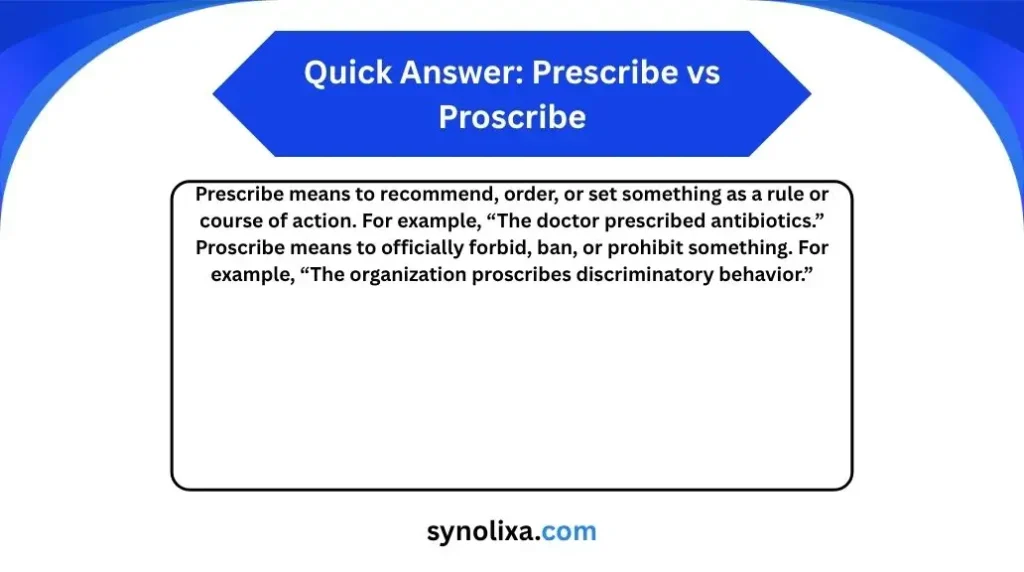
Prescribe means to recommend, order, or set something as a rule or course of action. For example, “The doctor prescribed antibiotics.”
Proscribe means to officially forbid, ban, or prohibit something. For example, “The organization proscribes discriminatory behavior.”
The easiest rule to remember:
Prescribe = tell someone what to do.
Proscribe = tell someone what not to do.
So, if something is recommended or ordered, use prescribe. If something is prohibited or banned, use proscribe.
Understanding the Basics: Prescribe vs Proscribe
The biggest difference between these words is their direction of meaning.
Prescribe usually points toward something that should be done, used, followed, or adopted.
Proscribe points toward something that should not be done, used, or accepted.
Merriam-Webster treats proscribe as a verb associated with forbidding or banning, while prescribe is associated with directing or establishing something as a rule or course of action. These meanings explain why the two words should not be treated as interchangeable.
Comparison Table
| Form | Type | Meaning | Example | Correct/Incorrect |
|---|---|---|---|---|
| Prescribe | Verb | To recommend, direct, or order | The doctor prescribed medication. | Correct |
| Proscribe | Verb | To forbid or ban | The school proscribes cheating. | Correct |
| Prescribed | Past tense/past participle | Recommended or officially ordered | The treatment was prescribed by a doctor. | Correct |
| Proscribed | Past tense/past participle | Forbidden or banned | The activity was proscribed by the organization. | Correct |
| Prescription | Noun | An order or recommendation, especially for medicine | She received a prescription. | Correct |
| Proscription | Noun | An official prohibition or ban | The law imposed a proscription on the practice. | Correct |
In one sentence
- Prescribe: “Do this.”
- Proscribe: “Do not do this.”
That simple contrast solves most usage questions.
Correct Meanings and Uses of Prescribe
1. Prescribe means to order medical treatment
The most familiar use of prescribe appears in medicine.
A doctor can prescribe:
- Medicine
- Treatment
- A dosage
- Rest
- Physical therapy
- A specific medical routine
For example:
The doctor prescribed a new medication.
Here, prescribed means that the doctor officially instructed the patient to use the medication.
Another example:
The doctor prescribed two weeks of physical therapy.
The doctor is recommending or ordering a particular course of treatment.
2. Prescribe means to recommend a course of action
The word is not limited to medicine.
For example:
The consultant prescribed a simple solution to the problem.
Here, prescribed means recommended or proposed.
Another example:
The guide prescribes several steps for improving workplace communication.
The guide establishes or recommends what people should do.
3. Prescribe can mean to establish a rule
Prescribe can also refer to officially setting a requirement or procedure.
For example:
The policy prescribes specific procedures for handling customer complaints.
The policy tells employees which procedures they should follow.
Another example:
The regulations prescribe safety standards for the equipment.
The regulations establish the standards that must be followed.
Sentence Breakdown
Consider:
The doctor prescribed a new treatment.
- The doctor = subject
- prescribed = verb
- a new treatment = object
The meaning is that the doctor recommended or ordered the treatment.
More Examples of Prescribe
- The physician prescribed a different treatment.
- The therapist prescribed several exercises.
- The law prescribes certain reporting procedures.
- The instructor prescribed additional reading.
- The doctor prescribed rest and regular checkups.
- The rules prescribe how applications must be submitted.
In each example, prescribe points toward something being recommended, ordered, or established.
Correct Meanings and Uses of Proscribe
1. Proscribe means to forbid
Proscribe means to officially prohibit or ban something.
For example:
The organization proscribes discriminatory behavior.
This means the organization officially forbids discriminatory behavior.
Another example:
The rules proscribe the use of unauthorized materials.
The rules prohibit those materials.
2. Proscribe is common in formal writing
You are more likely to encounter proscribe in formal, legal, academic, institutional, or policy-related writing than in casual conversation.
For example:
The regulations proscribe certain forms of conduct.
This means the regulations prohibit those forms of conduct.
In everyday conversation, people would usually say:
The regulations ban certain forms of conduct.
Both communicate the basic idea, but proscribe has a more formal tone.
3. Proscribe does not mean recommend
This is the critical distinction.
If a policy says:
The policy proscribes smoking in the building.
It means smoking is forbidden.
If you write:
The policy prescribes smoking in the building.
you have reversed the intended meaning. The sentence now suggests that smoking is required or recommended.
Sentence Breakdown
Consider:
The organization proscribed the practice.
- The organization = subject
- proscribed = verb
- the practice = object
The verb tells us that the organization officially prohibited the practice.
More Examples of Proscribe
- The law proscribes certain activities.
- The school proscribes cheating during examinations.
- The organization proscribes discriminatory conduct.
- The regulations proscribe unsafe procedures.
- The policy proscribes unauthorized access.
- The agreement proscribes the use of certain materials.
Prescribe vs Proscribe: A Simple Memory Trick
The similarity between the words makes memorization difficult, so use this shortcut:
💡 Think “PRESCRIPTION”
A prescription tells you what to take or do.
Therefore:
Prescribe = recommend or order.
🚫 Think “PROHIBIT”
Proscribe is associated with prohibition.
Therefore:
Proscribe = forbid or ban.
Another useful memory sentence is:
Doctors prescribe; rules can proscribe.
A doctor may prescribe medicine.
A rule may proscribe a behavior.
This is not an absolute rule for every context, but it is an excellent memory aid.
Test Tip: How to Choose the Correct Word
When you are unsure whether to use prescribe or proscribe, replace the word with a simpler verb.
Ask:
Does the sentence mean “recommend,” “order,” or “set a rule”?
If yes, use prescribe.
Does the sentence mean “ban,” “forbid,” or “prohibit”?
If yes, use proscribe.
Example
The regulation ______ the use of personal devices.
Try the replacements:
- The regulation recommends the use of personal devices.
- The regulation prohibits the use of personal devices.
If the intended meaning is “prohibits,” the correct word is:
The regulation proscribes the use of personal devices.
This substitution test is one of the easiest ways to avoid the mistake.
Case Study: Prescribe vs Proscribe in the Workplace
Imagine an employee receives an email from a company manager.
The email says:
“Our updated workplace policy prescribes a standard procedure for reporting safety concerns.”
Here, prescribes is correct because the policy establishes what employees should do.
Now imagine a second sentence:
“The same policy proscribes retaliation against employees who report safety concerns.”
Here, proscribes is correct because the policy prohibits a particular behavior.
Why both words can appear in the same document
A single policy can prescribe some actions and proscribe others.
For example:
The policy prescribes regular safety inspections and proscribes the use of unauthorized equipment.
The first part establishes what employees should do.
The second part identifies what employees must not do.
This example demonstrates the central difference perfectly.
Grammar Rules for Prescribe vs Proscribe
Both prescribe and proscribe are verbs.
They can be used in several grammatical forms.
Prescribe
| Form | Example |
|---|---|
| Present | The doctor prescribes treatment. |
| Third-person singular | She prescribes medication. |
| Present participle | The doctor is prescribing a new treatment. |
| Past tense | The doctor prescribed the medicine. |
| Past participle | The medicine was prescribed by the doctor. |
Proscribe
| Form | Example |
|---|---|
| Present | The policy proscribes certain behavior. |
| Third-person singular | The rule proscribes unauthorized access. |
| Present participle | The organization is proscribing the practice. |
| Past tense | The organization proscribed the practice. |
| Past participle | The practice was proscribed by the organization. |
The difference is semantic rather than grammatical.
Both words function as verbs, but their meanings point in different directions.
What Merriam-Webster Shows
Merriam-Webster’s usage information places proscribe among words associated with prohibiting, forbidding, and banning. Its thesaurus also lists prescribe among words connected with directing or ordering.
This supports the practical distinction:
- Prescribe → direct or establish
- Proscribe → prohibit or ban
The words are related historically and visually, but their modern meanings differ significantly.
Common Mistakes With Prescribe vs Proscribe
Mistake 1: Using prescribe when you mean ban
Incorrect:
The company prescribed the use of unauthorized software.
If the company does not allow unauthorized software, the correct sentence is:
The company proscribed the use of unauthorized software.
Mistake 2: Using proscribe when you mean recommend
Incorrect:
The doctor proscribed a new treatment.
If the doctor recommended the treatment, use:
The doctor prescribed a new treatment.
Mistake 3: Assuming similar spelling means similar meaning
The words look almost identical:
- prescribe
- proscribe
But their meanings are different.
This is a common problem with English vocabulary. Words can share letters, sounds, or historical roots without being interchangeable.
Why These Mistakes Happen
Fast typing
When people type quickly, they may select the familiar-looking word without checking its meaning.
Autocorrect
Autocorrect can sometimes encourage a familiar spelling even when the writer intended a less common word.
Lack of vocabulary knowledge
Because proscribe is less common in everyday speech, some writers may recognize it but not know exactly what it means.
Similar pronunciation
The words are pronounced similarly enough that hearing them in conversation does not always make the distinction obvious.
Confusion with “prescription”
People commonly connect prescribe with doctors and medicine, which makes its meaning easier to remember. Proscribe is less familiar, so it is more likely to be misused.
Similar Grammar Confusions
English contains many pairs that look or sound similar but have different meanings.
| Confusing Pair | Correct Difference |
|---|---|
| It’s / Its | It’s = it is; its = possessive |
| Your / You’re | Your = possessive; you’re = you are |
| Their / There / They’re | Possession / place / they are |
| Affect / Effect | Usually verb / usually noun |
| Accept / Except | Receive or agree / excluding |
| Advice / Advise | Noun / verb |
| Principal / Principle | Person or main / rule or belief |
| Prescribe / Proscribe | Recommend or order / forbid or ban |
The lesson is simple: similar-looking words should always be checked by meaning, not spelling alone.
Prescribe vs Proscribe in Everyday Conversation
In casual conversation, prescribe is much more common than proscribe.
You might say:
My doctor prescribed a new medicine.
You could also say:
The teacher prescribed a specific reading schedule.
However, instead of proscribe, everyday speakers usually use words such as:
- Ban
- Forbid
- Prohibit
- Disallow
- Prevent
For example:
Formal:
The rules proscribe outside food.
More conversational:
The rules prohibit outside food.
Both communicate the same basic idea.
Why “proscribe” sounds formal
The word often appears in institutional or legal contexts. As a result, it can sound more formal than ban or forbid.
That does not make it incorrect in everyday writing. It simply means that the surrounding context matters.
Prescribe vs Proscribe in Professional Writing
These words can be especially useful in professional communication because they distinguish requirements from restrictions.
Prescribe in professional writing
The procedure prescribes a three-step review process.
Meaning: the procedure establishes the process that should be followed.
Proscribe in professional writing
The policy proscribes the disclosure of confidential information.
Meaning: the policy prohibits the disclosure.
Professional writing tip
If your audience may not be familiar with proscribe, consider using prohibit or ban instead.
For example:
The policy prohibits unauthorized disclosure.
This is often clearer than:
The policy proscribes unauthorized disclosure.
The second sentence is grammatically correct, but the first may be easier for a general audience.
Prescribe vs Proscribe in Creative Writing
Creative writers can use both words to create a formal or authoritative tone.
For example:
The old code prescribed strict rituals for every ceremony.
Here, prescribed helps create the sense of an established tradition.
Another example:
The kingdom proscribed the forbidden practice.
Here, proscribed emphasizes prohibition.
Writers should choose based on meaning rather than sound.
If the sentence describes what characters are required or encouraged to do, prescribe may fit.
If the sentence describes what authorities forbid, proscribe may fit.
Prescribe vs Proscribe in Social Media and Texting
Social media usually favors simpler vocabulary.
Instead of:
The platform proscribes certain types of behavior.
A casual post might say:
The platform bans certain behavior.
Likewise, instead of:
The rules prescribe a specific procedure.
A casual writer might say:
The rules tell you what to do.
However, prescribe and proscribe remain useful when writing educational posts, professional content, policy explanations, or informational articles.
Quick social media tip
If your audience may misunderstand proscribe, use prohibit or ban.
Clear communication is usually more important than using a sophisticated word.
Why Prescribe vs Proscribe Matters
Using the correct word matters because the two words can point in opposite directions.
Imagine a workplace notice that says:
“The company prescribes the use of personal devices during confidential meetings.”
That sentence suggests the company requires or recommends their use.
Now change one word:
“The company proscribes the use of personal devices during confidential meetings.”
Now the meaning is that the company prohibits their use.
That is a major difference.
1. Clarity in communication
Correct word choice helps readers understand exactly what is expected or prohibited.
2. Professionalism
Accurate vocabulary makes formal writing clearer and more reliable.
3. Digital communication
Emails, policies, websites, and social posts can be read quickly. A single incorrect word can change the meaning of a sentence.
4. Legal and policy writing
In formal documents, distinctions between recommendation, requirement, and prohibition can be important.
A useful reminder
The right word does more than sound correct—it delivers the intended meaning.
Special Exceptions and Edge Cases
There is no major spelling exception that makes prescribe and proscribe interchangeable. Their meanings remain distinct.
However, prescribe has several meanings beyond medical treatment. It can mean to direct, establish, or lay down a rule or procedure.
Likewise, proscribe is not limited to laws. It can describe something officially forbidden by a rule, organization, authority, or established system.
Related nouns
Prescribe → prescription
Example:
The doctor wrote a prescription.
Proscribe → proscription
Example:
The policy resulted in the proscription of the practice.
The noun proscription is much less common in everyday English than prescription.
Related words
For prescribe:
- Prescription
- Prescribed
- Prescribing
For proscribe:
- Proscription
- Proscribed
- Proscribing
Remember that the forms retain their basic meanings.
Prescribe vs Proscribe: Quick Recap Checklist
Use this checklist whenever you are unsure.
| Question | If Yes → Use |
|---|---|
| Does it mean recommend? | Prescribe |
| Does it mean order or direct? | Prescribe |
| Does it mean establish a rule? | Prescribe |
| Does it mean prohibit? | Proscribe |
| Does it mean ban? | Proscribe |
| Does it mean forbid? | Proscribe |
Practice Example 1
The doctor ______ a new treatment.
The intended meaning is “recommended.”
Answer: prescribed
The doctor prescribed a new treatment.
Practice Example 2
The organization’s rules ______ discrimination.
The intended meaning is “forbid.”
Answer: proscribe
The organization’s rules proscribe discrimination.
Practice Example 3
The regulations ______ specific safety procedures.
The intended meaning is “establish or require.”
Answer: prescribe
The regulations prescribe specific safety procedures.
Prescribe vs Proscribe: Pronunciation and Spelling
Because the words are visually similar, pronunciation can add to the confusion.
Their spelling differs in the middle:
- prescribe
- proscribe
Notice the vowels:
pre-scribe
pro-scribe
The final element -scribe is the same, which makes the words look closely related.
Their shared spelling can make proofreading especially important. When you see one of these words in a sentence, do not rely only on how familiar it looks. Check the sentence’s intended meaning.
A spelling strategy
Break the words into two parts:
pre + scribe → prescribe
pro + scribe → proscribe
Then connect each word to its meaning:
prescribe → prescription → recommended treatment
proscribe → prohibition → forbidden action
This association makes the difference easier to remember.
Prescribe vs Proscribe: Examples in Different Situations
Medical
The physician prescribed a new medication.
Meaning: The physician ordered or recommended the medication.
Education
The course syllabus prescribes several required readings.
Meaning: The syllabus establishes what students should read.
Workplace
The policy proscribes the sharing of confidential information.
Meaning: The policy forbids sharing confidential information.
Law and regulation
The regulation prescribes safety procedures.
Meaning: The regulation establishes required procedures.
Organizational rules
The code of conduct proscribes harassment.
Meaning: The code of conduct prohibits harassment.
General advice
The expert prescribed a simple approach to the problem.
Meaning: The expert recommended a course of action.
These examples show how context determines which word belongs in the sentence.
How to Remember Prescribe vs Proscribe Forever
If you remember only one idea, remember this:
🩺 Prescribe = provide a direction
A doctor prescribes medicine.
A teacher can prescribe reading.
A policy can prescribe procedures.
🚫 Proscribe = prohibit
A rule can proscribe behavior.
A law can proscribe an activity.
An organization can proscribe certain conduct.
You can also use this two-word memory pair:
Prescribe = prescribe a plan.
Proscribe = prohibit a practice.
The first tells you what should happen.
The second tells you what should not happen.
FAQs
1. What is the difference between prescribe and proscribe?
Prescribe means to recommend, direct, order, or establish something. Proscribe means to forbid, prohibit, or ban something. For example, a doctor prescribes medicine, while a rule can proscribe certain behavior.
2. Is “proscribe” the opposite of “prescribe”?
In many contexts, the meanings contrast strongly: prescribe can establish or direct an action, while proscribe means to prohibit an action. However, they are not strict grammatical opposites in every possible use.
3. Does a doctor prescribe or proscribe medicine?
A doctor prescribes medicine. The doctor recommends or orders that the patient use the medicine according to the medical instructions.
4. Does proscribe mean prohibit?
Yes. Proscribe means to officially forbid, prohibit, or ban something. In many contexts, prohibit is a simpler and more common alternative.
5. Can a policy prescribe something?
Yes. A policy can prescribe a procedure, requirement, method, or course of action. For example, “The policy prescribes annual safety training” means the policy establishes or requires that training.
6. Is “prescribed” the past tense of prescribe?
Yes. Prescribed is both the simple past tense and past participle of prescribe.
Examples:
- The doctor prescribed the medication.
- The medication was prescribed by the doctor.
Similarly, proscribed is the past tense and past participle of proscribe.
Conclusion
The difference between prescribe vs proscribe becomes much easier once you focus on meaning instead of spelling.
Prescribe means to recommend, direct, order, or establish something. A doctor can prescribe medicine, a teacher can prescribe reading, and a policy can prescribe a procedure.
Proscribe means to forbid, prohibit, or ban something. A law, organization, or policy can proscribe certain actions or behavior.
The simplest memory trick is:
Prescribe = tell what to do.
Proscribe = tell what not to do.
When you are unsure, replace the word with recommend or prohibit. If “recommend” fits, choose prescribe. If “prohibit” fits, choose proscribe.
Once you remember this contrast, you can use both words accurately in medical, professional, academic, legal, creative, and everyday writing.
Prescribe points the way; proscribe draws the line.

Hi, I am Noah Harrison. I work at Synolixa as an English language editor, reviewing and creating helpful content to make English learning easier and clearer.
[…] look at whole day or all day in detail so you can use both expressions confidently. Prescribe vs Proscribe | Separate vs Seperate | Spatter or […]