Have you ever written a sentence like “My father and I went to the store” and then stopped to wonder whether it should be “My father and me”? 🤔 This is a very common grammar question, especially when two people appear together in a sentence.
The confusion happens because “I” and “me” are both first-person singular pronouns, but they do different jobs. The correct choice depends on whether the phrase is acting as the subject or the object of the sentence.
So, should you say “my father and I” or “my father and me”? The answer is: both can be correct, depending on the sentence.
For example:
- My father and I went fishing. ✅
- The teacher spoke to my father and me. ✅
In the first sentence, “my father and I” performs the action. In the second, “my father and me” receives the action after the preposition “to.”
This guide explains the difference in simple US English, with clear rules, examples, tests, tables, common mistakes, and FAQs. Giving or Given | Who to Contact or Whom to Contact | Bespeckled or Bespectacled
Quick Answer: My Father and I or My Father and Me?
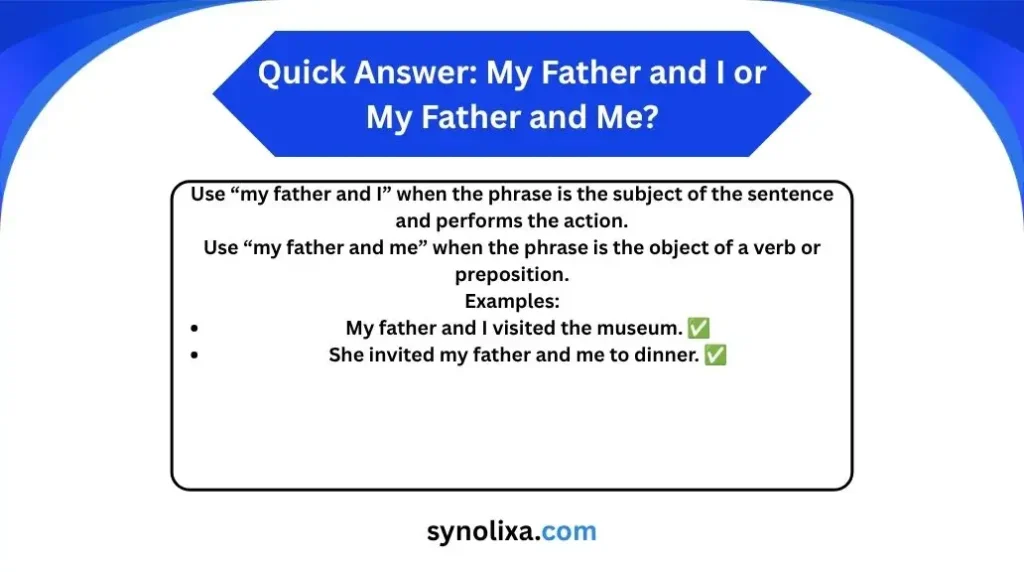
Use “my father and I” when the phrase is the subject of the sentence and performs the action.
Use “my father and me” when the phrase is the object of a verb or preposition.
Examples:
- My father and I visited the museum. ✅
- She invited my father and me to dinner. ✅
A simple test is to temporarily remove “my father.” If “I” sounds correct, use “my father and I.” If “me” sounds correct, use “my father and me.”
Understanding the Basics: My Father and I or My Father and Me
The main difference is pronoun case.
English uses different forms of some pronouns depending on their role in a sentence. “I” is a subject pronoun, while “me” is an object pronoun. Purdue OWL lists I among subject pronouns and me among object pronouns.
| Form | Type | Meaning | Example | Correct/Incorrect |
|---|---|---|---|---|
| My father and I | Subject phrase | My father + I perform the action | My father and I traveled together. | ✅ Correct |
| My father and me | Object phrase | My father + me receive the action | She called my father and me. | ✅ Correct |
| My father and I | Object phrase | I is incorrectly used as an object | She called my father and I. | ❌ Incorrect in standard grammar |
| My father and me | Subject phrase | Me is incorrectly used as a subject | My father and me went home. | ❌ Incorrect in standard grammar |
What Is a Subject?
The subject is the person or thing that performs the action or is being described by the verb.
Consider:
My father and I drove to the beach.
Who drove?
My father and I.
Therefore, the phrase is the subject.
Another example:
My father and I enjoyed the trip.
Who enjoyed the trip?
My father and I.
So “my father and I” is correct.
What Is an Object?
An object receives the action of a verb or follows a preposition.
Consider:
The coach congratulated my father and me.
Who was congratulated?
My father and me.
Therefore, the phrase is the object.
Another example:
She sat between my father and me.
The word between is a preposition, so the object form me is required.
Correct Meanings and Uses
When to Use “My Father and I”
Use “my father and I” when the phrase is the subject of the sentence.
Example 1: My Father and I Went Shopping
My father and I went shopping.
Breakdown:
- My father = part of the subject
- I = part of the subject
- went = verb
- shopping = activity
The two people performed the action of going shopping.
Therefore:
My father and I went shopping. ✅
Example 2: My Father and I Cooked Dinner
My father and I cooked dinner.
Who cooked dinner?
My father and I.
Because the phrase performs the action, use I.
Example 3: My Father and I Are Planning a Trip
My father and I are planning a trip.
The phrase is the subject because it tells us who is planning.
Correct:
My father and I are planning a trip. ✅
Incorrect in standard English:
My father and me are planning a trip. ❌
When to Use “My Father and Me”
Use “my father and me” when the phrase is the object of a verb or preposition.
Example 1: She Invited My Father and Me
She invited my father and me.
Who did she invite?
My father and me.
The phrase receives the action of “invited,” so me is correct.
Example 2: The Teacher Spoke to My Father and Me
The teacher spoke to my father and me.
The preposition to is followed by an object.
Therefore:
My father and me ✅
Example 3: The Gift Was for My Father and Me
The gift was for my father and me.
The preposition for is followed by an object.
Therefore, me is correct.
Example 4: Between My Father and Me
There is a special understanding between my father and me.
The preposition between takes an object pronoun.
Therefore:
between my father and me ✅
The Easy “Remove One Person” Test
One of the fastest ways to decide between “my father and I” and “my father and me” is to remove “my father.”
This leaves either I or me.
Ask yourself which sentence sounds correct.
Example 1
My father and I went to the park.
Remove “my father”:
I went to the park. ✅
Therefore:
My father and I went to the park. ✅
Example 2
The teacher helped my father and me.
Remove “my father”:
The teacher helped me. ✅
Therefore:
The teacher helped my father and me. ✅
Example 3
Incorrect:
My father and me went to the store.
Remove “my father”:
Me went to the store. ❌
That tells you that me is not correct in this position.
The correct sentence is:
My father and I went to the store. ✅
Example 4
Incorrect:
She invited my father and I.
Remove “my father”:
She invited I. ❌
The correct form is:
She invited me. ✅
Therefore:
She invited my father and me. ✅
Test Tip 💡
When you are unsure, remove the other person from the sentence.
- I went home. → My father and I went home.
- She called me. → She called my father and me.
This simple test works in many everyday sentences.
Why “My Father and I” Sounds More Formal
Some people have learned that they should always say “my father and I” because it sounds more polished or formal.
That idea creates a common mistake.
“My father and I” is not automatically more correct than “my father and me.”
The correct form depends on the grammatical role of the pronoun.
Compare:
My father and I attended the meeting. ✅
and:
The manager thanked my father and me. ✅
The first needs I because the phrase is the subject.
The second needs me because the phrase is the object.
Using I everywhere does not make a sentence more grammatical.
Why “My Father and Me” Is Sometimes Correct
Some speakers mistakenly believe that “me” is always wrong after a person’s name or noun.
That is not true.
Me is the normal object form of the first-person singular pronoun.
Purdue OWL’s pronoun-case guidance identifies I as the subjective form and me as the objective form.
For example:
My father called me.
Here, me is clearly the object.
When another noun or person is added, the same grammatical rule remains:
My father called my sister and me.
You would not say:
My father called my sister and I. ❌
The addition of “my sister” does not change the pronoun case.
My Father and I or My Father and Me After a Preposition
A useful clue is to look for a preposition.
Common prepositions include:
- to
- for
- with
- from
- between
- by
- about
- near
- beside
- around
- against
When the phrase follows one of these prepositions, me is generally the correct form.
Examples
The invitation was sent to my father and me. ✅
She sat beside my father and me. ✅
The decision was made by my father and me. ✅
The teacher talked with my father and me. ✅
This secret is between my father and me. ✅
Notice that I would not fit naturally if the phrase were used alone:
- to me ✅
- for me ✅
- with me ✅
- between me and him ✅
So the combined forms follow the same pattern.
My Father and I as the Subject
If the phrase comes before the main verb and performs the action, I is normally required.
Examples
My father and I watched the game.
My father and I visited our relatives.
My father and I cleaned the garage.
My father and I discussed the problem.
My father and I arrived early.
In each sentence, ask:
Who performed the action?
The answer is my father and I.
My Father and Me as the Object
Now consider these examples:
The doctor spoke with my father and me.
My aunt invited my father and me.
The guide showed my father and me the old building.
Everyone thanked my father and me.
The teacher gave my father and me some helpful advice.
In every case, the phrase is receiving an action or follows a preposition.
Therefore, me is correct.
Case Study: A Real-Life Workplace Conversation
Imagine an employee writing an email after a meeting.
Incorrect Version
The manager asked my father and I to attend the meeting.
This sounds familiar, but the pronoun is incorrect in standard grammar.
Why?
The manager asked someone to attend.
Who did the manager ask?
The manager asked me.
Therefore, the correct version is:
The manager asked my father and me to attend the meeting.
Another Example
Imagine someone describing what happened during the meeting:
My father and I attended the meeting with the manager.
This time, the phrase is the subject.
Who attended?
My father and I.
Therefore:
My father and I attended the meeting. ✅
The Key Lesson
The same two people can appear as either:
- my father and I
- my father and me
The choice changes because the grammatical role changes, not because the people change.
Grammar Rules: Why One Form Is Correct
Pronouns have different cases in English.
The three major categories are:
- Subjective case
- Objective case
- Possessive case
For first-person singular pronouns:
| Case | Pronoun | Example |
|---|---|---|
| Subjective | I | I called my father. |
| Objective | me | My father called me. |
| Possessive | my/mine | My father helped me. |
Purdue OWL explains that subjective pronouns function as subjects, while objective pronouns function as objects of verbs or prepositions.
This rule explains the difference between the two forms.
Subjective Case
My father and I went home.
I is part of the subject.
Objective Case
The teacher called my father and me.
Me is part of the object.
After a Preposition
The gift was for my father and me.
Me follows the preposition for.
A Note About Merriam-Webster and Standard English
Major English dictionaries and grammar references distinguish between subject and object pronouns. Standard grammar treats I as the subject form and me as the object form.
This is consistent with established grammar guidance such as Purdue OWL’s pronoun-case explanation, which explicitly pairs I with the subject position and me with the object position.
For everyday American English, this gives you a dependable rule:
Use I for the subject and me for the object.
When the pronoun is combined with another person, the same rule still applies.
Common Mistakes
Mistake 1: Using “Me” as the Subject
Incorrect:
My father and me went to the movies. ❌
Correct:
My father and I went to the movies. ✅
Why?
Because my father and I is doing the action.
Mistake 2: Using “I” as the Object
Incorrect:
The teacher called my father and I. ❌
Correct:
The teacher called my father and me. ✅
Why?
The phrase receives the action of called.
Mistake 3: Thinking “I” Is Always More Correct
Some writers have been taught to use “I” whenever another person is mentioned.
That produces sentences such as:
The invitation was for my father and I. ❌
The word for requires an object, so the correct sentence is:
The invitation was for my father and me. ✅
Mistake 4: Letting the Other Noun Confuse You
A long phrase can make the choice harder.
For example:
The principal thanked my father, my teacher, and me.
It may look complicated, but remove the other nouns:
The principal thanked me.
That makes the answer obvious.
Similar Grammar Confusions
The my father and I / my father and me question is part of a larger group of common English mistakes.
| Confusion | Correct Difference | Example |
|---|---|---|
| I / me | Subject vs. object | I called her. / She called me. |
| he / him | Subject vs. object | He helped. / I helped him. |
| she / her | Subject vs. object | She arrived. / I called her. |
| we / us | Subject vs. object | We left. / They followed us. |
| they / them | Subject vs. object | They came. / We saw them. |
| who / whom | Subject vs. object in formal usage | Who called? / Whom did you call? |
| it’s / its | Contraction vs. possessive | It’s cold. / Its color is bright. |
| your / you’re | Possessive vs. contraction | Your book. / You’re right. |
| their / there / they’re | Possession, place, contraction | Their house is there. They’re home. |
| then / than | Time vs. comparison | Then we left. / Taller than me. |
These mistakes often happen because people write quickly, rely on sound, or remember a rule only partially.
Why Do People Make This Mistake?
Fast Typing
When people type quickly, they may choose the pronoun that feels natural without checking its grammatical role.
Autocorrect
Autocorrect can sometimes change words or reinforce an incorrect choice, especially when a sentence is written quickly.
Lack of Knowledge
Many people understand the meaning of a sentence but have never learned the difference between subject and object pronouns.
Overcorrection
This is especially important.
Someone may learn that “John and I” is often correct and then begin using I in every sentence.
That creates errors such as:
She invited John and I. ❌
The problem is not a lack of confidence. It is applying a correct rule to the wrong grammatical situation.
Usage in Different Contexts
Everyday Conversation
In casual speech, people frequently use these expressions naturally.
Examples:
My father and I are going to the store.
Mom gave my father and me a ride.
This is between my father and me.
Even in casual conversation, the standard grammatical distinction remains useful.
Professional Writing
Accuracy matters more in emails, reports, applications, and workplace documents.
Examples:
My father and I attended the conference.
The coordinator contacted my father and me.
The project was completed by my father and me.
Using the correct pronoun makes the sentence clear and polished.
Creative Writing
Writers can use either form depending on the sentence.
My father and I walked quietly through the old neighborhood.
The memory stayed with my father and me for years.
The choice should follow the grammar of the sentence rather than the desired tone.
Social Media and Texting
Casual digital communication often contains shortened sentences or informal grammar.
You may see:
Me and my dad went out.
This construction is common in informal speech, but if your goal is standard written English, use:
My father and I went out.
For a polished caption, school assignment, email, or article, standard pronoun case is the safer choice.
Why It Matters
Correct pronoun usage helps readers understand who is acting and who is receiving an action.
Consider:
My father and I visited the office.
The subject is immediately clear.
Now compare:
The receptionist greeted my father and me.
The object is clear.
This distinction matters because good grammar supports:
- Clarity — Readers understand the sentence quickly.
- Professionalism — Correct grammar creates a polished impression.
- Accuracy — The sentence follows standard grammatical patterns.
- Digital communication — Clear writing is useful in emails, messages, posts, and online documents.
A useful principle is:
Choose the pronoun based on its job in the sentence, not on which form sounds more formal.
Special Exception: Informal Speech and Fixed Expressions
There is no special exception that makes “my father and I” or “my father and me” universally correct.
However, everyday spoken English sometimes uses constructions that differ from formal or edited written English.
For example:
Me and my father went fishing.
This wording occurs in casual speech and informal writing. However, in standard edited English, the preferred construction is:
My father and I went fishing.
The important point is that informal usage does not change the basic subject-object rule.
Another special point concerns “It is I” and “It is me.” Traditional formal grammar may favor “It is I,” while “It is me” is common in conversational English. Purdue OWL notes this formal/informal distinction.
That issue is separate from the basic rule for my father and I / my father and me.
My Father and I or My Father and Me: More Examples
Here are several examples to make the difference easy to remember.
Subject Examples
- My father and I went fishing. ✅
- My father and I watched a movie. ✅
- My father and I cooked dinner. ✅
- My father and I visited Chicago. ✅
- My father and I discussed the plan. ✅
- My father and I arrived early. ✅
Object Examples
- She invited my father and me. ✅
- He called my father and me. ✅
- The teacher helped my father and me. ✅
- They thanked my father and me. ✅
- The gift was for my father and me. ✅
- She sat between my father and me. ✅
Incorrect Examples
- My father and me went fishing. ❌
- The teacher called my father and I. ❌
- My father and I were invited by the host. ✅
- The host invited my father and me. ✅
The difference is always connected to the grammatical role.
A Simple Three-Step Method
When you are unsure, follow these three steps.
Step 1: Find the Verb
Identify the main action.
Example:
My father and I visited the museum.
The verb is visited.
Step 2: Ask “Who?”
Ask:
Who visited the museum?
Answer:
My father and I.
Therefore, I is correct.
Step 3: Remove “My Father”
Try:
I visited the museum.
That works.
Now try an object sentence:
The guide helped my father and me.
Ask:
Whom did the guide help?
Answer:
My father and me.
Remove “my father”:
The guide helped me.
That works.
This method is simple, fast, and reliable.
Quick Recap Checklist
| Question | If Yes → Use |
|---|---|
| Is the phrase doing the action? | My father and I |
| Is the phrase the subject? | My father and I |
| Does the phrase follow a preposition such as “to,” “for,” or “with”? | My father and me |
| Is the phrase receiving the action? | My father and me |
| Does the sentence still work with “I” alone? | My father and I |
| Does the sentence still work with “me” alone? | My father and me |
Practice Example 1
___ went to the store.
Remove “my father”:
I went to the store.
Answer:
My father and I went to the store. ✅
Practice Example 2
The teacher spoke to ___.
Remove “my father”:
The teacher spoke to me.
Answer:
The teacher spoke to my father and me. ✅
Practice Example 3
___ helped clean the house.
Remove “my father”:
I helped clean the house.
Answer:
My father and I helped clean the house. ✅
FAQs
1. Is “my father and I” always correct?
No. “My father and I” is correct when the phrase functions as the subject. For example, “My father and I went shopping.” When the phrase is an object, use “my father and me.”
2. Is “my father and me” grammatically correct?
Yes. “My father and me” is grammatically correct when the phrase functions as an object or follows a preposition. For example, “She invited my father and me.”
3. Should I say “My father and I went” or “My father and me went”?
Use “My father and I went.” The phrase is the subject and performs the action of going.
4. Should I say “between my father and I” or “between my father and me”?
Use “between my father and me.” The preposition between is followed by an object pronoun, so me is the correct choice.
5. Is “The teacher called my father and I” correct?
No. In standard English, use “The teacher called my father and me.” You can test this by removing “my father”: “The teacher called me.”
6. What is the easiest way to remember the difference?
Remove “my father” from the sentence. If I works by itself, use “my father and I.” If me works by itself, use “my father and me.”
Conclusion
The choice between “my father and I” and “my father and me” becomes easy once you understand the difference between subjects and objects.
Use “my father and I” when the phrase performs the action:
My father and I went to the park.
Use “my father and me” when the phrase receives the action or follows a preposition:
The teacher spoke to my father and me.
The most useful trick is to remove “my father” and see whether I or me works on its own. If you would say “I went,” use “my father and I.” If you would say “she called me,” use “my father and me.”
Do not choose I simply because it sounds more formal, and do not assume me is always wrong. Each pronoun has a specific grammatical job.
Remember: “I” does the action; “me” receives the action. Get the pronoun’s job right, and the choice becomes clear. ✨

Hi, I am Clara Anderson. I work at Synolixa as a vocabulary writer, focusing on synonyms, word meanings, and easy-to-understand English learning content.
[…] common mistakes, contextual uses, and practical tips for choosing the correct term in US English. My Father and I or My Father and Me | Giving or Given | Who to Contact or Whom to […]