Losing someone can lead to many different forms of remembrance, and two words that often cause confusion are elegy vs eulogy. They sound similar, and both are connected with death, grief, and remembering someone who has died. However, they are not the same thing. An elegy is a work of literature or poetry that expresses grief or reflects on the loss of someone or something. A eulogy, on the other hand, is a speech or piece of writing that praises and remembers a person who has died, usually delivered at a funeral or memorial service.
The confusion is understandable because both words can describe expressions of mourning. Still, their forms, purposes, and typical settings are different. Knowing the difference can help you choose the right word when writing a sympathy message, preparing a funeral speech, discussing literature, or simply talking about grief.
In this guide, we will explain elegy vs eulogy in simple terms, compare their meanings, examine real-life examples, discuss common mistakes, and provide easy tips for remembering which word to use. Whole Day or All Day | Prescribe vs Proscribe | Separate vs Seperate
Quick Answer: Elegy vs Eulogy
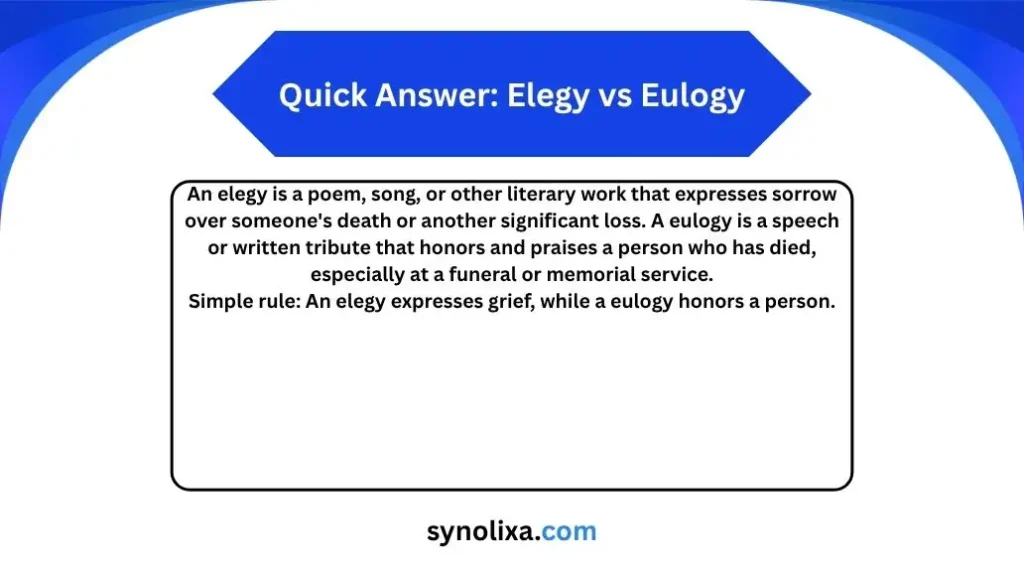
An elegy is a poem, song, or other literary work that expresses sorrow over someone’s death or another significant loss. A eulogy is a speech or written tribute that honors and praises a person who has died, especially at a funeral or memorial service.
Simple rule: An elegy expresses grief, while a eulogy honors a person.
Understanding the Basics of Elegy vs Eulogy
The easiest way to understand elegy vs eulogy is to focus on their purpose.
An elegy is primarily connected with mourning, grief, reflection, and loss. It is often poetic or literary. Although elegies frequently mourn people who have died, the term can also be used more broadly for works expressing sorrow over a loss.
A eulogy is primarily connected with praise, remembrance, and tribute. It is usually written or spoken about a person who has died and is commonly associated with funerals and memorial services.
Elegy vs Eulogy Comparison Table
| Form | Type | Meaning | Example | Correct/Incorrect |
|---|---|---|---|---|
| Elegy | Noun | A poem or literary work expressing grief or mourning | She wrote an elegy for her friend. | Correct |
| Eulogy | Noun | A speech or written tribute praising someone who has died | He delivered a eulogy at the funeral. | Correct |
| Elegy | Noun | A work reflecting on loss | The poem is an elegy for a lost era. | Correct |
| Eulogy | Noun | A formal tribute to a deceased person | Her brother gave the eulogy. | Correct |
| Elegy | Noun | A funeral speech | He gave an elegy at the funeral. | Usually incorrect |
| Eulogy | Noun | Any poem about sadness | She wrote a eulogy about the end of summer. | Usually incorrect |
The words overlap because both can involve mourning. The key difference is form and purpose.
What Does Elegy Mean?
An elegy is a poem, song, or other literary composition that expresses sorrow, especially sorrow caused by death or loss.
The word is often associated with poetry. An elegy may mourn a particular person, a group of people, a historical period, a lost relationship, or even something symbolic.
Examples of Elegy
- The poet wrote an elegy for his late father.
- The poem is an elegy for a lost generation.
- She composed an elegy after the death of her friend.
- The writer created an elegy reflecting on the passing of time.
In each example, the emphasis is on grief, loss, or reflection.
Elegy in Literature
Elegies have a long history in literature. They often explore emotions such as:
- Grief
- Sadness
- Memory
- Loss
- Love
- Reflection
- Acceptance
- Mortality
An elegy does not have to be a speech given at a funeral. In fact, many famous elegies are poems that readers encounter in books rather than at memorial services.
Does an Elegy Have to Be About a Person?
No.
An elegy can mourn the loss of something other than an individual. A writer might create an elegy for a lost culture, a vanished way of life, a destroyed place, or a period of history.
For example:
The novel reads like an elegy for a disappearing way of life.
Here, elegy does not mean a funeral speech. It means a work expressing sadness or reflection about a loss.
What Does Eulogy Mean?
A eulogy is a speech or written tribute that honors and praises a person who has died.
It is most commonly associated with funerals and memorial services. A family member, friend, colleague, religious leader, or another person close to the deceased may deliver a eulogy.
Examples of Eulogy
- Her daughter delivered a eulogy at the funeral.
- He wrote a heartfelt eulogy for his grandfather.
- The pastor gave a short eulogy during the memorial service.
- His eulogy focused on his father’s kindness and generosity.
The main purpose is to remember and honor the deceased person.
What Does a Eulogy Usually Include?
A eulogy may contain:
- Memories of the person
- Stories about their life
- Their achievements
- Their personality
- Their relationships
- Their values
- Their contributions to others
- Expressions of love and gratitude
A eulogy can certainly contain sadness. However, it often balances grief with appreciation and positive memories.
Elegy vs Eulogy: The Core Difference
The most important distinction is this:
An elegy is generally a work expressing grief or mourning, while a eulogy is generally a tribute praising and remembering a deceased person.
Think about the emotional focus.
Elegy = Grief and Loss
An elegy asks:
“What has been lost, and how do we feel about that loss?”
Eulogy = Praise and Remembrance
A eulogy asks:
“Who was this person, and why should we remember them?”
There can be overlap. A eulogy can express grief, and an elegy can praise someone. However, their traditional uses remain different.
Elegy vs Eulogy in Sentences
Looking at complete sentences can make the difference easier to understand.
Example 1: Elegy
The poet wrote an elegy after the death of his brother.
Breakdown:
- The poet = subject
- wrote = verb
- an elegy = object
- after the death of his brother = explains the occasion
The word elegy identifies a literary expression of grief.
Example 2: Eulogy
Maria delivered a eulogy at her grandmother’s funeral.
Breakdown:
- Maria = subject
- delivered = verb
- a eulogy = object
- at her grandmother’s funeral = explains the setting
Here, eulogy refers to a spoken tribute.
Example 3: Elegy Used Figuratively
The documentary is an elegy for a disappearing neighborhood.
The neighborhood is not necessarily a person who died. Instead, the documentary reflects on something that is being lost.
Example 4: Eulogy Used as a Tribute
His eulogy described him as a generous teacher and devoted father.
The word eulogy clearly refers to a tribute honoring a deceased person.
Test Tip: How to Choose the Right Word
Use this simple test:
Ask yourself what the word describes.
If it describes a poem, song, literary work, or artistic expression of grief, choose elegy.
If it describes a speech or tribute honoring a deceased person, choose eulogy.
Easy Memory Trick
Think:
Elegy → Emotion
Eulogy → Honor
The connection is not a perfect spelling rule, but it can help you remember the difference.
Another useful question is:
“Is someone standing at a funeral and speaking about the person who died?”
If yes, eulogy is probably the word you need.
If you are discussing a poem or literary work about loss, elegy is more likely.
Case Study: Elegy vs Eulogy in Real Life
Imagine that a woman named Sarah loses her father.
A week later, she writes a poem about how much she misses him. The poem describes her memories, sadness, and the feeling of losing someone she loved.
That poem can be called an elegy.
At her father’s memorial service, Sarah’s brother stands before the audience and talks about their father’s kindness, sense of humor, career, family life, and the memories they shared.
That speech is a eulogy.
Workplace Example
Imagine an employee named David passes away after many years at a company.
A coworker writes:
“David was the person everyone went to when they needed help. He welcomed new employees and always made time for others.”
If this is part of a speech at David’s memorial service, it could be part of a eulogy.
If a writer creates a reflective poem about David’s death and the loss felt by the workplace, that poem could be described as an elegy.
This example shows why the two words can feel similar while still serving different purposes.
Grammar Rules for Elegy and Eulogy
Both elegy and eulogy are nouns.
Using Elegy as a Noun
Correct:
She wrote an elegy for her mother.
Correct:
The poem became a moving elegy for lost childhood.
Incorrect in the usual sense:
She delivered an elegy praising her mother at the funeral.
The last sentence is not necessarily grammatically impossible, because language can overlap and evolve, but eulogy is normally the more precise word for a funeral tribute.
Using Eulogy as a Noun
Correct:
He delivered a eulogy at the memorial.
Correct:
Her eulogy included several funny stories.
Correct:
The family asked him to write the eulogy.
Incorrect in the usual sense:
The poet published a eulogy about the disappearance of an old tradition.
If the work is a literary reflection on loss rather than a tribute to a deceased person, elegy is generally more appropriate.
Standard dictionaries such as Merriam-Webster distinguish elegy as a work expressing sorrow or mourning, especially for someone who has died, while eulogy refers to praise or a commendatory speech or writing, particularly one honoring someone who has died.
Common Mistakes With Elegy vs Eulogy
People often confuse these words because they have similar sounds and both relate to death.
Mistake 1: Calling Every Funeral Speech an Elegy
Incorrect or less precise:
She gave an elegy at the funeral.
Better:
She gave a eulogy at the funeral.
A funeral speech honoring the deceased is normally called a eulogy.
Mistake 2: Calling Every Poem About Death a Eulogy
Less precise:
The poem is a eulogy for a lost generation.
Better:
The poem is an elegy for a lost generation.
The second sentence makes sense if the poem expresses grief or reflection over the loss.
Mistake 3: Assuming an Elegy Must Be Spoken
An elegy can be read, published, performed, or studied as literature. It does not have to be a speech.
Mistake 4: Assuming a Eulogy Must Be a Poem
A eulogy can be a speech or written tribute. It does not have to follow a poetic form.
Similar Grammar Confusions
The confusion between elegy vs eulogy is similar to many other English word pairs.
| Confusing Words | Correct Difference |
|---|---|
| It’s / Its | “It’s” means “it is”; “its” shows possession. |
| Your / You’re | “Your” shows possession; “you’re” means “you are.” |
| Their / They’re | “Their” shows possession; “they’re” means “they are.” |
| Affect / Effect | “Affect” is usually a verb; “effect” is usually a noun. |
| Compliment / Complement | A compliment is praise; a complement completes or enhances something. |
| Principal / Principle | A principal is a person or main thing; a principle is a rule or belief. |
| Elegy / Eulogy | An elegy expresses grief or mourning; a eulogy honors a deceased person. |
Why Do These Mistakes Happen?
There are several common reasons.
Fast Typing
When people type quickly, they may choose a familiar word without checking its exact meaning.
Autocorrect
Autocorrect can sometimes replace an intended word with another word that looks or sounds similar.
Lack of Knowledge
Some people simply have not learned the distinction. Because elegy and eulogy are relatively uncommon words in everyday conversation, confusion is understandable.
Similar Sounds
Both words begin with “eu/el”-like sounds and are associated with death and remembrance. That similarity makes them easy to mix up.
Elegy vs Eulogy in Everyday Conversation
In everyday conversation, eulogy is more likely to appear when people discuss funerals and memorial services.
Examples:
Who is giving the eulogy?
Her brother wrote the eulogy.
The eulogy was very touching.
The word elegy is more common in discussions about literature, poetry, music, and artistic expression.
Examples:
We studied an elegy in English class.
The poem is an elegy for the author’s father.
The song feels like an elegy for a lost era.
Elegy vs Eulogy in Professional Writing
Professional writing requires precision.
Suppose you are writing an obituary, memorial announcement, academic paper, or workplace message.
Use eulogy when discussing a tribute given in memory of a deceased person.
The family invited three close friends to speak during the eulogy.
Use elegy when discussing a literary or artistic work centered on grief or loss.
The novelist’s final chapter functions as an elegy for the old community.
Choosing the correct word makes your writing more precise and professional.
Elegy vs Eulogy in Creative Writing
Creative writers often use elegy in a broader and more symbolic way.
For example:
The abandoned theater stood as an elegy for the city’s golden age.
Here, elegy creates a literary sense of mourning for something that has disappeared.
A writer could also create a character who delivers a eulogy at a funeral:
Standing before the gathered family, she began the eulogy with a story from her childhood.
In creative writing, both words can create emotional depth, but they serve different roles.
Elegy vs Eulogy in Social Media and Texting
Social media has made memorial writing more common.
Someone might post:
Thinking of my grandfather today. He taught me to stay kind, patient, and grateful.
This is a tribute, but it is not automatically a eulogy.
A post containing a long poetic reflection about loss might be described as an elegy, especially if it has a literary style.
A post that reproduces or summarizes a speech given at a funeral could be connected with a eulogy.
In casual texting, however, people often simply use words such as:
- Tribute
- Memorial
- Speech
- Poem
- Remembrance
These terms may be easier for general audiences.
Why the Difference Matters
Understanding elegy vs eulogy matters because word choice affects meaning.
1. Clarity in Communication
Using the correct word helps readers immediately understand what you mean.
Compare:
I wrote a eulogy for my grandfather.
This clearly suggests a tribute.
With:
I wrote an elegy for my grandfather.
This suggests a literary or poetic expression of grief.
Both may be meaningful, but they communicate slightly different ideas.
2. Professionalism
In a funeral program, obituary, academic essay, or workplace announcement, precise vocabulary makes writing sound more polished.
3. Accuracy in Digital Communication
Online writing spreads quickly. A word used incorrectly can confuse readers or make a message sound less precise.
4. Better Literary Understanding
If you study poetry, knowing what an elegy means helps you understand the purpose and tone of a literary work.
“The right word makes the meaning clearer.”
This simple principle applies especially well to words that have related meanings.
Special Exceptions and Edge Cases
English vocabulary does not always fit into perfectly separate boxes.
There can be overlap between elegy and eulogy.
For example, a funeral speech may contain poetic or elegiac language. Similarly, a literary elegy may praise the person being mourned.
The words can therefore overlap in emotional content.
However, their typical uses remain distinct:
- Elegy → a work expressing grief, mourning, or reflection on loss.
- Eulogy → a speech or written tribute praising and remembering someone who has died.
What About “Elegiac”?
The adjective elegiac comes from elegy.
It describes something that has the emotional quality of an elegy.
Example:
The film has an elegiac tone.
This means the film has a reflective, mournful, or nostalgic quality.
What About “Eulogize”?
The verb eulogize comes from eulogy.
It means to praise someone highly, especially after death.
Example:
The speaker eulogized her longtime friend.
This connection can make the distinction easier:
Eulogy → eulogize → praise
Elegy → elegiac → mournful or reflective
Quick Recap Checklist
Use the following checklist whenever you are unsure.
| Question | If Yes → Use |
|---|---|
| Is it a poem expressing grief or mourning? | Elegy |
| Is it a literary work about loss? | Elegy |
| Is it a reflective work about something that has disappeared? | Elegy |
| Is it a speech honoring someone who died? | Eulogy |
| Is it a written tribute to a deceased person? | Eulogy |
| Is someone praising and remembering a person at a funeral? | Eulogy |
Practice Example 1
She wrote a poem about the loss of her childhood home.
Answer: Elegy
The work focuses on loss and reflection.
Practice Example 2
James spoke about his father’s kindness at the funeral.
Answer: Eulogy
The speech honors and remembers a deceased person.
Practice Example 3
The novel became an emotional reflection on a disappearing culture.
Answer: Elegy
The work expresses a sense of loss surrounding something that is disappearing.
FAQs
1. What is the main difference between an elegy and a eulogy?
An elegy is generally a poem or literary work that expresses grief or mourning, while a eulogy is a speech or written tribute that praises and remembers a person who has died.
2. Is a eulogy always given at a funeral?
No. A eulogy is commonly delivered at a funeral or memorial service, but it can also be given or published in other settings where someone is being honored after death.
3. Is an elegy always a poem?
No. Elegies are strongly associated with poetry, but the term can also describe other artistic or literary works that express mourning or reflection on loss.
4. Can an elegy be about something other than a person?
Yes. An elegy can express grief over the loss of a place, era, culture, relationship, tradition, or another meaningful thing.
5. Can a eulogy contain sadness?
Yes. A eulogy often includes grief and sadness. However, its main purpose is usually to honor, praise, and remember the deceased person.
6. How can I easily remember elegy vs eulogy?
Think of elegy as connected with emotion and mourning, and eulogy as connected with honoring someone who died. If it is a funeral tribute, eulogy is usually the right choice.
Conclusion
The difference between elegy vs eulogy comes down mainly to purpose and form. An elegy is a work that expresses grief, mourning, or reflection on a loss. It is often a poem or literary composition and may focus on a person, place, culture, relationship, or period of life that has been lost. A eulogy, in contrast, is a speech or written tribute that honors and praises a person who has died. It is especially common at funerals and memorial services.
Both words are connected with death and remembrance, which explains why they are often confused. However, they are not interchangeable in most situations.
When you need to remember the difference, keep one simple idea in mind: an elegy mourns a loss, while a eulogy honors a person. That distinction will help you choose the right word in everyday communication, professional writing, academic work, and creative writing.
Elegy expresses the grief; eulogy celebrates the life.

Hi, I am Clara Anderson. I work at Synolixa as a vocabulary writer, focusing on synonyms, word meanings, and easy-to-understand English learning content.
[…] grammar rules, examples, common mistakes, and the easiest way to remember which form to use. Elegy vs Eulogy | Whole Day or All Day | Prescribe vs […]
[…] mistakes, and different contexts of take it or leave it in simple US English. Gases or Gasses | Elegy vs Eulogy | Whole Day or All […]