Have you ever wondered whether to say “whole day” or “all day”? 🤔 Both expressions talk about a complete or extended period of a day, so it is easy to confuse them. However, they do not always work in exactly the same way. The difference mainly comes down to grammar, emphasis, and context.
In everyday American English, “all day” is usually the more natural expression when you mean that something happens throughout the entire day. For example, “I worked all day” means the work continued throughout the day. “The whole day” also refers to the entire day, but it can place more emphasis on the day as one complete period. For example, “I spent the whole day at home” emphasizes the complete amount of time spent at home.
Another important point is that “whole day” usually needs a determiner, such as the, a, my, or that. Saying “I stayed there whole day” is not standard English. You would normally say, “I stayed there the whole day.”
Let’s look at whole day or all day in detail so you can use both expressions confidently. Prescribe vs Proscribe | Separate vs Seperate | Spatter or Splatter
Quick Answer: Whole Day or All Day
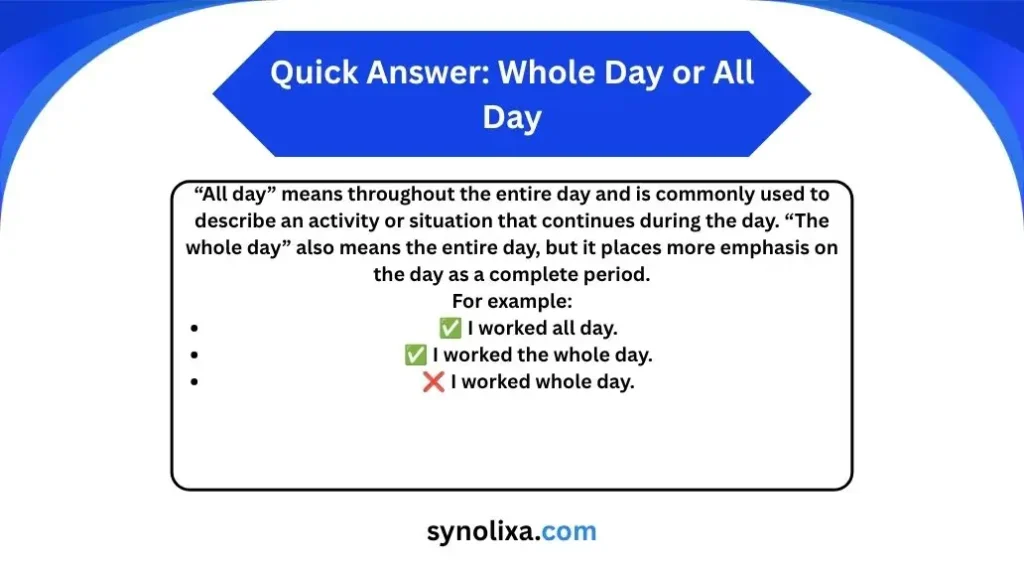
“All day” means throughout the entire day and is commonly used to describe an activity or situation that continues during the day. “The whole day” also means the entire day, but it places more emphasis on the day as a complete period.
For example:
- ✅ I worked all day.
- ✅ I worked the whole day.
- ❌ I worked whole day.
The first sentence sounds more natural in everyday English, while the second emphasizes the complete duration.
Understanding the Basics: Whole Day or All Day
The easiest way to understand whole day or all day is to look at how each expression is structured.
All day works as an adverbial expression of time. It tells us that something happens throughout the day.
The whole day is a noun phrase in which whole describes the noun day. Because day is a singular countable noun, the phrase normally needs a determiner.
Basic Comparison Table
| Form | Type | Meaning | Example | Correct/Incorrect |
|---|---|---|---|---|
| all day | Time expression | Throughout the entire day | I studied all day. | ✅ Correct |
| the whole day | Noun phrase | The entire day as one complete period | I studied the whole day. | ✅ Correct |
| whole day | Noun phrase without determiner | Intended to mean the entire day | I studied whole day. | ❌ Usually incorrect |
| all the day | Time expression | Intended to mean throughout the day | I studied all the day. | ❌ Usually unnatural |
| a whole day | Noun phrase | One complete day | The trip took a whole day. | ✅ Correct |
| my whole day | Noun phrase | The complete day belonging to or experienced by the speaker | My whole day was busy. | ✅ Correct |
The Main Difference
Consider these two sentences:
I waited all day.
I waited the whole day.
Both can communicate the idea that the waiting lasted for the entire day. However, all day is generally more natural when simply describing duration.
Now consider:
I spent the whole day cleaning.
This sentence emphasizes that cleaning occupied the complete day.
A useful shortcut is:
All day = throughout the day.
The whole day = the entire day as a complete period.
Correct Meanings and Uses
1. When to Use “All Day”
Use all day when you want to say that something happens throughout the day or continues for most or all of the day.
Examples:
- I have been working all day.
- She stayed at the library all day.
- We talked all day.
- It rained all day.
- He played video games all day.
In these examples, all day describes duration.
Sentence Breakdown
Consider:
I worked all day.
- I = subject
- worked = verb
- all day = time expression
The phrase tells us how long the activity continued.
2. When to Use “The Whole Day”
Use the whole day when you want to emphasize the complete day as one period.
Examples:
- I spent the whole day cleaning my room.
- She stayed home for the whole day.
- We had meetings for the whole day.
- He slept for the whole day.
- They traveled for the whole day.
The phrase can make the duration feel more complete or emphatic.
3. When to Use “A Whole Day”
A whole day is different from all day because it refers to one complete day as a unit.
Examples:
- The journey took a whole day.
- We spent a whole day exploring the city.
- It took me a whole day to finish the project.
- The repair may require a whole day.
Here, a whole day often emphasizes that the amount of time is long, complete, or perhaps more than expected.
Compare:
The trip lasted all day.
The trip lasted a whole day.
The first focuses on duration throughout the day. The second emphasizes that one complete day was required.
4. “My Whole Day”
You can also use possessive determiners with whole day.
Examples:
- My whole day was busy.
- Her whole day was filled with meetings.
- His whole day changed after the phone call.
- Our whole day was spent traveling.
The possessive word makes the phrase grammatical because whole modifies the singular noun day.
Test Tip 📝
If you are unsure whether to use all day or the whole day, try replacing the phrase with “throughout the day.”
If the replacement works naturally, all day is probably the best choice.
Example:
I studied all day.
Replacement:
I studied throughout the day.
The basic meaning remains clear.
Case Study: A Workplace Email
Imagine an employee writing an email to a manager.
Less Natural
I was working whole day on the report.
This sentence is missing a determiner before whole day.
Better
I was working all day on the report.
This is natural and direct.
Also Correct
I spent the whole day working on the report.
This version places stronger emphasis on the complete amount of time spent on the report.
What Should You Choose?
In a professional email, all day is often the simpler choice when you are simply describing duration.
For example:
I was working on the report all day and expect to finish it tomorrow.
If you want to emphasize how much time the task consumed, you could write:
I spent the whole day working on the report.
Both are grammatically acceptable, but the emphasis is slightly different.
Grammar Rules Explained
The difference becomes easier when you understand how all and whole behave grammatically.
How “All” Works
All can describe an entire quantity or extent.
With time expressions, English commonly uses:
- all day
- all night
- all morning
- all week
- all year
Examples:
- I waited all morning.
- She studied all night.
- We worked all week.
- They traveled all year.
The phrase all day therefore follows a common English pattern.
How “Whole” Works
Whole is an adjective meaning complete or entire.
When it modifies a singular countable noun, it normally appears with a determiner.
Common patterns include:
- the whole day
- a whole day
- my whole day
- the whole week
- her whole life
- that whole year
For example:
I spent the whole day outside.
Here, whole modifies day, and the functions as the determiner.
This is why:
I stayed home whole day.
is not standard US English.
The natural versions are:
I stayed home all day.
or
I stayed home the whole day.
Standard Grammar Guidance
Standard English grammar distinguishes between the broader use of all to express an entire amount or duration and whole as an adjective meaning complete or entire.
The important point is that whole normally requires a determiner when it modifies a singular countable noun such as day.
Therefore:
- ✅ all day
- ✅ the whole day
- ✅ a whole day
- ✅ my whole day
- ❌ whole day
The issue is not that whole day is never seen. It can appear in headlines, labels, titles, or intentionally shortened language. In a normal complete sentence, however, a determiner is generally required.
Why “Whole Day” Alone Sounds Wrong
One of the most common mistakes is leaving out the determiner.
❌ I was busy whole day.
A standard correction is:
✅ I was busy the whole day.
Or, more naturally:
✅ I was busy all day.
Why does this happen?
Because learners may know that whole means entire but may not realize that whole + singular countable noun normally needs a determiner.
English uses determiners in many similar expressions:
- the whole story
- the whole house
- a whole month
- my whole life
- that whole situation
The same pattern applies to day.
Common Mistakes
Mistake 1: “I worked whole day.”
❌ Incorrect in standard US English.
✅ I worked all day.
✅ I worked the whole day.
Mistake 2: “She studied all the day.”
This form is generally unnatural in modern American English.
More natural:
✅ She studied all day.
Or:
✅ She studied the whole day.
Mistake 3: Confusing “All Day” With “Every Day”
These expressions have different meanings.
All day describes duration.
Every day describes frequency.
Compare:
I worked all day yesterday.
This means I worked throughout yesterday.
I work every day.
This means I work on each day.
Mistake 4: Confusing “Whole Day” With “All Day”
Both can refer to the entire day, but they are structured differently.
❌ I stayed there whole day.
✅ I stayed there all day.
✅ I stayed there the whole day.
Why Do These Mistakes Happen?
Several common factors can cause these errors:
- Fast typing: People often omit small words such as the.
- Autocorrect: Automatic corrections can sometimes change phrases unexpectedly.
- Lack of knowledge: Learners may know the meaning of whole but not its grammatical pattern.
- Direct translation: A phrase that is grammatical in another language may not work the same way in English.
- Similar expressions: Because all and whole can both mean “entire,” learners may assume they have identical grammar.
Similar Grammar Confusions
| Confusion | Correct Forms | Common Error |
|---|---|---|
| its / it’s | its, it’s | Mixing possessive and contraction |
| your / you’re | your, you’re | Using the wrong form |
| their / they’re | their, they’re | Confusing possession and contraction |
| every day / everyday | every day, everyday | Treating them as interchangeable |
| all day / the whole day | both | Omitting the determiner with “whole” |
| a lot / alot | a lot | Writing “alot” |
| in front / infront | in front | Joining two words |
| too / to | too, to | Choosing the wrong word |
These mistakes are common because English contains many expressions that look or sound similar but follow different grammatical rules.
Usage in Different Contexts
Everyday Conversation 🗣️
In casual conversation, all day is extremely common.
Examples:
- What have you been doing all day?
- I have been waiting all day.
- It was hot all day.
- She stayed in bed all day.
You can also use the whole day:
- I spent the whole day with my family.
- We stayed at the beach the whole day.
However, all day often feels shorter and more natural.
Professional Writing 💼
Both forms can be correct in workplace communication.
For example:
I was in meetings all day.
This is concise and natural.
You could also write:
I was in meetings for the whole day.
This emphasizes the complete duration, although all day is often more concise.
Another example:
The training lasted all day.
This is straightforward professional English.
Creative Writing ✍️
Writers may choose either expression depending on emphasis.
She walked all day without stopping.
This creates a sense of continuous movement.
She spent the whole day walking through the forest.
This emphasizes the complete day as a period of experience.
Creative writing allows more flexibility because word choice can affect rhythm, emphasis, and mood.
Social Media and Texting 📱
In texts and social posts, all day is very common.
Examples:
- Been working all day 😩
- I could sleep all day.
- We talked all day 😂
- Rain all day today!
In informal digital communication, people sometimes write:
Whole day busy.
This may appear in casual texting, but it is not the standard grammatical structure for formal US English.
For polished writing, use:
I was busy all day.
or
I was busy the whole day.
“All Day Long” vs. “The Whole Day”
Another useful expression is all day long.
It means throughout the entire day and adds emphasis.
Examples:
- The baby cried all day long.
- We talked all day long.
- It rained all day long.
Compare:
I waited all day.
I waited all day long.
The second sentence sounds more emphatic.
You can also say:
I waited the whole day.
All three can communicate a similar basic idea, but their emphasis differs.
“The Whole Day” vs “For the Whole Day”
Both forms can occur, but they may be used slightly differently.
I stayed there the whole day.
I stayed there for the whole day.
The second version explicitly uses for to highlight duration.
However, English often does not need for with the whole day:
I stayed there the whole day.
This is perfectly understandable and grammatical.
You may also hear:
The event lasted for the whole day.
Here, for fits naturally because lasted describes duration.
Why It Matters
Choosing the right expression makes your writing clearer and more natural. Even when a reader can understand a sentence, a small grammatical error can make the sentence sound awkward.
For example:
I worked whole day.
The meaning is understandable, but the sentence does not follow standard English grammar.
Compare:
I worked all day.
This is concise and natural.
Or:
I worked the whole day.
This is also grammatical and emphasizes the complete period.
Clarity in Communication
Good grammar helps readers understand exactly what you mean without stopping to interpret your sentence.
Professionalism
Correct expressions are especially important in:
- Emails
- Reports
- School assignments
- Resumes
- Business documents
- Customer communication
Digital Communication
Social media and texting have made shortened forms common. However, informal communication does not change the rules of standard English when you are writing professionally.
A simple rule can help:
Use “all day” for natural duration; use “the whole day” when emphasizing the complete day.
A Short Quote to Remember
“Clear writing begins with clear choices.”
When two expressions seem similar, understanding their structure helps you choose the one that communicates your meaning naturally.
Special Exceptions and Edge Cases
There is no major special exception that makes whole day acceptable by itself in standard US English simply because it is informal.
However, you may encounter unusual or shortened forms in:
- Headlines
- Advertising
- Song titles
- Product names
- Informal notes
- Nonstandard English
- Deliberately stylized writing
For example, a business could use a phrase such as “Whole Day Sale” as a promotional headline. That does not necessarily mean the phrase follows the same grammatical pattern as a complete sentence.
In standard prose, use a determiner:
The whole day
A whole day
My whole day
That whole day
Quick Recap Checklist
Use this table whenever you are unsure.
| Question | If Yes → Use |
|---|---|
| Do you mean throughout the day? | all day |
| Do you want to emphasize the complete day? | the whole day |
| Are you referring to one complete day? | a whole day |
| Are you talking about your complete day? | my whole day |
| Are you describing each day? | every day |
| Are you trying to write “whole day” without a determiner? | Usually change it to all day or add a determiner |
Practice Examples
1. I was tired because I worked ___ .
Best answer: all day
I was tired because I worked all day.
2. We spent ___ at the museum.
Best answer: the whole day
We spent the whole day at the museum.
3. The journey took ___ .
Best answer: a whole day
The journey took a whole day.
A Simple Memory Trick 🧠
Think of the expressions this way:
ALL = throughout
WHOLE = complete
So:
all day = throughout the day
the whole day = the complete day
This simple distinction will help you avoid most mistakes.
FAQs
1. Is “all day” grammatically correct?
Yes. All day is a standard and very common English expression meaning throughout the entire day.
Example:
I worked all day.
2. Is “the whole day” grammatically correct?
Yes. The whole day is grammatically correct and means the entire day as a complete period.
Example:
I spent the whole day reading.
3. Is “whole day” correct without “the”?
Usually not in standard US English when you mean the entire day.
Instead, say:
I worked all day.
or
I worked the whole day.
4. Which is more natural: “whole day” or “all day”?
All day is generally more natural when describing an activity that continues throughout the day. The whole day is also correct when you want to emphasize the complete day.
5. Can I say “all the day”?
Although the phrase can appear in older, literary, or specialized contexts, all day is the normal expression in modern American English.
6. What is the difference between “all day” and “every day”?
All day refers to the duration of a day:
I worked all day.
Every day means each day:
I work every day.
They describe different ideas and should not be treated as interchangeable.
Conclusion
The choice between whole day or all day becomes simple once you understand their grammatical structure. All day is the common expression for something that happens throughout the day. The whole day emphasizes the day as a complete period, while a whole day refers to one complete day as a unit.
Remember that whole normally needs a determiner when it modifies the singular countable noun day. That is why “I worked whole day” is not standard US English, while “I worked all day” and “I worked the whole day” are correct.
For everyday communication, all day will often be your easiest and most natural choice. When you want to emphasize that an entire day was involved, the whole day can be useful.
The key rule is easy to remember: all day means throughout the day; the whole day means the complete day. Once you remember that distinction, choosing between these expressions becomes much easier. ✨

Hi, I am Ava Mitchell. I work at Synolixa as an English content writer, creating simple and useful resources about synonyms, vocabulary, and English usage.

[…] examples, discuss common mistakes, and provide easy tips for remembering which word to use. Whole Day or All Day | Prescribe vs Proscribe | Separate vs […]
[…] examples, common mistakes, and the easiest way to remember which form to use. Elegy vs Eulogy | Whole Day or All Day | Prescribe vs […]