Have you ever written a sentence and suddenly wondered whether it should be per say or per se? You are not alone. This is a common spelling confusion because both versions sound almost identical when spoken. The problem becomes even more noticeable when you see people using “per say” online, in messages, or even in professional writing.
The correct expression is per se. It comes from Latin and is used in English to mean “by itself,” “in itself,” or “intrinsically.” The spelling per say is generally a misspelling of the established expression per se. Dictionaries such as Oxford list per se as an adverb meaning that something is being considered on its own, rather than in relation to other things.
For example, you might say, “The idea is not wrong per se, but it needs more explanation.” Here, per se means that the idea is not wrong in itself.
In this guide, we will explain per say or per se, their meanings, correct usage, common mistakes, examples, grammar rules, and an easy memory trick so you never have to guess again. ✍️ Unalienable vs Inalienable | Beloved vs Loved | Do Not vs Dont
Quick Answer: Per Say or Per Se?
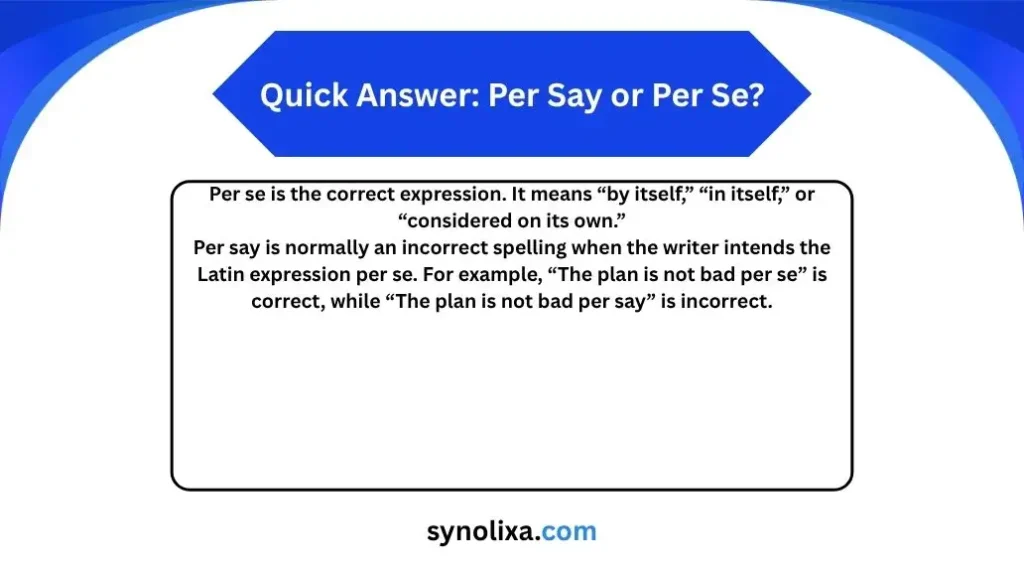
Per se is the correct expression. It means “by itself,” “in itself,” or “considered on its own.”
Per say is normally an incorrect spelling when the writer intends the Latin expression per se. For example, “The plan is not bad per se” is correct, while “The plan is not bad per say” is incorrect.
Understanding the Basics: Per Say or Per Se
The main difference is simple: per se is the standard expression, while per say is a common misspelling.
The word per can appear in many English expressions, but per se has a specific meaning and origin. Oxford identifies per se as an adverb from Latin and defines it as meaning “by itself,” especially when something is considered separately from other factors.
Comparison Table
| Form | Type | Meaning | Example | Correct/Incorrect |
|---|---|---|---|---|
| per se | Adverbial expression | By itself; in itself | The rule is not unfair per se. | ✅ Correct |
| per say | Common misspelling | No standard meaning in this expression | The rule is not unfair per say. | ❌ Incorrect |
| per se | Latin-derived expression | Intrinsically; considered alone | The product is not expensive per se. | ✅ Correct |
| per say | Spelling error | Intended as “per se” | It is not harmful per say. | ❌ Incorrect |
What Does “Per Se” Mean?
Per se means that you are considering something on its own, without adding other circumstances or factors.
Consider this sentence:
“Social media is not harmful per se.”
This does not mean that social media can never cause harm. It means that social media in itself is not necessarily harmful. Other factors may affect the situation.
You can often replace per se with:
- by itself
- in itself
- in its own nature
- intrinsically
- considered alone
For example:
- “The job is not difficult per se.”
- “The job is not difficult in itself.”
- “The job is not difficult by itself.”
The meaning remains similar.
Why Is “Per Se” Correct?
The expression per se comes from Latin. In English, it has been adopted as a fixed expression meaning “by itself” or “in itself.”
The important point is that se is not the English verb “say.” It is part of the Latin expression.
This explains why per say is not the correct spelling when you mean “in itself.”
Think about it this way:
Per se = by itself
The word se belongs to the original expression. Replacing it with say changes the spelling and does not preserve the standard expression.
Example
Correct:
The proposal is not unreasonable per se.
Meaning:
The proposal is not unreasonable in itself.
Incorrect:
The proposal is not unreasonable per say.
The second sentence is understandable, but the spelling of the expression is incorrect.
How to Use “Per Se” Correctly
1. To Mean “In Itself”
This is the most important use of per se.
Example:
The movie is not bad per se, but it is too long.
Here, the speaker is saying that the movie itself is not necessarily bad. The criticism is about its length.
Another example:
There is nothing wrong with the design per se.
Meaning:
There is nothing wrong with the design itself.
2. To Separate One Factor From Other Factors
Per se is useful when you want to distinguish one thing from the circumstances surrounding it.
Example:
The price is not expensive per se, but the additional fees make it costly.
The price itself is not necessarily expensive. The extra fees create the problem.
Another example:
Working from home is not difficult per se; managing distractions can be difficult.
The activity itself is not the problem. Something connected to it creates the difficulty.
3. To Add Precision to an Explanation
In professional or academic writing, per se can help make a distinction precise.
Example:
The theory is not incorrect per se, but it does not explain every situation.
The writer is not completely rejecting the theory. Instead, the writer is saying that the theory itself is not necessarily incorrect.
4. To Discuss Something in Isolation
You can use per se when an object, idea, action, or situation is being examined independently.
Example:
The technology is not dangerous per se.
This means the technology itself is not necessarily dangerous.
The surrounding context may still matter.
Sentence Breakdown: Understanding “Per Se”
Let’s examine a few examples closely.
Example 1
The restaurant is not expensive per se.
Breakdown:
- The restaurant = subject
- is not expensive = description
- per se = in itself
The speaker means the restaurant itself is not necessarily expensive.
Example 2
I don’t dislike the idea per se.
Breakdown:
- I = subject
- don’t dislike = verb phrase
- the idea = object
- per se = in itself
The speaker may have concerns about how the idea would be implemented, but the idea itself is not necessarily disliked.
Example 3
Competition is not harmful per se.
Here, per se separates competition itself from possible harmful behavior associated with competition.
Test Tip: How to Know Whether to Use “Per Se”
Here is a simple test.
Replace per se with “in itself.”
If the sentence still makes sense, per se is probably the expression you need.
For example:
The plan is not unrealistic per se.
Replace it:
The plan is not unrealistic in itself.
The sentence still makes sense. Therefore, per se is correct.
Try another:
The rule is not unfair per se.
→ The rule is not unfair in itself.
Again, the meaning works.
Easy Memory Trick 🧠
Remember:
SE = itself
So:
PER SE = in itself
Do not think of say when you hear the expression. Think of the phrase as one fixed unit:
per se
Case Study: A Workplace Email
Imagine that a manager is discussing a new software system with an employee.
The employee writes:
“The new software is not difficult per say, but the training materials are confusing.”
The intended meaning is clear, but per say is misspelled.
A corrected version would be:
“The new software is not difficult per se, but the training materials are confusing.”
Here, per se means that the software itself is not particularly difficult. The problem comes from the training materials.
This example shows why the expression can be useful in workplace communication. It allows a writer to make a careful distinction between a thing itself and another factor connected to it.
Grammar Rules: Per Se vs Per Say
The standard rule is straightforward:
Use “per se” when you mean “in itself.”
Per se is an established English expression derived from Latin.
Examples:
- The concept is not complicated per se.
- The book is not boring per se.
- The policy is not unfair per se.
- The task is not difficult per se.
Do Not Use “per say” for This Meaning
When you intend to say “in itself,” per say is considered a misspelling.
For example:
❌ The idea is not wrong per say.
✅ The idea is not wrong per se.
❌ The product is not expensive per say.
✅ The product is not expensive per se.
The spelling error often happens because se and say can sound similar in ordinary speech.
Oxford’s American English dictionary lists per se as an adverb, gives its pronunciation as approximately “pər SAY,” and identifies its meaning as “by itself.”
That pronunciation is one reason the spelling can be confusing. The sound resembles the English word say, but the written expression remains per se.
Is “Per Se” Formal?
Yes, per se can sound somewhat formal or sophisticated, especially in everyday conversation.
However, it is not incorrect or restricted to academic writing. It can appear in:
- conversations
- essays
- business writing
- journalism
- academic writing
- creative writing
- online discussions
If your audience may not be familiar with the expression, a simpler phrase such as “in itself” may sometimes be clearer.
For example:
The plan is not bad per se.
More conversational:
The plan is not bad in itself.
Both communicate essentially the same idea.
Common Mistakes With “Per Say”
Why do people write per say?
There are several common reasons.
1. Fast Typing
When people type quickly, they often write words according to how they sound rather than how they are spelled.
Because per se is pronounced similarly to “per say,” a writer may automatically type the more familiar English word say.
2. Pronunciation
This is probably one of the biggest sources of confusion.
When spoken aloud, per se sounds roughly like “per say.”
A person who has only heard the expression may reasonably assume that it is spelled per say.
3. Autocorrect
Autocorrect can sometimes reinforce familiar words. If someone types a less familiar expression incorrectly, a keyboard may suggest a familiar word.
However, autocorrect is not a reliable grammar authority. Always check the intended expression when writing something important.
4. Lack of Familiarity
Because per se comes from Latin, learners may not immediately recognize it as a fixed expression.
Once you learn that per se = in itself, the spelling becomes much easier to remember.
Similar Grammar and Spelling Confusions
The per say or per se confusion is similar to many other English errors where two forms sound alike or nearly alike.
| Confusion | Correct Form | Meaning |
|---|---|---|
| per say / per se | per se | in itself |
| it’s / its | it’s / its | it is / possessive form |
| your / you’re | your / you’re | possessive / you are |
| they’re / their / there | they’re / their / there | they are / possessive / place or existence |
| to / too / two | to / too / two | different grammatical meanings |
| affect / effect | affect / effect | influence / result, with context-dependent uses |
| then / than | then / than | time or sequence / comparison |
| accept / except | accept / except | receive or agree / excluding |
These errors happen because English spelling does not always match pronunciation perfectly.
Per Se in Everyday Conversation
You can use per se in everyday conversation, although simpler alternatives may sound more natural.
For example:
“I don’t hate the idea per se.”
A more casual version:
“I don’t hate the idea itself.”
Another example:
“It’s not difficult per se.”
A simpler alternative:
“It’s not difficult by itself.”
Both are grammatically understandable.
The choice depends on your audience and style.
Per Se in Professional Writing
Per se can be useful in professional writing when you need to make a distinction.
Consider this sentence:
The software is not unreliable per se, but the current configuration creates problems.
The phrase helps distinguish the software from the way it has been configured.
Another example:
The proposal is not impractical per se; however, it would require additional resources.
This is useful because the writer is not simply labeling the entire proposal as impractical. The writer is making a narrower point.
Professional Writing Tip
Although per se is acceptable, avoid using it simply to make writing sound more sophisticated.
If “in itself” is clearer, use “in itself.”
Clear writing is usually better than unnecessarily complicated writing.
Per Se in Creative Writing
Creative writers may use per se when they want a particular voice or rhythm.
For example:
It wasn’t the silence that frightened her per se; it was what the silence seemed to hide.
The phrase creates a subtle distinction between the silence itself and the meaning attached to it.
In creative writing, however, context matters. If a simpler phrase sounds more natural for the character or narrator, use it.
Per Se in Social Media and Texting
You may encounter per se on:
- Instagram captions
- social media posts
- comments
- text messages
- online forums
- discussion boards
For example:
“I’m not against the idea per se.”
Or:
“The trend isn’t bad per se.”
Because social media is informal, people also make spelling mistakes frequently. Seeing per say online does not make it the standard spelling.
If you are writing a school assignment, professional post, article, or formal message, use per se.
Why It Matters
Correct spelling matters because readers should not have to stop and interpret what you meant.
Using per se correctly can improve:
Clarity
Correct spelling makes your intended expression immediately recognizable.
Professionalism
In business, academic, and formal writing, small spelling mistakes can distract readers from your main point.
Accuracy
Using the established form shows that you understand the expression rather than simply reproducing the way it sounds.
Digital Communication
Online writing spreads quickly. A misspelled phrase can be copied repeatedly, making an incorrect spelling look more common than it actually is.
A useful writing principle is:
Clear writing helps readers focus on your message instead of your mistakes.
Special Exception: Can “Per Say” Ever Be Correct?
There is an important distinction here.
Per say is not the standard spelling of the Latin-derived expression meaning “in itself.”
However, two words can theoretically appear together in an unrelated sentence if per and say have their own grammatical roles.
For example:
Per the instructions, say the sentence aloud.
Here, per means “according to,” while say is an ordinary English verb.
This is completely different from the expression per se.
So, if you are asking:
“Is it per say or per se when I mean ‘in itself’?”
The answer is:
Per se.
Per Se vs “In Itself”
These expressions are closely related.
| Expression | Meaning | Example |
|---|---|---|
| per se | in itself | The idea isn’t bad per se. |
| in itself | considered alone | The idea isn’t bad in itself. |
| by itself | alone or without help | The machine can operate by itself. |
| intrinsically | naturally or essentially | The material is not intrinsically harmful. |
However, these alternatives are not always interchangeable in every sentence.
For example:
“She completed the task by herself.”
This usually means she completed it without help.
You would not normally replace by herself with per se.
Compare:
“The task is not difficult per se.”
Here, per se means the task itself is not difficult.
So, always consider the exact meaning you want.
When Should You Avoid “Per Se”?
Although per se is correct, there are situations where another phrase may be better.
Avoid It When Your Audience May Not Know the Expression
Instead of:
The system isn’t flawed per se.
You could write:
The system isn’t flawed in itself.
Avoid It When “Alone” Is the Real Meaning
For example:
She completed the project alone.
This is not the same as:
She completed the project per se.
Per se is not simply another word for “alone” when talking about a person’s actions.
Avoid It When a Simpler Word Is More Natural
Good writing is not about using the most sophisticated expression. It is about communicating clearly.
Quick Recap Checklist
Use this checklist whenever you are unsure about per say or per se.
| Question | If Yes → Use |
|---|---|
| Do you mean “in itself”? | per se |
| Do you mean “by itself” in the sense of considering something alone? | per se |
| Are you discussing something independently from other factors? | per se |
| Are you simply writing the English verb “say” after the word “per”? | per say may occur only if the two words have separate grammatical roles |
| Are you using the common expression meaning “in itself”? | per se |
Practice Example 1
The product isn’t dangerous ___, but it must be used correctly.
Answer: per se
Correct sentence:
The product isn’t dangerous per se, but it must be used correctly.
Practice Example 2
I don’t disagree with the proposal ___.
Answer: per se
Correct sentence:
I don’t disagree with the proposal per se.
Practice Example 3
The price isn’t unreasonable ___, but the additional costs are high.
Answer: per se
Correct sentence:
The price isn’t unreasonable per se, but the additional costs are high.
More Examples of “Per Se”
Here are additional examples to reinforce the correct usage:
- The design is not unattractive per se.
- The rule is not unreasonable per se.
- I have no objection to the plan per se.
- The assignment is not difficult per se.
- The argument is not incorrect per se.
- The book is not boring per se.
- The decision is not harmful per se.
- The method is not ineffective per se.
- The technology is not dangerous per se.
- The restaurant is not expensive per se.
- The idea is not unusual per se.
- The criticism is not unfair per se.
- The policy is not problematic per se.
- The approach is not outdated per se.
- The change is not negative per se.
In each sentence, per se means that the subject is being considered in itself.
FAQs
Is “per say” correct?
No, not when you intend the standard expression meaning “in itself.” The correct form is per se.
What does “per se” mean?
Per se means “by itself,” “in itself,” or “considered on its own.” It is used when something is being discussed separately from other factors.
Why do people spell it “per say”?
The confusion usually comes from pronunciation. Per se sounds approximately like “per say,” so people who have mainly heard the expression may spell it according to its sound.
Is “per se” formal?
It can sound somewhat formal or sophisticated, but it is a standard English expression. In casual writing, “in itself” can sometimes be a simpler alternative.
Can “per say” ever appear correctly?
Yes, but only when per and say are functioning as separate words in a sentence. It is not the correct spelling of the fixed expression per se.
What is an easy way to remember “per se”?
Remember:
Per se = in itself.
If you can replace the phrase with “in itself,” you probably want per se, not per say.
Conclusion
When choosing between per say or per se, the correct answer is almost always per se when you mean “in itself,” “by itself,” or “considered on its own.” The expression comes from Latin and has become an established part of English. Oxford’s American English dictionary identifies per se as an adverb meaning “by itself,” which confirms the standard spelling and usage.
The incorrect form per say is easy to understand because the two expressions sound alike. However, pronunciation should not determine the spelling. When you are talking about something in isolation or describing its nature on its own, write per se.
A simple memory trick can help: per se = in itself. If that substitution makes sense, choose per se.
Once you remember this rule, you will no longer need to pause over this common spelling question. ✨
When in doubt, remember: “in itself” = “per se.”

Hi, I am Clara Anderson. I work at Synolixa as a vocabulary writer, focusing on synonyms, word meanings, and easy-to-understand English learning content.
[…] or everyday message, knowing when to use than and then will help you avoid a very common mistake. Per Say or Per Se | Unalienable vs Inalienable | Beloved vs […]
[…] trick that will help you choose the correct word every time. 📝 Better Than or Better Then | Per Say or Per Se | Unalienable vs […]