Have you ever typed a sentence and suddenly stopped because you were unsure whether to use wonder or wander? You are not alone. These two words look and sound somewhat similar, but they have completely different meanings and uses. Understanding the difference between wonder vs wander is important because choosing the wrong word can change the meaning of your sentence.
The word wonder is usually connected with curiosity, questions, amazement, or admiration. For example, you might say, “I wonder what happened.” The word wander, on the other hand, describes moving around without a clear direction or purpose. For example, “We wandered through the park.”
The confusion often happens because both words begin with “w” and contain similar sounds. Fast typing, autocorrect, and unfamiliarity with the words can also lead to mistakes. Fortunately, the difference is easy to remember once you connect each word with its main idea.
In this guide, we will explain wonder vs wander in simple US English, show you how to use both words correctly, and provide practical examples you can remember. Minuet vs Minute | Better Than or Better Then | Per Say or Per Se
Quick Answer: Wonder vs Wander
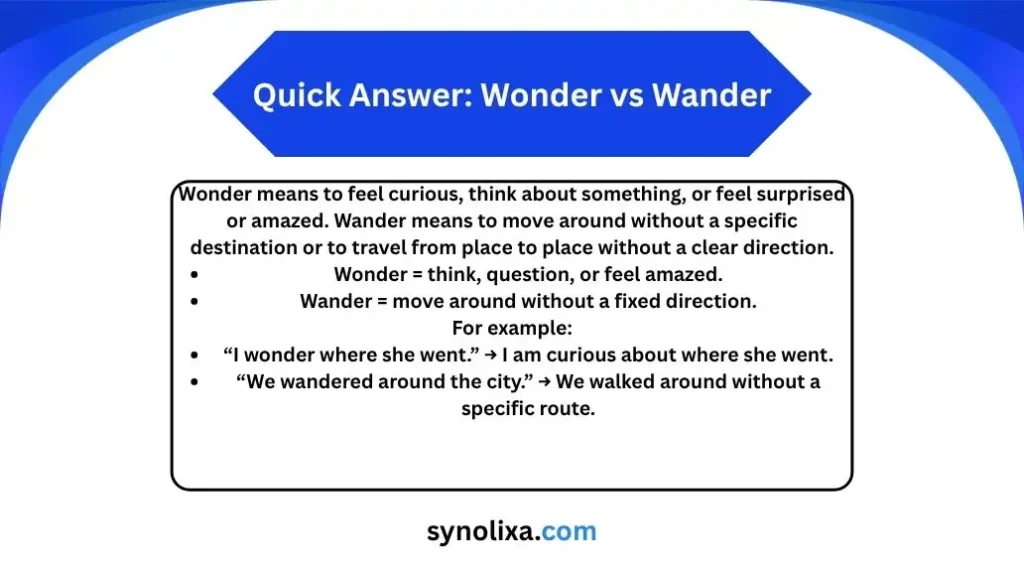
Wonder means to feel curious, think about something, or feel surprised or amazed. Wander means to move around without a specific destination or to travel from place to place without a clear direction.
- Wonder = think, question, or feel amazed.
- Wander = move around without a fixed direction.
For example:
- “I wonder where she went.” → I am curious about where she went.
- “We wandered around the city.” → We walked around without a specific route.
A simple memory trick is: wonder happens in your mind; wander happens with your movement.
Understanding the Basics: Wonder vs Wander
The easiest way to understand wonder vs wander is to focus on the action each word describes.
Wonder is generally a mental or emotional activity. You wonder when you are curious, uncertain, amazed, or thinking deeply about something.
Wander is generally a physical activity. You wander when you walk, travel, or move around without a particular destination or clear direction.
Comparison Table
| Form | Type | Meaning | Example | Correct/Incorrect |
|---|---|---|---|---|
| Wonder | Verb | To feel curious or think about something | I wonder what happened. | Correct |
| Wonder | Noun | A feeling of amazement or something remarkable | The view was a wonder. | Correct |
| Wander | Verb | To move around without a clear direction | We wandered through the town. | Correct |
| Wander | Noun | A walk or period of moving around | We went for a wander. | Correct, less common in US English |
| Wonder | Verb | To walk without direction | I wonder around the park. | Incorrect |
| Wander | Verb | To ask yourself a question | I wander why she left. | Incorrect |
The key distinction is simple:
Wonder is about curiosity or amazement. Wander is about movement.
Correct Meanings and Uses of Wonder
1. Wonder as a Verb Meaning “Be Curious”
One of the most common uses of wonder is to express curiosity.
For example:
“I wonder where John is.”
This means the speaker is curious about John’s location.
The sentence can be broken down like this:
- I = subject
- wonder = feel curious
- where John is = the information the speaker wants to know
More examples:
- I wonder what time the store closes.
- She wonders why he did that.
- We wonder whether they will come.
- He wondered what was inside the box.
- They wondered how the machine worked.
In all these examples, wonder relates to a question or uncertainty.
2. Wonder as a Verb Meaning “Think About Something”
Wonder can also describe thinking about a possibility.
For example:
“I wonder if it will rain tomorrow.”
The speaker is considering the possibility of rain.
Other examples include:
- I wonder if she remembers me.
- He wondered whether his idea would work.
- We wonder if they are still waiting.
- She wondered what would happen next.
Here, wonder does not mean physically moving. It describes a thought.
3. Wonder as a Verb Meaning “Be Amazed”
Wonder can also mean to feel amazement or admiration.
For example:
“The children wondered at the beauty of the stars.”
In this sense, wonder is connected to amazement and admiration.
You may also see expressions such as:
- a sense of wonder
- wonder at the beauty of nature
- wonder at the discovery
- filled with wonder
For example:
“The young child looked at the snow with wonder.”
The child feels amazed or fascinated.
4. Wonder as a Noun
Wonder can also function as a noun.
As a noun, it can describe something extraordinary, amazing, or remarkable.
For example:
“The ancient structure is a wonder of engineering.”
Here, wonder means something remarkable or amazing.
Another example:
“She looked at the night sky in wonder.”
In this sentence, wonder means a feeling of amazement.
Test Tip for Wonder
When you are unsure whether to use wonder, replace it with:
- ask myself
- be curious
- think about
- be amazed
If one of these meanings works, wonder is probably the correct word.
For example:
“I wonder where they went.”
Replace “wonder” with “am curious.”
“I am curious where they went.”
The basic meaning remains clear, so wonder is correct.
Correct Meanings and Uses of Wander
1. Wander as a Verb Meaning “Move Without Direction”
The most common meaning of wander is to move around without a specific destination or route.
For example:
“We wandered around the old neighborhood.”
This means we walked around without following a specific route.
Other examples:
- She wandered through the market.
- They wandered around the city.
- I wandered along the beach.
- He wandered through the garden.
- The tourists wandered around the village.
The important idea is movement without a fixed direction.
2. Wander Can Describe Walking Slowly or Casually
You do not always have to be completely lost to wander.
You can wander simply because you are walking casually and exploring.
For example:
“We wandered through the bookstore for an hour.”
This does not necessarily mean you were lost. It means you moved around casually, looking at different things.
Another example:
“She wandered through the park while listening to music.”
Again, the emphasis is on relaxed movement rather than a specific destination.
3. Wander Can Mean “Stray From a Path”
Wander can also describe moving away from a planned route.
For example:
“The hikers wandered off the main trail.”
This means they left the main trail.
It can also be used more generally:
“The conversation wandered away from the original topic.”
Here, wander is being used figuratively. The conversation moves away from its original subject.
4. Wander Can Describe Thoughts
Although wander is often physical, it can also be used with thoughts.
For example:
“My mind began to wander during the lecture.”
This means the person’s thoughts stopped focusing on the lecture and moved to other subjects.
Other examples:
- My thoughts wandered to childhood memories.
- His mind wandered during the meeting.
- Her attention wandered while she was reading.
This is still connected to the basic idea of moving without a fixed direction, but the movement is mental rather than physical.
Test Tip for Wander
When you are unsure whether to use wander, replace it with:
- walk around
- move without direction
- roam
- drift
- stray
For example:
“We wandered through the city.”
Replace “wandered” with “walked around.”
“We walked around the city.”
The meaning still works, so wandered is correct.
Wonder vs Wander in Simple Sentences
Seeing the words side by side can make the difference much easier to remember.
Wonder
- I wonder what she is doing.
- We wonder why the store is closed.
- He wondered whether they would arrive.
- She wondered about the answer.
- I wonder if he remembers me.
Wander
- We wandered around the park.
- She wandered through the museum.
- The dog wandered into the yard.
- They wandered along the street.
- My mind began to wander.
Notice the difference:
Wonder → curiosity or thought
Wander → movement or drifting
Compare These Two Sentences
“I wonder around the park.” ❌
This is incorrect if you mean that you walk around the park.
The correct sentence is:
“I wander around the park.” ✅
Now look at another example:
“I wander why she left.” ❌
If you mean that you are curious about why she left, the correct sentence is:
“I wonder why she left.” ✅
These examples show how changing one letter can completely change the meaning.
Wonder vs Wander: Pronunciation
Pronunciation can also help you distinguish the words.
In common US English pronunciation:
- wonder sounds approximately like WUN-der
- wander sounds approximately like WAHN-der
The vowel sound in the first syllable is different.
However, pronunciation can vary among speakers and accents. That is why relying only on sound is not always the best way to distinguish them.
The meaning is much more reliable.
If the sentence is about curiosity, choose wonder.
If the sentence is about moving around, choose wander.
Case Study: A Workplace Conversation
Imagine two coworkers discussing a project.
One coworker says:
“I wonder whether the client will approve the design.”
This is correct because the person is expressing uncertainty or curiosity.
Later, the same coworker says:
“I wandered around the office looking for the meeting room.”
This is also correct because the person physically moved around without immediately finding the destination.
Now imagine these incorrect versions:
“I wander whether the client will approve the design.” ❌
This should be wonder because the speaker is expressing curiosity.
“I wonder around the office looking for the meeting room.” ❌
This should be wander because the speaker is describing movement.
This workplace example shows why the distinction matters. A single letter can change the meaning of the sentence.
Grammar Rules for Wonder and Wander
Both wonder and wander are standard English words. Neither is simply a misspelling of the other.
The grammar rule depends on meaning.
Use Wonder When You Mean:
- be curious
- ask yourself something
- think about a possibility
- feel amazement
- regard something as remarkable
Examples:
- I wonder what happened.
- She wonders if he will call.
- We wondered about the result.
- They looked at the view in wonder.
Use Wander When You Mean:
- walk around
- move without a fixed destination
- roam
- drift
- stray from a path
- lose focus or move mentally away from a topic
Examples:
- We wandered through the park.
- He wandered around the city.
- The dog wandered away.
- My mind wandered during class.
Standard dictionaries, including Merriam-Webster, treat wonder and wander as distinct words with different meanings and pronunciations. The important point is that one cannot normally replace the other simply because the words look similar.
Common Mistakes With Wonder and Wander
Why do people confuse these words?
Several common factors contribute to the mistake.
1. Fast Typing
When people type quickly, they may write:
“I wander what happened.”
instead of:
“I wonder what happened.”
The error is easy to make because the words are visually similar.
2. Autocorrect
Autocorrect can sometimes change a word based on context or typing patterns. If you do not reread the sentence, the incorrect word may remain unnoticed.
3. Lack of Vocabulary Knowledge
Someone who has not learned the difference may assume the words have similar meanings because they look alike.
4. Sound Confusion
In casual speech, the difference between vowel sounds may not always be obvious to every listener.
5. Context Confusion
Some sentences contain abstract uses of wander, such as:
“My mind wandered.”
Because this describes mental activity, a learner may mistakenly associate wander with all forms of thinking.
Similar Grammar Confusions
Wonder and wander are part of a larger group of commonly confused English words.
| Confusing Words | Correct Difference | Example |
|---|---|---|
| Its / It’s | Possession vs. “it is” or “it has” | The dog wagged its tail. |
| Your / You’re | Possession vs. “you are” | You’re holding your phone. |
| Their / They’re | Possession vs. “they are” | They’re in their house. |
| Then / Than | Time/order vs. comparison | Better than before. |
| To / Too | Direction/infinitive vs. also/excessively | I want to go too. |
| Affect / Effect | Usually verb vs. usually noun | The change affected the result. |
| Wonder / Wander | Curiosity vs. movement | I wonder where he went. |
| Weather / Whether | Atmospheric conditions vs. alternatives/uncertainty | I wonder whether it will rain. |
| Lose / Loose | Fail to keep vs. not tight | Don’t lose the loose button. |
| Advice / Advise | Noun vs. verb | She gave me good advice. |
Learning these pairs can greatly improve everyday writing accuracy.
Wonder vs Wander in Everyday Conversation
Both words are common in ordinary conversation.
Examples With Wonder
- I wonder what time it is.
- I wonder if they are coming.
- I wonder why he left early.
- I wonder what she thinks.
- I wonder whether this is the right choice.
Examples With Wander
- Let’s wander around downtown.
- We wandered through the shops.
- The kids wandered around the backyard.
- I like to wander through bookstores.
- We wandered along the river.
A useful rule is:
Questions in your mind → wonder
Movement through a place → wander
Wonder vs Wander in Professional Writing
Professional writing requires precision.
Consider this sentence:
“I wonder if you could send the updated report.”
Here, wonder can be used to make a request sound polite.
For example:
“I was wondering if you could send the updated report by Friday.”
This is common in professional communication.
Now consider:
“The discussion wandered away from the main issue.”
Here, wandered describes how the discussion moved away from its intended topic.
Professional examples include:
- I wonder whether the client has reviewed the proposal.
- We wondered if the deadline could be extended.
- The discussion wandered into unrelated topics.
- The report begins clearly but later wanders from the main argument.
Using the correct word makes professional writing easier to understand.
Wonder vs Wander in Creative Writing
Creative writers use both words to create different effects.
Wonder
Wonder can create a feeling of mystery, curiosity, or amazement.
Example:
“She looked at the unfamiliar stars and wondered what existed beyond them.”
The word wondered creates curiosity.
Wander
Wander can create an image of physical or mental movement.
Example:
“He wandered through the quiet streets until the city lights began to disappear.”
Here, wandered gives the reader a sense of movement without a strict destination.
Writers may also combine both words:
“As she wandered through the forest, she wondered where the path would lead.”
This sentence is especially useful because it contains both words correctly.
- wandered = physically moved
- wondered = thought or felt curious
Wonder vs Wander in Social Media and Texting
Social media and texting often involve fast writing, which can increase spelling mistakes.
You might see:
“I wander what happened 😭”
The intended sentence is usually:
“I wonder what happened 😭”
Similarly:
“We wondered around the city all day.”
should be:
“We wandered around the city all day.”
Texting is informal, but using the correct word still helps your message communicate exactly what you mean.
A quick reread before sending can catch many mistakes.
Why Wonder vs Wander Matters
Correct word choice matters because English words can have very specific meanings.
1. Clarity in Communication
The wrong word can make your sentence confusing.
Compare:
“I wonder around the neighborhood.”
with:
“I wander around the neighborhood.”
The second sentence clearly describes movement.
2. Professionalism
Correct word choice is especially important in:
- emails
- reports
- applications
- school assignments
- workplace messages
- presentations
A small spelling mistake may distract readers from your main point.
3. Digital Communication
People communicate constantly through:
- text messages
- social media
- online comments
- digital documents
Because written communication is everywhere, understanding commonly confused words is useful.
4. Better Vocabulary
Learning the difference between similar-looking words improves your overall vocabulary.
As a useful reminder:
“Choose the word that matches the meaning, not the spelling.”
Special Exceptions and Edge Cases
There is no major grammatical exception that makes wonder and wander interchangeable.
However, both words have several extended meanings.
For example:
“My mind wandered.”
Here, wander is not physical. It means your thoughts moved away from the subject you were supposed to be focusing on.
Similarly:
“The wonder of nature is difficult to describe.”
Here, wonder is a noun describing amazement or something remarkable.
There are also proper names, titles, and brand names that may contain either word. In those cases, the word may be part of a specific name rather than being used according to its ordinary dictionary meaning.
The general rule remains unchanged:
Wonder = curiosity, thought, or amazement.
Wander = movement, roaming, drifting, or straying.
A Simple Memory Trick for Wonder vs Wander
If you frequently confuse these words, try this memory trick:
Wonder = “Why?”
When you wonder, you often have a question in your mind.
“I wonder why she left.”
Think:
Wonder → Why?
Wander = “Walk”
When you wander, you often move around.
“We wandered through the park.”
Think:
Wander → Walk
You can also remember:
Wonder uses your mind. Wander uses your feet.
This is not a complete description of every figurative use, but it is an excellent starting point for everyday English.
Quick Recap Checklist
Use this checklist whenever you are unsure.
| Question | If Yes → Use |
|---|---|
| Am I asking myself something? | Wonder |
| Am I curious about something? | Wonder |
| Am I expressing amazement? | Wonder |
| Am I talking about walking around? | Wander |
| Am I describing movement without a clear direction? | Wander |
| Am I describing thoughts drifting away from a topic? | Wander |
Practice Example 1
I ___ what time the movie starts.
The sentence describes curiosity.
Answer: wonder
Correct sentence:
“I wonder what time the movie starts.”
Practice Example 2
We ___ around the museum for two hours.
The sentence describes physical movement.
Answer: wandered
Correct sentence:
“We wandered around the museum for two hours.”
Practice Example 3
My mind began to ___ during the meeting.
The sentence describes thoughts drifting away from the subject.
Answer: wander
Correct sentence:
“My mind began to wander during the meeting.”
FAQs
1. What is the difference between wonder and wander?
Wonder means to feel curious, think about something, or feel amazement. Wander means to move around without a fixed direction or destination.
Example:
- I wonder what happened.
- We wandered through the park.
2. Is it “I wonder” or “I wander”?
Use “I wonder” when you mean “I am curious” or “I am thinking about something.”
Correct:
“I wonder where she is.”
“I wander” is used when you mean that you physically move around.
Correct:
“I wander around the neighborhood on weekends.”
3. Is “I wander why” correct?
No, not when you mean that you are asking yourself why something happened.
The correct phrase is:
“I wonder why.”
For example:
“I wonder why he left early.”
4. Is “wander around” correct?
Yes. Wander around is a common expression meaning to move around casually without a fixed route or destination.
Example:
“We wandered around the city after lunch.”
5. Can wonder and wander both describe the mind?
Yes, but they describe different ideas.
Wonder describes curiosity or thinking:
“I wonder what she meant.”
Wander can describe thoughts drifting away from a subject:
“My mind wandered during the lecture.”
6. What is an easy way to remember wonder vs wander?
Remember:
Wonder = curiosity.
Wander = movement.
A simple memory phrase is:
“Wonder asks; wander moves.”
Conclusion
The difference between wonder vs wander is simple once you focus on meaning. Wonder is mainly connected with curiosity, thought, questions, and amazement. Wander is mainly connected with moving, roaming, drifting, or straying without a fixed direction.
Use wonder when you are curious:
“I wonder what happened.”
Use wander when you are describing movement:
“We wandered through the park.”
Remember the easiest rule: wonder happens in your thoughts, while wander describes movement or drifting. This distinction can help you avoid one of the most common word-choice mistakes in everyday English.
Whether you are writing an email, completing an assignment, sending a text, or creating a social media post, choosing the correct word makes your message clearer.
So, when you stop and ask yourself, “Which one should I use?” remember:
Wonder asks. Wander moves. Once you remember that, you will rarely confuse them again.

Hi, I am Ava Mitchell. I work at Synolixa as an English content writer, creating simple and useful resources about synonyms, vocabulary, and English usage.