Beloved vs loved is a common English word-choice question because both words describe affection, care, or strong positive feelings. Have you ever wondered whether they mean exactly the same thing? These two words are closely related, but they are not always interchangeable. The main difference comes down to tone, emotional strength, context, and grammatical function.
Loved is the more common and neutral word. It can describe the action of loving someone or something, or it can describe someone who receives affection. For example, “She is loved by her family” is a natural everyday sentence.
Beloved usually expresses a deeper or more special sense of affection. It can mean dearly loved, deeply cherished, or greatly valued. For example, “She was a beloved teacher” suggests that she was especially cherished by her students and community.
Understanding the difference between beloved vs loved can help you choose the right word for everyday conversations, professional writing, social media posts, speeches, and creative writing. ❤️ Do Not vs Dont | Savor vs Saver | Proved vs Proven
Quick Answer: Beloved vs Loved
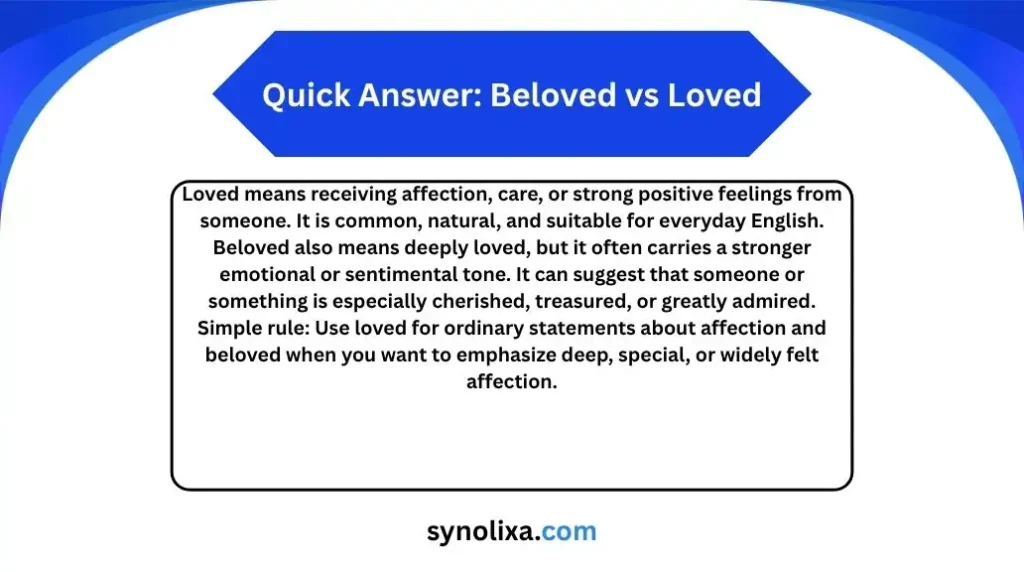
Loved means receiving affection, care, or strong positive feelings from someone. It is common, natural, and suitable for everyday English.
Beloved also means deeply loved, but it often carries a stronger emotional or sentimental tone. It can suggest that someone or something is especially cherished, treasured, or greatly admired.
Simple rule: Use loved for ordinary statements about affection and beloved when you want to emphasize deep, special, or widely felt affection.
Understanding the Basics: Beloved vs Loved
The easiest way to understand beloved vs loved is to think about their emotional intensity.
Loved
Loved is the past participle and past-tense form of the verb love. It can function as part of a verb phrase or as an adjective.
Examples:
- She is loved by her parents.
- He loved his childhood home.
- The children felt loved and supported.
- This song is loved by many people.
The word is broad and flexible. It can describe romantic love, family affection, friendship, appreciation, or strong attachment.
Beloved
Beloved can also function as an adjective, noun, or part of a verb form depending on the sentence.
As an adjective, it means dearly loved, greatly cherished, or deeply valued.
Examples:
- She was his beloved grandmother.
- The town remembers its beloved teacher.
- This is my beloved childhood book.
As a noun, beloved can refer to a person who is dearly loved.
Example:
- He wrote a letter to his beloved.
In this use, beloved has a more literary or romantic feeling.
Comparison Table
| Form | Type | Meaning | Example | Correct/Incorrect |
|---|---|---|---|---|
| loved | Verb/adjective | Received or experienced love | She is loved by her family. | Correct |
| beloved | Adjective/noun | Deeply or dearly loved | She was a beloved teacher. | Correct |
| loved | Adjective | Having affection or being cherished | He is a loved member of the team. | Correct, though less idiomatic in some contexts |
| beloved | Adjective | Especially cherished or admired | The beloved coach retired. | Correct |
| belove | Verb | Rare/archaic form related to beloved | The old text uses “belove.” | Rare/archaic |
The key distinction is not that one word is grammatically correct while the other is incorrect. Both are correct words. The important difference is how they are used and what emotional tone they create.
What Does “Loved” Mean?
The word loved comes from the verb love.
To love someone can mean to have deep affection for that person. To love something can mean to enjoy it greatly, value it, or feel strong attachment to it.
Loved as a Verb
When loved is used as a verb, it usually describes an action or emotional state in the past.
Examples:
- She loved her grandmother.
- They loved the movie.
- He loved playing soccer as a child.
- We loved our trip to California.
In these sentences, loved tells us what someone felt or enjoyed.
Loved as an Adjective
Loved can also describe someone or something that receives affection.
Examples:
- She is deeply loved by her family.
- He is a loved member of the community.
- The old restaurant remains loved by local customers.
The adjective loved is generally straightforward and neutral.
Sentence Breakdown
Consider this sentence:
The child felt loved by her parents.
- The child = subject
- felt = linking verb
- loved = adjective/past participle describing the child’s emotional experience
- by her parents = identifies the people showing the love
The sentence communicates that the child experienced affection and care.
What Does “Beloved” Mean?
Beloved means dearly loved, greatly cherished, or deeply valued.
It often adds emotional emphasis to a sentence.
For example:
The beloved teacher retired after forty years.
This does more than say that students liked the teacher. The word beloved suggests that the teacher was especially cherished by students, colleagues, or the community.
Beloved as an Adjective
This is the most common modern use.
Examples:
- She was a beloved mother.
- The beloved author died at an advanced age.
- The park is a beloved part of the neighborhood.
- He returned to his beloved hometown.
The word can describe people, places, objects, traditions, animals, books, characters, and even ideas.
Beloved as a Noun
Beloved can also be used as a noun, especially in literary or romantic writing.
Examples:
- She waited for her beloved.
- He wrote poems about his beloved.
- The character mourned the loss of his beloved.
This use is more poetic and less common in ordinary conversation.
The Main Difference Between Beloved and Loved
The central difference between beloved vs loved is degree and tone.
Loved is broad and everyday.
Beloved is more emotionally intense and often suggests that the person or thing is especially cherished.
Compare these sentences:
My grandmother was loved by everyone.
and
My grandmother was beloved by everyone.
Both are correct.
The first sentence simply says that people loved her.
The second sentence creates a warmer and more emotional impression. It suggests that she was deeply cherished.
Another Example
This is my loved childhood book.
This sentence is grammatically possible, but it sounds unnatural in many contexts.
A more natural sentence would be:
This is my beloved childhood book.
Here, beloved clearly communicates a special emotional attachment.
However, loved works naturally in sentences such as:
This book is loved by millions of readers.
In that sentence, loved focuses on popularity and affection rather than the speaker’s personal sentimental attachment.
Loved vs Beloved: Emotional Strength
One useful way to remember the difference is to think about emotional emphasis.
Loved
Loved can be:
- Neutral
- Everyday
- Direct
- Personal
- Romantic
- Familial
- General
Examples:
- I felt loved.
- She is loved by her children.
- This movie is loved by fans.
- He loved his dog.
Beloved
Beloved can be:
- Deeply emotional
- Sentimental
- Warm
- Formal
- Literary
- Respectful
- Strongly affectionate
Examples:
- Her beloved dog passed away.
- The beloved teacher was honored.
- He returned to his beloved hometown.
- The beloved tradition continues today.
This does not mean beloved is always stronger in every possible context. Context determines meaning and tone. However, it generally carries more emotional weight than the simple word loved.
Correct Meanings and Uses
1. Use “Loved” for Everyday Affection
When you simply want to say that someone receives love, loved is usually the natural choice.
Examples:
- Every child deserves to feel loved.
- She is loved by her family.
- He knew that he was loved.
- They wanted their daughter to feel loved.
These sentences are natural and conversational.
2. Use “Beloved” for Deep Affection
Use beloved when the person or thing is especially cherished.
Examples:
- She was a beloved grandmother.
- The town lost its beloved mayor.
- His beloved dog was always by his side.
- The restaurant is a beloved local institution.
The word creates a stronger emotional image.
3. Use “Loved” for Popularity
Loved is especially useful when talking about something that many people enjoy.
Examples:
- The movie is loved by audiences around the world.
- This recipe is loved by families everywhere.
- The singer is loved by millions of fans.
- The game is loved by children and adults.
Here, beloved could sometimes work, but loved is often more direct.
4. Use “Beloved” for Sentimental Writing
Beloved is common in emotional writing.
Examples:
- In memory of our beloved friend.
- She returned to her beloved hometown.
- He dedicated the book to his beloved wife.
- The family remembered their beloved grandfather.
This word works particularly well when expressing remembrance or strong emotional attachment.
A Useful Test Tip
When deciding between loved and beloved, ask yourself:
Am I simply saying that someone receives love, or am I emphasizing that they are deeply cherished?
If you are simply describing affection, choose loved.
If you want to emphasize deep affection, special attachment, or sentimental value, beloved may be the better choice.
Quick Test
She is ___ by her family.
The natural answer is:
She is loved by her family.
Now consider:
She was a ___ grandmother whose memory remains with everyone.
The natural choice is:
She was a beloved grandmother.
The context changes the best word.
Case Study: A Workplace Example
Imagine that a longtime teacher is retiring after 30 years at a school.
A principal writes:
“Ms. Carter has been a loved member of our school community.”
This sentence is understandable, but it sounds somewhat unusual.
A more natural version would be:
“Ms. Carter has been a beloved member of our school community.”
Why?
The principal is not merely saying that people had affection for Ms. Carter. The message emphasizes her importance and the strong emotional connection the school community has with her.
Now imagine an employee speaking casually:
“I know I am loved by my family, and they support me.”
Here, loved is perfect because the speaker is simply describing the affection they receive.
Practical Lesson
In professional writing, beloved can work well when describing a person who has had a meaningful and cherished role in a community.
However, it should not be used simply to make every sentence sound more emotional. Loved is often clearer and more natural.
Grammar Rules: Is “Beloved” Correct English?
Yes. Beloved is a standard English word.
It is traditionally connected to the verb love and is used as an adjective meaning something like dearly loved or greatly cherished.
Standard dictionaries, including Merriam-Webster, recognize beloved as a word associated with being dearly loved or greatly loved.
The important point is that beloved is not simply a “fancier spelling” of loved.
The words have overlapping meanings, but their usage and tone can differ.
Why “Beloved” Sounds Different
The prefix-like structure and historical development of beloved give it a distinctive established meaning. Modern speakers often use it as a fixed adjective.
Compare:
- loved friend
- beloved friend
The first simply states that the friend is loved.
The second suggests that the friend is particularly cherished.
Is “Beloved” a Past Tense?
Not normally in modern everyday English.
For example:
She loved him.
Here, loved is the past tense of love.
You would not normally replace it with beloved:
She beloved him. ❌
That sentence is incorrect in standard modern English.
Instead:
She loved him. ✅
Or:
He was her beloved. ✅
This distinction is extremely important.
Common Mistakes With Beloved and Loved
People sometimes confuse these words because they are closely connected.
Mistake 1: Using “Beloved” as a Normal Past-Tense Verb
Incorrect:
She beloved her children.
Correct:
She loved her children.
Beloved does not normally function as the simple past tense of love in modern standard English.
Mistake 2: Thinking Beloved Is Always More Correct
Some writers assume that beloved is a more sophisticated version of loved.
That is not true.
Both words are correct, but they serve different purposes.
Compare:
He is loved by his family.
He is beloved by his family.
Both are grammatical. The second has a more elevated or emotional tone.
Mistake 3: Overusing Beloved
Using beloved in every emotional sentence can make writing sound unnatural or overly dramatic.
For example:
My beloved sandwich was delicious.
This could be humorous or intentionally dramatic, but it is not the normal choice for ordinary writing.
A simpler sentence would be:
I loved the sandwich.
Mistake 4: Assuming Loved Is Always Weak
Loved can express extremely strong emotion.
For example:
She was deeply loved by her family.
The word deeply increases the emotional intensity without requiring beloved.
Similar Grammar Confusions
English contains many pairs that look or sound similar but work differently.
| Confusion | Correct Use | Example |
|---|---|---|
| it’s / its | it’s = it is; its = possession | It’s cold. / The dog wagged its tail. |
| your / you’re | your = possession; you’re = you are | Your book is here. / You’re early. |
| their / they’re | their = possession; they’re = they are | Their car is new. / They’re ready. |
| affect / effect | affect usually = influence; effect usually = result | Music can affect mood. |
| then / than | then = time/order; than = comparison | Eat first, then leave. / Taller than me. |
| accept / except | accept = receive; except = excluding | I accept the offer. |
| beloved / loved | beloved = deeply cherished; loved = received love | She was a beloved teacher. |
Why Do These Mistakes Happen?
Common reasons include:
- Fast typing
- Autocorrect
- Spell-check limitations
- Lack of grammar knowledge
- Similar meanings
- Similar word forms
- Writing without proofreading
- Confusing spoken and written English
The solution is simple: slow down when the distinction matters and consider the role of the word in the sentence.
Beloved vs Loved in Everyday Conversation
In everyday conversation, loved is generally more common.
Examples:
I loved that movie.
She is loved by everyone in the family.
He felt loved and appreciated.
These sentences sound natural and relaxed.
Beloved can also appear in conversation, but it often sounds more emotional, formal, humorous, or literary.
For example:
This is my beloved old guitar.
That sentence is perfectly correct, but it may sound more sentimental than:
This is my old guitar that I love.
The speaker’s choice depends on the intended tone.
Beloved vs Loved in Professional Writing
Professional writing requires careful attention to tone.
Loved works well when discussing popularity or customer appreciation:
The product is loved by customers across the country.
Beloved may work when discussing a respected person, institution, location, or tradition:
The beloved community leader retired after decades of service.
However, professional writers should avoid unnecessary emotional language when a neutral description is more appropriate.
For example:
The company introduced a new product.
is more objective than:
The company introduced its beloved new product.
The second sentence makes a stronger emotional claim that may not be necessary.
Beloved vs Loved in Creative Writing
Creative writing gives authors more freedom.
Beloved is especially useful when the writer wants to create a sentimental or poetic mood.
Examples:
- She walked through her beloved garden.
- He remembered his beloved childhood home.
- The character carried a photograph of his beloved mother.
- The old house remained beloved in his memories.
Loved can create a simpler and more direct style:
- She loved her garden.
- He loved his childhood home.
- He loved his mother.
- Everyone loved the old house.
Neither approach is automatically better. The writer chooses the word based on the desired voice.
Beloved vs Loved in Social Media and Texting
Social media often uses both words.
Loved
Loved is common in casual posts:
Loved this weekend! ❤️
I loved every minute of this trip.
Feeling loved today.
Beloved
Beloved can appear in tribute posts, memorials, or sentimental captions:
Remembering our beloved friend today. ❤️
Our beloved family dog will always be remembered.
Visiting my beloved hometown again.
The word beloved works particularly well when the post is emotional or commemorative.
Beloved vs Loved in Romantic Contexts
Both words can describe romantic relationships.
Examples with loved:
- She knew she was loved.
- He loved her deeply.
- They wanted to feel loved and understood.
Examples with beloved:
- She wrote a letter to her beloved.
- He returned to his beloved.
- The poem was dedicated to his beloved wife.
In romantic writing, beloved can sound poetic or old-fashioned.
For ordinary modern conversation, loved is usually more natural:
I know you love me.
rather than:
I know you beloved me. ❌
Again, beloved cannot simply replace loved as the past-tense verb.
Why the Difference Matters
Choosing between beloved vs loved matters because word choice affects meaning and tone.
1. Clarity
Using the right form helps readers understand exactly what you mean.
Compare:
She loved her father.
This describes her feelings.
Her father was beloved.
This describes how deeply cherished her father was.
2. Professionalism
Correct word choice makes writing sound polished.
Using beloved as a simple past-tense verb would create a grammatical error:
He beloved his family. ❌
Correct:
He loved his family. ✅
3. Emotional Accuracy
Sometimes you want a neutral statement. Other times you want a stronger emotional effect.
Loved can be direct.
Beloved can be more heartfelt.
4. Digital Communication
In emails, captions, messages, and posts, small word choices can change the tone significantly.
As a simple principle:
Choose the word that matches the emotion you actually want to communicate.
A Short Quote About Word Choice
“Words carry both meaning and feeling.”
This is especially true when comparing words such as loved and beloved. Their dictionary meanings overlap, but their emotional tone can be different.
Special Exceptions and Edge Cases
There is no major grammatical exception that makes beloved an alternative past-tense form of love in modern standard US English.
However, there are a few special uses worth knowing.
Beloved as a Noun
In literary or romantic language, beloved can be a noun:
She wrote a poem for her beloved.
Here, beloved means a person who is dearly loved.
Beloved as an Adjective
This is extremely common:
He was a beloved teacher.
The city is known for its beloved traditions.
Historical or Archaic Language
Older English can contain word forms that are uncommon today. You may encounter unusual uses of words related to belove in historical, poetic, or religious writing.
Modern US English normally uses:
loved
as the simple past tense of love.
Therefore, avoid replacing loved with beloved when describing an ordinary past action.
Examples: Correct and Incorrect Usage
Example 1
❌ She beloved her parents.
✅ She loved her parents.
Why?
The sentence needs the past-tense verb loved.
Example 2
❌ He was a loved teacher by everyone.
✅ He was a beloved teacher.
Why?
Beloved teacher is a natural adjective phrase for a teacher who was deeply cherished.
Example 3
✅ She is loved by her family.
This is completely correct.
Example 4
✅ She is beloved by her community.
This is also correct, but it sounds more emotional and elevated.
Example 5
✅ He loved his hometown.
This describes his affection for the place.
Example 6
✅ He returned to his beloved hometown.
This emphasizes his deep emotional attachment to the place.
Quick Recap Checklist
Use this checklist whenever you are unsure about beloved vs loved.
| Question | If Yes → Use |
|---|---|
| Am I describing a past action of loving someone or something? | loved |
| Am I saying someone receives affection? | loved |
| Am I emphasizing deep or special affection? | beloved |
| Am I describing a cherished person, place, or thing? | beloved |
| Am I using the word as a poetic noun for someone dearly loved? | beloved |
| Am I writing a simple everyday sentence? | Usually loved |
| Am I using it as the ordinary past tense of “love”? | loved |
Practice Examples
1. She ___ her grandparents very much.
Answer: loved
She loved her grandparents very much.
2. He was a ___ member of the community.
Answer: beloved
He was a beloved member of the community.
3. They felt ___ and supported.
Answer: loved
They felt loved and supported.
These examples show the main pattern clearly: loved is the ordinary form for the past action or general experience of receiving love, while beloved emphasizes something deeply cherished.
FAQs
1. Is beloved the same as loved?
Not exactly. Beloved and loved overlap in meaning, but beloved usually carries a stronger or more sentimental sense of being deeply cherished. Loved is more common and neutral.
2. Is “beloved” a past tense of “love”?
No. In modern standard English, the past tense of love is loved.
Correct:
She loved him.
Incorrect:
She beloved him.
3. Is “beloved” stronger than “loved”?
Usually, beloved has a stronger emotional or sentimental tone. However, context can change the intensity of either word. For example, “deeply loved” can express very strong affection.
4. Can I say “my beloved”?
Yes. My beloved is grammatically correct and can be used as a noun to refer to someone who is dearly loved. It is especially common in romantic, poetic, literary, or formal contexts.
5. Can “beloved” describe things?
Yes. Beloved can describe people, places, traditions, objects, books, animals, and other things that are deeply cherished.
Examples include:
- a beloved pet
- a beloved tradition
- a beloved hometown
- a beloved book
6. Which is more common: loved or beloved?
Loved is generally more common in ordinary modern English because it has many grammatical uses. Beloved is more specialized and often appears when the writer wants to emphasize deep affection, importance, or sentiment.
Conclusion
Understanding beloved vs loved becomes much easier when you focus on grammar and tone. Loved is the normal past-tense and past-participle form of the verb love. It can also describe someone or something that receives affection. It is common, flexible, and natural in everyday English.
Beloved is a related word that usually means deeply, dearly, or greatly loved. It often adds emotional warmth and can sound sentimental, respectful, literary, or formal. It can describe a cherished person, place, tradition, object, or animal, and it can also function as a noun in expressions such as “my beloved.”
The most important rule is simple: use “loved” when you need the normal verb form, and use “beloved” when you want to describe something or someone as especially cherished.
When in doubt, ask yourself whether you are describing the action of loving or emphasizing the special value of someone or something deeply cherished.
Choose the word that matches both the grammar and the feeling you want your reader to understand.

Hi, I am Noah Harrison. I work at Synolixa as an English language editor, reviewing and creating helpful content to make English learning easier and clearer.
[…] the meanings, the grammar, common mistakes, and the easiest way to remember which form to use. Beloved vs Loved | Do Not vs Dont | Savor vs […]
[…] and an easy memory trick so you never have to guess again. ✍️ Unalienable vs Inalienable | Beloved vs Loved | Do Not vs […]