When you are writing quickly, it is easy to wonder whether do not vs dont is the correct way to write this common negative expression. You may also wonder whether you should use “do not,” “don’t,” or “dont.” These forms look similar, sound similar, and are often used in the same kinds of sentences, but they are not all correct in standard English.
The confusion becomes especially common when people move between formal writing, casual conversations, texting, and social media. In everyday speech, “don’t” is extremely common. In formal writing, “do not” may be a better choice. Meanwhile, “dont” without an apostrophe is generally a spelling error when the intended meaning is “do not.”
So, what is the difference between do not vs dont? The answer is simple: “do not” is the complete form, “don’t” is the contraction, and “dont” is not the standard spelling of the contraction.
Understanding this small difference can make your writing clearer and more professional. It also helps you avoid one of the most common apostrophe mistakes in English. Let’s examine the forms, grammar rules, examples, common mistakes, and practical uses so you can choose the correct form with confidence. ✍️ Savor vs Saver | Proved vs Proven | Take It or Leave It
Quick Answer: Do Not vs Dont
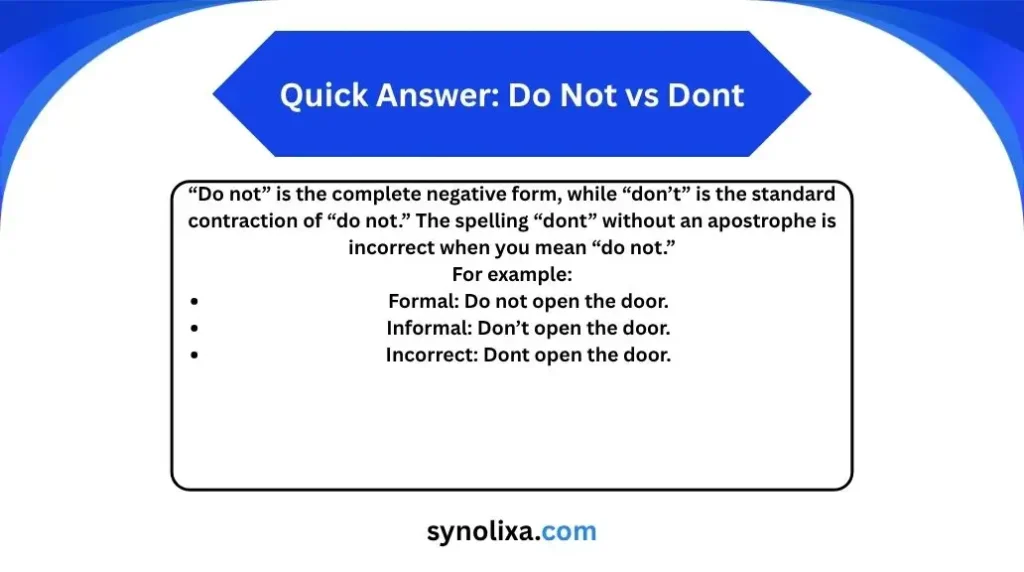
“Do not” is the complete negative form, while “don’t” is the standard contraction of “do not.” The spelling “dont” without an apostrophe is incorrect when you mean “do not.”
For example:
- Formal: Do not open the door.
- Informal: Don’t open the door.
- Incorrect: Dont open the door.
The apostrophe in “don’t” shows that letters have been omitted from “do not.”
Understanding the Basics: Do Not vs Dont
The main difference is not meaning but form and correctness.
Both “do not” and “don’t” express negation. They tell us that someone does not perform an action, or they can be used to give a negative command.
However, “dont” is missing the apostrophe. In standard English, that makes it an incorrect spelling when it is intended as the contraction of “do not.”
Comparison Table
| Form | Type | Meaning | Example | Correct/Incorrect |
|---|---|---|---|---|
| do not | Full form | Negative form of “do” | Do not touch the screen. | Correct |
| don’t | Contraction | Short form of “do not” | Don’t touch the screen. | Correct |
| dont | Misspelled contraction | Intended to mean “do not” | Dont touch the screen. | Incorrect |
The key point is easy to remember:
Do not = full form
Don’t = contracted form
Dont = incorrect spelling
Why Does “Don’t” Have an Apostrophe?
Contractions combine words by leaving out one or more letters. An apostrophe marks the missing letters.
Do not → don’t
The apostrophe represents the omitted letters from the original expression.
The same pattern appears in other contractions:
- cannot → can’t
- does not → doesn’t
- did not → didn’t
- is not → isn’t
- will not → won’t
- should not → shouldn’t
Therefore, writing “dont” removes the apostrophe that identifies the word as a contraction.
Correct Meanings and Uses
1. “Do Not” as the Full Negative Form
“Do not” is used to create a negative statement or instruction.
For example:
Do not forget your keys.
This means:
Make sure you do not forget your keys.
Here, “do” functions as an auxiliary verb, while “not” creates the negative meaning.
Another example is:
I do not understand the question.
The sentence means that the speaker does not understand the question.
2. “Don’t” as the Contraction
“Don’t” has exactly the same basic negative meaning as “do not.”
For example:
I don’t understand the question.
This means:
I do not understand the question.
The difference is primarily one of formality and style.
“I do not understand” sounds more deliberate or formal.
“I don’t understand” sounds more natural in ordinary conversation.
3. “Do Not” for Instructions
You will often see “do not” in instructions, notices, warnings, manuals, and official messages.
Examples include:
- Do not enter.
- Do not touch the equipment.
- Do not remove this label.
- Do not use your phone during the examination.
- Do not leave personal belongings unattended.
This form can sound firm and authoritative.
4. “Don’t” for Everyday Conversation
In casual conversation, “don’t” is extremely natural.
Examples:
- Don’t worry.
- Don’t be late.
- Don’t forget your homework.
- I don’t know.
- We don’t need anything.
- They don’t live here.
Using “do not” in these situations is not necessarily grammatically wrong, but it can sound more formal or emphatic.
Compare:
I don’t know what happened.
with:
I do not know what happened.
The first sounds conversational. The second may sound more deliberate or formal.
Test Tip
When you see “dont,” try expanding it.
Ask yourself:
Does “dont” mean “do not”?
If yes, the correct contraction is:
don’t
not:
dont
This simple test can catch the mistake immediately.
Do Not vs Don’t in Negative Sentences
Both forms can be used to make negative statements.
Using “Do Not”
I do not like spicy food.
Breakdown:
- I = subject
- do = auxiliary verb
- not = negative marker
- like = base-form main verb
- spicy food = object
Using “Don’t”
I don’t like spicy food.
Breakdown:
- I = subject
- don’t = contraction of “do not”
- like = base-form main verb
- spicy food = object
The meaning remains the same.
More Examples
Full form:
We do not agree with the decision.
Contraction:
We don’t agree with the decision.
Full form:
They do not understand the instructions.
Contraction:
They don’t understand the instructions.
Full form:
You do not need to wait.
Contraction:
You don’t need to wait.
Notice that the verb after “do not” or “don’t” remains in its base form.
Correct:
I don’t know.
Incorrect:
I don’t knows.
Correct:
They don’t understand.
Incorrect:
They don’t understands.
The auxiliary “do” carries the grammatical information, so the main verb stays in the base form.
Do Not vs Don’t in Negative Commands
Both forms can be used to create negative commands.
“Do Not”
Do not touch the painting.
This sounds formal and firm.
“Don’t”
Don’t touch the painting.
This sounds more natural in everyday speech.
Both sentences tell someone not to touch the painting.
Other examples include:
- Do not enter this room.
- Don’t enter this room.
- Do not forget your appointment.
- Don’t forget your appointment.
- Do not make noise.
- Don’t make noise.
The choice depends largely on context and tone.
Case Study: Workplace Email
Imagine a manager sends an email to employees about an important meeting.
Formal Version
Please do not arrive late for the meeting. The presentation will begin at 9:00 a.m.
This version is appropriate for a formal workplace message.
Now imagine a coworker sending a quick chat message:
Don’t be late for the meeting. It starts at 9:00.
This sounds natural and friendly.
But this version is incorrect:
Dont be late for the meeting.
The problem is the missing apostrophe.
What Can We Learn?
The workplace example shows three important points:
- Do not is grammatically correct.
- Don’t is also grammatically correct.
- Dont is incorrect when intended as the contraction.
The difference between the first two is mainly related to style, tone, and formality.
Grammar Rules: Why “Don’t” Is Correct
In English grammar, “don’t” is a contraction of “do not.”
A contraction is a shortened form of two words. The apostrophe indicates that part of the original wording has been removed.
The pattern is:
do not → don’t
Standard grammar references, including major English dictionaries and grammar guides, recognize “don’t” as the contraction of “do not.”
English uses “do” as an auxiliary verb to form negatives with many ordinary verbs.
For example:
I do not work here.
becomes:
I don’t work here.
Similarly:
We do not need help.
becomes:
We don’t need help.
The grammar is not changed simply because the contraction is used.
What About “Dont”?
“Dont” does not contain the apostrophe required to mark the contraction.
Therefore:
Dont worry.
is not the standard spelling.
The correct version is:
Don’t worry.
This is a spelling and punctuation issue rather than a difference in meaning.
When Should You Use “Do Not”?
Use “do not” when you want a more formal, careful, or emphatic style.
It is particularly useful in:
- Formal documents
- Official notices
- Policies
- Instructions
- Academic writing
- Professional communication
- Legal or administrative language
- Important warnings
Examples:
Employees do not need to submit the form again.
Do not share confidential information.
Students do not need to bring their textbooks tomorrow.
Please do not reply to this automated message.
The full form can make a statement feel more deliberate.
When Should You Use “Don’t”?
Use “don’t” naturally in:
- Everyday conversation
- Casual emails
- Text messages
- Informal chats
- Social media
- Friendly writing
- Dialogue in fiction
Examples:
I don’t think that’s a good idea.
Don’t worry about it.
We don’t have enough time.
I don’t remember his name.
Don’t forget to call me.
In conversational American English, “don’t” is often the more natural choice.
Usage in Different Contexts
Everyday Conversation
In normal conversation, contractions are common.
For example:
I don’t want coffee.
Don’t worry about me.
We don’t have to leave yet.
Using the full form is possible:
I do not want coffee.
But it may sound more formal or emphatic.
Professional Writing
Professional writing requires attention to audience and tone.
For a formal policy:
Employees do not have permission to access this area.
For a friendly workplace email:
Don’t forget to send me the report.
Both are grammatical. The appropriate choice depends on the relationship and purpose.
Academic Writing
In formal academic writing, many writers prefer full forms when the tone calls for them.
For example:
The results do not support the original hypothesis.
This can sound more formal than:
The results don’t support the original hypothesis.
However, contractions are not automatically grammatically wrong in every academic context. The important factor is the style expected by the assignment, institution, or publication.
Creative Writing
Creative writing allows greater flexibility.
Dialogue often uses contractions because characters speak naturally:
“Don’t worry,” Maya said.
Narration may use either form depending on the writer’s style:
He did not understand what was happening.
or:
He didn’t understand what was happening.
The choice can influence rhythm and voice.
Social Media and Texting
In texting and social media, “don’t” is standard and natural.
Examples:
Don’t miss this!
I don’t know 😂
Don’t worry!
However, typing “dont” without an apostrophe is still considered incorrect standard spelling.
Fast digital communication may explain why people omit apostrophes, but it does not make “dont” the standard form.
Why the Apostrophe Matters
Apostrophes can seem small, but they often carry important information.
Compare:
- dont ❌
- don’t ✅
The apostrophe tells the reader that “don’t” is a contraction.
Without it, the word no longer follows the standard spelling convention for the contraction.
This is similar to:
- its vs. it’s
- your vs. you’re
- were vs. we’re
- cant vs. can’t
- wont vs. won’t
A tiny punctuation mark can change whether a word is standard English.
Common Mistakes
People make mistakes with do not vs dont for several common reasons.
1. Fast Typing
When people type quickly, they may skip punctuation.
For example:
Dont forget.
may be typed instead of:
Don’t forget.
This is especially common in casual digital communication.
2. Autocorrect
Autocorrect and predictive text can sometimes produce unexpected results. Users may also become accustomed to typing quickly without checking punctuation.
3. Lack of Knowledge
Some learners may know that “don’t” sounds like one word but may not realize that the apostrophe is required.
4. Apostrophe Confusion
English has many contractions, and learners may not always remember where apostrophes belong.
Similar Grammar Confusions
| Confusion | Correct Forms | Main Difference |
|---|---|---|
| dont / don’t | don’t | “Don’t” = do not |
| its / it’s | its / it’s | Possession vs. it is/it has |
| your / you’re | your / you’re | Possession vs. you are |
| cant / can’t | can’t | “Can’t” = cannot |
| wont / won’t | won’t | “Won’t” = will not |
| didnt / didn’t | didn’t | “Didn’t” = did not |
| doesnt / doesn’t | doesn’t | “Doesn’t” = does not |
A Simple Editing Habit
Before publishing or submitting writing, search for common missing-apostrophe errors.
Look for:
- dont
- cant
- didnt
- doesnt
- wont
- isnt
- arent
Then check whether each word should contain an apostrophe.
This quick review can improve the accuracy of digital writing.
Why It Matters
Correct punctuation helps readers understand your writing quickly.
Clarity in Communication
Correct spelling reduces distractions.
Compare:
Dont forget the appointment.
with:
Don’t forget the appointment.
The second version follows standard English conventions and is immediately recognizable as the contraction of “do not.”
Professionalism
In professional writing, small errors can affect how polished a message appears.
A missing apostrophe may seem minor, but repeated punctuation and spelling errors can make an otherwise strong document look careless.
Digital Communication
People communicate through:
- Emails
- Text messages
- Workplace chats
- Social media
- Online forms
- School assignments
- Comments
Because so much communication is written, punctuation accuracy remains important.
“Small marks can carry big meaning.”
An apostrophe may be tiny, but using it correctly demonstrates attention to detail.
Special Exception: “Don’t” as a Noun
There is an interesting edge case involving “don’ts.”
The word “don’ts” can be used as a noun meaning things that should not be done.
For example:
The guide lists several dos and don’ts for new employees.
Here, “don’ts” is not simply being used as the verb contraction in a sentence such as “Don’t go.” It is functioning as a noun.
The apostrophe remains part of the conventional spelling.
You may also see:
dos and don’ts
This means:
things you should do and things you should not do.
This is different from:
Don’t touch that.
In the second sentence, “don’t” is the contraction of “do not.”
Do Not vs Don’t: Formality and Tone
The choice between “do not” and “don’t” can affect tone.
Consider:
Do not worry.
and:
Don’t worry.
Both are grammatically correct.
The first may sound more formal, deliberate, or emphatic.
The second sounds more conversational and relaxed.
Another example:
We do not agree.
versus:
We don’t agree.
Again, the basic meaning is the same, but the full form can create a stronger or more formal tone.
This does not mean that “do not” is always better in professional writing or that “don’t” is always too informal. Context matters.
Do Not vs Don’t in Questions
The same distinction appears in questions.
For example:
Why do you not understand?
is grammatically possible and can sound formal or emphatic.
A more conversational version is:
Why don’t you understand?
Both are understandable and grammatically structured.
Another example:
Do you not want to come?
versus:
Don’t you want to come?
The contraction is common in ordinary conversation.
Do Not vs Don’t With Different Subjects
The contraction “don’t” is used with I, you, we, and they in the present tense.
Examples:
- I don’t know.
- You don’t need this.
- We don’t agree.
- They don’t live nearby.
For third-person singular subjects such as he, she, and it, use “doesn’t,” not “don’t.”
Examples:
- He doesn’t know.
- She doesn’t understand.
- It doesn’t work.
Do not write:
She don’t understand. ❌
In standard English, write:
She doesn’t understand. ✅
The full form is:
She does not understand.
This distinction is important because “do not” and “does not” follow different subject patterns.
Quick Recap Checklist
Use this checklist when deciding between do not, don’t, and dont.
| Question | If Yes → Use |
|---|---|
| Do you want the full form? | do not |
| Are you writing casually or conversationally? | don’t |
| Are you writing a formal instruction? | do not |
| Are you writing dialogue or a casual message? | don’t |
| Are you tempted to write “dont”? | Change it to don’t |
| Does the sentence mean “do not”? | Use do not or don’t |
| Is the subject he, she, or it? | Usually use does not/doesn’t instead |
Practice Examples
1. Choose the correct form:
___ forget to bring your notebook.
Answer:
Don’t forget to bring your notebook.
A formal alternative is:
Do not forget to bring your notebook.
2. Correct the spelling:
Dont open the window.
Correct:
Don’t open the window.
3. Choose the formal version:
Employees ___ share their passwords.
Answer:
Employees do not share their passwords.
FAQs
Is “dont” correct English?
No. When you mean the contraction of “do not,” the standard spelling is “don’t,” with an apostrophe. “Dont” without an apostrophe is generally a spelling error.
Is “don’t” short for “do not”?
Yes. “Don’t” is the standard contraction of “do not.” For example, “I do not know” can be shortened to “I don’t know.”
Which is more formal: “do not” or “don’t”?
“Do not” is generally more formal, while “don’t” is more conversational. Formal notices, instructions, and official writing often use the full form, while everyday speech commonly uses the contraction.
Can I use “don’t” in professional writing?
Yes. “Don’t” is grammatically correct, and it can be appropriate in professional writing when the tone is conversational or friendly. For highly formal documents, the full form “do not” may be preferred.
Why does “don’t” need an apostrophe?
The apostrophe indicates that letters have been omitted when “do not” is shortened to “don’t.” Without the apostrophe, “dont” does not follow the standard spelling of the contraction.
Is “do not” always better than “don’t”?
No. Neither is universally better. “Do not” suits formal or emphatic contexts, while “don’t” is natural in conversation and informal writing. Choose the form that fits your audience and purpose.
Conclusion
The difference between do not vs dont is simple once you understand the role of the apostrophe. “Do not” is the complete negative form, while “don’t” is its standard contraction. “Dont” without an apostrophe is not the standard spelling when you mean “do not.”
Use “do not” when you want a full, formal, or more deliberate form. Use “don’t” when you want a natural conversational form or an informal style. Both are grammatically correct when used in the right context.
The most important rule is easy to remember:
Do not = full form
Don’t = contraction
Dont = incorrect
Whether you are writing an email, school assignment, workplace message, social media post, or everyday text, taking one second to add the apostrophe can make your writing cleaner and more accurate.
When in doubt, remember: if “dont” means “do not,” write “don’t.” ✍️

Hi, I am Ethan Parker. I work at Synolixa as a grammar and writing specialist, helping readers understand English grammar and improve their writing skills.
[…] conversations, professional writing, social media posts, speeches, and creative writing. ❤️ Do Not vs Dont | Savor vs Saver | Proved vs […]
[…] the grammar, common mistakes, and the easiest way to remember which form to use. Beloved vs Loved | Do Not vs Dont | Savor vs […]