
Have you ever typed “pajamas” and wondered why someone else wrote “pyjamas”? 🤔 If so, you are not making a grammar mistake. The difference between pajamas vs pyjamas is mainly a matter of regional spelling. Both words refer to the same type of comfortable clothing worn for sleeping or relaxing, but they are used differently depending on the variety of English.
In US English, pajamas is the standard spelling. In British English, pyjamas is the usual spelling. The meaning stays essentially the same, even though the spelling changes. Cambridge Dictionary identifies pajamas as the US spelling of pyjamas and defines the word as soft, loose clothing worn in bed, typically consisting of pants and a shirt.
This spelling difference is similar to other American and British English differences, such as color and colour or center and centre. So, when you see pajamas vs pyjamas, think about your target variety of English rather than assuming that one spelling is simply wrong. Wonder vs Wander | Minuet vs Minute | Better Than or Better Then
Quick Answer: Pajamas vs Pyjamas
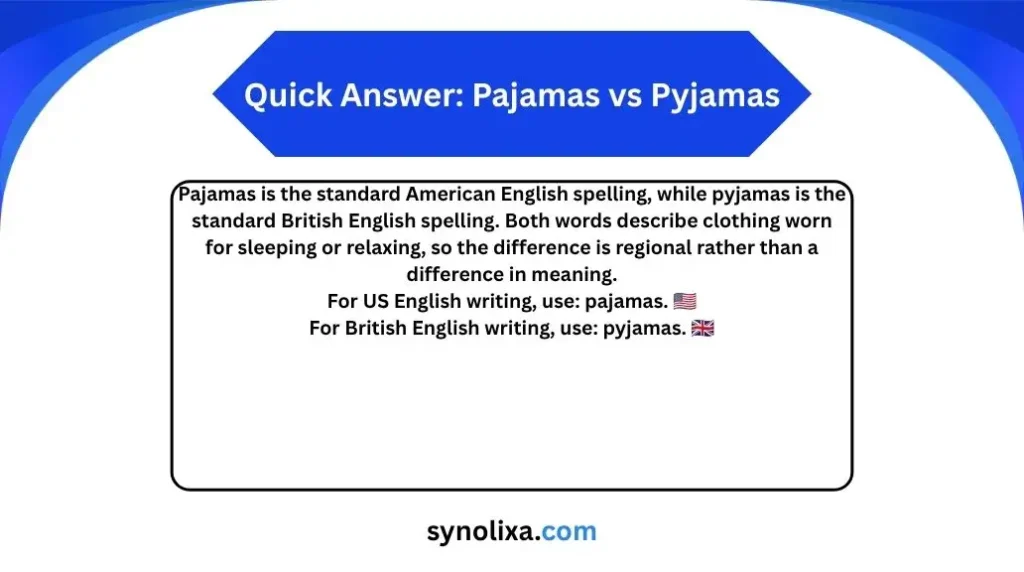
Pajamas is the standard American English spelling, while pyjamas is the standard British English spelling. Both words describe clothing worn for sleeping or relaxing, so the difference is regional rather than a difference in meaning.
For US English writing, use: pajamas. 🇺🇸
For British English writing, use: pyjamas. 🇬🇧
Understanding the Basics: Pajamas vs Pyjamas
The easiest way to understand pajamas vs pyjamas is to focus on the variety of English you are using.
| Form | Type | Meaning | Example | Correct/Incorrect |
|---|---|---|---|---|
| pajamas | US English | Clothes worn for sleeping | I bought new pajamas. | Correct in US English |
| pyjamas | British English | Clothes worn for sleeping | I bought new pyjamas. | Correct in British English |
| pajama | US singular/attributive form | Relating to or describing pajamas | She wore a pajama top. | Correct |
| pyjama | British singular/attributive form | Relating to or describing pyjamas | She wore a pyjama top. | Correct |
| pajamas in a British-English document | Regional spelling | Same clothing | Possible, but not standard British spelling | Usually avoid for consistency |
| pyjamas in a US-English document | Regional spelling | Same clothing | Possible, but not standard US spelling | Usually avoid for consistency |
The important point is that neither spelling is inherently incorrect. The correct choice depends on the English variety and the audience.
Pajamas: The American English Form
Pajamas is the standard US spelling.
Examples:
- I need to buy new pajamas.
- These pajamas are very comfortable.
- My brother changed into his pajamas.
- She wore blue pajamas to bed.
If you are writing an article, school assignment, website, email, or other material in American English, pajamas is normally the form you should choose.
Pyjamas: The British English Form
Pyjamas is the standard British spelling.
Examples:
- I need to buy new pyjamas.
- These pyjamas are very comfortable.
- My brother changed into his pyjamas.
- She wore blue pyjamas to bed.
The meaning is the same as pajamas. The extra y reflects the British spelling convention.
Correct Meanings & Uses
What Does “Pajamas” Mean?
Pajamas is a plural noun referring to clothing worn for sleeping or relaxing. A typical pair consists of a shirt or top and pants or bottoms.
For example:
I put on my pajamas before going to bed.
Here is the sentence breakdown:
- I = subject
- put on = verb phrase
- my = possessive determiner
- pajamas = noun
- before going to bed = time expression
The word pajamas identifies the clothing being worn.
What Does “Pyjamas” Mean?
Pyjamas has the same basic meaning but follows British spelling.
For example:
I put on my pyjamas before going to bed.
The grammar is exactly the same. Only the spelling changes.
Cambridge Dictionary lists pyjamas as the UK spelling of pajamas and defines it as soft, loose clothing worn in bed.
Can “Pajamas” Be Used for Relaxing?
Yes. Although pajamas are traditionally associated with sleeping, people can also wear them while relaxing at home.
Examples:
- I stayed in my pajamas all morning.
- He likes reading in his pajamas.
- The children watched a movie in their pajamas.
The word does not require that the person actually be asleep.
What Is “Pajama” in US English?
Pajama can appear as a singular noun or as an adjective-like modifier.
For example:
- a pajama top
- a pajama set
- a pajama party
- a pajama shirt
In ordinary US English, however, the complete sleepwear set is commonly referred to as pajamas.
What Is “Pyjama” in British English?
British English uses pyjama in similar combinations:
- a pyjama top
- a pyjama set
- a pyjama party
- pyjama bottoms
The difference is again the spelling: pajama in US English and pyjama in British English. Cambridge specifically identifies pyjama as the UK spelling of pajama.
Test Tip 📝
When you are unsure, ask yourself:
“Am I writing for an American or British English audience?”
- If the answer is American English, choose pajamas.
- If the answer is British English, choose pyjamas.
This simple test will solve most pajamas vs pyjamas questions.
Case Study: A Real-Life Writing Example
Imagine that you are writing an email to a hotel in the United States:
I accidentally left my pajamas in the room after checking out.
The spelling pajamas fits American English.
Now imagine that the same message is being written for a British audience:
I accidentally left my pyjamas in the room after checking out.
Both sentences communicate the same idea.
Workplace Example
Suppose an employee is helping organize a children’s event in the United States. The announcement might say:
Please remind students to bring their pajamas for Friday’s pajama-themed event.
For a British audience, the same announcement could use:
Please remind pupils to bring their pyjamas for Friday’s pyjama-themed event.
Neither version changes the event itself. The spelling simply follows the intended variety of English.
Why Consistency Matters
If a document is written in US English, it is generally better to use pajamas consistently rather than switching between pajamas and pyjamas.
The same principle applies to many regional spelling differences:
- color / colour
- favorite / favourite
- center / centre
- realize / realise
- pajamas / pyjamas
Consistency makes writing easier to read and gives the document a clear language style.
Grammar Rules Explained
Is “Pajamas” Correct?
Yes. Pajamas is correct in American English.
Cambridge Dictionary explicitly labels pajamas as the US spelling of pyjamas. Its American English entry defines the word as clothing worn in bed, consisting of a loosely fitting shirt and pants.
Therefore, if your writing follows US English conventions, pajamas is the appropriate spelling.
Is “Pyjamas” Correct?
Yes. Pyjamas is correct in British English.
Cambridge Dictionary identifies pyjamas as the UK spelling of pajamas.
So, calling pyjamas a spelling mistake would be incorrect. It is a legitimate regional spelling.
Why Are There Two Spellings?
English has developed different spelling conventions in different regions. American English and British English share most vocabulary, but some words developed or retained different spellings.
The difference between pajamas and pyjamas is one example of this broader pattern.
It is therefore better to think:
US English → pajamas
UK English → pyjamas
rather than:
correct → pajamas
incorrect → pyjamas
The second interpretation would wrongly treat a standard British spelling as an error.
Is This a Grammar Difference?
Not really.
It is primarily a spelling and regional-usage difference. The grammatical function and meaning remain essentially the same.
That distinction matters because people sometimes describe every word-choice question as a grammar issue. In this case, the key issue is spelling according to regional English conventions.
Common Mistakes With Pajamas vs Pyjamas
People often make mistakes with these words because English has many regional spelling differences.
Mistake 1: Mixing Regional Styles
A writer may use American spelling in one sentence and British spelling in another.
For example:
I bought new pajamas in my favorite shop and packed my pyjamas for the trip.
There is nothing inherently ungrammatical about either word, but the switching can make the document’s language style inconsistent.
Mistake 2: Assuming “Pyjamas” Is Wrong
Some American English learners see the y and assume it is a spelling error.
It is not.
Pyjamas is the standard British spelling.
Mistake 3: Assuming “Pajamas” Is Wrong
British English learners may encounter pajamas online and think the writer has misspelled the word.
Again, that is not necessarily true.
Pajamas is the standard American spelling.
Mistake 4: Fast Typing
Fast typing can cause accidental spelling changes. When someone types quickly, they may write whichever spelling they have recently seen.
Mistake 5: Autocorrect
Autocorrect can also influence spelling. A phone or computer configured for one variety of English may suggest a regional spelling that differs from the writer’s intended style.
Mistake 6: Lack of Knowledge
English learners may not realize that American and British English use different spellings.
Learning common regional pairs makes these differences much easier to recognize.
Similar Grammar and Spelling Confusions
The pajamas vs pyjamas issue belongs to a larger group of commonly confused English forms.
| Confusion | Correct Forms | Main Difference |
|---|---|---|
| it’s vs its | it’s / its | contraction vs possessive |
| your vs you’re | your / you’re | possessive vs contraction |
| there vs their vs they’re | all three | different grammatical functions |
| color vs colour | both | US vs UK spelling |
| center vs centre | both | US vs UK spelling |
| favorite vs favourite | both | US vs UK spelling |
| pajamas vs pyjamas | both | US vs UK spelling |
| practice vs practise | depends on usage and dialect | noun/verb and regional conventions |
| gray vs grey | both | common regional spelling difference |
The key lesson is simple: not every difference means one word is wrong.
Usage in Different Contexts
Everyday Conversation
In casual US conversation, pajamas is natural:
I’m already in my pajamas.
Another example:
These pajamas are so comfortable.
In British English, the equivalent is:
I’m already in my pyjamas.
And:
These pyjamas are so comfortable.
Professional Writing
Professional writing should follow the spelling convention appropriate for its audience.
For a US company:
Employees may wear pajamas during Friday’s themed charity event.
For a British company:
Employees may wear pyjamas during Friday’s themed charity event.
The important factor is consistency.
Creative Writing
Authors can use either form depending on the setting, narrator, or intended variety of English.
For an American character:
She ran downstairs in her pajamas.
For a British character:
She ran downstairs in her pyjamas.
In creative writing, regional spelling can help maintain a consistent voice.
Social Media and Texting
On social media, both forms are common because people write for audiences from many countries.
Examples:
- Pajama day! 😴
- Pyjama day! 💤
- New pajamas, new mood.
- Cozy pyjamas and a good book. 📚
In informal communication, readers usually understand both forms immediately.
Pajamas vs Pyjamas in American English
Because this article focuses on US English, the preferred form is:
Pajamas
Examples:
- I bought new pajamas yesterday.
- My pajamas are in the laundry.
- She wore her favorite pajamas.
- The children changed into their pajamas.
- We had a pajama party at school.
If you are writing for an American audience, using pajamas throughout your article or document is the safest choice.
Related American Expressions
US English also commonly uses informal expressions such as:
- PJs
- pajama set
- pajama top
- pajama bottoms
- pajama party
- pajama day
Cambridge lists PJs as an informal term related to pajamas.
Pajamas vs Pyjamas in British English
British English generally uses:
Pyjamas
Examples:
- I bought new pyjamas yesterday.
- My pyjamas are in the laundry.
- She wore her favorite pyjamas.
- The children changed into their pyjamas.
- We had a pyjama party at school.
British English also uses combinations such as:
- pyjama top
- pyjama bottoms
- pyjama set
- pyjama day
Cambridge’s British English entry lists pyjamas under nightwear and identifies pajamas as the US spelling.
Why It Matters
At first glance, pajamas vs pyjamas may seem like a tiny spelling issue. In everyday communication, it rarely causes confusion because readers understand both forms. However, choosing the appropriate regional spelling can make your writing more consistent and polished.
1. Clarity in Communication
Consistent spelling helps readers understand what variety of English your writing follows.
2. Professionalism
Businesses, schools, websites, and publications often follow a particular style guide. Using consistent regional spelling supports a polished appearance.
3. Digital Communication
Online content reaches international audiences. Knowing that pajamas and pyjamas are regional variants helps you interpret search results, articles, product descriptions, and social media posts correctly.
4. Writing Accuracy
Correct regional spelling demonstrates control over English conventions.
A useful principle is:
Good writing is not only about correct words; it is also about using them consistently.
Special Exception: “Pajama” and “Pyjama” in Other Uses
There is an interesting point to remember: the words do not always appear as the full plural pajamas or pyjamas.
The singular or attributive forms are also common:
- pajama top — US English
- pyjama top — UK English
- pajama pants — US English
- pyjama bottoms — UK English
- pajama party — US English
- pyjama party — UK English
Cambridge lists pyjama as a noun and adjective in British English and pajama as its US spelling.
There is also a broader cultural point: the word has connections to clothing traditions associated with South and West Asia, where related forms of pyjama/pajama can refer to loose trousers. Cambridge notes this separate clothing sense for the singular pyjama.
That means context can matter. In modern everyday American English, pajamas commonly means sleepwear, while related words can have broader historical or regional uses.
How to Remember the Difference 🧠
A simple memory trick can help.
Think “A” for America
pAjamas → America
The word pajamas contains an a, just like America.
Think “Y” for the UK
pYjamas → UK spelling
The y can remind you of the British spelling.
This is only a memory trick, not a grammatical rule, but it can make the distinction easier to remember.
Another method is to connect the pair with other regional spellings:
US: color, center, favorite, pajamas
UK: colour, centre, favourite, pyjamas
Once you recognize the pattern, the spelling becomes much easier.
Quick Recap Checklist
Use this checklist whenever you are unsure about pajamas vs pyjamas.
| Question | If Yes → Use |
|---|---|
| Am I writing in standard US English? | pajamas |
| Am I writing in standard British English? | pyjamas |
| Am I writing for an American website or publication? | pajamas |
| Am I writing for a British publication or audience? | pyjamas |
| Am I using a US style throughout my document? | pajamas |
| Am I using a UK style throughout my document? | pyjamas |
Practice Example 1
I bought new ___ for winter.
US English → pajamas
British English → pyjamas
Practice Example 2
She changed into her ___ before bed.
US English → pajamas
British English → pyjamas
Practice Example 3
The school is having a ___ day.
US English → pajama
British English → pyjama
Frequently Asked Questions
1. Is “pajamas” or “pyjamas” correct?
Both are correct. Pajamas is the standard US spelling, while pyjamas is the standard UK spelling.
2. Which spelling should I use in American English?
Use pajamas. If your writing follows US English conventions, pajamas is the standard choice.
3. Which spelling is British: pajamas or pyjamas?
Pyjamas is the standard British spelling. Cambridge identifies pyjamas as the UK form and pajamas as the US form.
4. Do pajamas and pyjamas have different meanings?
No. In the usual sleepwear sense, they have the same meaning. The main difference is regional spelling.
5. Is “pyjamas” a spelling mistake in American English?
It is not an invented or meaningless word, but pajamas is the standard American spelling. Pyjamas is associated with British English.
6. Should I use “pajamas” or “pyjamas” in an SEO article?
Choose the form that matches your target audience and language variety. For a US English article, use pajamas as the primary spelling while naturally mentioning pyjamas when explaining the regional difference.
Conclusion
The difference between pajamas vs pyjamas is simple once you know the regional spelling rule. Pajamas is the standard American English form, while pyjamas is the standard British English form. Both words refer to comfortable clothing worn for sleeping or relaxing, so neither spelling is universally “wrong.”
For US English writing, remember pajamas. For British English writing, remember pyjamas. The most important thing is to keep your spelling consistent with the variety of English you are using.
So, the next time you see these two spellings, do not wonder which one is correct. Ask a simpler question: Which English style am I writing? 🇺🇸🇬🇧
Pajamas for American English. Pyjamas for British English. Same clothing, different regional spelling.

Hi, I am Clara Anderson. I work at Synolixa as a vocabulary writer, focusing on synonyms, word meanings, and easy-to-understand English learning content.

[…] accurate. Once you learn the basic rule, choosing between eaten or ate becomes much easier. 🍳 Pajamas vs Pyjamas | Wonder vs Wander | Minuet vs […]