Have you ever stopped while writing a sentence and wondered whether you should use eaten or ate? You are not alone. These two words come from the same verb, eat, but they do not work in the same grammatical situations. Choosing the wrong one can make an otherwise clear sentence sound incorrect.
The main difference is simple: ate is the simple past tense of “eat,” while eaten is the past participle of “eat.” The word ate can normally stand alone as the main verb in a past-tense sentence. Eaten, however, usually needs a helping verb such as has, have, had, or be.
For example, you can say, “I ate breakfast at 8 a.m.” But you would say, “I have eaten breakfast already.”
Understanding this small difference can make your everyday conversations, school assignments, emails, and professional writing much more accurate. Once you learn the basic rule, choosing between eaten or ate becomes much easier. 🍳 Pajamas vs Pyjamas | Wonder vs Wander | Minuet vs Minute
Quick Answer: Eaten or Ate
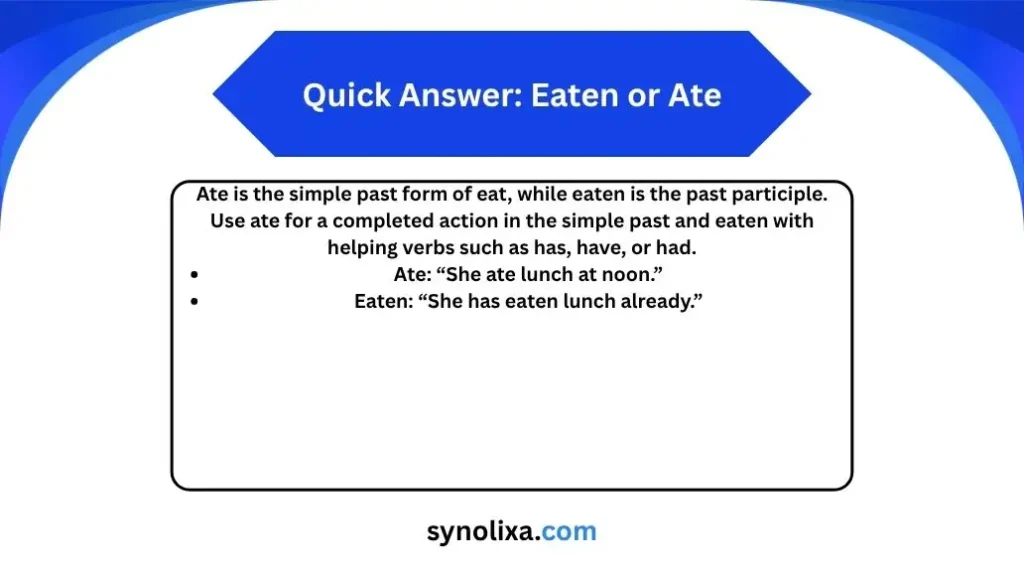
Ate is the simple past form of eat, while eaten is the past participle. Use ate for a completed action in the simple past and eaten with helping verbs such as has, have, or had.
- Ate: “She ate lunch at noon.”
- Eaten: “She has eaten lunch already.”
A useful shortcut is:
eat → ate → eaten
These are three forms of the same irregular verb.
Understanding the Basics: Eaten or Ate
The easiest way to understand eaten or ate is to look at their grammatical forms.
| Form | Type | Meaning | Example | Correct/Incorrect |
|---|---|---|---|---|
| Eat | Base form | To consume food | “I eat breakfast every day.” | Correct |
| Ate | Simple past | Consumed food in the past | “I ate breakfast earlier.” | Correct |
| Eaten | Past participle | Used with helping verbs or in participial constructions | “I have eaten breakfast.” | Correct |
| Ate | Past participle | Used after have/has/had | “I have ate breakfast.” | Incorrect |
| Eaten | Simple past | Used alone as simple past | “I eaten breakfast yesterday.” | Incorrect |
The key point is that ate and eaten are not interchangeable.
What Does “Ate” Mean?
Ate is the simple past tense of eat.
Use it when you are talking about something that happened and was completed in the past.
Examples:
- I ate breakfast at seven.
- She ate the last cookie.
- We ate at a new restaurant yesterday.
- They ate dinner before the movie.
- He ate an apple after school.
In each sentence, ate acts as the main verb.
What Does “Eaten” Mean?
Eaten is the past participle of eat.
A past participle usually works with an auxiliary or helping verb. Common combinations include:
- have eaten
- has eaten
- had eaten
- is eaten
- was eaten
- will have eaten
Examples:
- I have eaten already.
- She has eaten lunch.
- They had eaten before we arrived.
- The cake was eaten quickly.
The important distinction is that eaten generally does not function as the simple past tense by itself.
The Three Main Forms of “Eat”
It helps to memorize the three basic forms:
| Verb Form | Word | Example |
|---|---|---|
| Base form | eat | “I eat fruit every day.” |
| Simple past | ate | “I ate fruit yesterday.” |
| Past participle | eaten | “I have eaten fruit today.” |
Think of the pattern as:
Eat → Ate → Eaten
This pattern is similar to other irregular verbs:
- go → went → gone
- see → saw → seen
- write → wrote → written
- take → took → taken
- speak → spoke → spoken
This is why eaten cannot simply replace ate.
Correct Meanings and Uses
When to Use “Ate”
Use ate when you are describing a completed action in the past using the simple past tense.
For example:
I ate lunch at noon.
Here, ate tells us that the eating happened in the past.
Another example:
Maria ate the entire sandwich.
The sentence describes a completed past action.
Sentence Breakdown
Consider:
James ate dinner before the meeting.
- James = subject
- ate = simple past verb
- dinner = object
- before the meeting = time-related phrase
Because the action happened in the past, ate is correct.
When to Use “Eaten”
Use eaten when grammar requires the past participle.
The most common situation is the present perfect tense.
For example:
I have eaten breakfast.
The structure is:
Subject + have/has + past participle
Therefore:
- I have eaten.
- You have eaten.
- She has eaten.
- They have eaten.
You should not say:
I have ate breakfast. ❌
The correct sentence is:
I have eaten breakfast. ✅
Using “Eaten” With “Had”
Eaten is also used in the past perfect tense.
The structure is:
Subject + had + past participle
Example:
We had eaten before the guests arrived.
The eating happened first, and the guests’ arrival happened later.
Another example:
She had already eaten when I called her.
Here, had eaten correctly identifies an action completed before another past event.
Using “Eaten” in Passive Constructions
The word eaten can also appear in passive constructions.
For example:
The cake was eaten by the children.
Here, was is the helping verb, and eaten is the past participle.
Another example:
All the cookies were eaten.
The focus is on the cookies rather than the people who ate them.
A Simple Rule to Remember
If you are unsure about eaten or ate, ask yourself:
Is there a helping verb such as “have,” “has,” or “had”?
If yes, you probably need eaten.
Examples
- I ate breakfast at 8 a.m. ✅
- I have eaten breakfast. ✅
- She ate the pizza. ✅
- She has eaten the pizza. ✅
- They ate before the game. ✅
- They had eaten before the game. ✅
Avoid:
- I have ate breakfast. ❌
- She has ate the pizza. ❌
- They had ate before the game. ❌
Test Tip: How to Choose Between “Ate” and “Eaten”
Here is a quick test.
Step 1: Look for a helping verb
If you see have, has, or had, use eaten.
She has eaten.
They had eaten.
Step 2: If there is no helping verb, check whether you need simple past
If you are simply describing a completed past action, use ate.
She ate.
They ate.
Step 3: Look at the time expression
Words such as these often work naturally with the simple past:
- yesterday
- last night
- last week
- two hours ago
- this morning, when the morning is finished
Examples:
I ate breakfast yesterday.
We ate dinner two hours ago.
However, time expressions alone do not determine the verb. The entire grammatical structure matters.
Case Study: A Workplace Conversation
Imagine two coworkers discussing lunch.
Alex: “Did you eat lunch?”
Jordan: “Yes, I ate around noon.”
Here, ate is correct because the question and answer refer to a completed past event.
Now imagine a slightly different conversation:
Alex: “Have you eaten lunch?”
Jordan: “Yes, I have eaten already.”
Here, eaten is correct because the present perfect construction uses have + past participle.
This small change in the sentence changes the verb form.
Another Workplace Example
Suppose an employee sends an email:
“I have eaten lunch, so I am ready for the meeting.”
The grammar is correct.
But this version is incorrect:
“I have ate lunch, so I am ready for the meeting.” ❌
The problem is not the meaning. The reader can understand it. The problem is the verb form.
In professional writing, these small errors can make your writing appear less polished.
Grammar Rules: Why Is One Correct?
English verbs have different forms for different grammatical functions.
Eat is an irregular verb. Its forms do not follow the standard -ed pattern.
Instead:
- Present/base form: eat
- Past tense: ate
- Past participle: eaten
Standard dictionaries and grammar references, including Merriam-Webster, identify ate as the past tense of eat and eaten as its past participle.
The distinction follows a basic rule of English grammar:
The simple past uses the past-tense form, while perfect constructions use the past participle.
Compare:
I ate.
with:
I have eaten.
The first sentence uses the simple past.
The second uses the present perfect.
Likewise:
I ate before class.
and:
I had eaten before class.
The second sentence uses the past perfect.
Why “I Have Ate” Is Incorrect
The sentence:
I have ate lunch. ❌
contains two verb forms that do not belong together in this structure.
The verb have requires the past participle when forming the present perfect tense.
Therefore:
I have eaten lunch. ✅
The same rule applies to has and had:
- She has eaten. ✅
- They have eaten. ✅
- He had eaten. ✅
Not:
- She has ate. ❌
- They have ate. ❌
- He had ate. ❌
Common Mistakes With “Eaten or Ate”
Many people confuse these words because they come from the same verb. Their meanings are closely connected, but their grammatical roles differ.
Mistake 1: Using “Ate” After “Have”
Incorrect:
I have ate dinner.
Correct:
I have eaten dinner.
Why?
Because have + past participle forms the present perfect.
Mistake 2: Using “Ate” After “Had”
Incorrect:
She had ate before we arrived.
Correct:
She had eaten before we arrived.
The past perfect requires had + past participle.
Mistake 3: Using “Eaten” Alone as Simple Past
Incorrect:
I eaten breakfast yesterday.
Correct:
I ate breakfast yesterday.
Without a helping verb, the simple past form is ate.
Mistake 4: Treating “Eaten” as the Same as “Ate”
Although both refer to eating in the past, they serve different grammatical purposes.
Compare:
I ate the cake.
I have eaten the cake.
Both sentences are grammatically correct, but their tense structures are different.
Similar Grammar Confusions
The confusion between eaten or ate is part of a larger pattern in English. Many words have similar forms but different grammatical functions.
| Common Confusion | Correct Forms | Main Difference |
|---|---|---|
| its / it’s | its / it’s | Possession vs. “it is” or “it has” |
| your / you’re | your / you’re | Possession vs. “you are” |
| their / they’re | their / they’re | Possession vs. “they are” |
| then / than | then / than | Time/order vs. comparison |
| affect / effect | affect / effect | Usually verb vs. noun |
| lie / lay | lie / lay | Different verb patterns |
| went / gone | went / gone | Past tense vs. past participle |
| saw / seen | saw / seen | Past tense vs. past participle |
| ate / eaten | ate / eaten | Past tense vs. past participle |
These mistakes often happen because English has many irregular verbs.
Why Do These Mistakes Happen?
Fast Typing
People often type quickly and choose the first word that comes to mind.
Autocorrect
Autocorrect can sometimes suggest a grammatically inappropriate word, especially when a sentence is typed quickly.
Lack of Grammar Knowledge
Someone may understand the meaning but not know the difference between a simple past verb and a past participle.
Speech Patterns
In casual speech, people may hear incorrect constructions from others and eventually repeat them.
Eaten or Ate in Different Contexts
Everyday Conversation
In ordinary conversation, both words are common.
Use ate for a completed past action:
I ate at home last night.
Use eaten with a perfect construction:
I have eaten already.
Professional Writing
Professional writing benefits from precise grammar.
Correct:
I ate lunch before the meeting.
Correct:
I have eaten lunch, so I am ready to continue.
Incorrect:
I have ate lunch. ❌
Creative Writing
Authors can use both forms depending on the timeline of a story.
She ate quietly while everyone talked.
Or:
By the time the guests arrived, she had eaten.
The choice depends on the relationship between events.
Social Media and Texting
Informal digital communication may contain grammatical shortcuts.
For example:
Ate already!
This can be understood in casual texting, although it is technically an abbreviated sentence.
A complete standard sentence would be:
I ate already.
Or, depending on the intended meaning:
I have eaten already.
For formal writing, use complete grammatical structures.
Why It Matters
Knowing the difference between eaten or ate helps you communicate clearly.
Clarity
Correct verb forms make the timing of actions easier to understand.
Compare:
I ate before you arrived.
with:
I had eaten before you arrived.
The second sentence clearly establishes that the eating happened before another past event.
Professionalism
Grammar mistakes can distract readers in:
- Emails
- Reports
- Applications
- School assignments
- Business communication
- Articles
Using the correct verb form shows attention to detail.
Digital Communication
People communicate constantly through texts, emails, comments, and social media. Even short messages benefit from accurate grammar when clarity matters.
As a simple reminder:
“Clear grammar makes clear communication easier.”
Special Exception: “Eaten” as an Adjective or Participial Form
In some sentences, eaten can appear as part of a participial phrase or function in a descriptive role.
For example:
The eaten apple was left on the table.
This construction is grammatically possible, although it is less common than ordinary perfect-tense uses.
Another example is:
The cake was completely eaten.
Here, eaten is part of a passive construction.
These examples do not change the basic rule. Eaten remains the past participle form of eat.
There is no standard situation in which eaten replaces ate as the ordinary simple past form.
Eaten or Ate: Quick Recap Checklist
Use this checklist whenever you are unsure.
| Question | If Yes → Use |
|---|---|
| Did the action happen as a completed past event? | Ate |
| Does the sentence use “have”? | Eaten |
| Does the sentence use “has”? | Eaten |
| Does the sentence use “had”? | Eaten |
| Is the verb part of a passive construction? | Eaten |
| Is the word the simple past form by itself? | Ate |
Practice Examples
1. Yesterday, I ___ breakfast at 7 a.m.
Answer: ate
Yesterday, I ate breakfast at 7 a.m.
2. I have ___ breakfast already.
Answer: eaten
I have eaten breakfast already.
3. She had ___ before the movie started.
Answer: eaten
She had eaten before the movie started.
A Fast Memory Trick
Remember this three-word sequence:
Eat → Ate → Eaten
Think of it as:
- Eat = present/base
- Ate = past
- Eaten = past participle
Then connect eaten with helping verbs:
have eaten
has eaten
had eaten
This simple pattern can prevent many common grammar mistakes.
More Examples of “Ate”
Here are several natural examples:
- I ate breakfast early.
- She ate the last slice of pizza.
- We ate dinner together.
- They ate at a local restaurant.
- He ate an apple after lunch.
- I ate too much at the party.
- The children ate their snacks.
- Sarah ate before leaving home.
- We ate lunch outside.
- They ate everything on their plates.
In each sentence, ate describes a past action.
More Examples of “Eaten”
Here are several examples using eaten correctly:
- I have eaten breakfast.
- She has eaten already.
- They have eaten all the cookies.
- He had eaten before the meeting.
- We had eaten dinner when they arrived.
- The food was eaten quickly.
- The cake has been eaten.
- Have you eaten yet?
- She has never eaten sushi.
- By noon, they had eaten lunch.
Notice that eaten is supported by another verb in these constructions.
Eaten or Ate in Questions
Questions can sometimes make the distinction easier to see.
Simple Past Question
Did you eat breakfast?
Notice that we do not say:
Did you ate breakfast? ❌
Why?
Because did already marks the past tense. The main verb returns to its base form:
Did + eat
Present Perfect Question
Have you eaten breakfast?
Here, have is the helping verb, so we use the past participle:
Have + eaten
This gives us another useful pattern:
- Did you eat?
- Have you eaten?
Not:
- Did you ate? ❌
- Have you ate? ❌
Eaten or Ate in Negative Sentences
The same principle applies to negative sentences.
Simple Past
I did not eat breakfast.
Not:
I did not ate breakfast. ❌
Because did carries the past tense, the main verb stays in its base form.
Present Perfect
I have not eaten breakfast.
Not:
I have not ate breakfast. ❌
The structure is:
have + not + past participle
Therefore, eaten is correct.
A Simple Comparison
Consider these four sentences:
I eat breakfast every morning.
I ate breakfast this morning.
I have eaten breakfast.
I had eaten breakfast before school.
Each sentence uses a different verb form or tense structure.
| Sentence | Verb Form | Tense/Structure |
|---|---|---|
| I eat breakfast. | eat | Simple present |
| I ate breakfast. | ate | Simple past |
| I have eaten breakfast. | eaten | Present perfect |
| I had eaten breakfast. | eaten | Past perfect |
Seeing them together makes the pattern much easier to remember.
FAQs
Is “ate” the past tense of “eat”?
Yes. Ate is the simple past tense of eat.
Example:
I ate breakfast at 8 a.m.
Is “eaten” the past tense of “eat”?
No. Eaten is the past participle of eat. It normally appears with a helping verb such as have, has, or had.
Example:
I have eaten breakfast.
Is “I have ate” correct?
No. The standard grammatical form is “I have eaten.”
The present perfect requires have + past participle, and eaten is the past participle of eat.
Is “I ate already” correct?
Yes. “I ate already” can be grammatically correct, especially in conversational American English. A more explicit alternative is:
I have already eaten.
The best choice depends on the intended tense and context.
Is “I have eaten” correct?
Yes. “I have eaten” is grammatically correct.
It uses the present perfect structure:
have + eaten
Which is correct: “Did you eat?” or “Did you ate?”
The correct form is:
Did you eat?
After did, use the base form eat, not the past form ate.
Conclusion
The difference between eaten or ate becomes easy once you remember their grammatical roles. Ate is the simple past form of eat, so it is used for completed past actions: “I ate breakfast.” Eaten is the past participle, so it normally appears with helping verbs such as have, has, or had: “I have eaten breakfast.”
The most useful pattern to remember is:
Eat → Ate → Eaten
Use ate for the simple past, and use eaten when a grammatical structure calls for the past participle. Also remember that after did, you use eat, not ate: “Did you eat?”
Once you understand these patterns, choosing between eaten or ate becomes much more natural. Whether you are writing an email, completing an assignment, posting online, or having a conversation, the right verb form helps make your meaning clear.
Remember: Ate tells what happened; eaten works with a helping verb. 🍽️

Hi, I am Ethan Parker. I work at Synolixa as a grammar and writing specialist, helping readers understand English grammar and improve their writing skills.

[…] mistakes, and provide practical examples you can use in everyday and professional writing. ✍️ Eaten or Ate | Pajamas vs Pyjamas | Wonder vs […]