Have you ever stopped while writing a question and wondered whether to say “when I can” or “when can I”? 🤔 These two phrases contain the same words, but their word order changes their grammatical function. This small difference can make a sentence sound natural and correct—or awkward and incorrect.
The confusion usually happens because “when” can introduce a question or a dependent clause. In a direct question, English normally uses question word order: “When can I…?” In a statement or dependent clause, the normal word order is different: “when I can…”
For example, you would ask, “When can I call you?” But you might say, “Please tell me when I can call you.” Both forms are correct, but they are used in different sentence structures.
Understanding this distinction will help you write clearer questions, emails, messages, and everyday conversations. Once you learn the simple rule, choosing between when I can or when can I becomes much easier. Mine as Well or Might as Well or Mind as Well | To Fast or Too Fast | Input or Imput
Quick Answer: When I Can or When Can I?
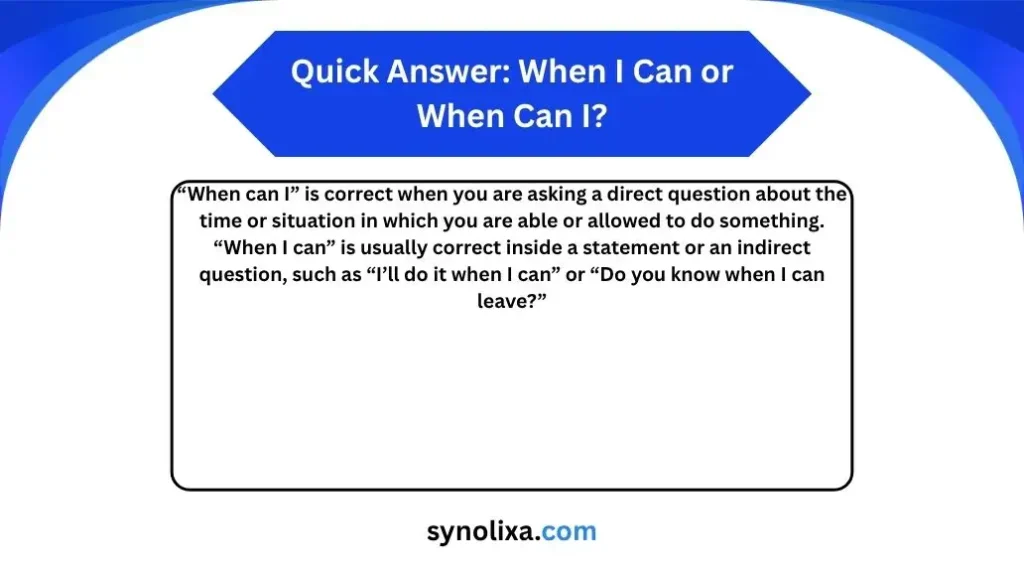
“When can I” is correct when you are asking a direct question about the time or situation in which you are able or allowed to do something.
“When I can” is usually correct inside a statement or an indirect question, such as “I’ll do it when I can” or “Do you know when I can leave?”
In short:
- Direct question: “When can I go?”
- Statement: “I’ll go when I can.”
- Indirect question: “Do you know when I can go?”
The key difference is sentence structure, not meaning alone.
Understanding the Basics: When I Can or When Can I
The easiest way to understand when I can or when can I is to look at word order.
In a direct question, English often places the helping verb before the subject:
When + can + I + verb?
In a dependent clause, the subject comes before the helping verb:
when + I + can + verb
This is why “When can I?” and “when I can” can both be grammatically correct.
Comparison Table
| Form | Type | Meaning | Example | Correct/Incorrect |
|---|---|---|---|---|
| When can I…? | Direct question | Asks when I am able or allowed to do something | When can I start? | ✅ Correct |
| when I can… | Dependent clause | Refers to a time when I am able to do something | I will start when I can. | ✅ Correct |
| when I can…? | Indirect question clause | Reports or embeds a question | Do you know when I can start? | ✅ Correct |
| When I can…? | Direct question | Subject-auxiliary order is unusual for a normal direct question | When I can start? | ❌ Usually incorrect |
| when can I… | Clause inside a statement | Uses direct-question word order inside a dependent clause | I don’t know when can I start. | ❌ Incorrect |
The important point is that “when I can” is not always wrong, and “when can I” is not always wrong. The correct form depends on how the phrase functions in the sentence.
What Does “When Can I” Mean?
“When can I” is used to begin a direct question.
It normally asks about:
- Permission
- Availability
- Possibility
- Opportunity
- A suitable time
- The earliest or latest time something can happen
Example 1: Asking for Permission
When can I leave?
Here, the speaker wants to know the time at which they are allowed to leave.
Breakdown:
- When = asks about time
- can = expresses possibility or permission
- I = subject
- leave = main verb
The word order is:
When + can + subject + verb
Example 2: Asking About Availability
When can I meet with you?
This asks about a suitable or available time.
Example 3: Asking About an Opportunity
When can I apply for the program?
The speaker wants to know when applying becomes possible or permitted.
Example 4: Asking About Timing
When can I expect a response?
This asks about the expected time of a response.
Example 5: Asking About Permission
When can I use the computer?
The speaker wants to know when they are allowed to use it.
What Does “When I Can” Mean?
“When I can” usually appears in a statement or dependent clause.
It can mean “at the time that I am able to” or “whenever I am able to.”
For example:
I will help you when I can.
This does not directly ask a question. It makes a statement about a future action.
Another example is:
I visit my grandparents when I can.
Here, “when I can” means whenever the speaker has the ability or opportunity to visit.
Example 1: “I’ll Call You When I Can.”
This sentence means:
I’ll call you as soon as I am able to do so.
The phrase “when I can” is a dependent clause.
Example 2: “I Help When I Can.”
This means:
I help whenever I have the ability or opportunity to help.
Again, there is no direct question.
Example 3: “I’ll Finish It When I Can.”
This means:
I’ll finish it when I have the opportunity or ability to do so.
The phrase does not ask when the action will happen. It describes the condition or time for the action.
Direct Questions vs. Indirect Questions
One of the most important grammar points in when I can or when can I is the difference between direct and indirect questions.
Direct Question
A direct question uses question word order:
When can I submit the form?
The auxiliary verb can comes before the subject I.
Indirect Question
An indirect question usually uses statement word order:
Do you know when I can submit the form?
Notice what happens.
Direct:
When can I submit the form?
Indirect:
Do you know when I can submit the form?
The words “I can” remain in normal statement order inside the indirect question.
More Examples
Direct:
When can I speak to the manager?
Indirect:
Could you tell me when I can speak to the manager?
Direct:
When can I start?
Indirect:
Do you know when I can start?
Direct:
When can I register?
Indirect:
I would like to know when I can register.
This is one of the most useful rules to remember.
Why “When Can I” Is Correct in Direct Questions
English questions often require subject-auxiliary inversion.
That means the auxiliary verb moves before the subject.
Compare:
Statement:
I can leave now.
Question:
Can I leave now?
When you add “when,” the same pattern continues:
When can I leave?
The structure is:
Question word + auxiliary + subject + main verb
For example:
- When can I go?
- When can she start?
- When can they arrive?
- When can we meet?
- When can you help?
The auxiliary can comes before the subject.
Why “When I Can” Is Correct in Dependent Clauses
Dependent clauses do not normally use the same inverted word order as direct questions.
Consider:
I can leave now.
If this becomes part of a larger sentence, the normal subject-verb order remains:
I will leave when I can.
The clause is:
when + I + can
Not:
when + can + I
Therefore:
✅ I’ll leave when I can.
❌ I’ll leave when can I.
The second version incorrectly uses direct-question word order inside a dependent clause.
The Role of “Can”
The word “can” is a modal auxiliary verb.
It can express several ideas, including:
- Ability
- Possibility
- Permission
For example:
Ability:
I can swim.
Permission:
You can leave now.
Possibility:
It can happen.
When asking a question, can normally moves before the subject:
Can I swim?
Can I leave?
Can it happen?
With when, the same structure applies:
When can I leave?
This is why “when can I” is the normal form for a direct question.
Correct Meanings and Uses
Asking When You Are Allowed to Do Something
Use “when can I” when asking for permission.
Examples:
- When can I leave?
- When can I enter?
- When can I use the room?
- When can I submit my application?
- When can I take the test?
These questions ask about permission or an approved time.
Asking When Something Is Possible
You can also use “when can I” to ask about possibility.
When can I get the information?
When can I schedule an appointment?
When can I access the account?
The speaker wants to know when the action becomes possible.
Describing a Future Opportunity
Use “when I can” when the phrase is part of a larger statement.
I’ll visit when I can.
I’ll respond when I can.
I’ll help when I can.
Here, the speaker is not asking a direct question.
Asking an Indirect Question
Use “when I can” after expressions such as:
- Do you know…
- Could you tell me…
- I wonder…
- I’d like to know…
- Please tell me…
- Can you explain…
Examples:
Do you know when I can apply?
Could you tell me when I can arrive?
I wonder when I can start.
I’d like to know when I can register.
Test Tip 📝
Try putting the phrase at the beginning of the sentence.
If you are directly asking someone a question, “When can I…?” will usually be correct.
If the phrase is part of a longer sentence, check whether it is an embedded or dependent clause. If it is, “when I can” is usually the correct structure.
For example:
Direct question:
When can I call?
Embedded question:
Do you know when I can call?
This simple test works in many everyday situations.
Case Study: A Workplace Conversation
Imagine an employee has finished a task and wants to ask their supervisor about the next step.
The employee asks:
“When can I start the next project?”
This is a direct question. The employee is asking the supervisor for information.
Now imagine the employee is speaking to a coworker:
“Do you know when I can start the next project?”
This is an indirect question. The employee is not directly asking, “When can I start?” Instead, the question is embedded inside a larger sentence.
Now consider a third example:
“I’ll start the next project when I can.”
This is a statement. It means the employee will begin when they have the ability or opportunity.
The Three Structures
| Situation | Correct Form |
|---|---|
| Direct question | When can I start? |
| Indirect question | Do you know when I can start? |
| Statement | I’ll start when I can. |
This example shows why both forms can be correct.
Grammar Rules According to Standard English
Standard English grammar distinguishes between direct questions and embedded questions.
Major English dictionaries and grammar references, including Merriam-Webster, describe can as a modal auxiliary used to express ability, possibility, and permission. In direct questions, modal auxiliaries commonly appear before the subject.
For example:
Can I go?
When when is added:
When can I go?
However, when the question becomes embedded in another sentence, English generally returns to normal statement word order:
Do you know when I can go?
This distinction is sometimes called subject-auxiliary inversion in direct questions.
The important rule is:
Direct question → auxiliary before subject
Embedded question → subject before auxiliary
So:
✅ When can I leave?
✅ Do you know when I can leave?
❌ Do you know when can I leave?
This rule applies beyond can.
Compare:
- Where is she?
- Do you know where she is?
And:
- When will they arrive?
- Do you know when they will arrive?
The pattern is consistent.
Common Mistakes With “When I Can or When Can I”
Many people make mistakes with these phrases because the difference is based on word order rather than vocabulary.
Mistake 1: Using Direct Question Order in an Indirect Question
Incorrect:
❌ I don’t know when can I leave.
Correct:
✅ I don’t know when I can leave.
Why?
Because “when I can leave” is an embedded question.
Mistake 2: Using Statement Order in a Direct Question
Incorrect:
❌ When I can leave?
Correct:
✅ When can I leave?
The first version may appear in casual speech or informal writing, but it is not the standard form for a complete direct question.
Mistake 3: Confusing Ability With Permission
Sometimes can has a different meaning depending on context.
When can I leave?
This may mean:
- When am I allowed to leave?
- When is it possible for me to leave?
The context determines the exact meaning.
Why Do These Mistakes Happen?
Common reasons include:
- Fast typing: People often type quickly and do not notice word order.
- Autocorrect: Phones can change words or structures unexpectedly.
- Lack of grammar knowledge: Direct and indirect questions can be difficult to distinguish.
- Speech patterns: Casual spoken English sometimes sounds different from formal written English.
- Translation habits: Speakers of other languages may transfer sentence patterns from their first language.
Similar Grammar Confusions
The problem with when I can or when can I is similar to many other English word-order or contraction questions.
| Confusion | Correct Choice | Example |
|---|---|---|
| it’s / its | Depends on meaning | It’s cold. / The dog wagged its tail. |
| your / you’re | Depends on meaning | Your book is here. / You’re late. |
| their / there / they’re | Depends on meaning | They’re coming over there with their bags. |
| then / than | Depends on meaning | First eat, then leave. / Taller than me. |
| affect / effect | Depends on function | It affected me. / The effect was clear. |
| who / whom | Depends on grammatical role | Who called? / Whom did you call? |
| can / may | Depends on meaning and style | Can I go? / May I go? |
| when I can / when can I | Depends on sentence structure | I’ll go when I can. / When can I go? |
Learning grammar by looking at sentence structure is often more effective than memorizing isolated words.
Usage in Different Contexts
Everyday Conversation
In casual conversation, “When can I?” is very common.
Examples:
When can I come over?
When can I see you?
When can I pick it up?
When can I call you?
For statements, use “when I can.”
I’ll call you when I can.
I’ll visit when I can.
I’ll help when I can.
Professional Writing
In professional emails, both structures are useful.
Direct question:
When can I expect the updated report?
Indirect question:
Could you please let me know when I can expect the updated report?
The second version is especially useful when you want a polite and professional tone.
Creative Writing
Writers may use either form depending on the character or narrative style.
For example:
“When can I leave?” she asked.
This is a direct question.
A narrative sentence might say:
He wondered when he could leave.
Creative writing allows more flexibility, but standard grammar still helps keep the meaning clear.
Social Media and Texting 📱
Informal messages often shorten sentences:
When can I come?
When can I call?
When can I get it?
Some people may type:
When I can?
This can appear in casual texting, but it is not the standard grammatical form of a direct question.
For clear writing, especially when the message matters, use:
When can I…?
When “When I Can” Appears at the End of a Sentence
A very common structure is:
I’ll do it when I can.
Here, “when I can” is perfectly correct.
It means:
I’ll do it when I have the opportunity or ability.
Other examples include:
- I’ll reply when I can.
- I’ll visit when I can.
- I’ll help when I can.
- I’ll finish it when I can.
- I’ll call you when I can.
In these sentences, “when I can” functions as a time-related dependent clause.
Can “When I Can” Start a Sentence?
Yes.
For example:
When I can, I’ll help you.
This is grammatically correct.
Here, “when I can” means approximately “when I am able to.”
Another example:
When I can, I try to read more.
The phrase is still a dependent clause.
However, if you are asking a direct question, use:
When can I help you?
Not:
❌ When I can help you?
Can “When Can I” Appear in a Larger Sentence?
Yes, but be careful.
It is correct when the words form an actual direct question:
When can I leave?
But it is generally incorrect to place direct-question word order inside an ordinary embedded question:
❌ I don’t know when can I leave.
Instead:
✅ I don’t know when I can leave.
The issue is not the phrase itself. The issue is where the phrase appears and what grammatical role it plays.
Why This Difference Matters
Grammar is not only about following rules. It helps readers and listeners understand your meaning quickly.
Clarity in Communication
Compare:
When can I start?
with:
Do you know when I can start?
Both are clear because the word order matches the sentence structure.
Professionalism
Correct grammar can make emails and workplace communication sound more polished.
Instead of:
❌ Please tell me when can I submit this.
Write:
✅ Please tell me when I can submit this.
Digital Communication
Messages, emails, comments, and online posts are often read quickly. Clear sentence structure helps readers understand your meaning without stopping to interpret it.
A Simple Reminder
“Question order asks; statement order connects.”
When you are asking directly, use “when can I.” When the phrase is embedded in another sentence, use “when I can.”
Special Exceptions and Edge Cases
There is no major standard-English exception that changes the basic rule for “when I can or when can I.” However, informal speech, texting, dialogue, and intentionally fragmented writing can sometimes use unusual word order.
For example, someone might write:
“When I can?”
This could be understood in conversation as a shortened or surprised repetition of something previously said. However, it is not the normal structure for a complete direct question.
Similarly, creative writing may intentionally break grammatical rules to reflect a character’s speech pattern.
For standard English, formal writing, schoolwork, professional emails, and clear communication, follow the normal structures.
Quick Recap Checklist
Use this checklist whenever you are unsure about when I can or when can I.
| Question | If Yes → Use |
|---|---|
| Am I asking a direct question? | When can I…? |
| Am I asking when I am allowed to do something? | When can I…? |
| Am I asking when something is possible? | When can I…? |
| Is the phrase inside an indirect question? | when I can… |
| Is it part of a statement? | when I can… |
| Does it mean “whenever I am able”? | when I can… |
Practice Examples
1. You are asking your teacher about an assignment.
✅ When can I submit the assignment?
2. You are telling someone when you will respond.
✅ I’ll respond when I can.
3. You are politely asking someone for information.
✅ Could you tell me when I can submit the form?
These three examples cover the main patterns.
A Simple Memory Trick
Remember this formula:
Direct Question = CAN + I
When can I go?
Statement or Indirect Question = I + CAN
I’ll go when I can.
Do you know when I can go?
Think of it as:
Question → Can I?
Embedded statement → I can
This small trick can help you choose the correct form quickly.
More Examples of “When Can I?”
Here are several natural examples:
- When can I start?
- When can I leave?
- When can I call you?
- When can I visit?
- When can I apply?
- When can I register?
- When can I submit the form?
- When can I expect an answer?
- When can I pick up my order?
- When can I schedule the meeting?
All of these are direct questions.
More Examples of “When I Can”
Here are examples where “when I can” is part of a statement or embedded clause:
- I’ll call you when I can.
- I help whenever I can.
- I’ll visit when I can.
- I’ll finish the work when I can.
- She helps when she can.
- He works from home when he can.
- Do you know when I can apply?
- Please tell me when I can arrive.
- I wonder when I can start.
- Let me know when I can help.
Notice that the last four examples contain an indirect or embedded question.
FAQs
1. Is “When can I” grammatically correct?
Yes. “When can I” is grammatically correct when it begins a direct question.
Example:
When can I start?
It asks about the time when the speaker can begin.
2. Is “when I can” grammatically correct?
Yes. “When I can” is correct when it functions as part of a statement or an indirect question.
Examples:
I’ll call you when I can.
Do you know when I can call you?
3. Should I say “When can I go?” or “When I can go?”
For a direct question, say:
When can I go?
If the phrase is inside a larger sentence, use:
Do you know when I can go?
4. Is “I don’t know when can I” correct?
No. In standard English, an indirect question normally uses statement word order.
Incorrect:
❌ I don’t know when can I leave.
Correct:
✅ I don’t know when I can leave.
5. Is “I’ll do it when I can” correct?
Yes. This is a natural and grammatically correct sentence.
Here, “when I can” means when I am able to do it or when I have the opportunity to do it.
6. Why does “can” come before “I” in “When can I?”
Because “When can I?” is a direct question. English normally places the modal auxiliary can before the subject I in this type of question.
The pattern is:
When + can + I + verb?
Conclusion
The difference between “when I can or when can I” is mainly a matter of sentence structure. “When can I” is the standard form for a direct question, such as “When can I leave?” or “When can I start?” The modal verb can comes before the subject I because direct questions use question word order.
On the other hand, “when I can” is correct in statements and indirect questions. For example, “I’ll call you when I can” and “Do you know when I can call you?” use normal subject-before-verb order.
The easiest rule to remember is simple: direct question = “when can I”; statement or indirect question = “when I can.” Once you recognize whether you are asking directly or embedding the question inside another sentence, the choice becomes much easier.
Remember: When you ask directly, say “When can I?” When the question is inside a sentence, say “when I can.” ✨

Hi, I am Ava Mitchell. I work at Synolixa as an English content writer, creating simple and useful resources about synonyms, vocabulary, and English usage.
[…] should you write its self or itself? In ordinary English, choose itself. When I Can or When Can I | Mine as Well or Might as Well or Mind as Well | To Fast or Too […]