Have you ever typed a sentence like “You are driving to fast” and wondered whether to fast or too fast is correct? This is a common English grammar mistake because to and too sound exactly the same when spoken. However, they have different meanings and grammatical jobs. Knowing the difference can make your writing clearer and more accurate.
The correct phrase is “too fast” when you mean that something happens at a speed that is higher than necessary, safe, comfortable, or expected. For example, “You are walking too fast” means the person is walking at a speed that is more than the speaker wants.
The phrase “to fast” is usually not correct when you are describing speed. However, to fast can be grammatically correct when fast is used as a verb, meaning to avoid food for a period of time. For example, “She decided to fast before the ceremony.”
So, the key is simple: use too fast when talking about excessive speed, but use to fast only when fast functions as a verb. Input or Imput | Company-Wide or Companywide | Unselect or Deselect
Quick Answer: To Fast or Too Fast
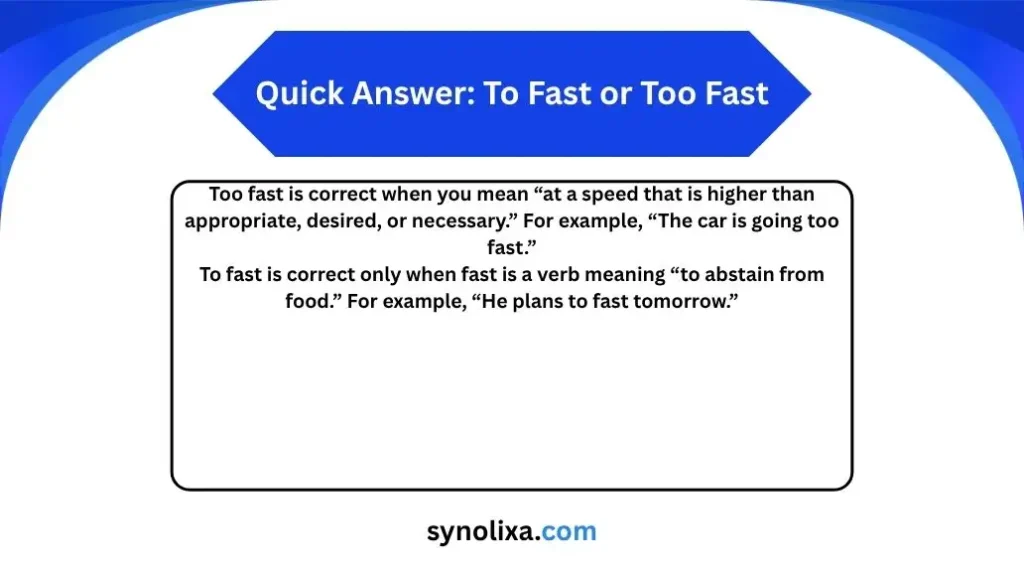
Too fast is correct when you mean “at a speed that is higher than appropriate, desired, or necessary.” For example, “The car is going too fast.”
To fast is correct only when fast is a verb meaning “to abstain from food.” For example, “He plans to fast tomorrow.”
Understanding the Basics: To Fast or Too Fast
The easiest way to understand to fast or too fast is to look at the grammatical role of each word.
To has several common functions. It can introduce an infinitive, as in “to run,” “to eat,” or “to study.” It can also act as a preposition, as in “go to school.”
Too is an adverb. It can mean more than is wanted, needed, or appropriate. It can also mean also, as in “I want to go too.”
When fast describes speed, it is usually an adjective or adverb. Therefore, when you want to say that something happens at an excessive speed, you need too fast.
| Form | Type | Meaning | Example | Correct/Incorrect |
|---|---|---|---|---|
| to fast | Infinitive | To abstain from food | “They decided to fast.” | Correct when fast is a verb |
| too fast | Adverb + adverb | At an excessive speed | “You are driving too fast.” | Correct |
| to fast | Intended as excessive speed | Incorrect spelling for “too fast” | “He runs to fast.” | Incorrect |
| too fast | Describes excessive speed | More quickly than appropriate | “The machine is moving too fast.” | Correct |
What Does “To Fast” Mean?
To fast can be a correct grammatical phrase. In this phrase, fast is a verb.
To fast means to deliberately avoid eating food for a period of time. The phrase to fast is therefore an infinitive.
Examples:
- “She decided to fast.”
- “They plan to fast for a day.”
- “He chose to fast before the event.”
In each sentence, to is part of the infinitive to fast.
What Does “Too Fast” Mean?
Too fast means at a speed that is greater than desired, suitable, safe, or necessary.
Examples:
- “You are driving too fast.”
- “The video is playing too fast.”
- “He talks too fast.”
- “The children are running too fast.”
Here, too modifies fast and shows excess.
A useful way to remember this is:
Too = more than needed or wanted.
So, if someone says, “You are speaking too fast,” they mean the person’s speech is faster than the listener can comfortably follow.
Correct Meanings & Uses
1. Use “Too Fast” for Excessive Speed
The most common use of too fast is to describe something moving, happening, or being done at an excessive speed.
For example:
“The car is going too fast.”
Breakdown:
- The car = subject
- is going = verb phrase
- too fast = describes excessive speed
The sentence does not simply say that the car is moving quickly. It says the car is moving more quickly than is appropriate.
Other examples include:
- “You are walking too fast.”
- “The train is moving too fast.”
- “This computer is running too fast for the old software.”
- “The conversation is moving too fast.”
- “The music is playing too fast.”
2. Use “Too Fast” for Speech
People often use too fast when someone speaks quickly.
For example:
“Could you repeat that? You are talking too fast.”
This means the speaker’s speed makes the conversation difficult to follow.
Compare:
- “She talks fast.” → She speaks quickly.
- “She talks too fast.” → She speaks more quickly than the listener wants or can easily understand.
The word too changes the meaning from simple speed to excessive speed.
3. Use “Too Fast” for Reading
You can also use too fast when someone reads quickly.
For example:
“You are reading too fast. Slow down.”
The sentence suggests that the reading speed is higher than appropriate for the situation.
4. Use “Too Fast” for Processes
Too fast does not have to describe physical movement.
It can describe something that happens more quickly than expected or desired.
Examples:
- “The project is moving too fast.”
- “The changes happened too fast.”
- “The story develops too fast.”
- “The lesson is going too fast.”
Here, too fast describes the pace of an activity or process.
5. Use “To Fast” When “Fast” Is a Verb
There are situations where to fast is completely correct.
For example:
“Some people choose to fast for religious reasons.”
Here, fast means to abstain from food. It is not describing speed.
Other examples:
- “She wants to fast tomorrow.”
- “They decided to fast.”
- “He plans to fast during the observance.”
- “The group agreed to fast.”
In these examples, to fast follows the normal infinitive pattern:
to + verb
Examples:
- to eat
- to walk
- to run
- to study
- to fast
To Fast or Too Fast in a Sentence
The meaning of the sentence usually tells you which form you need.
Consider these two examples:
“The car is going too fast.”
Here, too fast describes excessive speed.
“She decided to fast.”
Here, to fast means she decided not to eat for a period of time.
Although fast appears in both phrases, its grammatical role is different.
| Sentence | Meaning |
|---|---|
| “The car is moving too fast.” | The car is moving excessively quickly. |
| “She decided to fast.” | She decided to abstain from food. |
| “He talks too fast.” | He speaks more quickly than appropriate. |
| “They plan to fast.” | They plan to abstain from food. |
The Easy Test Tip
Here is a simple test you can use.
Test Tip: Ask What You Mean
Ask yourself:
Am I talking about excessive speed?
If yes, use too fast.
“You are driving too fast.”
Am I using “fast” as a verb meaning to abstain from food?
If yes, use to fast.
“They decided to fast.”
Another helpful trick is to replace too with very or excessively.
- “He is driving too fast.”
- “He is driving excessively fast.”
The meaning works, so too is appropriate.
You cannot replace to with excessively:
- “He is driving to fast.” ❌
- “He is driving excessively fast.” ✅
This shows that the intended phrase is too fast.
Case Study: A Workplace Conversation
Imagine a manager reviewing a presentation with a colleague.
The colleague says:
“I think we can finish this presentation to fast.”
The sentence contains the wrong word if the intended meaning is that the presentation is being completed at an excessive speed.
The correct sentence is:
“I think we are moving through this presentation too fast.”
Why?
Because the speaker means that the presentation is progressing more quickly than it should.
Now consider a completely different context:
“The employee decided to fast before the ceremony.”
Here, to fast is correct because fast is a verb.
This example shows why context matters. The spelling is determined by meaning and grammar, not simply by pronunciation.
Grammar Rules: Why “Too Fast” Is Usually Correct
The distinction between to and too follows standard English grammar.
Too is an adverb. It can modify an adjective or adverb to show an excessive degree.
Examples:
- too difficult
- too expensive
- too slowly
- too quickly
- too fast
In too fast, the word too indicates that the speed is beyond an acceptable or desired level.
To, on the other hand, is commonly used as part of an infinitive.
Examples:
- to run
- to walk
- to read
- to write
- to fast
Merriam-Webster identifies too as an adverb with meanings that include an excessive degree, while to has several grammatical functions, including its use before a verb in an infinitive.
This distinction is important because the two words are homophones: they sound alike but have different spellings and meanings.
Why “To Fast” Is Wrong for Speed
Suppose you write:
“The car is going to fast.”
If you mean that the car is traveling at an excessive speed, the sentence is incorrect.
The correct version is:
“The car is going too fast.”
The mistake happens because to and too sound identical in normal speech.
However, spelling should reflect meaning and grammatical function.
Common Mistakes With To Fast or Too Fast
The mistake is easy to make, especially in informal digital communication.
1. Fast Typing
When people type quickly, they may select to automatically because it is shorter and extremely common.
For example:
“You are going to fast.”
The writer may know the correct form but make a typing mistake.
2. Autocorrect
Autocorrect can sometimes contribute to word-choice mistakes. If you type quickly, a device may not understand the intended meaning.
Always review sentences containing common homophones.
3. Lack of Knowledge
Some writers have not learned the difference between to, too, and two.
These words sound alike but perform different grammatical functions.
4. Confusing Sound With Spelling
English contains many homophones.
Because to and too sound the same, listening alone cannot tell you which spelling to use.
You need to consider the meaning.
Similar Grammar Confusions
The to fast or too fast problem belongs to a larger group of common English word-choice mistakes.
| Confusing Forms | Correct Use | Example |
|---|---|---|
| to / too | too for excess | “You are too fast.” |
| your / you’re | your shows possession | “Your phone is here.” |
| its / it’s | it’s = it is | “It’s too late.” |
| there / their / they’re | Different grammatical roles | “They’re over there.” |
| than / then | than for comparison | “Faster than before.” |
| affect / effect | Different grammatical functions | “The change had an effect.” |
| two / too / to | Different meanings | “Two people went too.” |
| weather / whether | Different meanings | “I don’t know whether it will rain.” |
Learning these patterns can make your writing much more accurate.
Usage in Different Contexts
Everyday Conversation
Too fast is very common in everyday speech.
Examples:
- “You’re walking too fast.”
- “Why are you driving too fast?”
- “The movie is moving too fast.”
- “You’re talking too fast.”
In casual conversation, the phrase is natural and easy to understand.
Professional Writing
In professional writing, correct word choice matters.
Examples:
- “The project is progressing too fast for the team to review every stage.”
- “The presentation moved too fast for several attendees.”
- “The software is processing the data too fast for the current monitoring system.”
Using to fast when you mean excessive speed can make professional writing look careless.
Creative Writing
Writers may use too fast to describe action, emotions, events, or changes.
Examples:
- “The night seemed to pass too fast.”
- “Everything was happening too fast.”
- “The story moved too fast for her to understand what was happening.”
Creative writing often depends on precise descriptions, so the correct form helps preserve meaning.
Social Media and Texting
On social media, texting, and messaging apps, people often make quick typing mistakes.
You may see:
“This year went by to fast.”
The correct version is:
“This year went by too fast.”
Even though casual writing is less formal, too fast remains the standard spelling when describing excessive speed or pace.
Why It Matters
Choosing to fast or too fast correctly may seem like a small detail, but small details affect the quality of communication.
Clarity
Correct word choice helps readers understand your intended meaning immediately.
Compare:
“The meeting went too fast.”
with:
“The meeting went to fast.”
The first sentence is clear and standard. The second contains a word-choice error.
Professionalism
Grammar mistakes can affect how polished your writing appears, especially in:
- Emails
- Reports
- School assignments
- Applications
- Business documents
- Presentations
Digital Communication
Messages are often written quickly, but they can still represent your communication skills.
Correct spelling makes texts, posts, comments, and emails easier to read.
“Clear writing makes your meaning easier to trust.”
Accuracy is not about sounding perfect. It is about making your message easy to understand.
Special Exception: When “To Fast” Is Correct
There is an important exception.
To fast is correct when fast is being used as a verb.
For example:
“They decided to fast.”
Here, to fast means to abstain from food.
The phrase follows the normal infinitive structure:
to + base verb
Examples:
- to fast
- to walk
- to sleep
- to study
- to work
So it would be wrong to claim that to fast is always incorrect.
The correct rule is more precise:
Use “too fast” for excessive speed. Use “to fast” when “fast” means to abstain from food.
Another Edge Case
You may also encounter to and fast next to each other for other grammatical reasons, although the intended structure may be different.
For example:
“She went to Fast Fitness.”
If Fast Fitness is a proper name, to can be a preposition introducing the destination. In such a case, Fast is part of the name rather than the adverb in too fast.
The important point is to judge the words by their grammatical role and context.
To Fast or Too Fast: Quick Recap Checklist
Use this checklist whenever you are unsure.
| Question | If Yes → Use |
|---|---|
| Am I describing excessive speed? | too fast |
| Am I saying something is happening more quickly than desired? | too fast |
| Am I describing someone speaking very quickly? | too fast |
| Does “fast” mean abstaining from food? | to fast |
| Is “to” introducing the verb “fast”? | to fast |
Practice Examples
1. “You are driving ___ fast.”
Answer: too fast
Why? The sentence describes excessive speed.
2. “They decided ___ fast.”
Answer: to fast
Why? Here, fast is a verb meaning to abstain from food.
3. “The speaker is talking ___ fast.”
Answer: too fast
Why? The speaker is talking at an excessive speed.
FAQs
Is “to fast” grammatically correct?
Yes. To fast is grammatically correct when fast is used as a verb meaning to abstain from food. For example, “They decided to fast.”
Is “too fast” the correct phrase for speed?
Yes. Use too fast when something happens at a speed that is greater than appropriate, desired, safe, or necessary. For example, “The car is going too fast.”
Why do people confuse “to” and “too”?
The main reason is pronunciation. To and too are homophones, so they sound alike. Fast typing, autocorrect, and limited familiarity with English homophones can also cause mistakes.
Is “going to fast” correct?
Not if you mean “going at an excessive speed.” The correct sentence is “going too fast.”
For example:
- ❌ “The car is going to fast.”
- ✅ “The car is going too fast.”
Can “too fast” describe something other than physical speed?
Yes. Too fast can describe speech, reading, processes, changes, progress, or the pace of an event.
Examples include:
- “You are talking too fast.”
- “The project is moving too fast.”
- “The story develops too fast.”
What is an easy way to remember “to fast” vs. “too fast”?
Remember:
Too = more than needed.
If you mean excessive speed, choose too fast.
If fast is a verb meaning to abstain from food, choose to fast.
Conclusion
The difference between to fast or too fast becomes easy once you focus on meaning. Use too fast when you are describing excessive speed or a pace that is greater than desired, appropriate, or necessary. For example, “You are driving too fast” and “The speaker is talking too fast” are both correct.
Use to fast when fast is a verb meaning to abstain from food. For example, “They decided to fast” is grammatically correct.
The two phrases sound alike, which explains why they are often confused. However, their grammatical roles are different. When in doubt, ask yourself what you mean. If you are talking about excessive speed, choose too fast. If you mean abstaining from food, choose to fast.
Remember: If the speed is more than you want, it is “too fast”—not “to fast.”

Hi, I am Ethan Parker. I work at Synolixa as a grammar and writing specialist, helping readers understand English grammar and improve their writing skills.
[…] simple examples you can remember. By the end, choosing the right expression should feel easy. ✅ To Fast or Too Fast | Input or Imput |Company-Wide or […]
[…] when I can or when can I becomes much easier. Mine as Well or Might as Well or Mind as Well | To Fast or Too Fast | Input or […]