
Spoilt vs spoiled is a common spelling question in English because both words come from the verb spoil and often have the same meaning. You may see spoiled in an American article and spoilt in a British book, email, or conversation. This difference can make writers wonder whether one spelling is correct and the other is a mistake.
The answer is simple: both forms are accepted in standard English. However, American English generally prefers spoiled, while British English commonly uses both spoiled and spoilt. The two forms can describe food that has gone bad, plans that have been ruined, or someone who receives excessive attention and privileges.
Choosing the right form depends mainly on your audience and the style of English you are using. If you are writing a school assignment, professional email, website article, or social media post for American readers, spoiled is usually the safest choice.
In this guide, you will learn the difference between spoilt and spoiled, understand their grammatical roles, explore practical examples, and discover how to avoid common spelling mistakes. By the end, you will know how to use both forms confidently and consistently. Jewelry or Jewellery | Lath vs Lathe | Their Life or Their Lives
Quick Answer: Spoilt vs Spoiled
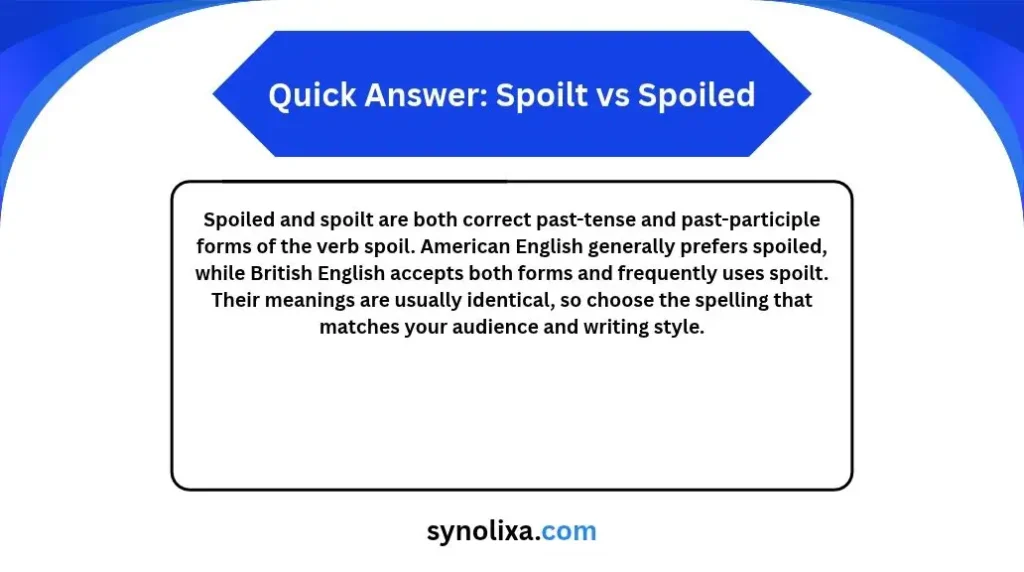
Spoiled and spoilt are both correct past-tense and past-participle forms of the verb spoil. American English generally prefers spoiled, while British English accepts both forms and frequently uses spoilt. Their meanings are usually identical, so choose the spelling that matches your audience and writing style.
Understanding the Basics of Spoilt vs Spoiled
The verb spoil has several meanings. It can mean to ruin something, cause food to deteriorate, or treat someone too generously. Both spoiled and spoilt can express these meanings.
For example:
- The rain spoiled our picnic.
- The rain spoilt our picnic.
- The milk has spoiled.
- The milk has spoilt.
Both versions are grammatically acceptable. The difference lies mainly in regional spelling preferences.
Spoilt vs Spoiled: Comparison Table
| Form | Grammatical Type | Meaning | Example | Correct or Incorrect? |
|---|---|---|---|---|
| Spoiled | Simple past | Ruined something | The storm spoiled our plans. | Correct |
| Spoilt | Simple past | Ruined something | The storm spoilt our plans. | Correct |
| Spoiled | Past participle | Became damaged or unusable | The food has spoiled. | Correct |
| Spoilt | Past participle | Became damaged or unusable | The food has spoilt. | Correct |
| Spoiled | Adjective | Overindulged | He is a spoiled child. | Correct |
| Spoilt | Adjective | Overindulged | He is a spoilt child. | Correct |
The examples are correct, but their suitability depends on the regional variety of English. For a US audience, spoiled is generally preferred.
What Is the Meaning of Spoiled?
Spoiled can describe something that has been damaged, ruined, or made less enjoyable. It can also describe a person who is accustomed to receiving too much attention or too many privileges.
Examples:
- The spoiled food was thrown away.
- The unexpected announcement spoiled the surprise.
- The spoiled child refused to share the toys.
The exact meaning depends on the noun or situation being described.
What Is the Meaning of Spoilt?
Spoilt carries the same basic meanings as spoiled. It is especially familiar in British English.
Examples:
- The rain spoilt our afternoon.
- The milk had spoilt.
- The spoilt child wanted another gift.
These sentences communicate the same ideas as their spoiled alternatives.
Spoilt vs Spoiled as Past-Tense Verb Forms
Understanding the past tense helps you use both forms correctly.
When to Use Spoiled
In American English, spoiled is the usual simple past form of spoil.
Examples:
- The heavy rain spoiled our plans.
- My brother spoiled the surprise.
- The loud music spoiled the recording.
Consider this sentence:
The heavy rain spoiled our plans.
- Subject: The heavy rain
- Verb: spoiled
- Object: our plans
The verb describes an action that happened in the past.
When to Use Spoilt
In British English, spoilt is also commonly used as the simple past form.
Examples:
- The heavy rain spoilt our plans.
- My brother spoilt the surprise.
- The loud music spoilt the recording.
The grammatical structure remains unchanged. Only the spelling of the verb differs.
Spoilt vs Spoiled in Past-Tense Sentences
Compare these examples:
| American English | British English Alternative |
|---|---|
| The weather spoiled our holiday. | The weather spoilt our holiday. |
| She spoiled the surprise. | She spoilt the surprise. |
| The mistake spoiled the result. | The mistake spoilt the result. |
Both columns express the same meanings. If you are writing for an American audience, use the forms in the first column.
Spoilt vs Spoiled as Past Participles
A past participle is commonly used with helping verbs such as has, have, had, and been.
Spoiled With Has, Have, and Had
Examples:
- The milk has spoiled.
- The vegetables have spoiled.
- The food had spoiled before dinner.
In each sentence, spoiled works with a helping verb to describe a condition or completed event.
For example:
The vegetables have spoiled.
- Subject: The vegetables
- Helping verb: have
- Past participle: spoiled
This construction tells the reader that the vegetables are no longer fresh.
Spoilt With Has, Have, and Had
The same grammatical pattern works with spoilt.
Examples:
- The milk has spoilt.
- The vegetables have spoilt.
- The food had spoilt before dinner.
These forms are especially familiar in British English. In American English, spoiled is more common.
Common Past-Participle Mistakes
Avoid changing the helping verb incorrectly.
- Correct: The food has spoiled.
- Correct: The food had spoiled.
- Incorrect: The food have spoiled.
The last example contains a subject-verb agreement error. The problem is not the choice between spoiled and spoilt.
Spoilt vs Spoiled as Adjectives
Both words can function as adjectives. Their meaning depends on what they describe.
Spoiled Food
When food is described as spoiled, it means that the food has deteriorated and may no longer be safe to eat.
Examples:
- The spoiled milk was discarded.
- We found spoiled vegetables in the refrigerator.
- The spoiled fruit had an unpleasant smell.
In American English, spoiled food is the usual spelling.
British English may use spoilt food instead.
Remember that harmful food contamination is not always visible or detectable by smell. When food safety is uncertain, follow appropriate food-safety guidance.
A Spoiled or Spoilt Child
The words can also describe a person who has become accustomed to excessive indulgence.
Examples:
- The spoiled child demanded another toy.
- Her parents worried that she was becoming spoiled.
- The spoilt teenager expected everyone to agree with him.
The adjective can sound critical because it suggests that someone has difficulty accepting limits or dealing with disappointment.
However, context matters. The word does not mean that every child who receives affection or gifts is spoiled.
A Spoiled or Spoilt Experience
Both forms can describe an experience that has become less enjoyable.
Examples:
- The argument spoiled the evening.
- The unexpected delay spoiled the trip.
- The rude comment spoiled an otherwise pleasant conversation.
British English may use spoilt in these sentences without changing the meaning.
Spoilt vs Spoiled in Real-Life Situations
Practical examples make it easier to understand when each form is appropriate.
Case Study 1: A Professional Email
Imagine that an employee needs to explain why a presentation must be recorded again.
American English version:
Subject: Presentation Recording Update
Hello Team,
Unfortunately, a technical problem spoiled the original presentation recording. I am preparing a replacement and will share it as soon as it is ready.
Thank you for your patience.
Best regards,
Alex
British English version:
Subject: Presentation Recording Update
Hello Team,
Unfortunately, a technical problem spoilt the original presentation recording. I am preparing a replacement and will share it as soon as it is ready.
Thank you for your patience.
Best regards,
Alex
Both versions are understandable and grammatically acceptable. The American version is more suitable for a US-focused workplace document.
Case Study 2: A Conversation About Food
Mia: Why did you throw away the milk?
Noah: It had spoiled, and I did not want to risk using it.
This conversation uses the common American form. In British English, Noah could say, “It had spoilt.”
The meaning would remain the same.
Case Study 3: Describing a Ruined Event
Imagine that a family plans a picnic, but heavy rain begins before they arrive.
American English:
“The rain spoiled our picnic, so we went to a nearby café instead.”
British English:
“The rain spoilt our picnic, so we went to a nearby café instead.”
Both sentences describe an event that did not go as planned.
Case Study 4: A Social Media Caption
Suppose you want to share a photograph from a rainy holiday.
American caption:
“The rain spoiled our beach day, but we still made wonderful memories! ☔”
British caption:
“The rain spoilt our beach day, but we still made wonderful memories! ☔”
Both captions work. The spelling should match your preferred regional style.
Spoilt vs Spoiled: Grammar Rules and Dictionary Guidance
Rule 1: Both Forms Are Accepted
The verb spoil has two commonly recognized forms for the simple past and past participle:
- Regular form: spoil, spoiled, spoiled
- Alternative form: spoil, spoilt, spoilt
The regular form uses the ending -ed. The alternative form ends in -t.
Neither form is automatically incorrect.
Rule 2: American English Generally Prefers Spoiled
American English usually uses spoiled in formal writing, education, business communication, journalism, and online content.
Examples:
- The storm spoiled the celebration.
- The food has spoiled.
- She spoiled the ending of the movie.
If you are creating content specifically for US readers, spoiled is generally the best choice.
Rule 3: British English Uses Both Forms
British English commonly accepts both spoiled and spoilt. The -t form is particularly familiar in phrases such as spoilt child and spoilt for choice.
Examples:
- The weather spoiled our plans.
- The weather spoilt our plans.
Both can be correct in British English.
Rule 4: The Meaning Usually Stays the Same
The two forms generally have the same meaning.
Compare:
- The children spoiled the game.
- The children spoilt the game.
Both sentences mean that the children ruined the game.
The choice is mainly about spelling preference, not a difference in tense or meaning.
Rule 5: Follow Your Style Guide
A style guide helps writers maintain consistent spelling throughout a document.
For American English, use spoiled unless a proper name or a specific quotation requires another spelling.
For British English, check the publication’s preferred style. Some publications favor spoilt, while others accept both.
What Do Merriam-Webster and Other Dictionaries Say?
Merriam-Webster is a useful reference for American English spelling, meanings, and usage. British dictionaries, including Oxford Learner’s Dictionaries, can help explain British spelling preferences and examples.
When checking spoiled and spoilt, consider the dictionary’s regional focus. A word may be less common in one variety of English without being incorrect in another.
The key distinction is that spoiled is the usual American form, while both forms are accepted in British English.
Common Mistakes With Spoilt vs Spoiled
Even though both spellings are accepted, writers sometimes misunderstand their differences.
Mistake 1: Believing Spoilt Is Always Wrong
Some writers assume that spoilt is a spelling mistake.
That is not true. It is an accepted form, particularly in British English.
Examples:
- Correct: The rain spoilt our plans.
- Also correct: The rain spoiled our plans.
For a US audience, the second version is usually preferable.
Mistake 2: Believing Spoiled Is Only American
British English also uses spoiled. It is not an exclusively American spelling.
For example, both sentences can appear in British writing:
- The food has spoiled.
- The food has spoilt.
The preferred form depends on the writer and publication.
Mistake 3: Mixing Regional Spellings
Switching between forms without a clear reason may make a document look inconsistent.
For example:
- The food spoiled overnight.
- The weather spoilt the trip.
- The surprise was spoiled.
Each form may be grammatically acceptable, but a consistent style is easier to read.
Mistake 4: Using the Wrong Helping Verb
Compare:
- Correct: The food has spoiled.
- Correct: The food had spoilt.
- Incorrect: The food have spoiled.
The third sentence contains a subject-verb agreement error. The issue is not the spelling of the past participle.
Mistake 5: Trusting Autocorrect Without Checking
Autocorrect may replace one regional spelling with another. It may also follow the language settings selected for your keyboard or word processor.
If your document uses American English, check that your editing tools are set to US English.
Why Do These Mistakes Happen?
Fast typing: Writers often use the first spelling that comes to mind.
Autocorrect: Editing software may suggest the more common form for its selected language settings.
Lack of knowledge: Some people learn only one form and assume the alternative is incorrect.
Mixed language settings: A document may combine American and British spelling conventions.
A simple proofreading step can help prevent these issues.
Similar Grammar and Spelling Confusions
| Word Pair | Main Difference | Example |
|---|---|---|
| It’s / Its | It’s means “it is” or “it has”; its shows possession. | It’s raining. The dog wagged its tail. |
| Your / You’re | Your shows possession; you’re means “you are.” | Your bag is here. You’re welcome. |
| Their / There | Their shows possession; there refers to a place or introduces something. | Their house is over there. |
| Advice / Advise | Advice is a noun; advise is a verb. | She gave me advice. I advise caution. |
| Practice / Practise | US English uses practice for both; British English commonly uses practise as a verb. | I practice daily. |
| Spoilt / Spoiled | Both are accepted forms, with different regional preferences. | The trip was spoiled. The trip was spoilt. |
Spoilt vs Spoiled in Different Writing Contexts
Everyday Conversation
In casual conversation, both forms are understandable. People usually follow the spelling and speech habits of their region.
Examples:
- American: “The milk has spoiled.”
- British: “The milk has spoilt.”
- American: “You spoiled the surprise!”
- British: “You spoilt the surprise!”
Use the form that sounds natural for your audience.
Professional Writing
In professional writing, consistency matters. American companies generally prefer spoiled in reports, emails, presentations, and website content.
British organizations may use spoilt, spoiled, or a mixture permitted by their style guide.
If you are unsure, check the organization’s editorial guidelines.
Academic Writing
Academic writing requires accurate grammar and consistent spelling.
If your institution specifies American English, use spoiled. If it specifies British English, follow the institution’s preferred form.
Examples:
- The delay spoiled the experiment.
- The sample had spoiled before the test began.
Both examples use standard American spelling.
Creative Writing
Creative writers can choose spelling to suit the setting, narrator, or character voice.
For example:
- “You’ve spoilt the ending!” she complained.
- “You spoiled the ending!” he replied.
Regional spelling may support a character’s voice, but spelling alone does not establish someone’s nationality.
Social Media and Texting
Both forms are common enough to be understood online.
Examples:
- “Feeling spoiled on my birthday! 🎂”
- “The rain spoilt our beach plans. 🌧️”
- “Someone spoiled the movie ending! 😭”
For content targeting US readers, spoiled is generally the more natural option.
SEO Articles and Website Content
For an article targeting an American audience, use spoiled as the primary spelling. Include spoilt when discussing the spelling difference, but avoid repeating the keyword unnecessarily.
A useful title is:
Spoilt vs Spoiled: Which Spelling Is Correct?
The article should answer the reader’s question early, explain regional preferences, and provide clear examples.
Natural keyword placement is more helpful than excessive repetition.
Why the Difference Between Spoilt and Spoiled Matters
Clarity in Communication
Both spellings generally convey the same meaning. However, readers may be more familiar with one form than the other.
Using the spelling expected by your audience helps them read without distraction.
Professionalism
Consistent spelling demonstrates attention to detail. This is especially useful in business emails, school assignments, published articles, and reports.
Accuracy in Digital Communication
Online content can reach readers from many countries. Understanding regional spelling helps you adapt your writing for different audiences.
Better Editing Decisions
Knowing that both forms are accepted prevents unnecessary corrections. It also helps you distinguish genuine grammatical mistakes from regional preferences.
A useful writing principle is: Choose the form that fits your audience, then use it consistently.
Special Cases: Spoilt for Choice and Other Expressions
Spoilt for Choice vs Spoiled for Choice
The expression spoilt for choice means having so many options that choosing one becomes difficult.
Example:
“Visitors to the city are spoilt for choice when it comes to restaurants.”
The phrase spoiled for choice communicates the same idea.
Example:
“Visitors to the city are spoiled for choice when it comes to restaurants.”
The spoilt version is particularly common in British English. Both versions are understandable.
Spoiled vs Rotten
When discussing food, spoiled usually means that the food has deteriorated and may no longer be safe to eat. Rotten can describe food that has undergone decomposition.
Examples:
- The milk has spoiled.
- The apple is rotten.
The words overlap in meaning but are not interchangeable in every situation.
Spoiled in a Positive or Affectionate Sense
Sometimes, spoiled is used affectionately to describe someone who receives special treatment.
Examples:
- I felt spoiled by all the birthday gifts.
- Our dog is spoiled with attention.
In these sentences, the word may be playful rather than critical. The surrounding context determines its tone.
Proper Names and Titles
A brand, book, product, or creative work may use Spoilt or Spoiled as part of its official name.
When referring to a proper name, preserve its established spelling rather than changing it to match your preferred regional style.
Quick Recap Checklist: Spoilt vs Spoiled
Use this checklist whenever you are unsure which spelling to choose.
| Question | If Yes, Use |
|---|---|
| Am I writing standard American English? | Spoiled |
| Does my British publication prefer the -t form? | Spoilt |
| Does my British style guide accept both forms? | Either form, used consistently |
| Am I describing food that has deteriorated? | Spoiled or spoilt, according to regional style |
| Am I describing an overindulged child? | Spoiled or spoilt, according to regional style |
| Am I referring to a proper name? | Use its official spelling |
Practice Examples
1. American English: The heavy rain ______ our weekend plans.
Answer: spoiled
Explanation: Spoiled is the usual American English form.
2. British English: The children were described as ______ because they received everything they wanted.
Answer: spoilt or spoiled
Explanation: Both forms are accepted in British English, although spoilt is especially familiar in this context.
3. American English: The food had ______ before we could prepare dinner.
Answer: spoiled
Explanation: Spoiled is the standard choice for American English.
An Easy Way to Remember the Difference
- American English: Usually use spoiled.
- British English: Both spoiled and spoilt are accepted.
- Meaning: Usually identical.
- Best practice: Follow the regional style guide and remain consistent.
FAQs
1. Is Spoilt or Spoiled Correct?
Both are correct. Spoiled is the usual form in American English, while British English accepts both spoiled and spoilt. Choose the form that matches your audience.
2. Is Spoilt British English?
Yes. Spoilt is a familiar British English form, particularly in expressions such as spoilt child and spoilt for choice. British English also uses spoiled.
3. Do Americans Use Spoilt?
Americans may recognize and occasionally use spoilt, but spoiled is much more common in standard American writing. For US-focused articles and professional documents, spoiled is generally the best choice.
4. Is It Spoilt Child or Spoiled Child?
Both expressions are grammatically correct. Spoiled child is more common in American English, while spoilt child is especially familiar in British English.
5. Should I Write the Food Has Spoilt or the Food Has Spoiled?
Both forms are possible. American English generally prefers “The food has spoiled.” British English can use either “The food has spoilt” or “The food has spoiled,” depending on regional preference and style.
6. Does Spoilt for Choice Mean the Same as Spoiled for Choice?
Yes. Both expressions mean having so many options that it is difficult to choose. Spoilt for choice is especially common in British English, while spoiled for choice is also used.
Conclusion
The difference between spoilt vs spoiled becomes easy to understand once you know that both are accepted forms of the verb spoil. They can describe ruined plans, food that has deteriorated, or someone who has received too much attention or too many privileges.
The main difference is regional preference. American English generally uses spoiled, while British English accepts both spoiled and spoilt. Neither form is automatically incorrect simply because it is less common in a particular country.
When writing a school assignment, business email, website article, or social media post, consider your intended audience. Choose spoiled for standard American English, or follow the relevant British style guide if you are writing for a British audience.
Remember that good writing is not only about choosing the right spelling. It is also about making your message clear, natural, and consistent. Know your audience, choose your spelling, and write with confidence.

Hi, I am Ethan Parker. I work at Synolixa as a grammar and writing specialist, helping readers understand English grammar and improve their writing skills.
[…] or improving your English grammar, this guide will help you use the correct expression confidently. Spoilt vs Spoiled | Jewelry or Jewellery | Lath vs […]
[…] practical examples, common mistakes, and best uses of both spellings. On Friday or In Friday | Spoilt vs Spoiled | Jewelry or […]