Have you ever wondered whether to write jewelry or jewellery when describing a beautiful necklace, a gold ring, or a pair of earrings? You may have seen both spellings in online stores, fashion magazines, and everyday conversations. This can make it difficult to determine which version is correct.
The good news is that both spellings are accepted in English. The difference comes from regional spelling conventions rather than grammar or meaning. American English uses jewelry, while British English generally uses jewellery. Both words describe decorative items worn on the body, including necklaces, rings, bracelets, earrings, and other accessories.
Understanding this distinction is helpful for students, bloggers, business owners, and professional writers. Choosing the appropriate spelling makes your writing more consistent and helps you connect with your intended audience.
In this guide, you will learn the meanings of both forms, explore their grammatical uses, discover common spelling mistakes, and see how to apply the correct version in professional writing, social media, and website content. You will also find practical examples, a comparison table, a quick checklist, and answers to frequently asked questions. Lath vs Lathe | Their Life or Their Lives | Is It To or Too Early
Quick Answer: Jewelry or Jewellery?
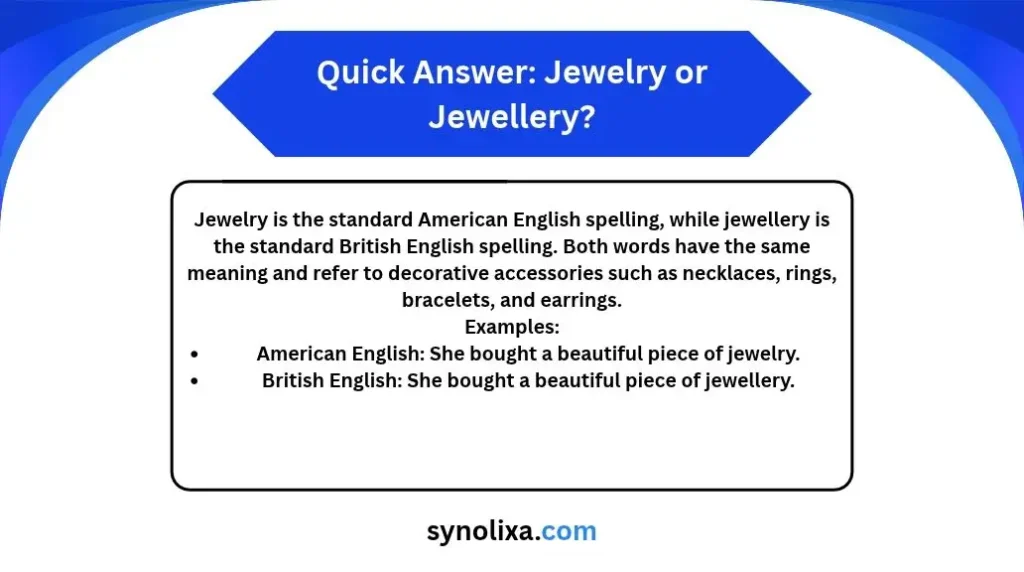
Jewelry is the standard American English spelling, while jewellery is the standard British English spelling. Both words have the same meaning and refer to decorative accessories such as necklaces, rings, bracelets, and earrings.
Examples:
- American English: She bought a beautiful piece of jewelry.
- British English: She bought a beautiful piece of jewellery.
Both sentences are correct. Choose the version that matches your audience and use it consistently.
Understanding the Basic Difference
The primary difference between these two forms is their spelling. American English generally favors the shorter version, whereas British English typically uses the longer one.
Neither spelling changes the meaning of the word or its grammatical function.
Comparison Table
| Form | Type | Meaning | Example | Correct/Incorrect |
|---|---|---|---|---|
| Jewelry | American English | Decorative items worn on the body | She sells handmade jewelry. | Correct in American English |
| Jewellery | British English | Decorative items worn on the body | She sells handmade jewellery. | Correct in British English |
| Jewelery | Common misspelling | Intended to describe decorative accessories | She sells jewelery online. | Incorrect standard spelling |
| Jewlery | Common misspelling | Intended to describe decorative accessories | He collects antique jewlery. | Incorrect standard spelling |
Remember that jewelry and jewellery are both correct. The other two forms are generally considered misspellings.
What Does the Word Mean?
The word refers to decorative objects worn for personal adornment. These items may be made from gold, silver, platinum, gemstones, pearls, beads, glass, wood, or other materials.
Common examples include:
- Rings worn on fingers.
- Necklaces worn around the neck.
- Bracelets worn around the wrist.
- Earrings worn on the ears.
- Brooches attached to clothing.
- Pendants worn on chains.
- Anklets worn around the ankles.
For example, consider the sentence, “She wears gold jewelry every day.”
Here, the word describes decorative accessories that she wears regularly. A British writer could express the same idea by writing, “She wears gold jewellery every day.”
Which Spelling Should You Choose?
The right spelling depends on the variety of English you are using.
- Use jewelry when writing in American English.
- Use jewellery when writing in British English.
- Follow your organization’s style guide for professional documents.
- Keep the spelling consistent throughout your article.
If you are writing for an American audience, the shorter form is generally the natural choice. For a British audience, the longer form is preferred.
Correct Meanings and Practical Uses
Although the spelling differs, both forms work in the same contexts. Understanding their practical uses can help you write natural sentences.
Personal Accessories
The most common use is to describe decorative items worn on the body.
Examples:
- She wears gold jewelry to special events.
- My sister collects handmade jewellery.
- He bought a silver bracelet as a gift.
- The store sells fashionable accessories for all ages.
Consider the sentence, “She wears gold jewelry every day.”
- She is the subject.
- Wears is the verb.
- Gold jewelry is the object.
- Every day explains how often she wears it.
The sentence is correct in American English because it follows the standard American spelling convention.
Business and Retail
Retailers, designers, and manufacturers frequently use the word when describing their products.
Examples:
- The company specializes in fine jewelry.
- Our shop offers handmade jewellery.
- The designer creates custom pieces for clients.
- The retailer sells gold and silver accessories.
American businesses generally prefer jewelry, while British businesses generally prefer jewellery.
Gifts and Special Occasions
Decorative accessories are popular gifts for birthdays, weddings, anniversaries, graduations, and other celebrations.
Examples:
- He bought a necklace for his mother’s birthday.
- She received a beautiful piece of jewelry.
- They selected matching jewellery for their wedding.
- Her grandmother gave her a gold ring.
When referring to an individual item without naming it, the expression a piece of jewelry is especially useful.
Fashion and Design
Fashion writers use the word when discussing personal style, accessories, and trends.
Examples:
- Minimalist jewelry complements many outfits.
- Silver jewellery looks elegant with formal clothing.
- The designer creates modern accessories from recycled materials.
- Handmade pieces can make thoughtful gifts.
The spelling depends on the regional English convention, not on the style, material, or value of the accessory.
Test tip: Identify your target audience before choosing a spelling. American readers generally expect jewelry, while British readers generally expect jewellery.
A Real-Life Writing Example
Imagine that you own an online store selling necklaces, rings, bracelets, and earrings. Your business operates in the United States, and most of your customers are American.
You decide to write a description for your website’s main product category.
An Inconsistent Example
“Our jewellery collection includes elegant gold jewelry, silver jewellery, and handmade jewelry for every occasion.”
The sentence is understandable, but it mixes American and British spelling conventions. This inconsistency can make the website appear insufficiently edited.
The Correct American Version
“Our jewelry collection includes elegant gold jewelry, silver jewelry, and handmade jewelry for every occasion.”
This version follows American English spelling.
The Correct British Version
“Our jewellery collection includes elegant gold jewellery, silver jewellery, and handmade jewellery for every occasion.”
This version follows British English spelling.
What Can We Learn From This Example?
The main lesson is consistency. Businesses should select a spelling convention that suits their target audience and apply it throughout their websites, emails, advertisements, and product descriptions.
The same principle applies to academic essays, blog posts, professional reports, and creative writing.
Grammar Rules and Standard Usage
The difference between the two spellings is regional, not grammatical. Both forms are nouns and follow the same basic usage rules.
Rule 1: Follow American English Spelling
American English uses jewelry as its standard spelling. Merriam-Webster lists this form in its dictionary.
Examples:
- I bought new jewelry for the celebration.
- The jewelry store is near my office.
- She designs custom jewelry for clients.
- This collection includes gold necklaces.
These sentences are suitable for American English writing.
Rule 2: Follow British English Spelling
British English generally uses jewellery.
Examples:
- I bought new jewellery for the celebration.
- The jewellery shop is near my office.
- She designs custom jewellery for clients.
- This collection includes gold necklaces.
The grammatical structure and meaning remain the same.
Rule 3: Understand Uncountable Nouns
In ordinary usage, jewelry is an uncountable noun. The British form follows the same rule.
You would not normally say a jewelry or three jewelries when referring to individual accessories.
Incorrect: She bought three jewelries.
Correct: She bought three pieces of jewelry.
Other correct examples include:
- She owns a lot of jewelry.
- He collects several pieces of jewellery.
- They sell different types of jewelry.
- I need some jewellery for the event.
To count individual items, name them directly or use the expression pieces of jewelry.
Rule 4: Use Articles Correctly
Because the noun is generally uncountable, it does not normally take the indefinite article a directly when referring to the category.
Incorrect: She bought a jewelry.
Correct: She bought a piece of jewelry.
However, the article a is appropriate before a countable noun.
Correct: She bought a jewelry box.
In this example, box is the countable noun, while jewelry describes the type of box.
Rule 5: Keep the Meaning Unchanged
You do not need to alter the sentence structure when switching between regional spellings.
American English: The jewelry was expensive.
British English: The jewellery was expensive.
Both sentences are grammatically correct.
Rule 6: Follow Your Style Guide
If your teacher, employer, publisher, or client specifies American or British English, follow that requirement.
For example, a US-focused blog should generally use the American spelling, while a UK-focused publication should generally use the British spelling.
Common Spelling Mistakes to Avoid
Writers sometimes confuse these forms because they look different but have the same meaning.
Mistake 1: Calling the British Form Incorrect
Some American English writers assume that jewellery is always a spelling error.
That is incorrect. It is the standard British English form.
Mistake 2: Calling the American Form Incorrect
British writers who are more familiar with jewellery may mistakenly believe that jewelry is wrong.
However, jewelry is the standard American spelling and is widely understood internationally.
Mistake 3: Mixing Regional Spellings
Switching between the two forms without a clear reason can create an inconsistent writing style.
Inconsistent: “Our jewellery collection features the latest jewelry trends.”
Consistent American English: “Our jewelry collection features the latest jewelry trends.”
Consistent British English: “Our jewellery collection features the latest jewellery trends.”
Mistake 4: Writing Jewelery
The spelling jewelery is a common mistake. Writers may accidentally add an extra letter because they are unsure how to spell the word.
Remember the standard forms:
- American English: jewelry.
- British English: jewellery.
Mistake 5: Using Jewelries as the Plural
Because the noun is generally uncountable, jewelries is not the usual plural form for individual accessories.
Incorrect: The shop sells many jewelries.
Correct: The shop sells many pieces of jewelry.
You can also name the individual items, such as rings, necklaces, earrings, and bracelets.
Why Do These Errors Happen?
Several everyday habits can lead to spelling mistakes:
- Fast typing: Writers may add or omit letters.
- Autocorrect: A keyboard may suggest an unexpected regional spelling.
- Lack of knowledge: Some people do not realize that both forms are accepted.
- Mixed reading habits: Exposure to American and British websites can lead to inconsistent spelling.
- Insufficient proofreading: Writers may overlook small differences during editing.
The best solution is to select a regional spelling convention before writing and check the final document for consistency.
Similar Spelling and Grammar Confusions
| Word Pair | Difference | Example |
|---|---|---|
| Color / Colour | American / British spelling | My favorite color is blue. |
| Favorite / Favourite | American / British spelling | This is my favorite necklace. |
| Center / Centre | American / British spelling | The store is in the city center. |
| It’s / Its | Contraction / possessive form | It’s beautiful. The ring lost its shine. |
| Your / You’re | Possessive / contraction | Your necklace is lovely. You’re thoughtful. |
| There / Their / They’re | Location / possession / contraction | They’re bringing their items over there. |
| Advice / Advise | Noun / verb | I need advice. Please advise me. |
These examples show that some differences involve regional spelling, while others involve meaning or grammatical function.
Usage in Different Writing Contexts
The appropriate spelling depends on your audience and the purpose of your writing.
Everyday Conversation
In casual conversations, both forms are easy to understand.
American English: “I love your jewelry!”
British English: “I love your jewellery!”
The spelling generally reflects the variety of English used by the speaker or writer.
Professional Writing
Professional documents should follow a consistent spelling convention.
American English: “Our jewelry collection features carefully selected materials and timeless designs.”
British English: “Our jewellery collection features carefully selected materials and timeless designs.”
Consistency makes business communication more polished and easier to edit.
Creative Writing
Authors can choose either spelling depending on their audience and editorial style.
An American novel might describe a character wearing antique jewelry. A British novel might describe the same character wearing antique jewellery.
The important point is to follow the established spelling style throughout the book.
Social Media and Texting
Social media captions often use informal language, but consistent spelling helps creators maintain a clear brand identity.
Examples:
- “Obsessed with my new jewelry!”
- “This jewellery set is perfect for the wedding.”
- “Shop handmade jewelry for every occasion.”
- “Discover beautiful jewellery gifts.”
Creators should choose the form that suits their primary audience.
Academic Writing
Students should follow their school’s or teacher’s spelling requirements.
For a US English assignment, use jewelry. For a British English assignment, use jewellery.
Avoid switching between the two forms unless the assignment specifically discusses regional spelling differences.
Online Stores and Product Descriptions
Online retailers should consider where their customers live.
American English: “Shop handmade jewelry, including silver rings, gold necklaces, and elegant bracelets.”
British English: “Shop handmade jewellery, including silver rings, gold necklaces, and elegant bracelets.”
Using familiar spelling can make product descriptions feel more natural to customers.
Search Engine Optimization
For SEO, choose the spelling that matches your target audience and search intent.
A US-focused article will generally target jewelry, while a UK-focused article will generally target jewellery.
Related search terms include:
- Fine jewelry or fine jewellery.
- Handmade jewelry or handmade jewellery.
- Gold jewelry or gold jewellery.
- Silver jewelry or silver jewellery.
- Jewelry store or jewellery shop.
Use these phrases naturally in headings, descriptions, and body text. Avoid excessive repetition because readability and useful information should remain the priorities.
Why Correct Spelling Matters
Although the spelling difference is small, choosing the appropriate form can improve the quality of your writing.
Clarity in Communication
Using the spelling your audience expects helps readers recognize words quickly. It also reduces the chance that they will mistake a regional spelling for an editing error.
Professionalism
Consistent spelling shows attention to detail. Businesses and content creators should review product titles, advertisements, website pages, and emails for consistency.
Accuracy in Digital Content
Digital content often passes through several writers, editors, and publishing tools. A clear style guide helps everyone follow the same spelling conventions.
Audience Expectations
Regional spelling can make content feel more familiar to readers. American readers generally expect jewelry, while British readers generally expect jewellery.
Neither form is inherently superior. The goal is to communicate naturally with your audience.
A useful reminder is: “Choose your audience, choose your spelling, and stay consistent.”
Special Cases and Exceptions
There is no grammatical exception that makes the two forms different in meaning. However, several situations deserve attention.
Brand Names
A company may use a particular spelling in its official name or branding. Preserve the official spelling when referring to that business.
For example, if a company calls itself “ABC Jewellery,” do not automatically change its name to “ABC Jewelry” when writing for an American audience.
Direct Quotations
When reproducing an exact quotation, preserve the spelling used in the original source when accuracy requires it.
If a British writer uses jewellery, retain that spelling inside the direct quotation even if the surrounding article uses American English.
International Audiences
Websites that serve American and British customers may need a clear editorial policy. Choose a primary spelling based on your audience or provide appropriately localized pages where necessary.
Related Expressions
The same regional difference appears in related phrases.
- American English: jewelry box.
- British English: jewellery box.
Both expressions describe a container used to store decorative accessories.
Quick Recap Checklist
Use this checklist to select the appropriate spelling for your writing.
| Question | If Yes, Use |
|---|---|
| Am I writing for an American audience? | Jewelry |
| Am I writing for a British audience? | Jewellery |
| Does my US publication require American English? | Jewelry |
| Does my UK publication require British English? | Jewellery |
| Am I reproducing an exact quotation? | Preserve the source’s spelling |
| Am I using a company’s official name? | Preserve the official spelling |
| Have I already chosen a spelling convention? | Keep it consistent |
Practice Examples
Example 1: She bought a necklace and matching ___ for the celebration.
- American English: jewelry.
- British English: jewellery.
Example 2: Our online store specializes in handmade ___.
- American English: jewelry.
- British English: jewellery.
Example 3: The British magazine published an article about vintage ___.
- Natural British English choice: jewellery.
The correct answer depends on the regional spelling convention, not on a difference in meaning.
An Easy Memory Trick
Remember this simple association:
- Jewelry = United States.
- Jewellery = United Kingdom.
This connection makes the difference easier to remember whenever you write an article, prepare a report, or create website content.
FAQs
1. Is jewelry or jewellery correct?
Both spellings are correct. Jewelry is standard in American English, while jewellery is standard in British English. Choose the form that matches your audience and use it consistently.
2. Why do Americans spell it differently?
American English generally uses the shorter spelling, jewelry. This is an established regional spelling convention recognized by American dictionaries, including Merriam-Webster.
3. Is jewellery a misspelling in the United States?
No. Jewellery is the standard British English spelling. Although jewelry is preferred in the United States, the British form is not inherently incorrect.
4. Is jewelry countable or uncountable?
Jewelry is generally an uncountable noun. You would normally say “a piece of jewelry,” “some jewelry,” or “three pieces of jewelry” rather than “a jewelry” or “three jewelries.” The same rule applies to jewellery.
5. Which spelling should I use for SEO?
Use jewelry when targeting American readers and jewellery when targeting British readers. Choose related keywords naturally and make sure your spelling matches your audience and content strategy.
6. Are the two spellings pronounced differently?
They are generally pronounced the same or very similarly, depending on the speaker’s accent. The main difference is spelling, not meaning. Both words refer to decorative items worn on the body.
Conclusion
The difference between these two spellings becomes easy to understand when you remember one simple rule: jewelry is the standard American English spelling, while jewellery is the preferred British English spelling.
Both words describe the same decorative accessories, including rings, necklaces, bracelets, earrings, and other items worn for personal adornment. Neither spelling is universally more correct than the other. Your choice should depend on your audience, writing style, and regional conventions.
If you are writing for American readers, choose jewelry. If you are writing for British readers, choose jewellery. Keep the spelling consistent throughout articles, business documents, product descriptions, and social media posts.
Remember that the noun is generally uncountable. Use expressions such as “a piece of jewelry” when referring to an individual item, and avoid misspellings such as jewelery.
When in doubt, consult a reliable dictionary or your organization’s style guide.
The golden rule is simple: choose the spelling your readers expect, and use it consistently in every sentence.

Hi, I am Clara Anderson. I work at Synolixa as a vocabulary writer, focusing on synonyms, word meanings, and easy-to-understand English learning content.

[…] spelling mistakes. By the end, you will know how to use both forms confidently and consistently. Jewelry or Jewellery | Lath vs Lathe | Their Life or Their […]
[…] grammar, this guide will help you use the correct expression confidently. Spoilt vs Spoiled | Jewelry or Jewellery | Lath vs […]