
Have you ever written a word and then wondered whether you spelled it correctly? English has many words that sound exactly the same but have different spellings depending on where you live. The difference between spectre or specter is a perfect example. Both spellings are correct, but choosing the right one depends mainly on your audience and the type of English you are using.
If you read British novels, watch American movies, or write articles for an international audience, you may have noticed both versions. At first glance, the extra letter r might seem unimportant. However, understanding regional spelling differences can help you write more clearly and confidently.
The word spectre or specter usually refers to a ghost, a frightening image, or something unpleasant that seems likely to happen. Writers also use it figuratively to describe threats, fears, and troubling possibilities. For example, someone might refer to the specter of failure when discussing a difficult challenge.
In this guide, you will learn the meaning of both spellings, their grammatical uses, the difference between American and British English, and common mistakes to avoid. You will also find practical examples, comparison tables, grammar tips, and answers to frequently asked questions. Mom vs Mum | Moose vs Mousse | Fair vs Good
Quick Answer: Spectre or Specter
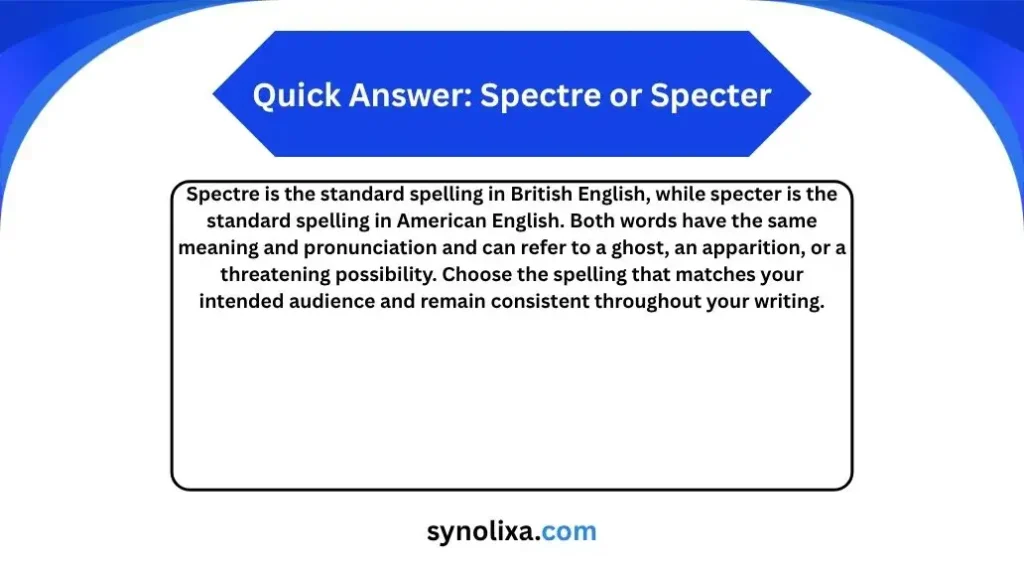
Spectre is the standard spelling in British English, while specter is the standard spelling in American English. Both words have the same meaning and pronunciation and can refer to a ghost, an apparition, or a threatening possibility. Choose the spelling that matches your intended audience and remain consistent throughout your writing.
Understanding the Basics of Spectre or Specter
The difference between spectre and specter is a matter of regional spelling, not meaning. Neither word is inherently more correct than the other.
American English generally uses specter. British English generally uses spectre. Other English-speaking regions may follow British conventions, American conventions, or a local style guide.
Comparison Table
| Form | Type | Meaning | Example | Correct/Incorrect |
|---|---|---|---|---|
| Spectre | Noun; British spelling | A ghost or threatening possibility | A spectre appeared in the old house. | Correct in British English |
| Specter | Noun; American spelling | A ghost or threatening possibility | A specter appeared in the old house. | Correct in American English |
| Spectre | Noun; regional spelling | A troubling possibility | The spectre of war worried the nation. | Correct in British English |
| Specter | Noun; regional spelling | A troubling possibility | The specter of war worried the nation. | Correct in American English |
The key point is simple: both spellings are correct, but regional conventions determine which one is usually preferred.
Why Are There Two Spellings?
English spelling developed over many centuries. Different regions adopted different spelling conventions, and some differences became firmly established through dictionaries, publishers, schools, and editorial standards.
The ending -re appears in several British English words, while American English often uses -er in the same position.
Consider these examples:
- Centre / Center: The middle of something.
- Theatre / Theater: A place for performances or a dramatic work.
- Metre / Meter: A unit of length in the metric system, although meter also has other meanings.
- Spectre / Specter: A ghost or frightening possibility.
These pairs demonstrate a broader pattern in English spelling. However, not every word follows the same rule, so it is best to learn common forms individually.
Correct Meanings and Uses of Spectre or Specter
Both spellings have the same core meanings. The correct choice depends on your intended meaning and regional spelling convention.
1. Spectre or Specter as a Ghost
The most familiar meaning of spectre or specter is a ghost or an apparition. It describes something that appears supernatural, especially the spirit or image of a dead person.
Writers often use this meaning in horror stories, mystery novels, and supernatural fiction.
Examples:
- A spectre wandered through the abandoned mansion.
- The villagers claimed to have seen a specter near the cemetery.
- In the story, a mysterious spectre appeared at midnight.
Sentence breakdown:
Consider this sentence:
“The specter frightened everyone in the house.”
- The: A definite article identifying a particular figure.
- Specter: The noun naming the ghost.
- Frightened: The past-tense verb describing the action.
- Everyone in the house: The people affected by the action.
The sentence is grammatically correct in American English. In British English, you would normally write, “The spectre frightened everyone in the house.”
The meaning remains unchanged.
2. Spectre or Specter as a Threatening Possibility
The word is also used figuratively to describe something unpleasant that people fear may happen.
This meaning is common in news reports, political discussions, business writing, and serious commentary. The feared event does not need to be supernatural or even certain to occur.
Examples:
- The specter of unemployment worried many workers.
- The spectre of economic decline affected public confidence.
- The company faced the specter of bankruptcy.
- The spectre of another conflict troubled the community.
Sentence breakdown:
“The specter of bankruptcy worried the business owner.”
- Specter: The main noun.
- Of bankruptcy: Identifies the threatening possibility.
- Worried: Describes the emotional effect.
- The business owner: The person experiencing concern.
Here, the word does not describe an actual ghost. Instead, it presents bankruptcy as a frightening possibility.
This figurative meaning is particularly useful when you want to communicate a serious threat without claiming that the outcome is certain.
3. Spectre or Specter in Literature
Writers often use these words to create mystery, suspense, or a sense of approaching danger.
In literary writing, a spectre may be a literal supernatural figure. It may also symbolize guilt, fear, memory, or an unresolved problem.
Examples:
- The spectre of his past mistakes followed him throughout the novel.
- A pale spectre stood beneath the moonlight.
- The specter of defeat haunted the general’s thoughts.
In the first and third examples, the words are figurative. They describe emotional burdens rather than physical ghosts.
In the second example, the spectre is presented as a supernatural figure.
Writing tip: If you want to create an eerie atmosphere, either spelling works. Choose the version that matches the spelling convention used throughout your story.
4. Spectre or Specter in News and Formal Writing
These words can appear in formal writing when discussing risks, fears, or possible negative outcomes.
For example:
- The specter of rising costs affected consumer confidence.
- Leaders discussed the spectre of political instability.
- The specter of a prolonged recession influenced investment decisions.
These sentences are appropriate when the writer wants to emphasize a troubling possibility.
However, the word can sound dramatic. In ordinary business communication, a simpler term such as risk, threat, or possibility may be more suitable.
Compare these sentences:
- Dramatic: “The specter of failure haunted the project.”
- Neutral: “The risk of failure concerned the project team.”
Both communicate concern, but the first creates a stronger emotional impression.
Test Tip: How to Choose the Correct Spelling
Use this simple test:
- Identify your audience.
- If you are writing in standard American English, choose specter.
- If you are writing in standard British English, choose spectre.
- If your publication or organization has a style guide, follow it.
- Keep the spelling consistent throughout the document.
Remember that the intended meaning does not determine which spelling is correct. The regional convention does.
Case Study: Spectre or Specter in Real-Life Writing
Imagine that a communications manager is preparing an article about a company facing financial difficulties.
The manager writes:
“The specter of bankruptcy has raised concerns among employees.”
The sentence is correct for an American audience. It uses specter to describe the possibility that the company may become bankrupt.
Now imagine that the same article is being prepared for a British business magazine.
The editor changes the sentence to:
“The spectre of bankruptcy has raised concerns among employees.”
The meaning has not changed. Only the regional spelling has been adjusted.
Example From a Workplace Email
Suppose an employee needs to explain a potential problem to a manager.
American English version:
Subject: Financial Risk Update
“The specter of rising costs may affect our budget next quarter. We should review our expenses and consider possible solutions.”
British English version:
Subject: Financial Risk Update
“The spectre of rising costs may affect our budget next quarter. We should review our expenses and consider possible solutions.”
Both versions are clear, professional, and grammatically correct.
What Does This Case Study Teach Us?
This example highlights three important lessons:
- Both spellings communicate the same idea.
- Regional spelling conventions matter in professional writing.
- Consistency is more important than choosing one form as universally correct.
If you are writing for an international audience, you can use either spelling when no specific convention is required. However, following a recognized style guide helps your writing look polished and consistent.
Grammar Rules Explanation: Spectre or Specter
Understanding the grammar behind these words is straightforward because both forms belong to the same part of speech.
Rule 1: Both Words Are Nouns
A noun names a person, place, thing, or idea. Spectre and specter are nouns.
They can function as the subject or object of a sentence.
As a subject:
- The specter appeared at the window.
- The spectre frightened the children.
As an object:
- They feared the specter.
- The villagers described a mysterious spectre.
The spelling changes according to regional convention, but the grammatical function stays the same.
Rule 2: Both Spellings Can Be Singular or Plural
The singular forms are spectre and specter. Their usual plural forms are spectres and specters.
Examples:
- One specter appeared in the story.
- Several specters appeared in the story.
- One spectre appeared in the story.
- Several spectres appeared in the story.
The same regional spelling pattern applies to the plural forms.
Rule 3: Neither Spelling Is Universally Incorrect
A common mistake is to assume that spectre is wrong because it contains an extra letter, or that specter is wrong because it differs from British spelling.
Neither assumption is accurate.
- In standard American English, specter is the usual spelling.
- In standard British English, spectre is the usual spelling.
A word may be less common in a particular region without being universally incorrect.
Rule 4: Use Reliable Dictionaries
Established dictionaries help writers verify spelling, meaning, pronunciation, and regional usage.
For example, Merriam-Webster is a useful reference for standard American English, while the Oxford English Dictionary and Cambridge Dictionary are useful references for British English and broader English usage.
When checking a dictionary, look for regional labels such as chiefly British or chiefly US. These labels help you understand where a spelling is normally used.
The general rule is to follow the dictionary and editorial conventions appropriate for your audience.
Rule 5: Maintain Consistency
Consistency is essential in articles, reports, essays, and books.
Suppose you are writing an American English article. You use specter in the introduction but spectre in the conclusion. Even though both spellings are valid regionally, the inconsistency may look like an editing mistake.
Choose your preferred regional convention before drafting and apply it throughout the text.
Common Mistakes With Spectre or Specter
Writers often confuse these words because they sound the same and have identical meanings. The difference is visual rather than grammatical.
Mistake 1: Treating One Spelling as Always Wrong
Incorrect assumption: “Spectre is a spelling mistake.”
Why it is wrong: Spectre is standard British English, while specter is standard American English.
Better approach: Identify your target audience before deciding which form to use.
Mistake 2: Mixing Regional Spellings
Example:
“The specter of failure worried the team, but the spectre disappeared from their concerns.”
This sentence may be understandable, but the shift in spelling is unnecessary if both instances refer to the same word under the same regional convention.
A consistent American version would use specter in both places. A consistent British version would use spectre.
Mistake 3: Assuming the Word Always Means a Ghost
The word can refer to a supernatural figure, but it can also describe a threatening possibility.
For example:
“The specter of inflation worried shoppers.”
This sentence refers to a possible economic problem, not a ghost.
Mistake 4: Using the Word When a Simpler One Would Be Clearer
The word spectre or specter can make writing sound dramatic or literary.
For example:
“The specter of a delayed delivery concerned the customer.”
A simpler alternative is:
“The possibility of a delayed delivery concerned the customer.”
Neither sentence is grammatically wrong. The second is simply more direct.
Mistake 5: Relying Only on Autocorrect
Spell-checking software may accept both forms because both are recognized English words. It may not know whether you are following American or British conventions.
Always consider your audience instead of relying exclusively on automated corrections.
Table of Similar Grammar and Spelling Confusions
| Confusing Words | Main Difference | Example |
|---|---|---|
| Spectre / Specter | British and American spelling | The specter appeared at night. |
| Centre / Center | British and American spelling | Meet me at the center. |
| Theatre / Theater | British and American spelling | We visited the theater. |
| Colour / Color | British and American spelling | Her favorite color is blue. |
| It’s / Its | Contraction versus possessive determiner | It’s raining; the dog wagged its tail. |
| Your / You’re | Possessive determiner versus contraction | Your bag is here; you’re welcome. |
| Their / There / They’re | Possession, place, or contraction | They’re leaving their bags there. |
| Principal / Principle | Person or main item versus rule or belief | The principal explained the principle. |
| Affect / Effect | Usually a verb versus usually a noun | The change may affect the result. |
Why Do These Mistakes Happen?
Several factors can lead to spelling confusion.
1. Fast typing
People often type quickly and overlook small spelling differences. Because spectre and specter look almost identical, the difference can go unnoticed.
2. Autocorrect
A keyboard may suggest a spelling based on its language settings. If those settings do not match your intended regional English, you may receive an unexpected suggestion.
3. Lack of knowledge
Some writers learn only one regional spelling convention. When they encounter the alternative, they may assume it is incorrect.
4. Reading different types of English
Someone who regularly reads both American and British publications may naturally encounter both forms.
5. Unclear editorial standards
A website or workplace that has no spelling guide may use different regional forms across its documents.
The solution is simple: understand the difference, select a regional convention, and proofread your writing.
Usage of Spectre or Specter in Different Contexts
Both words work in several writing situations. The most suitable spelling depends on your audience and the tone of your content.
1. Everyday Conversation
In ordinary conversation, people may use the word when talking about ghosts, frightening stories, or possible problems.
Examples:
- “I thought I saw a specter in the hallway.”
- “The spectre of another delay is worrying everyone.”
In casual speech, the spelling difference is not audible because the words are pronounced the same way.
If you are speaking rather than writing, you generally do not need to think about the regional spelling.
2. Professional Writing
In professional documents, consistency and clarity are important.
Examples:
- The specter of financial loss remains a concern.
- The spectre of further disruption may affect operations.
Use specter for standard American English documents and spectre for standard British English documents.
For a business report, you might also consider a simpler alternative such as risk, threat, or possibility if it communicates your point more directly.
3. Academic Writing
Academic writing requires accurate spelling and consistent editorial choices.
For example:
“The specter of political instability influenced public debate.”
This sentence is suitable for an American English academic paper.
A British English paper would normally use:
“The spectre of political instability influenced public debate.”
When writing an essay or research paper, check your instructor’s guidelines or the required publication style. Do not change spelling conventions without a reason.
4. Creative Writing
Creative writers can use either form to describe supernatural figures or symbolic fears.
Examples:
- The spectre emerged from the fog.
- A specter of regret followed the main character.
- The spectre of an ancient curse shaped the village’s traditions.
A ghost story set in Britain may naturally use spectre if the author is following British spelling conventions. An American novel would normally use specter.
However, setting alone does not determine spelling. The author’s or publisher’s chosen convention matters most.
5. Social Media and Texting
Social media posts, comments, and text messages often use informal language.
Examples:
- “That old house looks like it has a specter!”
- “The spectre of exams is getting closer.”
Both are understandable. Nevertheless, if you are creating content for an American audience, specter is the more natural choice. For British readers, spectre is generally preferred.
The distinction may matter more in blog posts, educational content, and professional social media accounts than in casual messages.
6. News Articles and Editorials
Journalists sometimes use these words to emphasize an approaching threat.
Examples:
- The specter of recession has affected market confidence.
- The spectre of renewed conflict remains a concern.
Because newspapers and news websites follow editorial standards, their preferred regional spelling usually determines which form appears.
Why the Difference Between Spectre or Specter Matters
You might wonder whether one extra letter deserves so much attention. In many situations, readers will understand either spelling. However, knowing the difference helps you produce more consistent and professional writing.
1. Clarity in Communication
Understanding regional spelling prevents unnecessary confusion.
A reader who is unfamiliar with British spelling may question spectre, while a British reader may be more accustomed to that form. Both are valid, but audience awareness helps your writing feel natural.
2. Professionalism
Consistency shows that you have reviewed your work carefully.
Imagine receiving a report that switches randomly between color and colour, or specter and spectre. The reader may suspect that the document has not been properly edited.
Using one regional convention throughout your work creates a more polished impression.
3. Accuracy in Digital Communication
Search engines, spelling tools, and publishing platforms can recognize multiple English variants. However, consistent spelling helps readers understand that your choices are intentional rather than accidental.
If your website targets American readers, use American spelling throughout your content. If it targets British readers, follow British conventions.
4. Better Writing Confidence
Learning common spelling differences helps you edit more efficiently.
Instead of repeatedly questioning whether spectre is a mistake, you can recognize it as a regional variant and focus on the sentence’s meaning.
5. Stronger Audience Awareness
Different audiences have different language expectations. Choosing an appropriate spelling shows that you understand the people you are addressing.
A useful writing principle: “Consistency makes correct writing easier to trust.”
This short principle captures the practical lesson: know your audience, choose the appropriate form, and apply it consistently.
Special Exceptions and Important Notes
Although the main rule is straightforward, a few details are worth remembering.
1. Proper Names and Titles
Some works of fiction, organizations, products, or other named entities may use Spectre or Specter as part of an official name.
For example, Spectre is the title of a James Bond film released in 2015. In such cases, preserve the official spelling of the title, regardless of the regional spelling convention used in the rest of your writing.
A proper name is not automatically changed to match your usual spelling preferences.
2. Technical and Specialized Contexts
The word spectre may also appear in specialized names or terminology. If you are discussing a particular scientific, historical, cultural, or technical subject, verify the exact term used by the relevant source.
Do not automatically replace the spelling in an official name or quotation.
3. Historical Texts
Older books and historical documents may use spelling conventions that differ from modern standards.
If you are quoting an original source, preserve its spelling when accuracy requires it. If you are writing a modern explanation, use the convention appropriate for your audience.
4. International English
English-speaking regions do not always follow a single spelling system in every context. Some countries generally use British conventions, while others follow American conventions or local standards.
When writing for an international audience, choose a consistent style guide rather than assuming that every country follows exactly the same rules.
5. Pronunciation
Spectre and specter are generally pronounced the same way. The final spelling difference does not create a meaningful difference in pronunciation.
This is why people may use the correct word in speech but remain uncertain about which spelling to choose in writing.
Quick Recap Checklist: Spectre or Specter
Use this checklist to select the appropriate spelling.
| Question | If Yes → Use |
|---|---|
| Are you writing in standard American English? | Specter |
| Are you writing in standard British English? | Spectre |
| Does your organization’s style guide specify a spelling? | Follow the style guide |
| Are you reproducing an official title or proper name? | Preserve its official spelling |
| Are you unsure which regional convention your audience expects? | Check the publication’s spelling standards |
| Have you already chosen one form for your article? | Keep that form consistent |
Practice Examples
Test your understanding with these sentences.
Example 1: American English
“The ______ of recession worried investors.”
Correct answer: specter
Explanation: Standard American English generally uses specter.
Example 2: British English
“The ______ of war remained a concern.”
Correct answer: spectre
Explanation: Standard British English generally uses spectre.
Example 3: General meaning
“The specter of failure affected his confidence.”
Is the sentence correct?
Yes. It is grammatically correct in American English. The word refers to the troubling possibility of failure rather than a literal ghost.
Quick Memory Trick
Remember this simple pattern:
- Specter = American English
- Spectre = British English
The letter e before the final r is the spelling clue associated with the British form.
This is a useful memory aid, not a universal rule for every English word.
FAQs
1. Is spectre or specter the correct spelling?
Both spellings are correct. Spectre is the standard British English spelling, while specter is the standard American English spelling. Choose the form that matches your audience or required style guide.
2. What does spectre or specter mean?
A spectre or specter is a ghost, apparition, or frightening possibility. The word can describe a supernatural figure or a figurative threat, such as the specter of economic collapse.
3. Is spectre British or American?
Spectre is primarily the British English spelling. It is also used in other English-speaking contexts that follow British spelling conventions.
4. Is specter American or British?
Specter is the standard American English spelling. American writers commonly use it when referring to ghosts or threatening possibilities.
5. Do spectre and specter have different meanings?
No. The two words have the same basic meanings and pronunciation. Their difference is regional spelling, not grammar or definition.
6. How can I remember the difference between spectre and specter?
Remember that specter is the usual American spelling and spectre is the usual British spelling. If you write for a particular publication, check its style guide and use the same form consistently.
Conclusion
Understanding spectre or specter is easy once you know the difference between British and American English. Both words are correct, and both can describe a ghost, an apparition, or a frightening possibility. The only major difference is their regional spelling.
Use specter when writing in standard American English. Choose spectre when following standard British English conventions. If you are writing for a school, business, publisher, or website, follow its preferred spelling guide.
Remember that context also matters. The word can describe a supernatural figure, but it can also refer to an unpleasant possibility, such as the specter of failure or the spectre of war. Both meanings are useful in everyday communication, professional writing, and creative work.
Most importantly, do not treat one spelling as universally wrong. Choose the form that suits your audience, check your work carefully, and remain consistent from beginning to end.
The simplest rule to remember is this: specter for American English, spectre for British English.

Hi, I am Noah Harrison. I work at Synolixa as an English language editor, reviewing and creating helpful content to make English learning easier and clearer.

[…] By the end, you will know which spelling to choose and when to use a more polite alternative. Spectre or Specter | Mom vs Mum | Moose vs […]