Have you ever wondered whether to write apposed vs opposed when describing two things placed next to each other or expressing disagreement with an idea? These words look and sound similar, but they have different meanings. Choosing the wrong word can change the message you want to communicate.
The confusion between apposed and opposed often happens because both words contain the same ending and are pronounced similarly in many contexts. However, their meanings are not interchangeable. Apposed generally means placed close together or brought into contact, while opposed means against something or someone. For example, two surfaces can be apposed when they touch, but two people can be opposed when they disagree about a decision.
Understanding the difference between these terms can improve your grammar, vocabulary, and writing accuracy. Whether you are writing an email, preparing a school assignment, creating professional content, or communicating on social media, using the correct word helps your readers understand your intended meaning.
In this guide, you will learn the meanings of apposed and opposed, their grammatical functions, common mistakes, practical examples, and simple ways to remember which word to use. By the end, you will be able to distinguish these words with confidence. Damnit or Dammit | Spectre or Specter | Mom vs Mum
Quick Answer: Apposed vs Opposed
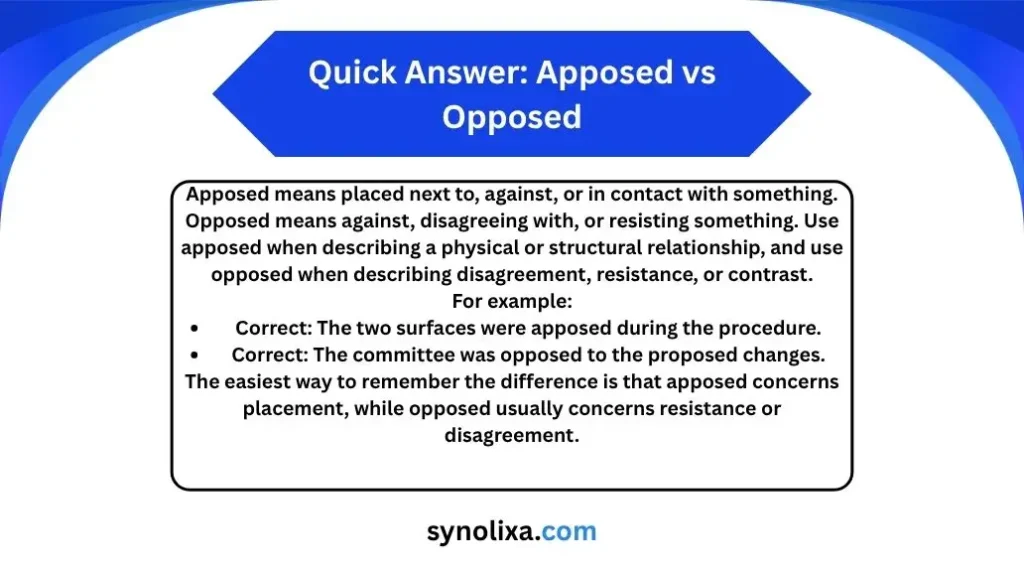
Apposed means placed next to, against, or in contact with something. Opposed means against, disagreeing with, or resisting something. Use apposed when describing a physical or structural relationship, and use opposed when describing disagreement, resistance, or contrast.
For example:
- Correct: The two surfaces were apposed during the procedure.
- Correct: The committee was opposed to the proposed changes.
The easiest way to remember the difference is that apposed concerns placement, while opposed usually concerns resistance or disagreement.
Understanding the Basics of Apposed vs Opposed
Although apposed and opposed look similar, they communicate different ideas. The main difference is the relationship between the things or people being described.
Comparison Table
| Form | Type | Meaning | Example | Correct/Incorrect |
|---|---|---|---|---|
| Apposed | Verb form or adjective | Placed close together or in contact | The two edges were apposed. | Correct when describing placement |
| Opposed | Verb form or adjective | Against, resisting, or disagreeing | She opposed the proposal. | Correct when describing disagreement |
| Apposed | Past participle of appose | Brought into a position of contact or proximity | The surfaces were carefully apposed. | Correct in a suitable technical context |
| Opposed | Past tense or past participle of oppose | Resisted or disagreed with something | They opposed the new rule. | Correct when describing resistance |
| Apposed | Incorrect substitute for opposed | Used mistakenly to express disagreement | He was apposed to the plan. | Incorrect for the intended meaning |
| Opposed | Incorrect substitute for apposed | Used mistakenly to describe touching surfaces | The edges were opposed and touching. | Usually incorrect if physical contact is intended |
What Is the Main Difference?
The difference becomes clear when you examine the intended message.
- Apposed describes things positioned beside, against, or in contact with each other.
- Opposed describes disagreement, resistance, or a state of being against something.
Consider these sentences:
- The two pieces of material were apposed along their edges.
- The two managers were opposed to the new policy.
In the first sentence, apposed describes the position of two physical objects. In the second sentence, opposed explains the managers’ disagreement with a policy.
The words are not interchangeable because their meanings are different.
Correct Meanings and Uses of Apposed vs Opposed
To use these words accurately, you need to understand how each word works in a sentence.
1. What Does Apposed Mean?
Apposed is the past-tense or past-participle form of the verb appose. It means to place something next to or in contact with another thing.
The word is relatively uncommon in everyday American English. It appears more often in specialized, scientific, medical, anatomical, and technical writing.
For example:
- The two surfaces were apposed carefully.
- The edges were apposed to create a continuous boundary.
- The structures were positioned closely together.
In each example, the word describes physical placement rather than disagreement.
Sentence Breakdown
Consider this sentence:
“The two surfaces were apposed during the procedure.”
- The two surfaces: The objects being described.
- Were: The auxiliary verb used to form the passive construction.
- Apposed: The past participle describing how the surfaces were positioned.
The sentence means that the surfaces were brought together or placed in contact.
When Should You Use Apposed?
Use apposed when you need to describe:
- Two surfaces placed in contact.
- Edges positioned next to each other.
- Structures brought close together.
- A physical relationship in a technical description.
For everyday writing, simpler alternatives such as placed together, aligned, or brought into contact may be more natural.
For example:
Technical: The two edges were apposed.
Everyday: The two edges were placed together.
Both sentences communicate a similar idea, but the second is easier for most readers to understand.
2. What Does Opposed Mean?
Opposed is the past-tense and past-participle form of the verb oppose. It can also function as an adjective.
It means to resist something, disagree with an idea, or be against a person, proposal, action, or condition.
For example:
- The residents opposed the construction project.
- She was opposed to changing the schedule.
- The two teams opposed each other in the final match.
- He opposed the decision because it was unfair.
The word is common in everyday conversation, professional writing, news reports, academic work, and formal discussions.
Sentence Breakdown
Consider this sentence:
“The employees opposed the proposed changes.”
- The employees: The people taking action.
- Opposed: The past-tense verb expressing disagreement.
- The proposed changes: The decision or action they disagreed with.
The sentence means that the employees did not support the proposed changes.
When Should You Use Opposed?
Use opposed when discussing:
- Disagreement with an opinion.
- Resistance to a rule or policy.
- Objections to a proposal.
- Competition or conflict between groups.
- A person’s negative position toward an action.
Examples:
- My parents opposed the decision.
- The board opposed the new regulations.
- Several voters were opposed to the proposal.
- The two candidates held opposed views.
Notice that opposed can describe both an action and a state of disagreement.
3. Can Apposed and Opposed Both Describe Physical Relationships?
Sometimes their meanings may appear close because both can involve things positioned against each other. However, their usual meanings remain different.
Apposed emphasizes proximity, positioning, or contact. Opposed emphasizes resistance, contrast, or being against something.
Compare:
- The two surfaces were apposed.
This means they were placed close together or in contact. - The two surfaces were opposed.
This may suggest that they faced one another or were positioned in opposition, depending on the context. It does not automatically mean they were touching.
For this reason, you should choose the word that expresses the exact relationship you intend to describe.
A Simple Test Tip for Choosing the Correct Word
Here is an easy way to decide between apposed and opposed.
Ask yourself: Am I describing placement, or am I describing disagreement?
- If you mean placement or contact, consider apposed.
- If you mean disagreement, resistance, or being against something, use opposed.
Examples:
- The scientists placed the structures together.
Better technical wording: The structures were apposed. - The scientists disagreed with the proposed explanation.
Correct wording: The scientists opposed the explanation. - The committee did not support the plan.
Correct wording: The committee opposed the plan. - The two edges touched each other.
Possible technical wording: The edges were apposed.
Test tip: If you can replace the word with disagreed with or resisted, the correct word is usually opposed. If you can replace it with placed together or brought into contact, apposed may be appropriate.
Case Study: Apposed vs Opposed in Real-Life Writing
Imagine that a laboratory team is preparing a report about two materials. At the same time, the team’s manager is writing an email about a proposed change to the laboratory’s schedule.
Although both documents discuss the same workplace, they require different words.
Situation 1: A Technical Report
A researcher writes:
“The two surfaces were opposed during the test.”
The intended meaning is that the surfaces were carefully placed in contact. However, opposed does not communicate that meaning as precisely as the writer wants.
A clearer version is:
“The two surfaces were apposed during the test.”
An even simpler version for a general audience is:
“The two surfaces were placed together during the test.”
The choice depends on the audience and the level of technical detail required.
Situation 2: A Workplace Email
The manager writes:
“I am apposed to changing the laboratory schedule.”
The intended meaning is that the manager disagrees with the change. In this case, apposed is incorrect.
The corrected sentence is:
“I am opposed to changing the laboratory schedule.”
This version clearly communicates disagreement.
What Can We Learn From These Situations?
The surrounding sentence determines which word is appropriate.
- Use apposed when discussing physical placement or contact.
- Use opposed when discussing resistance or disagreement.
- Prefer simpler wording when a specialized term might confuse readers.
The lesson is simple: never choose a word based on appearance alone. Choose it based on meaning.
Grammar Rules Explanation: Apposed vs Opposed
Understanding the grammatical forms of these words will help you avoid mistakes.
Rule 1: Apposed Comes From the Verb Appose
The verb appose means to place next to or in contact with something.
Its forms include:
- Base form: appose
- Third-person singular: apposes
- Present participle: apposing
- Past tense: apposed
- Past participle: apposed
Examples:
- The technician will appose the two surfaces.
- The technician apposes the edges carefully.
- The technician is apposing the structures.
- The technician apposed the surfaces yesterday.
- The surfaces have been apposed.
The verb is valid English, but it is uncommon compared with more familiar words such as place, align, and position.
Rule 2: Opposed Comes From the Verb Oppose
The verb oppose means to resist, disagree with, or act against something.
Its forms include:
- Base form: oppose
- Third-person singular: opposes
- Present participle: opposing
- Past tense: opposed
- Past participle: opposed
Examples:
- I oppose the proposal.
- She opposes the new rule.
- They are opposing the decision.
- We opposed the change last year.
- The proposal has been opposed by several groups.
Unlike appose, oppose is widely used in everyday English.
Rule 3: Opposed Often Appears With To
When opposed functions as an adjective describing disagreement, it commonly appears in the construction opposed to.
Examples:
- I am opposed to the idea.
- They are opposed to the new policy.
- She was opposed to working late.
In these sentences, to is a preposition. When a verb follows it, that verb usually takes the -ing form.
Correct: He is opposed to changing the plan.
Incorrect: He is opposed to change the plan.
However, oppose can also function as a verb without to:
Correct: He opposes changing the plan.
The distinction is important because opposed to and oppose follow different grammatical patterns.
Rule 4: Do Not Treat the Words as Interchangeable
A word can be correctly spelled but still be wrong for a particular sentence.
For example:
Incorrect: The workers were apposed to the new policy.
Correct: The workers were opposed to the new policy.
The spelling apposed is legitimate, but it does not mean that someone disagrees with a policy.
Similarly:
Incorrect for the intended meaning: The two surfaces were opposed to create a continuous connection.
Clearer: The two surfaces were apposed to create a continuous connection.
The correct choice depends on the intended meaning and the grammatical structure.
Rule 5: Check a Reliable Dictionary
Standard dictionaries such as Merriam-Webster distinguish appose, meaning to place beside or in contact with, from oppose, meaning to resist or stand against.
When you encounter an unfamiliar word, check its dictionary definition, pronunciation, part of speech, and example sentences. A dictionary can also help you determine whether a word is common, formal, technical, or rarely used.
For specialized writing, consult the relevant professional terminology guide as well. A technical field may use a term more narrowly than ordinary conversation does.
Common Mistakes With Apposed vs Opposed
Confusion between these words can occur for several reasons.
1. Similar Spelling
Both words end in -posed. Their visual similarity may lead writers to assume that they have the same meaning.
However, the first part of each word changes its meaning significantly.
- Apposed: placed together or in contact.
- Opposed: against or disagreeing.
2. Fast Typing
When writing quickly, people sometimes select a familiar-looking word without checking its meaning.
For example:
Incorrect: I am apposed to the new rules.
Correct: I am opposed to the new rules.
A quick proofreading check can prevent this error.
3. Autocorrect
Spell-checking tools may accept both words because both are valid English words. As a result, a spelling checker may not identify the incorrect word choice.
For example, a program may accept “apposed” even when the writer means “opposed.”
Always check the meaning of a sentence, not just the spelling.
4. Lack of Knowledge
Some writers have rarely encountered apposed because it is uncommon in everyday English. They may assume that it is simply another form of opposed.
Learning the definition of each word and reading examples in context can solve this problem.
5. Misunderstanding the Word To
The phrase opposed to is common, while apposed to is much less common and does not normally communicate disagreement.
Incorrect: She is apposed to the proposal.
Correct: She is opposed to the proposal.
Comparison Table of Similar Grammar Confusions
| Confusing Words | Correct Difference | Example |
|---|---|---|
| It’s / Its | It’s means it is or it has; its shows possession. | It’s raining. The dog wagged its tail. |
| Your / You’re | Your shows possession; you’re means you are. | Your bag is here. You’re early. |
| Their / There | Their shows possession; there refers to a place or introduces a statement. | Their house is over there. |
| Affect / Effect | Affect is usually a verb; effect is usually a noun. | The change affected us. The effect was clear. |
| Complement / Compliment | A complement completes something; a compliment expresses praise. | The sauce complements the meal. She gave me a compliment. |
| Apposed / Opposed | Apposed describes placement; opposed describes resistance or disagreement. | The surfaces were apposed. We opposed the proposal. |
The best way to avoid these mistakes is to understand what each word communicates. Correct spelling matters, but correct word choice matters just as much.
Usage of Apposed vs Opposed in Different Contexts
Different writing situations call for different vocabulary choices.
1. Everyday Conversation
In everyday conversation, opposed is much more common than apposed.
Examples:
- I am opposed to that idea.
- My friends opposed the decision.
- Are you opposed to going tomorrow?
Most people would not use apposed unless they were discussing a specialized subject.
Instead of saying, “The pieces were apposed,” a speaker might say, “The pieces were placed together.”
2. Professional Writing
Professional writing requires precise and appropriate language.
Use opposed when describing objections, disagreements, or resistance.
Examples:
- The department opposed the proposed budget.
- Several employees were opposed to the revised schedule.
- The organization opposed the new regulations.
Use apposed when the technical meaning of physical placement is necessary.
Example:
“The two surfaces were apposed before the measurements were taken.”
If the audience may not know the term, explain it or use a more familiar alternative.
3. Academic Writing
Academic writing may use either word, depending on the subject.
In anatomy, biology, medicine, or other technical fields, apposed may describe structures that lie close together or touch.
Examples:
- The surfaces were apposed along their edges.
- The structures remained closely apposed.
In political science, history, sociology, or argument analysis, opposed is more likely to describe conflicting positions.
Examples:
- The two groups opposed the legislation.
- The researchers presented opposed interpretations of the findings.
Always follow the terminology used in your discipline.
4. Creative Writing
Creative writers can use opposed to describe conflict between characters, beliefs, or forces.
Examples:
- The two sisters were opposed on nearly every issue.
- He opposed the king’s decision.
- Their beliefs were opposed, but their goals were similar.
The word can also describe physical orientation in an appropriate context, although another word may be clearer.
Apposed is more likely to appear in a highly technical or deliberately specialized passage.
5. Social Media and Texting
On social media, readers generally prefer simple, direct language.
Examples:
- I’m opposed to this change.
- Many users opposed the new update.
- Are you opposed to the idea?
Using apposed instead of opposed can make a message confusing.
For example:
Unclear: I’m apposed to the update.
Clear: I’m opposed to the update.
When writing short messages, choose the word that communicates your meaning immediately.
6. Scientific and Medical Contexts
The word apposed can be useful in technical descriptions of structures that are positioned close together or in contact.
For example:
“The tissue surfaces were apposed.”
This describes a physical relationship.
By contrast:
“The researchers opposed the proposed treatment.”
This means that the researchers disagreed with or resisted the proposal.
The two words may appear in the same broad professional environment, but their meanings remain distinct.
Why the Difference Between Apposed and Opposed Matters
Choosing the correct word helps readers understand your meaning without stopping to interpret the sentence.
1. Clarity in Communication
Using the wrong word can make your sentence confusing.
Consider:
“I am apposed to the plan.”
A reader may recognize that you intended to express disagreement, but the sentence uses the wrong word.
The correct version is:
“I am opposed to the plan.”
Clear wording reduces misunderstandings.
2. Professionalism
Grammar and word choice influence how readers evaluate professional communication.
A correctly written email, report, or presentation shows that you have taken care with your message.
For example:
“We are opposed to the proposed changes.”
This is clear, direct, and suitable for a professional setting.
3. Accuracy in Digital Communication
Digital writing often happens quickly. Emails, text messages, social media posts, and online articles may be published without careful proofreading.
Because spell-checking tools can accept both words, writers need to review meaning as well as spelling.
A short review can help you catch incorrect substitutions.
4. Better Vocabulary
Learning uncommon words expands your understanding of English.
Knowing apposed helps you recognize technical writing, while knowing opposed helps you express disagreement accurately.
You do not need to use complicated vocabulary in every sentence. The best word is the one that communicates your meaning clearly.
A useful writing principle: “Choose the word that says exactly what you mean.”
This is a practical reminder to prioritize clarity over unnecessary complexity.
Special Exceptions and Less Common Uses
Although the basic distinction is straightforward, some contexts deserve additional attention.
1. Apposed Is a Valid but Uncommon Word
It is incorrect to assume that apposed is always a misspelling.
The word is valid English. It is simply less common than opposed and usually appears in specialized contexts.
For example:
“The two surfaces were apposed.”
This can be correct when the writer means that the surfaces were placed together.
2. Opposed Can Describe Contrasting Things
The word opposed does not always refer to a personal disagreement.
It can also describe ideas, forces, directions, or positions that conflict with or contrast with each other.
Examples:
- The two candidates held opposed views.
- The forces moved in opposed directions.
- The arguments were opposed in their basic assumptions.
The exact meaning depends on the sentence.
3. Opposed Can Function as an Adjective
Compare these examples:
- The residents opposed the plan.
- The residents were opposed to the plan.
In the first sentence, opposed is the past-tense verb.
In the second sentence, opposed functions as an adjective describing the residents’ position.
Both constructions are correct.
4. Apposed May Be Better Replaced With a Simpler Word
Even when apposed is technically correct, it may not be the best choice for a general audience.
For example:
Technical: The edges were apposed.
Plain English: The edges were placed together.
Choose the technical term when precision matters and your audience understands it. Choose simpler wording when accessibility is more important.
5. There Is No General Brand-Name Exception
Neither spelling has a special general grammar rule because of a brand name. A company, product, publication, or fictional character may use a particular spelling as a proper name, but that does not change the ordinary meanings of the words in standard English.
When writing about a named entity, follow its official spelling. In ordinary sentences, use apposed and opposed according to their meanings.
Quick Recap Checklist: Apposed vs Opposed
Use this checklist whenever you are unsure which word belongs in your sentence.
| Question | If Yes → Use |
|---|---|
| Am I describing surfaces placed next to each other or in contact? | Apposed |
| Am I describing disagreement with a decision? | Opposed |
| Am I describing resistance to a rule or proposal? | Opposed |
| Am I describing a technical physical relationship between structures? | Apposed, when appropriate |
| Am I describing conflicting beliefs or opinions? | Opposed |
| Would disagreed with make sense in my sentence? | Opposed |
| Would placed together make sense in my sentence? | Apposed, when the technical meaning fits |
Practice Examples
Choose apposed or opposed for each blank.
- The committee was ______ to the proposed changes.
- The two surfaces were carefully ______ before the test.
- Several residents ______ the construction project.
Answers:
- Opposed — The committee disagreed with the changes.
- Apposed — The surfaces were brought into contact.
- Opposed — The residents resisted or disagreed with the project.
A Final Memory Trick
Remember these two short definitions:
- Apposed = placed together.
- Opposed = against something.
If you remember these meanings, you will be able to choose the correct word in most situations.
FAQs
1. What is the difference between apposed and opposed?
Apposed means placed next to or in contact with something. Opposed means against something, resisting it, or disagreeing with it. The correct choice depends on whether you are describing physical placement or disagreement.
2. Is apposed a real word?
Yes. Apposed is the past-tense and past-participle form of appose, which means to place beside or in contact with something. It is uncommon in everyday English but can be appropriate in technical writing.
3. Is opposed the correct word for disagreement?
Yes. Opposed is the correct word when describing disagreement, resistance, or a lack of support for a proposal. For example, “She was opposed to the decision” means that she disagreed with it.
4. Can I say “I am apposed to this idea”?
Not if you mean that you disagree with the idea. The correct sentence is “I am opposed to this idea.” The word apposed does not ordinarily express disagreement.
5. How do I remember when to use apposed vs opposed?
Remember that apposed relates to placement or contact, while opposed relates to resistance or disagreement. If you mean “placed together,” consider apposed. If you mean “against” or “disagreeing with,” use opposed.
6. Which word is more common in American English?
Opposed is much more common in everyday American English, professional communication, and general writing. Apposed appears mainly in specialized or technical contexts where its specific meaning is useful.
Conclusion
Understanding apposed vs opposed is easier when you focus on meaning rather than spelling. Although these words look similar, they serve different purposes in English. Apposed means placed next to or in contact with something, and it is most often used in specialized or technical contexts. Opposed means against, resisting, or disagreeing with something, and it is common in everyday conversation and professional writing.
When you are unsure which word to choose, ask yourself whether your sentence describes physical placement or disagreement. If you mean that two surfaces are positioned together, apposed may be appropriate. If you mean that a person or group disagrees with an idea, opposed is the correct choice.
Remember that a spell-checker may accept both words, so always check the meaning of your sentence. Clear writing does not require complicated vocabulary. It requires accurate word choices that help readers understand your message.
Final rule to remember: Apposed means placed together; opposed means against. Choose the right word, and make every sentence count.

Hi, I am Clara Anderson. I work at Synolixa as a vocabulary writer, focusing on synonyms, word meanings, and easy-to-understand English learning content.
[…] practical examples, grammar tips, comparison tables, and answers to frequently asked questions. Apposed vs Opposed | Damnit or Dammit | Spectre or […]
[…] examples, common mistakes, and simple tips for remembering the correct form. Polite vs Courteous | Apposed vs Opposed | Damnit or […]