
Roofs vs rooves is a common spelling question for people learning English and writers who want to use the correct plural of roof. If you have ever wondered whether to write the roofs of the houses or the rooves of the houses, you are not alone. Both forms have appeared in English, but they are not equally common in modern American writing.
The good news is that the rule is simple. Roofs is the standard plural of roof in contemporary American English. The word rooves is a rare alternative that may appear in older texts or certain regional contexts, but it is generally not recommended for everyday writing.
This distinction is important when writing school assignments, professional emails, construction reports, real estate descriptions, blog posts, and social media updates. Using the standard spelling helps your message look clear and professional.
In this guide to roofs vs rooves, you will learn the difference between the two forms, understand the plural spelling rule, explore real-life examples, and discover how to avoid common mistakes. You will also find a comparison table, practical writing tips, a recap checklist, and frequently asked questions to help you remember the correct form. Piece of Mine or Peace of Mind | It Is Must vs It Is a Must | Bad Rap or Bad Rep
Quick Answer: Roofs vs Rooves
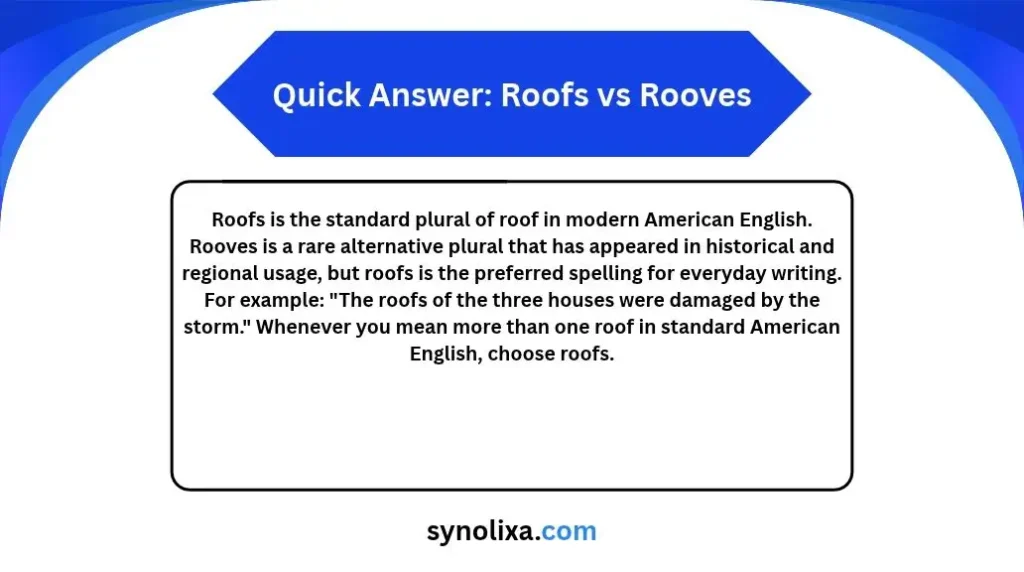
Roofs is the standard plural of roof in modern American English. Rooves is a rare alternative plural that has appeared in historical and regional usage, but roofs is the preferred spelling for everyday writing.
For example: “The roofs of the three houses were damaged by the storm.” Whenever you mean more than one roof in standard American English, choose roofs.
Understanding the Basics of Roofs vs Rooves
The difference between roofs and rooves becomes easier to understand when you look at their meanings, spelling patterns, and accepted usage.
Both forms refer to multiple roofs when used as plural nouns. However, roofs is the familiar and widely accepted form in modern American English.
What Does Roof Mean in Roofs vs Rooves?
The word roof is a noun that describes the upper covering of a building or another structure. It protects the space underneath from weather conditions such as rain, snow, wind, and sunlight.
Examples:
- The roof of our house needs repairs.
- Snow covered the roof overnight.
- The garage has a metal roof.
- A contractor inspected the roof before winter.
Each sentence refers to one roof, so the singular form is appropriate.
What Does Roofs Mean in Roofs vs Rooves?
Roofs is the standard plural form of roof. It refers to two or more roof structures.
Examples:
- The roofs of the houses are red.
- Several roofs were damaged by strong winds.
- Workers repaired the roofs of three apartment buildings.
- Solar panels were installed on the roofs.
In each example, the noun refers to more than one roof. Adding -s creates the standard plural.
What Does Rooves Mean in Roofs vs Rooves?
Rooves is an alternative plural form of roof. It has appeared in older English and some regional usage, but it is uncommon in contemporary American English.
You may encounter this form in an older document, a historical discussion, or a source that preserves regional language.
For example:
- An old text may refer to the rooves of village cottages.
- A historical language discussion may compare roofs and rooves.
These examples illustrate the alternative spelling. They do not make rooves the preferred form for modern American writing.
When writing an essay, business email, report, or online article, use roofs unless you have a specific reason to preserve a historical or regional variant.
Roofs vs Rooves: Comparison Table
| Form | Type | Meaning | Example | Correct/Incorrect |
|---|---|---|---|---|
| Roof | Singular noun | One roof | The roof is leaking. | Correct |
| Roofs | Standard plural noun | Two or more roofs | The roofs need repairs. | Correct |
| Rooves | Rare plural variant | Two or more roofs | The rooves were repaired. | Generally avoid in standard American English |
| Roof’s | Singular possessive or contraction | Something belonging to one roof, or roof is | The roof’s edge is damaged. | Correct when appropriate |
| Roofs’ | Plural possessive | Something associated with multiple roofs | The roofs’ colors match. | Correct when appropriate |
The main rule for roofs vs rooves: Use roof for one roof and roofs for multiple roofs in standard modern American English.
Correct Meanings and Uses of Roofs vs Rooves
Learning the difference between roofs and rooves is not just about memorizing two spellings. It also involves understanding when to use a singular noun, when to use a plural noun, and when an alternative spelling may appear.
1. Use Roof for One Structure
Use roof when referring to a single structure.
Examples:
- The roof is covered with shingles.
- Our roof needs a professional inspection.
- A bird landed on the roof.
- The roof protects the house from rain.
Sentence breakdown:
In the sentence “Our roof needs a professional inspection,” the word our identifies the roof associated with the speaker. Because the sentence refers to one structure, roof is correct.
2. Use Roofs for Multiple Structures
Use roofs when talking about two or more roofs.
Examples:
- The roofs of both buildings are new.
- Workers inspected several roofs yesterday.
- The neighborhood has many colorful roofs.
- Strong winds damaged the roofs of nearby houses.
Sentence breakdown:
In “Workers inspected several roofs yesterday,” the word several indicates more than one roof. The plural noun roofs is therefore appropriate.
3. Choose Roofs Instead of Rooves in Professional Writing
Professional writing should follow standard spelling conventions. This includes business emails, property inspection reports, insurance documents, construction estimates, and real estate listings.
Examples:
- The inspection covered the roofs of all five properties.
- The contractor estimated the cost of replacing three roofs.
- The report identified damage to several roofs.
- The maintenance team inspected the roofs before winter.
In each sentence, roofs is the standard spelling.
4. Recognize Rooves as a Rare Alternative
Understanding the alternative form is useful when reading older material or discussing the history of English.
Examples of contexts in which you might encounter rooves include:
- Historical descriptions of buildings.
- Older documents that preserve traditional spelling.
- Regional speech or writing.
- Discussions of English plural variations.
If you encounter rooves in an old quotation, you may preserve the original spelling when accuracy requires it. However, when writing your own modern American English text, roofs is the safer choice.
5. Practice Roofs vs Rooves in Everyday Sentences
Examples:
- The roofs are covered with leaves.
- All the roofs on this street look different.
- We can see the roofs from the hill.
- The roofs need to be checked before the rainy season.
- Several roofs have solar panels.
These examples demonstrate the standard plural form in ordinary situations.
Test Tip: Replace the plural noun with the singular word roof. If the sentence refers to multiple structures, write roofs in standard American English. Do not automatically change the f to v.
Roofs vs Rooves: A Real-Life Case Study
Imagine that a property manager is preparing a report after a severe storm. The manager inspects six houses and discovers that three roofs have missing shingles.
The manager writes:
“The storm damaged three rooves in the neighborhood.”
The intended meaning is clear, but rooves is not the recommended plural for a standard American English report.
A better version is:
“The storm damaged three roofs in the neighborhood.”
Why Is Roofs Better Than Rooves in This Report?
The revised sentence follows standard modern American spelling conventions. It is suitable for an insurance claim, a contractor’s report, a property inspection, or a professional email.
Now imagine that the property manager sends an email to the maintenance team.
Subject: Roof Inspection Update
“The inspection is complete. Three roofs need repairs, and two others require additional checks. Please review the attached report before scheduling the work.”
This message is clear, concise, and professional.
What Does This Roofs vs Rooves Example Teach Us?
The example highlights three important lessons:
- Accuracy: Standard spelling prevents unnecessary distractions.
- Professionalism: Consistent language makes reports easier to read and understand.
- Clarity: Readers can focus on the repair work instead of wondering about an unusual spelling.
The main lesson is simple: even when an alternative spelling exists, the standard form is usually the best choice for professional communication.
Grammar Rules Explained: Roofs vs Rooves
To understand why roofs is preferred, it helps to review how English forms plural nouns.
Rule 1: Most Nouns Add S to Form the Plural
Many English nouns become plural by adding -s.
Examples:
- Book → books
- Car → cars
- House → houses
- Window → windows
- Roof → roofs
The word roof follows this regular plural pattern in standard modern American English.
Rule 2: Some Nouns Ending in F Change to VES
Certain English nouns ending in -f or -fe form their plurals by changing that ending to -ves.
Examples:
- Leaf → leaves
- Wolf → wolves
- Knife → knives
- Wife → wives
- Life → lives
Because these words follow a different pattern, writers sometimes assume that every noun ending in -f must change to -ves.
That assumption is incorrect.
Rule 3: Roofs vs Rooves Shows Why English Has Exceptions
English does not follow one universal plural rule. Some nouns ending in -f take -s, some change to -ves, and some have accepted variations.
| Singular | Standard Plural |
|---|---|
| Roof | Roofs |
| Chief | Chiefs |
| Belief | Beliefs |
| Leaf | Leaves |
| Wolf | Wolves |
| Knife | Knives |
| Life | Lives |
The spelling of roof is one of the forms that should be learned individually. The fact that leaf becomes leaves does not mean that roof must become rooves.
Rule 4: Check a Reliable Dictionary for Roofs vs Rooves
Major dictionaries are useful references when you are unsure about a plural form.
Merriam-Webster and other established dictionaries provide entries for English words and their accepted forms. When checking roof, look for the standard plural and any labels attached to alternative forms.
Dictionary labels can help explain whether a form is common, rare, historical, regional, or nonstandard. A listed variant is not necessarily equally suitable in every situation.
For modern American writing, roofs is the usual plural form.
Rule 5: Consider Your Audience and Writing Purpose
The right spelling should fit the language standard and purpose of your text.
- For an American school essay, use roofs.
- For a business report, use roofs.
- For a modern blog post, use roofs.
- For a historical quotation, preserve the source’s original spelling when necessary.
- For a discussion of English word history, explain rooves as a rare variant.
Learning these distinctions helps you write accurately without assuming that every noun follows the same pattern.
Common Mistakes With Roofs vs Rooves
Writers often confuse these forms because English has several plural spelling patterns. Fortunately, the most common mistakes are easy to correct.
Mistake 1: Applying the VES Rule to Every F Word
Incorrect for standard American English:
“The roofs of the houses were damaged.”
This sentence is actually correct. The mistake occurs when someone changes roofs to rooves because they remember words such as leaves and wolves.
Correct:
“The roofs of the houses were damaged.”
Mistake 2: Assuming Rooves Sounds More Formal
Some writers believe that rooves sounds more sophisticated or traditional. However, an unusual spelling does not automatically make writing more formal.
For modern American business writing, use roofs.
Mistake 3: Trusting Autocorrect Without Checking
Typing tools may accept unusual words, overlook a mistake, or behave differently depending on their dictionaries and settings.
A spelling checker might not flag rooves, even when roofs is more appropriate for your document.
Always consider the context rather than relying entirely on automated suggestions.
Mistake 4: Confusing Roofs With Roof’s and Roofs’
Plural nouns and possessive nouns have different functions.
- Roofs: The roofs are old.
- Roof’s: The roof’s surface is damaged.
- Roofs’: The roofs’ colors are similar.
Roofs refers to multiple roofs. Roof’s can show possession by one roof or form the contraction roof is. Roofs’ indicates possession or association involving multiple roofs.
Do not add an apostrophe simply because a noun is plural.
Mistake 5: Assuming Every Dictionary Variant Is Equally Common
Dictionaries record words and variations that occur in English. However, their entries may distinguish between standard, rare, historical, and regional forms.
Encountering rooves in a source does not mean it is interchangeable with roofs in every modern context.
Mistake 6: Forgetting to Proofread
A writer may know the correct spelling but still make an error while typing quickly. A final review can catch these mistakes before publication.
Read the sentence aloud, check the noun’s meaning, and confirm the spelling if you are unsure.
Similar Grammar Confusions
| Confusing Forms | Correct Usage | Example |
|---|---|---|
| Roofs / rooves | Use roofs in standard American English. | The roofs need repairs. |
| Leaf / leaves | Use leaves for the usual plural. | The leaves fell. |
| Chief / chieves | Use chiefs. | The chiefs attended the meeting. |
| Belief / believes | Beliefs is the plural noun; believes is a verb. | Their beliefs differ. |
| It’s / its | It’s means it is or it has; its is possessive. | It’s raining. |
| Your / you’re | Your is possessive; you’re means you are. | You’re holding your book. |
| There / their | There indicates a place or introduces a statement; their is possessive. | Their house is over there. |
| Advice / advise | Advice is a noun; advise is a verb. | I advise you to follow the advice. |
Why Do These Mistakes Happen?
Common causes include:
- Fast typing: Writers may use a familiar spelling pattern without thinking about the individual word.
- Autocorrect: A device may accept a rare variant or fail to suggest the preferred spelling.
- Lack of knowledge: Some writers have never learned which nouns follow irregular plural patterns.
- Overgeneralization: A writer may assume that a rule for one word applies to every similar word.
- Limited proofreading: A quick review may overlook a small spelling difference.
The solution is straightforward: learn the standard plural, check a reliable dictionary when necessary, and proofread important documents.
Usage of Roofs vs Rooves in Different Contexts
The purpose of your writing can affect how you handle a rare variant. However, roofs remains the best general choice for modern American English.
1. Roofs vs Rooves in Everyday Conversation
In everyday conversation, roofs is the usual plural.
Examples:
- “The roofs on our street need repairs.”
- “I can see the roofs from the balcony.”
- “Those roofs look new.”
- “The roofs are covered with snow.”
You do not need a special grammatical construction. Use the standard plural naturally.
2. Roofs vs Rooves in Professional Writing
Professional writing includes emails, reports, contracts, inspection records, and property listings.
Examples:
- “The contractor inspected all six roofs.”
- “The roofs of the commercial properties require maintenance.”
- “The final report lists the roofs that need replacement.”
- “The inspection team documented damage to several roofs.”
Using roofs helps maintain consistency with standard American spelling conventions.
3. Roofs vs Rooves in Academic Writing
Students may encounter rooves while researching historical texts or variations in English. In an ordinary academic essay, however, roofs is the safer choice.
Examples:
- “The roofs of medieval buildings varied by region.”
- “The study examined roof construction in traditional homes.”
- “The roofs of the buildings were compared across several periods.”
If your assignment concerns historical language, you can explain the alternative form as part of your analysis.
4. Roofs vs Rooves in Creative Writing
Creative writers have more freedom to reproduce regional speech, historical language, or a character’s individual vocabulary.
A historical character might use rooves in dialogue if the writer has a sound linguistic reason for that choice.
However, creative freedom does not mean that every unusual form is automatically historically accurate. Research the period, region, and source before using a variant deliberately.
For ordinary modern narration, roofs remains the standard choice.
5. Roofs vs Rooves in Social Media and Texting
Social media posts are often written quickly, making spelling mistakes easy to overlook.
Examples:
- “The roofs look beautiful after the snow.”
- “We are replacing the roofs this summer.”
- “Several roofs were damaged in last night’s storm.”
Even in casual messages, standard spelling makes your meaning clear.
6. Roofs vs Rooves in Real Estate and Construction
Real estate agents, architects, contractors, and property managers frequently discuss multiple roofs.
Examples:
- “The property includes two buildings with separate roofs.”
- “All roofs will be inspected before closing.”
- “The roofs of the apartment complex were recently renovated.”
- “The contractor will provide estimates for repairing the roofs.”
In these contexts, accuracy matters because the writing may become part of a formal record.
Why Choosing Roofs Matters
Choosing the standard plural may seem like a small detail, but correct spelling contributes to clear and professional communication.
Clarity in Communication
Readers should not have to stop and wonder whether an unusual spelling is intentional. Using roofs keeps the sentence familiar and easy to understand.
For example:
“The roofs of the three houses need repairs.”
This sentence communicates the information directly without drawing attention away from the message.
Professionalism in Writing
Spelling mistakes can distract readers from the quality of a report, proposal, or business email. Consistent spelling helps your writing appear careful and credible.
For contractors, property managers, and real estate professionals, attention to detail supports clear documentation.
Writing Accuracy and Clarity
Correct spelling demonstrates an understanding of standard English conventions. It also helps prevent repeated mistakes in longer documents.
Learning that roof becomes roofs gives you one more reliable spelling rule to apply when writing.
Digital Communication and SEO
Online content is often scanned quickly by readers. Clear spelling supports readability in articles, newsletters, social media posts, and website content.
Although search engines do not reward every individual spelling choice in isolation, useful and well-edited content can improve the overall reader experience.
A Short Quote to Remember
“Clarity begins with choosing the right words.”
The principle applies to grammar and spelling alike. When you know the standard form, you can communicate confidently and keep your reader focused on the message.
Special Exceptions and Interesting Facts About Roofs vs Rooves
English has developed over many centuries. During that time, different spellings and plural forms have appeared in written and spoken language.
Is Rooves Always Wrong?
Not necessarily in every historical or descriptive context. Rooves has existed as a variant plural and may appear in regional usage or older sources.
However, a form can exist without being the best choice for standard contemporary writing. In modern American English, roofs is the expected plural.
If you are quoting an old document, retain the original spelling when accuracy requires it. If you are writing your own text, use roofs unless you have a specific reason to reproduce the variant.
Why Do Some People Expect Rooves?
The main reason is analogy. Several common nouns ending in -f change to -ves in the plural.
For example:
- Leaf becomes leaves.
- Wolf becomes wolves.
- Knife becomes knives.
- Life becomes lives.
People naturally notice these patterns and may apply them to roof. But English has exceptions, and the standard plural of roof is roofs.
Does British English Always Use Rooves?
No. It would be misleading to say that all British English speakers use rooves or that rooves is the standard British plural.
Roofs is widely used in both American and British English. The alternative rooves may occur in certain regional or historical contexts, but it is not the usual spelling to teach as the general plural.
What About Company Names and Product Names?
A business, publication, product, or creative work may use Rooves as part of its official name or branding.
In such cases, preserve the name as officially written. A proper name does not change the general rule for the common noun roof.
For example, if a company is officially named “Rooves Design,” reproduce that name accurately. In your own sentence, you would still write, “The roofs were repaired.”
Does the Spelling Change the Meaning?
Usually, no. When roofs and rooves are used as plural forms, they refer to the same basic concept: more than one roof.
The difference is primarily one of spelling, frequency, and appropriateness in modern usage.
Quick Recap Checklist: Roofs vs Rooves
Use this checklist whenever you are unsure which form belongs in your sentence.
| Question | If Yes → Use |
|---|---|
| Are you talking about one roof? | Roof |
| Are you talking about two or more roofs? | Roofs |
| Are you writing a standard American English article? | Roofs |
| Are you preparing a professional report or business email? | Roofs |
| Are you discussing an older text that uses the variant spelling? | Preserve or explain rooves when appropriate |
| Are you using an official brand or company name? | Follow the official spelling of the name |
| Are you unsure which form a dictionary recommends? | Check a reliable current dictionary |
Three Practice Examples
Choose the appropriate word for each sentence.
1. The ______ of the houses were damaged by strong winds.
A. Roofs
B. Rooves
2. The contractor inspected all the ______ before preparing the estimate.
A. Roofs
B. Rooves
3. The old document used the historical variant ______ when describing the buildings.
A. Roofs
B. Rooves
Answers and Explanations
1. Roofs. The sentence refers to multiple houses, so roofs is the standard plural.
2. Roofs. A professional inspection report should use the standard modern plural.
3. Rooves. This sentence specifically describes a historical variant. The word is included to illustrate older or less common usage, not to recommend it for ordinary modern writing.
A Simple Memory Trick
Remember this sentence:
One roof, two roofs, many roofs.
The word roof takes -s in its standard plural form. You do not need to change the f to v.
FAQs
1. Is Roofs or Rooves Correct?
Roofs is the standard plural of roof in modern American English. Rooves is a rare or less common variant that appears in some historical and regional usage. For everyday writing, choose roofs.
2. Why Is the Plural of Roof Roofs Instead of Rooves?
English plural rules include exceptions. Although some nouns ending in -f change to -ves, others simply add -s. Roof belongs to the second group in standard modern English, so its usual plural is roofs.
3. Is Rooves a Real Word?
Yes, rooves has been used as a plural variant of roof. However, it is uncommon in contemporary American English. Recognizing it as a variant does not mean it is the preferred spelling for general writing.
4. Do British People Say Roofs or Rooves?
Both forms have appeared in English usage, but roofs is widely used in British English as well as American English. Rooves may appear in certain regional or historical contexts, but it should not be treated as the standard plural for all British speakers.
5. What Is the Plural of Roof in a School Essay?
Use roofs. It is the standard spelling expected in contemporary American English and is appropriate for school assignments, reports, and formal writing.
6. How Can I Remember the Correct Plural of Roof?
Remember the simple pattern: roof → roofs. Do not automatically apply the -f to -ves pattern used by words such as leaf → leaves. When in doubt, consult a reliable dictionary.
Conclusion
The difference between roofs vs rooves is easy to understand once you learn the standard plural form. In modern American English, roofs is the correct and widely accepted choice for everyday writing. It refers to two or more roofs and follows a plural spelling pattern used by several other English nouns.
Although rooves has appeared as an alternative plural in historical and regional usage, it is uncommon in contemporary American English. Therefore, it is best avoided in school assignments, professional emails, reports, articles, and other standard writing.
Remember that English nouns do not all follow the same plural pattern. Words such as leaf and wolf change to leaves and wolves, but roof normally becomes roofs.
The easiest way to remember the rule is to practice it in everyday sentences: one roof, two roofs, and many roofs.
When you choose the standard spelling, your writing becomes clearer, more consistent, and easier to read. When in doubt, choose roofs and write with confidence.

Hi, I am Noah Harrison. I work at Synolixa as an English language editor, reviewing and creating helpful content to make English learning easier and clearer.

[…] grammar rule, explore everyday examples, and discover practical ways to avoid this common mistake. Roofs vs Rooves | Piece of Mine or Peace of Mind | It Is Must vs It Is a […]