Have you ever wondered whether to write dieing or dying in an email, school assignment, or social media post? The spelling difference between dieing vs dying confuses many English writers because both forms appear to follow a logical pattern. However, only one is the standard spelling when you want to describe the process of dying.
The correct word is dying. It is the present participle of the verb die and can describe a person or animal approaching death, a plant losing its life, a battery running out of power, or a tradition gradually disappearing. It can also appear in expressions such as “dying to know,” which means being very eager to learn something.
The spelling dieing is generally incorrect when used with these meanings in standard modern English. The confusion often comes from the mistaken idea that adding -ing to die simply produces dieing. English spelling has several patterns, and this verb follows the pattern that changes ie to y before the suffix.
In this guide to dieing vs dying, you will learn the correct spelling, understand the grammar rule, explore everyday examples, and discover practical ways to avoid this common mistake. Roofs vs Rooves | Piece of Mine or Peace of Mind | It Is Must vs It Is a Must
Quick Answer: Dieing vs Dying
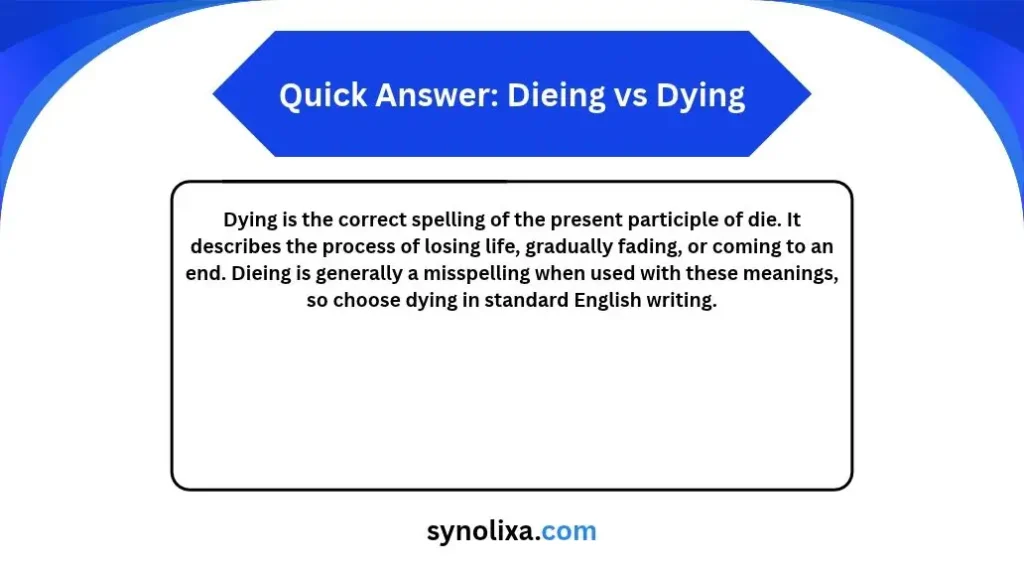
Dying is the correct spelling of the present participle of die. It describes the process of losing life, gradually fading, or coming to an end. Dieing is generally a misspelling when used with these meanings, so choose dying in standard English writing.
Understanding the Basics of Dieing vs Dying
The main difference between dieing vs dying is spelling, not pronunciation. Both forms are often intended to express the same meaning, but only dying is standard when referring to the verb die.
The base verb die means to stop living or cease to exist. When it becomes a present participle, its spelling changes to dying.
Consider these examples:
- Correct: The plant is dying.
- Incorrect: The plant is dieing.
- Correct: My phone battery is dying.
- Incorrect: My phone battery is dieing.
The correct form follows a conventional English spelling pattern. When certain verbs ending in ie take the suffix -ing, the final ie changes to y.
Dieing vs Dying Comparison Table
| Form | Type | Meaning | Example | Correct/Incorrect |
|---|---|---|---|---|
| Dying | Present participle | Losing life or gradually ending | The flowers are dying. | Correct |
| Dying | Adjective | Approaching death or fading | The dying plant needs attention. | Correct |
| Dieing | Nonstandard spelling in this context | Usually intended to mean dying | The flowers are dieing. | Incorrect |
| Die | Base verb | To stop living or cease to exist | Plants die without water. | Correct |
| Died | Simple past and past participle | Stopped living or ceased to exist | The tree died last year. | Correct |
| Dies | Third-person singular present | Stops living or ceases to exist | The flower dies without water. | Correct |
The Main Rule for Dieing vs Dying
Use dying when describing an ongoing process related to the verb die.
For example:
- The old tree is dying.
- The battery is dying.
- The tradition is dying out.
- I am dying to see the new movie.
The meaning changes according to the context, but the spelling remains the same.
Correct Meanings and Uses of Dying
Understanding the different meanings of dying makes the dieing vs dying spelling rule easier to remember. The word can be used literally or figuratively.
1. Dying Means Approaching the End of Life
The most direct meaning of dying describes a person, animal, or other living organism that is approaching death.
Examples:
- The dying patient received medical attention.
- The family cared for their dying pet.
- The rescue team found a dying bird.
In the sentence “The dying patient received care,” the word dying describes the noun patient. It functions as an adjective.
Remember that the standard spelling is dying, even when the sentence describes a serious or emotional situation.
2. Dying Describes a Plant Losing Life
The word dying frequently describes plants, flowers, and trees that are becoming unhealthy or losing life.
Examples:
- The flowers are dying because they lack water.
- We tried to save the dying tree.
- Several garden plants are dying in the heat.
In “The flowers are dying,” the word are is a helping verb, and dying forms part of the present progressive tense. The sentence describes an ongoing process.
This example also demonstrates why the dieing vs dying distinction matters in everyday writing: the correct spelling remains dying.
3. Dying Describes Something Losing Power or Strength
English speakers often use dying figuratively when something is becoming weaker or gradually stopping.
Examples:
- My phone battery is dying.
- The fire was dying when we arrived.
- The sound of the music was dying away.
A battery does not literally die in the biological sense. Instead, the word communicates that its power is running out.
Likewise, a fading sound or weakening fire can be described as dying.
4. Dying Describes a Disappearing Tradition
A tradition, custom, language, or industry may be described as dying when it becomes less common or is at risk of disappearing.
Examples:
- The old tradition is slowly dying.
- Some traditional crafts are dying out.
- The community wants to protect a dying language.
The expression dying out means gradually disappearing or ceasing to exist.
These examples reinforce the dieing vs dying rule because the same spelling is used for both literal and figurative meanings.
5. Dying Expresses a Strong Desire
The informal expression dying to means being extremely eager to do something.
Examples:
- I am dying to hear the news.
- She is dying to visit Paris.
- We are dying to know the results.
These sentences are figurative. They express excitement, curiosity, or eagerness rather than literal death.
Test tip: If you mean losing life, fading, or being extremely eager to do something, dying is the standard spelling.
Dieing vs Dying: Grammar Rules Explained
The spelling difference between dieing vs dying comes from a conventional English spelling pattern. Understanding that pattern helps prevent similar mistakes.
Why Does Die Become Dying?
The base verb is die. When the present participle is formed, the spelling changes from ie to y before adding -ing.
The result is dying.
Compare the following verbs:
| Base Verb | Correct -ing Form |
|---|---|
| Die | Dying |
| Lie | Lying |
| Tie | Tying |
| Vie | Vying |
These verbs share a similar spelling pattern. The final ie changes to y before the suffix -ing is added.
This is why dieing is not the standard form when describing the process of dying.
Why Is the Rule Different From Making or Writing?
English verbs do not all follow exactly the same spelling pattern.
For example:
- Make → Making
- Write → Writing
- Hope → Hoping
- Die → Dying
- Lie → Lying
In make, write, and hope, the final silent e is removed before adding -ing. In die and lie, the final ie changes to y.
The key lesson is that English spelling depends on the particular word and its established form. You cannot always predict the correct spelling by attaching a suffix mechanically.
What Do Standard Dictionaries Say About Dying?
Standard American dictionaries, including Merriam-Webster, list dying as the standard present participle of die. When you encounter an unfamiliar spelling, consulting a reputable dictionary is a reliable way to verify it.
For ordinary modern English, the distinction is straightforward:
- Die → Dying
- Lie → Lying
- Tie → Tying
Learning these forms together makes the dieing vs dying spelling rule easier to recall.
Dieing vs Dying: A Real-Life Case Study
Imagine that a student wants to email a teacher about a classroom plant.
The student writes:
“Hello, I wanted to let you know that the plant near the window is dieing. It may need more water and sunlight.”
The message is understandable, but dieing is not the standard spelling in this sentence.
A corrected version reads:
“Hello, I wanted to let you know that the plant near the window is dying. It may need more water and sunlight.”
Why Is the Corrected Sentence Better?
The corrected version improves the email in three ways.
- Spelling accuracy: It uses the accepted form dying.
- Professional presentation: It shows attention to detail.
- Clear communication: It follows standard written English.
The same principle applies to workplace emails, school assignments, website articles, and public social media posts.
A spelling mistake may not prevent readers from understanding the message, but correcting it helps your writing appear more polished.
Common Mistakes in Dieing vs Dying
Many people make the dieing vs dying mistake because they try to apply a familiar spelling rule without considering the specific word.
Here are some common reasons for the confusion.
1. Applying the Wrong Suffix Rule
Some writers assume that adding -ing means keeping the entire base verb unchanged.
They may reason that die + ing should become dieing. However, the standard spelling pattern changes ie to y.
Correct: The battery is dying.
Incorrect: The battery is dieing.
2. Typing Too Quickly
Fast typing can cause errors when writers focus on the message rather than the spelling of each word.
A person may type dieing without noticing the mistake.
Solution: Review your writing before sending it, especially when preparing an important email, report, or article.
3. Relying Too Much on Autocorrect
Autocorrect and spelling tools can help, but they do not always identify every error. Their suggestions can also vary according to application settings and dictionaries.
Solution: Learn the correct spelling rather than depending entirely on automated corrections.
4. Not Knowing the Spelling Pattern
A writer may know that make becomes making but may not know that die becomes dying.
Learning a few related examples makes this pattern easier to remember.
5. Confusing Similar-Looking Words
English contains many words that look or sound alike but have different meanings or spellings.
| Common Confusion | Correct Usage | Example |
|---|---|---|
| Dieing / Dying | Dying | The plant is dying. |
| It’s / Its | It’s = it is; its = possession | It’s losing its color. |
| Your / You’re | Your = possession; you’re = you are | You’re holding your book. |
| Their / There | Their = possession; there = a place | Their car is parked there. |
| To / Too | To = direction or infinitive marker; too = also or excessively | I want to come too. |
| Then / Than | Then = time or sequence; than = comparison | She is taller than I am. |
| Lieing / Lying | Lying | He is lying on the sofa. |
| Tieing / Tying | Tying | She is tying her shoes. |
Checking the meaning and spelling of a word before publishing can help you avoid these common errors.
Dieing vs Dying in Different Writing Contexts
The correct spelling of dying does not change between formal and informal writing. However, its meaning and suitability can vary according to context.
Everyday Conversation
In everyday conversation, dying can describe literal death, a fading condition, or an intense desire.
Examples:
- The flowers are dying.
- My phone battery is dying.
- I am dying to hear your news.
- The campfire is dying down.
These sentences are natural examples of standard usage.
Professional Writing
Professional communication requires careful spelling and clear wording.
Examples:
- The office plant appears to be dying.
- The device’s battery is dying and needs replacement.
- The report examines the decline of a dying industry.
In formal writing, consider whether a more precise term would communicate your meaning better. For example, declining industry may be more appropriate than dying industry in a business report.
Academic Writing
Academic writing values precision, consistency, and clarity.
Examples:
- The researcher examined the effects of drought on dying plants.
- The report discussed the decline of a dying tradition.
- The study described changes in a tree population.
Depending on the field, expressions such as declining population, plant mortality, or loss of habitat may be more precise.
Regardless of the wording you choose, the correct spelling of the ordinary present participle of die remains dying.
Creative Writing
In fiction, poetry, and descriptive writing, dying can communicate emotion, change, or atmosphere.
Examples:
- The dying light spread across the empty street.
- A dying flame flickered in the wind.
- The final notes faded into the dying echoes of the hall.
Writers can use the word literally or metaphorically, but its standard spelling does not change.
Social Media and Texting
Online conversations often include informal expressions such as:
- “I’m dying to see this!”
- “My laptop is dying.”
- “This trend is dying out.”
- “I’m dying of laughter!”
These expressions communicate excitement, frustration, or amusement. They are common in informal communication, and dying remains the correct spelling.
Why the Dieing vs Dying Difference Matters
Correct spelling helps readers understand your writing and gives your message a more polished appearance.
1. Clarity in Communication
Readers can usually understand a misspelled word from context, but spelling errors may distract them from your main point.
Compare:
- Correct: My phone is dying.
- Incorrect: My phone is dieing.
The first sentence follows standard English spelling and is suitable for ordinary written communication.
2. Professionalism
Spelling accuracy matters in job applications, business emails, school assignments, reports, and online articles.
Using dying correctly shows attention to detail and helps your writing look carefully prepared.
3. Better Writing Skills
Learning the dieing vs dying distinction also teaches you to recognize related spelling patterns.
Once you remember die → dying, it becomes easier to recall lie → lying and tie → tying.
4. Accuracy in Digital Communication
Digital messages are often read quickly, so polished spelling can help your writing look more reliable.
Spelling tools are useful, but understanding the rule allows you to recognize errors independently.
A useful reminder is: “Clear writing begins with choosing the right word.”
Small spelling decisions can make a meaningful difference in the quality of everyday communication.
Special Exceptions to the Dieing vs Dying Rule
In ordinary modern English, dieing is not the standard spelling of the present participle of die.
However, an unusual spelling may appear in a proper name, historical document, or specialized technical context. Such examples need to be evaluated individually rather than treated as general spelling exceptions.
The noun die can refer to a tool used to cut, shape, or stamp material. Certain technical terms derived from this noun may have specialized forms, depending on the industry. That does not make dieing an acceptable alternative to dying when describing death, fading, or gradual decline.
If you encounter dieing in a technical manual or historical text, check the context and consult an appropriate dictionary or industry reference.
For ordinary sentences about a person, animal, plant, battery, tradition, or fading light, use dying.
Dieing vs Dying: Quick Recap Checklist
Use this checklist to verify the correct spelling before completing your sentence.
| Question | If Yes → Use |
|---|---|
| Are you describing someone or something approaching death? | Dying |
| Are you describing a plant losing its health? | Dying |
| Are you describing a battery running out of power? | Dying |
| Are you describing a tradition gradually disappearing? | Dying |
| Are you saying you are very eager to do something? | Dying |
| Are you using the present participle of the verb die? | Dying |
Practice Examples for Dieing vs Dying
Example 1: The flowers are (dieing / dying) because the soil is too dry.
Correct answer: dying
Explanation: The sentence describes flowers gradually losing their health.
Example 2: I am (dieing / dying) to find out who won the competition.
Correct answer: dying
Explanation: The expression dying to find out means being very eager to know something.
Example 3: The old battery is (dieing / dying), so the device keeps shutting down.
Correct answer: dying
Explanation: The word describes a battery that is running out of power.
A Simple Memory Trick
Remember these three forms:
- Die → Dying
- Lie → Lying
- Tie → Tying
In each case, the final ie changes to y before -ing is added.
This simple pattern is an effective way to avoid the most common spelling mistake involving dieing vs dying.
FAQs
1. Is dieing or dying the correct spelling?
Dying is the correct spelling when referring to the present participle of die. The spelling dieing is generally incorrect in standard modern English.
Example: “The plant is dying because it needs water.”
2. Why is dying spelled with a y instead of ie?
The conventional English spelling pattern changes the final ie to y before adding -ing. Therefore, die becomes dying, just as lie becomes lying and tie becomes tying.
3. Is dieing ever correct in English?
Not as the ordinary present participle of die. If the spelling appears in a specialized term, proper name, or historical document, examine the context and consult a suitable reference.
4. What is the past tense of die?
The simple past tense of die is died. Its past participle is also died.
Examples:
- The tree died last year.
- The tree has died.
Use dying when describing an ongoing process.
5. What is the difference between dying and dead?
Dying describes a process or condition in which life is approaching its end. Dead describes a state in which life has ended.
Examples:
- The plant is dying. It is still in the process of losing life.
- The plant is dead. It is no longer alive.
6. How can I remember the correct spelling of dying?
Remember the pattern die → dying. Practicing it alongside lie → lying and tie → tying can make the correct spelling easier to recall.
Conclusion
The difference between dieing vs dying becomes easy to understand once you learn the standard spelling pattern. Dying is the correct present participle of die. It can describe a person or animal approaching death, a plant losing life, a battery running out of power, or a tradition gradually disappearing. It also appears in figurative expressions such as “dying to know,” which means being very eager to find out something.
By contrast, dieing is generally a misspelling when used with these meanings. The standard form changes the final ie to y before adding -ing.
Remember the related forms die → dying, lie → lying, and tie → tying. These examples make the spelling pattern easier to recognize and apply.
Whether you are writing a school assignment, a professional email, a blog post, or a social media caption, choose dying when you mean the ordinary present participle of die.
The rule is simple: when something is dying, spell it with a y—not an ie.

Hi, I am Ava Mitchell. I work at Synolixa as an English content writer, creating simple and useful resources about synonyms, vocabulary, and English usage.

[…] from formal writing. By the end, you will have a simple method for choosing the right expression. Dieing vs Dying | Roofs vs Rooves | Piece of Mine or Peace of […]
[…] “too early” confidently and avoid this common English grammar mistake. For Who or For Whom | Dieing vs Dying | Roofs vs […]
[…] In this guide, you will learn the difference between their life or their lives, understand the essential grammar rules, explore practical examples, and discover how to avoid common mistakes. Whether you are writing an email, an article, a school assignment, or a social media post, these simple explanations will help you choose the correct expression confidently. Is It To or Too Early | For Who or For Whom | Dieing vs Dying […]