Have you ever wondered whether to say “in the store” or “at the store” when talking about shopping, meeting someone, or describing where you are? These two expressions are common in everyday American English. Both are grammatically correct, but they are not always used in the same situations.
The confusion happens because both phrases describe a person’s location. For example, you might tell a friend, “I am in the store,” or “I am at the store.” Although these sentences are correct, they can communicate slightly different ideas.
Understanding the difference between in the store or at the store can help you speak and write more naturally. The key is knowing whether you want to emphasize being physically inside the building or simply being at that particular location.
In this guide, you will learn the meanings, grammar rules, practical examples, common mistakes, and differences between these expressions. You will also discover how to choose the right phrase in conversations, professional writing, emails, and social media messages. Nighttime or Night-Time | Artefact vs Artifact | On Friday or In Friday
Quick Answer: In the Store or At the Store?
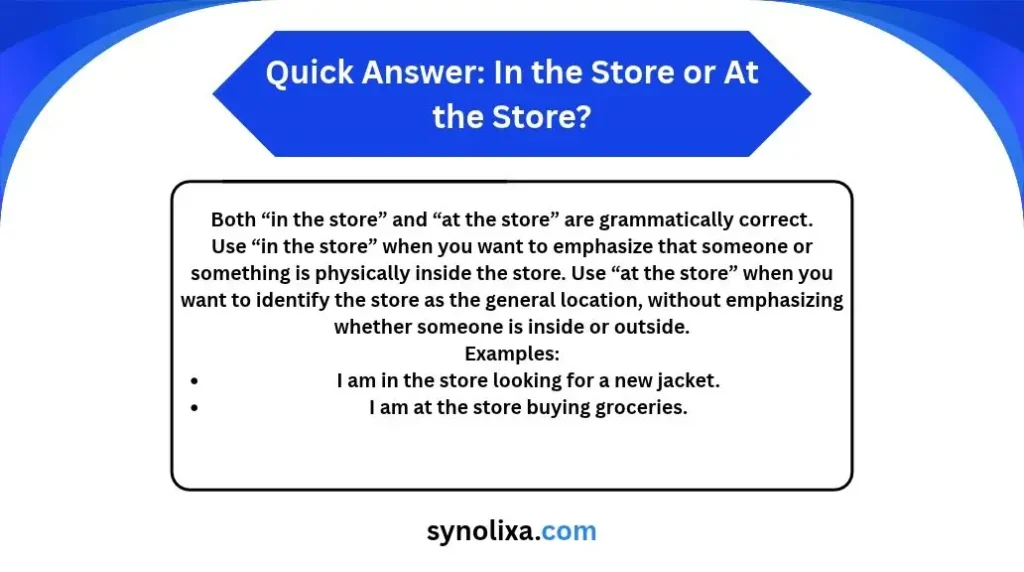
Both “in the store” and “at the store” are grammatically correct.
Use “in the store” when you want to emphasize that someone or something is physically inside the store. Use “at the store” when you want to identify the store as the general location, without emphasizing whether someone is inside or outside.
Examples:
- I am in the store looking for a new jacket.
- I am at the store buying groceries.
The difference is mainly about location and emphasis, not grammatical correctness.
Understanding the Basics of In the Store or At the Store
To understand these expressions, you first need to understand how the prepositions in and at work in English.
Both words describe locations, but they approach location differently.
What Does In the Store Mean?
The expression “in the store” means physically inside a store or within its interior space.
The preposition in commonly describes something surrounded by boundaries or located within an enclosed area.
For example:
- She is in the store.
- There are many customers in the store.
- I left my shopping bag in the store.
- He is waiting in the store near the entrance.
In each sentence, the focus is on the inside area of the building.
What Does At the Store Mean?
The expression “at the store” identifies the store as a particular location or destination.
It does not necessarily explain whether someone is inside the building, standing outside, or somewhere on the store’s premises.
For example:
- I am at the store.
- My father is at the store buying groceries.
- We met at the store yesterday.
- She is at the store with her friends.
Here, the store is the location being discussed.
Comparison Table: In the Store vs At the Store
| Form | Type | Meaning | Example | Correct/Incorrect |
|---|---|---|---|---|
| In the store | Prepositional phrase | Physically inside the store | I am in the store. | Correct |
| At the store | Prepositional phrase | At the store’s general location | I am at the store. | Correct |
| In a store | Prepositional phrase | Inside an unspecified store | He works in a store. | Correct |
| At a store | Prepositional phrase | At an unspecified store location | We met at a store. | Correct |
| On the store | Prepositional phrase | Usually suggests a surface or position above the store | I am on the store. | Usually incorrect for this meaning |
Important: Neither expression is automatically better. Your intended meaning determines which one you should use.
Correct Meanings and Uses of In the Store or At the Store
Let’s explore the situations in which each phrase works best.
1. Use In the Store When Describing an Interior Location
Choose “in the store” when you want to explain that someone or something is inside the building.
The phrase is especially useful when the interior location matters.
Examples:
- The children are playing in the store.
- I found a beautiful dress in the store.
- Several employees are working in the store.
- There is a new bakery in the store.
- My phone is somewhere in the store.
Sentence breakdown:
Sentence: My phone is somewhere in the store.
- My phone: The subject.
- Is: The linking verb.
- Somewhere: An indefinite location word.
- In the store: The prepositional phrase describing where the phone is.
The phrase identifies the phone’s location inside the building.
2. Use At the Store When Identifying a General Location
Use “at the store” when the important information is that someone is at that location.
You do not need to explain whether the person is inside or outside.
Examples:
- I am at the store right now.
- My mother is at the store.
- We stopped at the store after work.
- He is waiting at the store.
- I will meet you at the store tomorrow.
Sentence breakdown:
Sentence: I am at the store right now.
- I: The subject.
- Am: The linking verb.
- At the store: The prepositional phrase identifying the location.
- Right now: An expression of time.
The sentence tells the listener where the speaker is without specifying an exact position inside the building.
3. Use In the Store When the Interior Matters
Sometimes, the physical position of someone or something is important.
In these situations, “in the store” is usually the clearer choice.
Examples:
- The manager is in the store checking the shelves.
- My wallet is in the store near the checkout counter.
- There are several new products in the store.
- The customers are shopping in the store.
- I saw my teacher in the store yesterday.
These sentences focus on the building’s interior.
4. Use At the Store When Discussing Shopping Activities
When talking about a shopping trip, “at the store” is a natural expression.
Examples:
- I bought some milk at the store.
- She spent two hours at the store.
- We met our neighbors at the store.
- He forgot his shopping list at the store.
- My parents are at the store getting supplies.
The expression identifies where the activity happened.
5. Use In the Store When Describing Something Located Inside
The preposition in is useful when identifying objects, products, people, or activities within the store.
Examples:
- The shoes in the store are expensive.
- There is a new security system in the store.
- The employees in the store are helpful.
- I saw a beautiful painting in the store.
- The products in the store are on sale.
The emphasis is on the interior space and the things found there.
6. Use At the Store When Talking About Meetings
When arranging a meeting, “at the store” is often the more natural expression.
Examples:
- Let’s meet at the store.
- I will see you at the store at noon.
- They agreed to meet at the store.
- We met at the store before going home.
The phrase identifies the meeting point.
However, if you want to specify that someone should meet you inside the building, you can say:
- Let’s meet inside the store.
- Meet me in the store near the entrance.
Both communicate more specific positioning.
In the Store or At the Store: A Practical Case Study
Imagine that Sarah and John are planning to meet after work.
Sarah sends John a message:
Sarah: Where are you?
John: I am at the store.
Sarah wants to know whether John is already inside the building.
Sarah: Are you inside?
John: Yes, I am in the store near the checkout counter.
This conversation demonstrates how the expressions work naturally.
What Happened in This Conversation?
John first uses “at the store” because he wants to identify his general location.
Sarah then asks whether he is physically inside the building.
John answers with “in the store” because he wants to describe his exact position relative to the building.
Workplace Example
Consider this workplace email:
Subject: Store Inspection
Hello Team,
I will be at the store tomorrow morning to review the inventory and discuss the new product arrangements.
During the inspection, I will spend some time in the store checking the shelves and reviewing the customer service area.
Thank you.
In this example:
- At the store identifies the inspection location.
- In the store describes where the inspection activities will take place.
Both phrases are appropriate.
Grammar Rules: Why In the Store and At the Store Are Correct
English prepositions communicate relationships between people, objects, and locations.
The difference between these expressions comes from the meanings of the prepositions.
Rule 1: In Describes an Interior Space
The preposition in generally means inside something or within an enclosed area.
Examples:
- The food is in the refrigerator.
- The students are in the classroom.
- My brother is in the kitchen.
- The customers are in the store.
The store is treated as a physical space with an interior.
Rule 2: At Identifies a Location or Point
The preposition at commonly identifies a particular place or point.
Examples:
- She is at the supermarket.
- I am at the office.
- They are at the airport.
- We are at the store.
The emphasis is on the location rather than the physical boundaries of the building.
Rule 3: Context Determines the Best Choice
Sometimes, both expressions can describe the same situation.
For example:
- I am at the store.
- I am in the store.
Both can be correct if the speaker is inside the building.
However, the second sentence makes the interior location explicit.
What Do Grammar Authorities Say?
Standard English dictionaries and grammar references, including Merriam-Webster, recognize the established meanings of prepositions such as in and at.
Their general meanings support this distinction:
- In commonly describes a position within an area or enclosed space.
- At identifies a particular place, position, or point.
This is a difference in meaning and emphasis rather than a rule that makes one expression universally correct and the other incorrect.
Common Mistakes With In the Store or At the Store
Even fluent English speakers sometimes confuse these expressions.
The most common reason is that both phrases can describe the same general location.
Mistake 1: Thinking Only One Expression Is Correct
Incorrect belief: You must always say “in the store” when discussing a store.
Correct understanding: Both expressions are correct, depending on the intended meaning.
Examples:
- I am at the store. (Correct)
- I am in the store. (Correct)
Mistake 2: Using In When the General Location Is Enough
Consider:
“I will meet you in the store at 5 p.m.”
This sentence is grammatically correct if the meeting is intended to take place inside the building.
However, if the store is simply the meeting point, the following may sound more natural:
“I will meet you at the store at 5 p.m.”
Mistake 3: Forgetting the Article
Some learners write:
- I am in store.
- She is at store.
These expressions are generally incorrect when referring to an ordinary physical retail store in American English.
Better:
- I am in the store.
- She is at the store.
The article the identifies a particular store. The article a can introduce an unspecified store.
Mistake 4: Confusing In With On
The preposition on generally describes a surface or position.
Examples:
- The bag is in the store. (Inside the building.)
- The sign is on the store. (Attached to its exterior surface.)
These expressions communicate different relationships.
Why Do These Mistakes Happen?
There are several common reasons:
1. Fast typing
People sometimes choose the first preposition that comes to mind when sending quick messages.
2. Autocorrect
Autocorrect may change words or suggest alternatives without considering the intended meaning.
3. Lack of knowledge
English learners may memorize individual expressions without understanding how prepositions work.
4. Translation from another language
Some languages use one preposition for situations where English uses several different prepositions.
Similar Grammar Confusions
| Confusing Words | Correct Difference | Example |
|---|---|---|
| It’s / Its | It’s means it is; its shows possession. | It’s cold outside. |
| Your / You’re | Your shows possession; you’re means you are. | You’re holding your bag. |
| In / At | In emphasizes an interior; at identifies a location. | I am in the store. |
| There / Their | There identifies a place; their shows possession. | Their bags are over there. |
| To / Too | To is a preposition; too means also or excessively. | I want to go too. |
| Then / Than | Then relates to time; than makes comparisons. | She is taller than me. |
Usage in Different Contexts
The choice between these expressions can depend on the situation and the information you want to communicate.
1. Everyday Conversation
In everyday American English, both expressions are common.
Examples:
- I am at the store. Do you need anything?
- I am in the store looking for bread.
- We stopped at the store on our way home.
- There are too many people in the store.
- My sister is at the store with our mother.
Tip: Use at for general location and in when the interior matters.
2. Professional Writing
In workplace communication, both phrases can make your message clear and professional.
Examples:
- The regional manager will be at the store on Monday.
- Several employees are working in the store today.
- The new products have arrived at the store.
- The inspection team is in the store reviewing the inventory.
- Please leave the documents at the store office.
In professional writing, select the phrase that communicates the intended location accurately.
3. Creative Writing
Writers can use both expressions to create different descriptions.
Examples:
- He waited at the store until the rain stopped.
- She walked slowly through the store.
- A mysterious sound came from somewhere in the store.
- They met at the store just before sunset.
The phrase “at the store” establishes a setting, while “in the store” can place a character or object within the building.
4. Social Media and Texting
Short messages often use these expressions.
Examples:
- At the store. Need anything?
- I’m in the store looking for a gift.
- Currently at the store with my family.
- Just arrived at the store.
- Still in the store shopping!
Both phrases are suitable for casual digital communication.
5. Academic Writing
Academic writing may require more precise descriptions of physical locations.
Examples:
- The researchers collected customer feedback at the store.
- The observation took place inside the store.
- The study examined customer behavior in the store.
- The survey was conducted at three different stores.
The distinction becomes especially useful when researchers describe where observations or activities occurred.
Why the Difference Between In the Store and At the Store Matters
Understanding prepositions may seem like a small part of English grammar, but it makes everyday communication more accurate.
1. It Improves Clarity
The correct preposition helps readers understand exactly what you mean.
Compare:
- I am at the store.
- I am in the store.
The first identifies your general location. The second makes it clear that you are inside.
2. It Supports Professionalism
Correct preposition use makes emails, reports, and workplace messages easier to understand.
For example:
“The delivery team is at the store.”
This identifies the team’s location.
“The delivery team is in the store.”
This emphasizes that the team is inside the building.
3. It Improves Digital Communication
People frequently send short location updates through text messages and social media.
Choosing the appropriate expression reduces unnecessary questions and confusion.
4. It Strengthens Your Grammar Skills
Learning the difference between in and at helps you understand other location expressions.
For example:
- In the office / At the office
- In the hospital / At the hospital
- In the classroom / At the classroom
- In the restaurant / At the restaurant
Remember that the natural choice can depend on the noun and the intended meaning.
A useful grammar reminder: “The right preposition makes your meaning clearer.”
Special Exceptions and Important Edge Cases
Although the basic distinction is straightforward, some situations require additional attention.
1. In the Store vs. At the Store in American English
In American English, both expressions are widely used.
For example:
- I am in the store.
- I am at the store.
Neither is incorrect.
2. Store as a Verb
The word store can also function as a verb meaning to keep something for future use.
Examples:
- We store extra supplies in the basement.
- Please store the documents safely.
- The company stores customer information securely.
These examples are different from the location expressions discussed in this article.
3. In-Store as an Adjective
The hyphenated expression in-store can function as an adjective.
Examples:
- The company offers in-store discounts.
- Customers can receive in-store assistance.
- The business introduced a new in-store promotion.
Here, in-store describes something available or happening inside a physical retail location.
4. At the Store vs. At a Store
These expressions are also different.
At the store refers to a particular store that the speaker and listener can identify.
Example: I left my umbrella at the store.
At a store refers to an unspecified store.
Example: I found this jacket at a store downtown.
Both are grammatically correct.
5. In the Store vs. Inside the Store
The phrase inside the store emphasizes the interior even more directly.
Examples:
- The customers are inside the store.
- The customers are in the store.
Both are correct and communicate nearly the same location.
Quick Recap Checklist
Use these questions to choose the right expression.
| Question | If Yes → Use |
|---|---|
| Are you emphasizing that someone is physically inside the building? | In the store |
| Are you simply identifying someone’s general location? | At the store |
| Are you describing something located within the building? | In the store |
| Are you identifying a shopping destination or meeting point? | At the store |
| Are you explaining where an activity happened without emphasizing the interior? | At the store |
Easy Memory Trick
Remember these two simple ideas:
- IN = Inside: Think about the interior of the building.
- AT = Location: Think about the store as a particular place.
This simple trick can help you choose the right preposition in most everyday situations.
Practice Examples: Test Your Understanding
Try these sentences to check your knowledge.
Example 1
I am ______ the store looking for a new pair of shoes.
Correct answer: In
Complete sentence: I am in the store looking for a new pair of shoes.
Why? The sentence emphasizes the speaker’s physical position inside the building.
Example 2
Let’s meet ______ the store after school.
Correct answer: At
Complete sentence: Let’s meet at the store after school.
Why? The store is being identified as the meeting location.
Example 3
There are many customers ______ the store today.
Correct answer: In
Complete sentence: There are many customers in the store today.
Why? The sentence describes customers who are physically inside the building.
Example 4
My father is ______ the store. He will be home soon.
Correct answer: At
Complete sentence: My father is at the store. He will be home soon.
Why? The sentence identifies his general location.
Example 5
I bought this notebook ______ the store yesterday.
Correct answer: At
Complete sentence: I bought this notebook at the store yesterday.
Why? The sentence identifies the place where the purchase happened.
FAQs
1. Is It Correct to Say In the Store or At the Store?
Yes. Both expressions are grammatically correct in American English. Use “in the store” to emphasize being physically inside the building and “at the store” to identify the general location.
2. What Is the Main Difference Between In the Store and At the Store?
The main difference is emphasis. “In the store” focuses on the interior of the building, while “at the store” identifies the store as a location or destination.
3. Should I Say I Am In the Store or I Am At the Store?
Both sentences are correct. Say “I am in the store” when you want to make it clear that you are inside. Say “I am at the store” when you simply want to tell someone your location.
4. Is At the Store More Common in American English?
Both expressions are common in American English. “At the store” is especially natural when discussing shopping trips, general locations, or meeting points. “In the store” is useful when the interior location matters.
5. Can I Use In the Store When Talking About Shopping?
Yes. You can say “I am in the store shopping for groceries.” The phrase emphasizes that you are physically inside the building while shopping.
6. Is In-Store the Same as In the Store?
No. “In the store” is a prepositional phrase describing a location. “In-store” is commonly used as a hyphenated adjective, as in “in-store offers” or “in-store promotions.”
Conclusion
Understanding the difference between in the store or at the store makes your English communication clearer and more natural. Both expressions are grammatically correct, but they emphasize different aspects of location.
Use “in the store” when you want to describe someone or something physically inside the building. Choose “at the store” when you want to identify the store as a general location, destination, or meeting point.
For example, “I am in the store looking for groceries” emphasizes your physical position inside the building. However, “I am at the store buying groceries” simply identifies where you are shopping.
Remember that context determines which expression works best. You do not need to memorize complicated rules. Just remember that in focuses on the inside, while at identifies the location.
Mastering small grammar differences like this can make a big improvement in your everyday English. Choose the preposition that communicates your meaning clearly, and your writing will sound more natural and confident.

Hi, I am Ethan Parker. I work at Synolixa as a grammar and writing specialist, helping readers understand English grammar and improve their writing skills.
[…] the difference and confidently choose the correct word in everyday and professional communication. In the Store or At the Store | Nighttime or Night-Time | Artefact vs […]