Have you ever stopped while writing a sentence because you were unsure whether to use nighttime or night-time? You are not alone. Many English learners and even experienced writers wonder whether this expression should be written as one word or with a hyphen. Although both forms appear in written English, their usage can depend on regional spelling preferences and editorial style.
The good news is that the difference is simple once you understand the basic spelling rule. In American English, nighttime is the standard and preferred spelling. It is written as one word without a hyphen. The alternative spelling, night-time, is also recognized, particularly in British English and some other varieties of English.
In this guide, we will explore the meanings, grammatical rules, examples, common mistakes, and differences between these two forms. You will also learn how to choose the appropriate spelling for emails, professional documents, creative writing, and everyday conversations.
By the end, you will know when to use each form and how to write more confidently. Artefact vs Artifact | On Friday or In Friday | Spoilt vs Spoiled
Quick Answer: Nighttime or Night-Time?
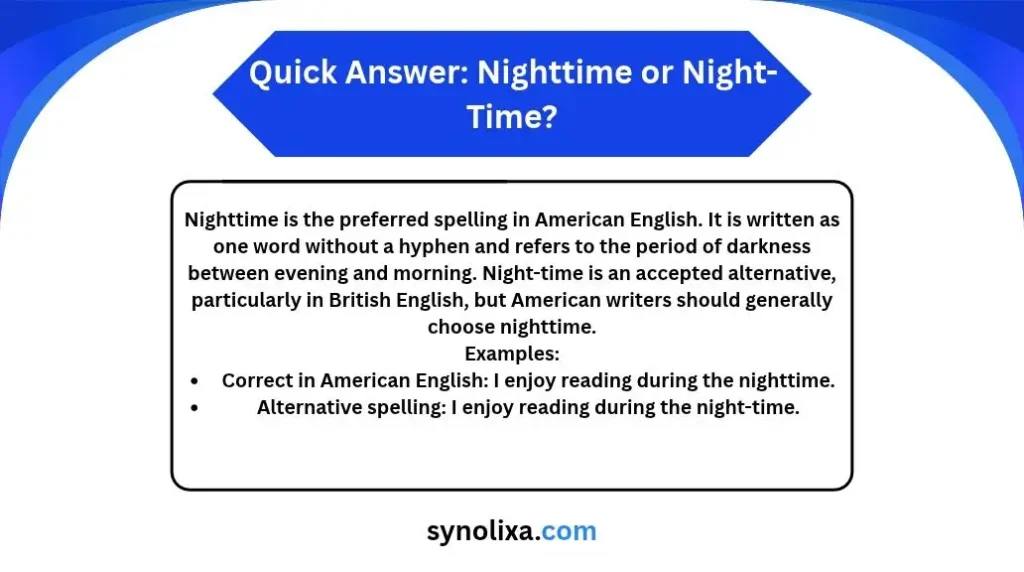
Nighttime is the preferred spelling in American English. It is written as one word without a hyphen and refers to the period of darkness between evening and morning. Night-time is an accepted alternative, particularly in British English, but American writers should generally choose nighttime.
Examples:
- Correct in American English: I enjoy reading during the nighttime.
- Alternative spelling: I enjoy reading during the night-time.
Both communicate the same general idea.
Understanding the Basics of Nighttime or Night-Time
Before exploring the detailed grammar rules, it is important to understand how these two spellings work.
The words nighttime and night-time describe the same general period: the hours when it is dark outside, usually between sunset and sunrise.
The main difference is their spelling convention.
- Nighttime: A closed compound word written without a hyphen.
- Night-time: A hyphenated compound word written with a hyphen.
American English generally favors closed compounds when a spelling has become established. That is why nighttime is the preferred choice in American publications and everyday writing.
Comparison Table
| Form | Type | Meaning | Example | Correct/Incorrect |
|---|---|---|---|---|
| Nighttime | Closed compound | The period of darkness | I enjoy nighttime walks. | Correct |
| Night-time | Hyphenated compound | The period of darkness | The night-time sky looks beautiful. | Accepted alternative |
| Night time | Open compound | The period of darkness | We traveled at night time. | Less standard; generally avoid |
| NightTime | Unusual capitalization | A nonstandard general spelling | I prefer NightTime walks. | Incorrect in ordinary prose |
The important point is that nighttime is the safest choice for standard American English.
Correct Meanings and Uses of Nighttime
The word nighttime has several practical uses. Understanding its grammatical role will help you use it correctly in different sentences.
1. Nighttime as a Noun
A noun names a person, place, thing, or concept. The word nighttime functions as a noun when it identifies the period of darkness.
Examples:
- Nighttime is my favorite part of the day.
- The streets become quieter at nighttime.
- Some animals are more active during nighttime.
Sentence breakdown:
Consider this sentence:
“Nighttime brings a peaceful atmosphere.”
- Nighttime: Subject and noun.
- Brings: Verb.
- A peaceful atmosphere: Object.
Here, nighttime identifies the period being discussed.
2. Nighttime as an Adjective
The word can also describe another noun. In this role, it functions as an adjective.
Examples:
- The nighttime temperature was unusually low.
- We watched the nighttime sky.
- The nighttime scenery was beautiful.
Sentence breakdown:
“The nighttime temperature dropped quickly.”
- The: Article.
- Nighttime: Adjective describing temperature.
- Temperature: Noun.
- Dropped: Verb.
- Quickly: Adverb.
The word describes what kind of temperature is being discussed.
3. Nighttime in Everyday Expressions
The word appears in several common expressions.
Examples:
- Nighttime activities
- Nighttime routine
- Nighttime hours
- Nighttime photography
- Nighttime entertainment
- Nighttime environment
- Nighttime temperatures
These expressions use nighttime as a single word.
For example:
“My nighttime routine includes reading a book.”
The word describes the routine that takes place during the night.
4. Nighttime in Descriptive Writing
Writers often use this word when describing the atmosphere, scenery, or events that happen after sunset.
Examples:
- The nighttime landscape looked peaceful.
- Nighttime brought a sense of calm to the village.
- The nighttime breeze moved gently through the trees.
In descriptive writing, nighttime helps establish the setting and atmosphere.
Correct Meanings and Uses of Night-Time
Although nighttime is the preferred American spelling, night-time is not automatically a spelling mistake.
It is an established hyphenated alternative.
1. Night-Time in British English
British English sometimes uses hyphenated compounds where American English prefers closed compounds.
For example:
- The night-time temperature was low.
- Night-time activities are common in the city.
- The night-time atmosphere was peaceful.
These sentences are understandable and acceptable in styles that follow the hyphenated convention.
2. Night-Time as an Adjective
The hyphenated form can appear before a noun to describe something associated with the night.
Examples:
- Night-time transportation is available in the area.
- The night-time event attracted many visitors.
- Night-time photography requires suitable lighting.
The hyphen connects the two elements into one descriptive expression.
3. Night-Time in Published Writing
Some newspapers, magazines, and publishers follow their own spelling conventions.
A publication may prefer night-time because it follows a particular British English style guide.
This does not mean that the closed spelling is wrong. It simply reflects an editorial preference.
4. Night-Time in Formal Documents
When writing a formal document, consistency is important.
If the document follows British English and its style guide uses night-time, follow that convention.
If the document follows American English, use nighttime.
Do not switch between the two spellings without a reason.
Nighttime or Night-Time: Real-Life Case Study
Imagine that a company is preparing an email about a scheduled maintenance project.
Two employees write the same announcement using different spelling conventions.
Example 1: American English
Subject: Nighttime Maintenance Schedule
“Please note that nighttime maintenance will take place on Friday. The service may be temporarily unavailable during the scheduled hours.”
Example 2: Hyphenated Style
Subject: Night-Time Maintenance Schedule
“Please note that night-time maintenance will take place on Friday. The service may be temporarily unavailable during the scheduled hours.”
Both versions communicate the same information.
However, if the company follows American English, the first version is the better choice.
What Can We Learn From This Example?
This case study highlights three important lessons:
- Both spellings can communicate the same meaning.
- Regional spelling conventions influence compound-word preferences.
- Consistency matters in professional communication.
The best approach is to select one spelling convention and use it throughout the document.
Grammar Rules: Why Is Nighttime Preferred?
The difference between nighttime and night-time is mainly a matter of compound-word spelling rather than a difference in meaning.
1. Understanding Compound Words
A compound word is created when two or more words combine to express one idea.
English compound words generally appear in three forms:
Closed compounds
These words are written together without spaces or hyphens.
Examples:
- Bedroom
- Toothbrush
- Sunlight
- Nighttime
Hyphenated compounds
These words are connected using a hyphen.
Examples:
- Well-known
- Part-time
- Mother-in-law
- Night-time
Open compounds
These words are written separately.
Examples:
- Ice cream
- Living room
- Post office
The spelling of compound words can change over time as usage becomes established.
2. American English Spelling Convention
American English commonly uses nighttime as a closed compound.
For example:
- I prefer nighttime photography.
- The nighttime weather was pleasant.
- Nighttime traffic is usually lighter.
These examples follow the standard American spelling preference.
3. British English Spelling Convention
British English publications may use night-time.
For example:
- The night-time economy supports local businesses.
- Night-time temperatures can fall quickly.
- The night-time event begins at sunset.
The hyphenated spelling is a recognized alternative.
4. What Does Merriam-Webster Say?
Merriam-Webster is a widely used American dictionary that provides spelling, pronunciation, and usage information.
Its dictionary entry recognizes nighttime as a standard English word.
This supports using the closed spelling in American English.
For writers following a particular publication’s style guide, the preferred spelling should always be checked against that guide.
Test Tip
When you are unsure which spelling to choose, ask yourself:
“Am I writing in American English?”
- If yes, use nighttime.
- If you are following a British publication that prefers the hyphenated spelling, use night-time.
- If you are unsure, nighttime is the safer general choice for US English.
Common Mistakes With Nighttime and Night-Time
Writers sometimes make spelling mistakes because English compound words do not always follow one predictable pattern.
Here are some common reasons for confusion.
1. Confusing Compound-Word Rules
Some compound words use hyphens, while others are written as one word.
For example:
- Part-time
- Full-time
- Nighttime
- Bedroom
Because part-time contains a hyphen, some writers assume that nighttime must also contain one.
However, compound words have different established spellings.
2. Fast Typing
People often write quickly when sending emails, messages, or social media posts.
They may add a hyphen automatically or leave unnecessary spaces between words.
Taking a moment to review your writing can prevent these mistakes.
3. Autocorrect
Autocorrect tools sometimes suggest alternative spellings based on language settings.
A device using British English preferences may suggest night-time, while an American English setting may favor nighttime.
Always consider your intended audience rather than accepting every automatic suggestion.
4. Lack of Knowledge
Some writers simply do not know that both forms are recognized.
Learning the difference between American and British spelling conventions makes it easier to choose the appropriate form.
Table of Similar Grammar and Spelling Confusions
| Word or Phrase | Correct Usage | Meaning |
|---|---|---|
| It’s / Its | Depends on meaning | Contraction / Possessive |
| Your / You’re | Depends on meaning | Possessive / You are |
| Everyday / Every day | Depends on context | Ordinary / Each day |
| Online / On-line | Online is standard today | Connected to the internet |
| Email / E-mail | Email is widely preferred | Electronic mail |
| Nighttime / Night-time | Both recognized | Period of darkness |
| Weekend / Week-end | Weekend is standard | Saturday and Sunday |
| Today / To-day | Today is standard | The present day |
The lesson is simple: never assume that two similar-looking compound words follow identical spelling rules.
Usage of Nighttime or Night-Time in Different Contexts
Choosing the right spelling also depends on your writing environment.
Let’s examine how these forms work in different situations.
1. Everyday Conversation
In everyday conversation, people usually say “nighttime” rather than discussing its spelling.
Examples:
- I enjoy nighttime walks.
- The children usually sleep at nighttime.
- The city looks different during nighttime.
- We prefer traveling during the daytime.
Although the spelling difference rarely affects spoken communication, it matters when writing.
2. Professional Writing
Professional writing requires consistency and accuracy.
In American business documents, nighttime is generally the preferred form.
Examples:
- Nighttime operations will begin at 10 p.m.
- The nighttime schedule has been updated.
- Employees should review the nighttime security procedures.
Using the standard American spelling makes professional documents consistent.
3. Creative Writing
Creative writers can use either recognized spelling depending on the intended language variety.
Examples:
- The nighttime sky was filled with stars.
- A quiet village rested beneath the night-time sky.
If your story is written in American English, choose nighttime.
If you are following British English conventions, night-time may be appropriate.
The most important thing is to maintain consistency.
4. Social Media and Texting
Social media users often prefer short and familiar words.
Examples:
- Nighttime vibes are different.
- I love nighttime photography.
- Enjoying the peaceful nighttime atmosphere.
- The city looks magical at night.
For American social media content, nighttime is the natural spelling choice.
5. Academic Writing
Academic writing requires a consistent spelling system.
If your assignment follows American English, use nighttime throughout.
For example:
“The study examined changes in nighttime temperatures across different regions.”
Avoid alternating between nighttime and night-time unless you are discussing spelling variations directly.
6. Website and Blog Content
Website writers should consider their target audience.
For an American audience:
- Nighttime photography
- Nighttime activities
- Nighttime routine
For a British audience, a publication may prefer:
- Night-time photography
- Night-time activities
- Night-time routine
The important point is to match your audience’s spelling convention.
Why the Difference Between Nighttime and Night-Time Matters
At first glance, the difference may seem insignificant. Both forms communicate the same basic idea.
However, spelling consistency plays an important role in effective writing.
1. Clarity in Communication
Correct spelling helps readers understand your message without unnecessary distractions.
When a word is written according to a familiar convention, readers can focus on its meaning rather than its appearance.
For example:
“The nighttime event starts at 8 p.m.”
This is clear and natural in American English.
2. Professionalism
Professional documents should follow consistent spelling and punctuation rules.
Using nighttime in American business communication demonstrates attention to standard American spelling conventions.
3. Writing Accuracy
Learning compound-word spelling helps you become a more confident writer.
It also makes proofreading easier because you understand why certain words are written together.
4. Digital Communication
Online content reaches readers from different countries.
A website targeting American readers should generally use American spelling conventions. A British publication may choose different conventions.
This small decision helps create a consistent reading experience.
A Short Writing Reminder
“Consistency makes good writing easier to understand.”
This simple principle applies to spelling, punctuation, grammar, and sentence structure.
Special Exceptions and Important Usage Notes
Although nighttime is the preferred American spelling, there are a few situations worth understanding.
1. Regional Spelling Preferences
The biggest difference is regional.
- American English: Nighttime
- British English: Night-time is also commonly encountered.
Neither spelling changes the basic meaning.
2. Editorial Style Guides
Different publishers may have different rules.
A newspaper, academic institution, or publishing company may establish its own preferred spelling.
When writing for a specific organization, follow its style guide.
3. Proper Names and Branding
A company, product, event, or creative project may use an unusual spelling as part of its official name.
For example, a brand could choose a stylized name such as “Night-Time Events.”
That capitalization and punctuation would be part of its branding rather than a general grammar rule.
Do not automatically apply a brand’s spelling to ordinary sentences.
4. Nighttime vs. Night Time
Another variation is the open form night time.
Although readers can understand it, nighttime is the established closed form preferred in standard American English.
Examples:
- Preferred: I enjoy nighttime walks.
- Less standard: I enjoy night time walks.
For polished American writing, choose the one-word form.
5. Nighttime vs. Evening
These words are related but do not always mean exactly the same thing.
- Evening: The period between late afternoon and the beginning of night.
- Nighttime: The period associated with darkness, generally after evening.
Example:
“We went shopping in the evening and watched a movie at nighttime.”
This sentence demonstrates the difference between the two expressions.
Quick Recap Checklist: Nighttime or Night-Time?
Use this checklist whenever you are unsure about the spelling.
| Question | If Yes → Use |
|---|---|
| Are you writing standard American English? | Nighttime |
| Are you following a British style guide that prefers a hyphen? | Night-time |
| Are you writing an American business email? | Nighttime |
| Are you writing an American academic assignment? | Nighttime |
| Are you following a publisher’s specific spelling rules? | Follow its preferred form |
| Are you using the word as a noun or adjective in American English? | Nighttime |
Practice Examples
Test your understanding with these sentences.
Example 1
“I enjoy reading during the ______.”
Correct answer: nighttime
Explanation: American English uses the closed compound spelling.
Example 2
“The ______ economy creates many employment opportunities.”
Possible answer: night-time
Explanation: This is an accepted hyphenated spelling, particularly in British English. American publications may use nighttime economy.
Example 3
“She enjoys taking photographs of the ______ sky.”
Correct American English answer: nighttime
Explanation: The word describes the sky during the night.
Quick Self-Test
Choose the preferred spelling for standard American English:
- Nighttime or night-time?
- The night time schedule or the nighttime schedule?
- Night-time photography or nighttime photography?
Answers:
- Nighttime.
- The nighttime schedule.
- Nighttime photography.
Remember that the hyphenated version is an accepted alternative, not an entirely incorrect word.
FAQs
1. Is nighttime one word or two?
Nighttime is one word in standard American English. It is a closed compound that refers to the period of darkness between evening and morning. Writing it as one word is the preferred choice for American readers.
2. Is night-time grammatically correct?
Yes. Night-time is an accepted hyphenated spelling. It is particularly common in British English and certain editorial styles. However, American English generally prefers the closed spelling, nighttime.
3. Which spelling is correct in American English: nighttime or night-time?
Nighttime is the preferred spelling in American English. It is widely used in American dictionaries, publications, and everyday writing. If you are writing for a US audience, choose the one-word form.
4. Is nighttime a noun or an adjective?
Nighttime can function as both a noun and an adjective.
As a noun: “Nighttime is peaceful.”
As an adjective: “The nighttime temperature is low.”
Its grammatical role depends on how it is used in a sentence.
5. Should I write nighttime or night time?
For standard American English, write nighttime as one word. The open form night time is less standard. The hyphenated form night-time is an accepted alternative, especially in British English.
6. Does nighttime have the same meaning as night-time?
Yes. Both spellings refer to the period of darkness, generally between sunset and sunrise. The difference is spelling preference, not meaning. The one-word form is preferred in American English, while the hyphenated form is also used in other English varieties.
Conclusion
The difference between nighttime or night-time is easier to understand when you consider regional spelling conventions. Both forms refer to the same general period of darkness, but they are not equally preferred in every variety of English.
For standard American English, nighttime is the correct and recommended choice. It is written as one word without a space or hyphen. The alternative spelling, night-time, is also recognized and appears particularly often in British English and certain publication styles.
When writing emails, academic assignments, professional documents, or website content for American readers, choose nighttime. If you are writing for a British publication, follow its preferred spelling convention.
Remember one simple rule: American English generally uses nighttime, while night-time remains an accepted alternative.
Once you understand this distinction, you can avoid unnecessary spelling confusion and make your writing clearer, more consistent, and more professional.

Hi, I am Clara Anderson. I work at Synolixa as a vocabulary writer, focusing on synonyms, word meanings, and easy-to-understand English learning content.
[…] choose the right phrase in conversations, professional writing, emails, and social media messages. Nighttime or Night-Time | Artefact vs Artifact | On Friday or In […]