Mom vs mum is a common English spelling question that confuses many writers. Have you ever wondered which word you should use in an article, school assignment, email, or social media post? Although both spellings look different, they refer to the same person: a mother. The main difference is the variety of English in which each word is commonly used.
Understanding mom vs mum is simple once you know the regional spelling rules. In American English, mom is the standard and most common spelling. In British English, mum is widely used, especially in the United Kingdom. The same difference appears in other English-speaking regions, including Canada, Australia, and New Zealand, although local preferences can vary.
Neither word is automatically wrong. The best choice depends on your audience, location, and writing style. If you are writing for American readers, mom is usually the right choice. If you are writing for a British audience, mum will generally sound more natural.
In this guide, you will learn the meanings of both words, their grammatical uses, regional differences, common mistakes, and practical examples. By the end, you will know exactly when to use mom and when to use mum. Moose vs Mousse | Fair vs Good | Leotard vs Tights
Quick Answer: Mom vs Mum
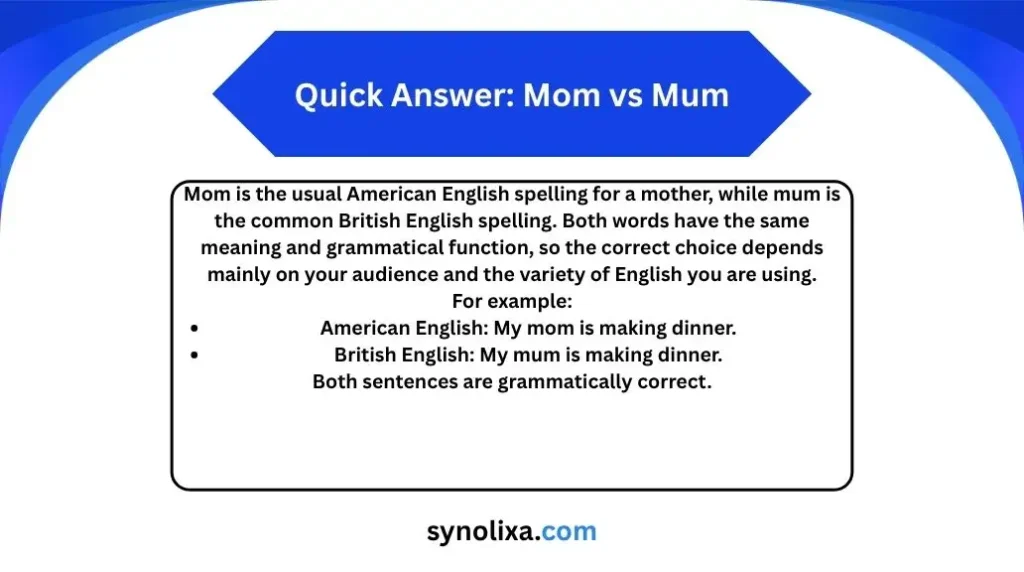
Mom is the usual American English spelling for a mother, while mum is the common British English spelling. Both words have the same meaning and grammatical function, so the correct choice depends mainly on your audience and the variety of English you are using.
For example:
- American English: My mom is making dinner.
- British English: My mum is making dinner.
Both sentences are grammatically correct.
Understanding the Basics of Mom vs Mum
The difference between mom and mum is primarily regional spelling. Neither word has a different basic meaning, and neither is inherently more correct than the other.
What Does Mom Mean?
Mom is an informal noun commonly used in American English to refer to one’s mother. It is a familiar, affectionate word that appears in everyday speech, personal writing, school assignments, and casual conversations.
Examples:
- My mom works at a local hospital.
- I bought a birthday card for my mom.
- Mom, can you help me with this homework?
- My mom taught me how to cook.
In American English, mom is the spelling most readers will expect.
What Does Mum Mean?
Mum is an informal noun commonly used in British English to mean mother. It has the same basic meaning as mom and is used in similar situations.
Examples:
- My mum is visiting us this weekend.
- I called my mum after school.
- Mum, where are my keys?
- My mum taught me how to ride a bike.
In British English, mum is familiar and natural. It is also widely used in Australia and New Zealand.
Mom vs Mum: Comparison Table
| Form | Type | Meaning | Example | Correct/Incorrect |
|---|---|---|---|---|
| Mom | Informal noun | Mother; common in American English | My mom is kind. | Correct in American English |
| Mum | Informal noun | Mother; common in British English | My mum is kind. | Correct in British English |
| Mom’s | Possessive or contraction | Belonging to Mom, or Mom is/Mom has | Mom’s car is blue. | Correct when used appropriately |
| Mum’s | Possessive or contraction | Belonging to Mum, or Mum is/Mum has | Mum’s car is blue. | Correct when used appropriately |
| Moms | Plural noun | More than one mom | The moms met at school. | Correct |
| Mums | Plural noun | More than one mum | The mums met at school. | Correct |
Key takeaway: Use mom for standard American English and mum for standard British English. Choose one spelling that fits your audience and use it consistently.
Correct Meanings and Uses of Mom vs Mum
Although the spelling differs, both words can be used in almost identical grammatical situations. The following sections explain their main uses.
1. Using Mom or Mum as a Common Noun
A common noun names a general person, place, thing, or idea. When you refer to your mother in a sentence without using the word as a direct name, mom or mum is usually lowercase.
Examples in American English:
- My mom is reading a book.
- Her mom works from home.
- I am going shopping with my mom.
Examples in British English:
- My mum is reading a book.
- Her mum works from home.
- I am going shopping with my mum.
Sentence breakdown:
In “My mom is reading a book,” the word mom identifies the person who is reading. It is a common noun because it follows the possessive word my and does not function as a direct name.
The same rule applies to mum.
2. Using Mom or Mum as a Direct Address
When you speak directly to your mother and use Mom or Mum as a name, capitalize the word.
American English:
- Mom, I need your advice.
- Thank you, Mom.
- Can you pick me up, Mom?
British English:
- Mum, I need your advice.
- Thank you, Mum.
- Can you pick me up, Mum?
Sentence breakdown:
In “Thank you, Mom,” the word Mom directly identifies the person being addressed. It is capitalized because it functions like a name.
This is different from “Thank you to my mom,” where mom is a common noun and remains lowercase.
3. Using Mom’s or Mum’s to Show Possession
Both spellings can take an apostrophe and an s to show possession.
Examples:
- My mom’s phone is on the table.
- My mum’s phone is on the table.
- Mom’s favorite color is blue.
- Mum’s favorite color is blue.
The apostrophe shows that something belongs to the mother.
For example, in “My mom’s phone is on the table,” the phone belongs to the speaker’s mother.
Remember that mom’s and mum’s can also be contractions of mom is or mum is, and sometimes mom has or mum has.
Examples:
- Mom’s coming home soon. (Mom is coming home soon.)
- Mum’s finished her work. (Mum has finished her work.)
The surrounding sentence determines which meaning is intended.
4. Using Moms or Mums in the Plural
Use moms when referring to multiple mothers in American English. Use mums when referring to multiple mothers in British English.
Examples:
- The moms organized a school event.
- The mums organized a school event.
- Many moms share parenting advice online.
- Many mums share parenting advice online.
Both plural forms are grammatically correct. The choice depends on the variety of English you are writing.
5. Using Mom or Mum in Family Conversations
These words are especially common in informal family conversations. They can express affection, familiarity, and closeness.
Examples:
- I love you, Mom.
- I love you, Mum.
- My mom always encourages me.
- My mum always encourages me.
The emotional meaning does not change because of the spelling. Both words can communicate love and respect for a mother.
Test Tip
Ask yourself two simple questions:
- Am I writing in American English or British English?
- Am I referring to my mother generally, or am I addressing her directly?
Use mom for American English and mum for British English. Capitalize either word when it is used as a direct name, such as “Thanks, Mom” or “Thanks, Mum.”
Mom vs Mum in Real-Life Situations: A Case Study
Imagine that two students, Emma and Olivia, are writing short messages about their mothers.
Emma lives in the United States, while Olivia lives in the United Kingdom. Both students want to write a message thanking their mothers for helping them prepare for an important school presentation.
Emma’s Message: American English
“Thank you, Mom, for helping me practice my presentation. I could not have done it without you!”
This message uses Mom because Emma follows American English conventions. The word is capitalized because she is addressing her mother directly.
Olivia’s Message: British English
“Thank you, Mum, for helping me practice my presentation. I could not have done it without you!”
Olivia uses Mum because it is the usual spelling in British English. The capitalization follows the same direct-address rule.
What Can We Learn from This Example?
Both messages are correct. Neither student has made a spelling or grammar mistake.
The difference is regional preference, not meaning. If Emma were writing for a British publication, she might change Mom to Mum to match the publication’s style. Similarly, Olivia might use Mom when quoting an American speaker or discussing an American source.
The important lesson is to consider your audience before choosing a spelling. Consistency makes your writing easier to follow and helps it sound natural to readers.
Grammar Rules Explained: Mom vs Mum
The grammar rules for mom and mum are nearly identical. The difference lies in regional spelling and usage rather than sentence structure.
Rule 1: Choose the Spelling That Matches Your Variety of English
American English generally uses mom. British English generally uses mum.
Correct American English:
- My mom is a teacher.
Correct British English:
- My mum is a teacher.
The words perform the same grammatical role in both sentences.
Rule 2: Capitalize Direct Forms of Address
Capitalize Mom or Mum when using it as a direct name.
Correct:
- Mom, your dinner is ready.
- Mum, your dinner is ready.
Usually lowercase:
- My mom made dinner.
- My mum made dinner.
The distinction is based on how the word functions in the sentence, not on whether the writer uses American or British English.
Rule 3: Use Apostrophes Correctly
An apostrophe is needed to show possession in singular forms such as mom’s and mum’s.
Correct:
- My mom’s bag is missing.
- My mum’s bag is missing.
Incorrect:
- My moms bag is missing.
- My mums bag is missing.
In the incorrect examples, the apostrophe is missing from the possessive form.
However, when you mean more than one mother, the plural forms moms and mums do not need an apostrophe.
Correct:
- The moms attended the meeting.
- The mums attended the meeting.
Rule 4: Match Your Publication’s Style
If you are writing for a school, website, newspaper, or business, follow its preferred variety of English. An American publication will usually prefer mom, while a British publication will generally prefer mum.
Consistency is especially important in long articles. Avoid switching between mom and mum without a clear reason.
What Do Standard Dictionaries Say?
Merriam-Webster identifies mom as an informal term for mother, consistent with American usage. British dictionaries, including the Oxford English Dictionary and Cambridge Dictionary, recognize mum as a familiar term for mother in British English.
These dictionary conventions support the central rule: both spellings are legitimate, but their regional preferences differ.
Common Mistakes When Using Mom vs Mum
Because the words have the same meaning, writers sometimes assume that they can switch between them freely in every situation. Although readers will generally understand either form, mixing regional conventions can make writing feel inconsistent.
Mistake 1: Mixing American and British Spellings
Inconsistent:
- My mom is a doctor, and my mum is very supportive.
This sentence is not automatically grammatically incorrect, but it may confuse readers if both words refer to the same person and no change in context is intended.
More consistent American English:
- My mom is a doctor, and she is very supportive.
More consistent British English:
- My mum is a doctor, and she is very supportive.
Mistake 2: Using the Wrong Capitalization
Incorrect in ordinary running text:
- I went shopping with My Mom.
Correct:
- I went shopping with my mom.
When mom is used as a common noun after my, it is normally lowercase. Capitalize it when it functions as a direct name, as in “I went shopping with Mom.”
Mistake 3: Forgetting the Apostrophe
Incorrect:
- My moms favorite food is pizza.
Correct:
- My mom’s favorite food is pizza.
The apostrophe is needed because the sentence refers to something belonging to one mother.
Mistake 4: Confusing Mum with Mummy or Mommy
Mummy and mommy are affectionate alternatives for mother. Mommy is especially common in American English, while mummy is common in British English.
Examples:
- Mommy, can you read me a story?
- Mummy, can you read me a story?
These words are not spelling mistakes. They are related terms with a more affectionate or childlike tone.
Mistake 5: Treating One Regional Form as Universally Wrong
Incorrect assumption:
- “Mum” is always a spelling mistake.
Better understanding:
- Mum is standard in British English.
- Mom is standard in American English.
The correct form depends on the writing context.
Why Do These Mistakes Happen?
Common reasons include:
- Fast typing: Writers may use whichever spelling comes to mind first.
- Autocorrect: A device or keyboard may favor one regional dictionary over another.
- Lack of knowledge: Some writers do not realize that American and British English use different everyday terms.
- Exposure to different media: Films, books, websites, and social platforms introduce readers to both spellings.
- Inconsistent editing: A writer may change regional styles while revising a long document.
A quick proofreading check can prevent most of these problems.
Similar Grammar Confusions
| Word Pair | Difference | Example |
|---|---|---|
| Mom vs mum | American vs British spelling | My mom/mum is here. |
| It’s vs its | Contraction vs possessive determiner | It’s raining. The dog wagged its tail. |
| Your vs you’re | Possession vs “you are” | Your coat is here. You’re welcome. |
| Color vs colour | American vs British spelling | The color/colour is bright. |
| Favorite vs favourite | American vs British spelling | This is my favorite/favourite book. |
| Mommy vs mummy | Regional and affectionate forms | Mommy/Mummy, come here. |
These examples show that some differences involve regional conventions, while others involve separate grammatical meanings. Always identify which type of difference you are dealing with before making a correction.
Mom vs Mum in Different Contexts
The right spelling can depend on where your writing will appear. Understanding the context helps you choose naturally.
1. Everyday Conversation
In everyday American conversations, mom is the common choice.
Examples:
- My mom is picking me up.
- I need to ask my mom something.
- Mom, I’m home!
In everyday British conversations, mum is more common.
Examples:
- My mum is picking me up.
- I need to ask my mum something.
- Mum, I’m home!
In both varieties, the words are informal and familiar.
2. Professional Writing
Professional writing usually calls for a consistent style. However, the best spelling still depends on the intended audience.
For an American audience:
- Our school invites every mom to the annual family event.
For a British audience:
- Our school invites every mum to the annual family event.
In a formal report, you may prefer mother instead of either informal term, especially when discussing family relationships in an academic, legal, or medical context.
For example:
- The student’s mother attended the meeting.
Choose the wording that suits the tone and purpose of your document.
3. Creative Writing
Writers can use mom or mum to make dialogue sound natural for a character’s location and background.
Example of an American character:
- “Mom, I left my notebook in the car!”
Example of a British character:
- “Mum, I left my notebook in the car!”
Using regional vocabulary helps establish a character’s voice. In narration, it is usually best to follow the conventions of the book’s overall style unless the author has a specific reason to do otherwise.
4. Social Media and Texting
Both words are common in digital communication.
American-style post:
- So grateful for my mom today! ❤️
British-style post:
- So grateful for my mum today! ❤️
Text messages often use short, informal language. However, the regional spelling distinction remains the same.
Examples:
- “Can you call Mom?”
- “Can you call Mum?”
- “Happy birthday, Mom!”
- “Happy birthday, Mum!”
You can also use affectionate alternatives such as mommy, mummy, mama, or mam, depending on family preference and regional usage.
5. School Assignments and Essays
If your teacher expects American English, use mom. If the assignment follows British English, use mum.
If no style is specified, check your textbook, class instructions, or the variety of English used throughout your assignment.
For a formal essay, mother may be more appropriate than either informal term.
6. Websites and SEO Articles
Writers creating online content should consider their target readers and search intent.
- A website focused on American readers will usually use mom.
- A website focused on British readers will usually use mum.
- An international article can explain both spellings and identify their regional differences.
If your focus keyword is “mom vs mum,” include that exact phrase naturally in the title, introduction, and relevant headings. Avoid repeating it unnecessarily just to increase keyword density.
The goal is to answer readers’ questions clearly, not to force the keyword into every paragraph.
Why the Difference Between Mom and Mum Matters
At first glance, the difference between mom and mum may seem minor. Both words mean mother, and most English speakers can understand them. However, choosing the appropriate spelling can improve the quality of your writing.
1. Clarity in Communication
Using the form expected by your audience helps your writing feel familiar. American readers generally expect mom, while British readers generally expect mum.
The meaning remains clear in either case, but regional consistency can make reading smoother.
2. Professionalism
Consistent spelling shows that you have considered your audience and reviewed your work carefully. This matters in business communication, educational writing, publishing, and website content.
A single use of mum in an American article is unlikely to cause a serious problem. Repeated, unexplained switching between regional styles, however, may make the text appear poorly edited.
3. Writing Accuracy
Correct spelling is part of effective communication. Although mom and mum are both correct, using the form that fits your chosen style demonstrates awareness of English conventions.
Remember that accuracy involves more than spelling. Capitalization, apostrophes, punctuation, and sentence structure matter too.
4. Digital Communication
Online readers come from different countries. Writers who understand regional differences can create content that feels appropriate to their intended audience.
For example, a parenting website aimed at American families will probably use mom, while a British parenting website will generally use mum.
5. Respect for Regional Language
English has several standard varieties. American, British, Canadian, Australian, and other English-speaking communities have their own vocabulary and spelling preferences.
Recognizing these differences helps writers avoid incorrectly labeling a valid regional form as a mistake.
A useful reminder: “Good writing meets readers where they are.”
This short principle captures the value of choosing words that fit your audience. The goal is not to declare one regional form superior, but to communicate naturally and accurately.
Special Exceptions and Related Forms
Although mom and mum follow a straightforward regional pattern, a few related words and special situations deserve attention.
1. Mommy and Mummy
Mommy is an affectionate form often used in American English. Mummy is a common affectionate form in British English.
Examples:
- My mommy packed my lunch.
- My mummy packed my lunch.
Both are correct within their respective language varieties and family contexts.
Be careful, however: mummy can also refer to a preserved body from ancient times. The meaning depends on the sentence.
2. Mama and Mam
Other words for mother include mama, momma, and mam. Their popularity varies by region, community, and family tradition.
Examples:
- I called my mama yesterday.
- My momma makes wonderful cookies.
- I’m going to visit my mam.
These words are not interchangeable in every context because they may convey different regional, cultural, or personal associations.
3. Brand Names and Titles
Some businesses, products, books, and other named works may use Mom or Mum as part of an official title or brand name. In such cases, preserve the official spelling when referring to that name.
For example, a product or publication with Mom in its official name should not automatically be changed to Mum for British readers.
The same principle applies to quotations: preserve a speaker’s original wording when accuracy requires it.
4. Canadian and Australian Usage
Canadian English can use mom widely, although preferences may vary by family and region. Australian English generally favors mum.
These patterns are useful guidelines rather than absolute rules for every individual. People may use the form they grew up with or the one preferred in their family.
5. Personal Family Preferences
Some families have a preferred name for a mother that differs from the most common regional form. If a person calls their mother Mom while living in Britain, or Mum while living in the United States, that personal choice is perfectly understandable.
Regional conventions guide general writing, but personal names and family preferences can differ.
Quick Recap Checklist: Mom vs Mum
Use the following table to make the right choice quickly.
| Question | If Yes → Use |
|---|---|
| Am I writing in standard American English? | Mom |
| Am I writing in standard British English? | Mum |
| Am I referring to several mothers in American English? | Moms |
| Am I referring to several mothers in British English? | Mums |
| Am I showing that something belongs to one mother? | Mom’s or mum’s |
| Am I addressing my mother directly? | Mom or Mum, capitalized |
| Am I writing a formal report where a neutral term is better? | Mother |
| Am I quoting a source that uses a particular spelling? | Preserve the source’s original spelling when appropriate |
Practice Examples
Choose the best word for each sentence. The answers follow the examples.
1. American English: “My _____ is coming to the school concert.”
Answer: mom
“My mom is coming to the school concert” follows standard American usage.
2. British English: “I bought a present for my _____.”
Answer: mum
“I bought a present for my mum” follows standard British usage.
3. Possessive form: “My _____ favorite book is on the table.” The sentence follows American English.
Answer: mom’s
The apostrophe indicates that the book belongs to the speaker’s mother. In British English, the corresponding form would be mum’s.
Final Self-Check
Before publishing or submitting your writing, ask yourself:
- Have I chosen the spelling that matches my audience?
- Have I used the same regional style throughout?
- Have I capitalized Mom or Mum when addressing my mother directly?
- Have I used apostrophes correctly in possessive forms?
- Have I checked whether mother would be more suitable for a formal context?
If you can answer yes to these questions, your usage is likely to be clear and consistent.
FAQs
1. Is Mom or Mum Correct?
Both mom and mum are correct. Mom is the standard spelling in American English, while mum is the usual spelling in British English. The correct choice depends on your audience and writing style.
2. Why Do Americans Say Mom and British People Say Mum?
The difference developed through the regional evolution of English vocabulary and pronunciation. American English standardized mom, while British English commonly uses mum. Both forms continue to be used today.
3. Is Mum Wrong in American English?
No. Mum is a recognized English word and will generally be understood by American readers. However, mom is the usual choice when writing in standard American English.
4. Is Mom Wrong in British English?
No. British readers generally understand mom, but mum is the more familiar spelling in standard British English. Follow the preferred spelling of your audience or publication.
5. Should Mom and Mum Be Capitalized?
Capitalize Mom or Mum when using the word as a direct name, such as “Thanks, Mom” or “Good morning, Mum.” Use lowercase when referring to a mother generally, as in “My mom is at work” or “My mum is at work.”
6. What Is the Difference Between Mom, Mum, Mommy, and Mummy?
Mom is common in American English, and mum is common in British English. Mommy and mummy are affectionate alternatives often used by children or within families. The word mummy can also refer to an ancient preserved body, depending on context.
Conclusion
The difference between mom vs mum is simple: mom is the usual spelling in American English, while mum is the usual spelling in British English. Both words mean mother, and both are grammatically correct when used according to the conventions of the relevant variety of English.
Choose mom when writing for an American audience and mum when writing for a British audience. In other English-speaking regions, consider local preferences. Also, remember the basic grammar rules: capitalize the word when addressing your mother directly, use lowercase when referring to her generally, and include an apostrophe in possessive forms such as mom’s and mum’s.
Most importantly, stay consistent throughout your writing. You do not need to memorize a complicated rule or treat either spelling as universally wrong. Simply consider your audience, purpose, and preferred style.
The easiest rule to remember is this: American English uses “mom,” British English uses “mum,” and both express the same familiar word for mother.

Hi, I am Ethan Parker. I work at Synolixa as a grammar and writing specialist, helping readers understand English grammar and improve their writing skills.

[…] practical examples, comparison tables, grammar tips, and answers to frequently asked questions. Mom vs Mum | Moose vs Mousse | Fair vs […]