Have you ever typed imbed or embed and stopped because you were not sure which spelling was correct? You are not alone. The confusion around imbed vs embed is understandable because both forms appear in English, and both can describe putting something firmly into something else. The good news is that the difference is much simpler than it first appears.
Embed is the more common modern spelling, especially in technology, professional writing, and general English. However, imbed is also a legitimate US English variant of embed. Major dictionaries recognize it, so calling imbed an outright spelling mistake would be inaccurate. Cambridge Dictionary specifically lists imbed as the US form of embed.
Both words can mean to fix, place, or insert something firmly into another thing. They can also describe information, images, videos, technology, ideas, or objects that are incorporated into something larger.
So, when should you use imbed, and when should you use embed? This guide explains the difference, the grammar behind both forms, common mistakes, examples, and the safest choice for modern writing. Comma Before or After For Example | Eaten or Ate | Pajamas vs Pyjamas
Quick Answer: Imbed vs Embed
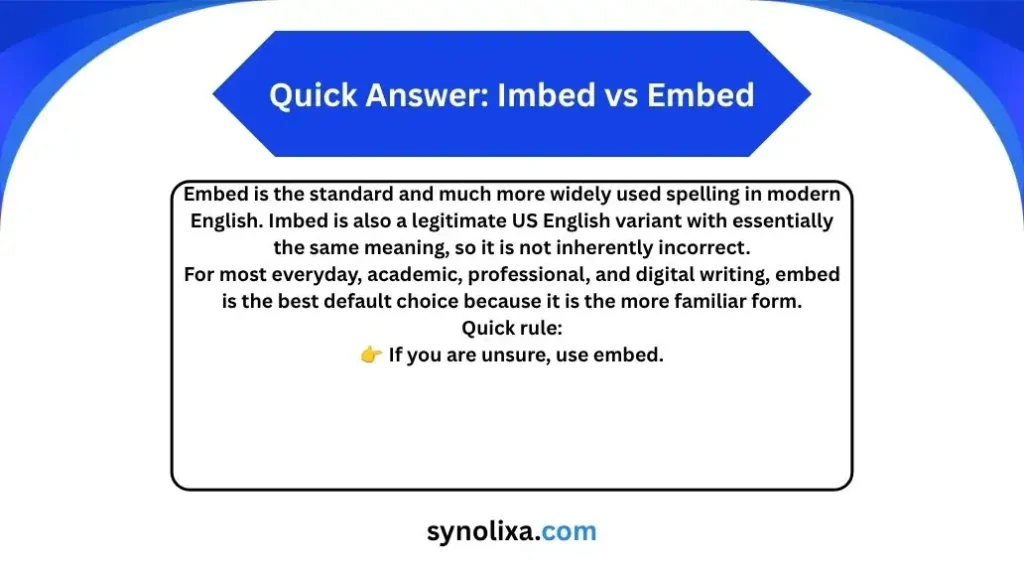
Embed is the standard and much more widely used spelling in modern English. Imbed is also a legitimate US English variant with essentially the same meaning, so it is not inherently incorrect.
For most everyday, academic, professional, and digital writing, embed is the best default choice because it is the more familiar form.
Quick rule:
👉 If you are unsure, use embed.
Understanding the Basics: Imbed vs Embed
The central point is easy:
- Embed = to place or fix something firmly inside something else.
- Imbed = a recognized US variant of embed with the same basic meaning.
Both forms function primarily as verbs.
Consider these examples:
- The designer will embed the video in the article.
- The designer will imbed the video in the article.
Both sentences can be understood as saying that the video will be incorporated into the article. However, embed is generally the more familiar spelling to modern readers.
Comparison Table
| Form | Type | Meaning | Example | Correct/Incorrect |
|---|---|---|---|---|
| embed | Verb | To place or fix firmly within something | Please embed the video in the page. | Correct |
| imbed | Verb | A US variant meaning the same as embed | The technician will imbed the component in the device. | Correct |
| embedded | Past tense/past participle/adjective | Fixed or incorporated within something | The image is embedded in the document. | Correct |
| imbedded | Past tense/past participle/adjective | Variant form of embedded | The component was imbedded in the material. | Correct, but less common |
| embeded | Incorrect spelling | — | Please embeded the image. | Incorrect |
| imbeddeded | Incorrect spelling | — | The file was imbeddeded. | Incorrect |
The important distinction is that imbed and embed are both legitimate, while forms such as embeded are spelling errors.
What Does “Embed” Mean?
The verb embed means to place something firmly inside another substance, object, system, document, or context.
For example:
The stone was embedded in the wall.
Here, the stone is physically fixed inside the wall.
But embed is not limited to physical objects. English speakers also use it in abstract and technological contexts.
Physical Meaning
You can embed one physical object into another:
- The jeweler embedded a small stone in the ring.
- The nail became embedded in the wooden board.
- The sensor is embedded in the machine.
- The roots are deeply embedded in the soil.
In each example, something is firmly positioned within something else.
Digital Meaning
In modern technology, embed is extremely common.
It can mean placing digital content directly into another digital environment.
For example:
- You can embed a video on a website.
- The developer embedded an image into the application.
- The article contains an embedded chart.
- The website allows users to embed social media content.
Cambridge specifically includes the technological meaning of incorporating text, sound, images, or video into a computer file, email, or website.
Abstract Meaning
The word can also describe ideas, feelings, values, or practices that become firmly established.
Examples:
- The tradition is deeply embedded in the culture.
- Trust is embedded in their relationship.
- The idea became embedded in public discussion.
- These principles are embedded in the company’s policies.
In these examples, nothing is physically inserted. Instead, the idea or quality becomes a strong part of something.
What Does “Imbed” Mean?
Imbed has the same basic meaning as embed. It is recognized as a US English variant.
Cambridge Dictionary lists imbed as a verb and directs readers to embed. Its examples show the form being used for physical and abstract meanings.
For example:
- The rock was imbedded in the soil.
- The program has imbedded security features.
- The idea became deeply imbedded in the culture.
The spelling may look unusual to readers who are accustomed to embed, but that does not make it grammatically invalid.
Why Does “Imbed” Exist?
English contains many spelling variations that developed through historical usage, regional preferences, and changes in standard writing.
The prefix im- can appear before certain consonants, as in:
- impossible
- immature
- immobile
- imbalance
This may help explain why imbed looks natural to some writers.
However, modern English has overwhelmingly favored embed in many contexts, especially technology and professional communication.
Is “Imbed” Correct or Incorrect?
This is one of the most important questions about imbed vs embed.
“Imbed” Is Correct
Imbed is a valid word.
It is not simply a typo for embed. Major dictionary sources recognize it as a US variant. Cambridge lists imbed as a US form and provides examples of its use.
Therefore, these sentences are grammatically possible:
- The device was imbedded in the wall.
- The researcher imbedded the sensor into the material.
- The software allows users to imbed images.
Why Do Most Writers Prefer “Embed”?
Although imbed is correct, embed is generally the more familiar and widely used form in contemporary writing.
This matters because good writing is not only about whether a word is technically correct. It is also about readability and consistency.
If most readers expect embed, using imbed may briefly make them wonder whether it is a typo.
That is why embed is usually the safer choice.
Embed vs Imbed in Technology
Technology is one area where embed is especially dominant.
You may encounter phrases such as:
- embedded video
- embedded image
- embedded link
- embedded code
- embedded software
- embedded system
- embedded content
- embedded file
- embedded media
For example:
You can embed the video directly into the webpage.
This sounds natural to modern readers.
You could technically write:
You can imbed the video directly into the webpage.
But the second version is less familiar and may look unusual in technical documentation.
Embedded Systems
The word embedded is especially important in computing.
An embedded system is a computer system designed as part of a larger device or product.
Examples include computing systems inside:
- cars
- appliances
- industrial equipment
- electronic devices
- medical equipment
In technical contexts, embedded is the established spelling.
Therefore, phrases such as embedded system should generally not be changed to imbedded system merely because imbed is technically a valid variant.
Embed vs Imbed in Professional Writing
Professional writing values clarity, consistency, and familiar terminology.
Suppose you are writing a workplace email:
Please embed the chart in the report before sending it to the client.
This is immediately clear.
Now consider:
Please imbed the chart in the report before sending it to the client.
The sentence is still understandable, but some readers may pause over the spelling.
For professional communication, embed is usually the more practical choice.
Examples
Professional:
Please embed the updated chart in the presentation.
Professional:
The report includes an embedded spreadsheet.
Professional:
We need to embed the video before publishing the page.
These forms are familiar and easy to understand.
Imbed vs Embed in Everyday Conversation
In casual speech, the difference is almost invisible because the two words are pronounced the same.
Cambridge gives the US pronunciation of embed as /ɪmˈbed/.
Because the spoken forms sound alike, the issue usually appears in writing.
For example, if someone says:
“You can embed the image in the document.”
You hear the meaning, but you cannot know which spelling they would use until you see the written form.
That is why imbed vs embed is primarily a spelling and usage question rather than a pronunciation question.
Imbed vs Embed in Creative Writing
Creative writers may use either form depending on their preferred style.
For example:
The memory was deeply embedded in her mind.
This is natural and familiar.
A writer could also use:
The memory was deeply imbedded in her mind.
That variant is possible, but embedded is generally more recognizable.
For creative writing, the goal is often to avoid distracting the reader. Since embed is more familiar, it will usually flow more smoothly.
Imbed vs Embed on Social Media and in Texting
Social media and texting are less formal, but spelling still affects clarity.
You might write:
How do I embed a video?
This is the most recognizable form.
Someone might write:
How do I imbed a video?
The meaning is still clear, but some readers may assume it is a spelling mistake.
In short digital messages, embed is the better default.
Grammar Rules for Embed and Imbed
The grammar is straightforward because both words function as verbs.
Present Tense
Use embed or imbed as the base form.
Examples:
- I embed videos in my articles.
- They embed images in the report.
- I imbed the diagram in the document.
- They imbed the component in the device.
Third-Person Singular
Add -s:
- She embeds the image.
- He embeds the video.
- The software embeds the file.
With imbed:
- She imbeds the image.
- The program imbeds the information.
Past Tense
The usual past form is created with -ed:
- embed → embedded
- imbed → imbedded
Examples:
- She embedded the video.
- She imbedded the video.
Present Participle
The same pattern applies:
- embedding
- imbedding
For modern general writing, embedding is much more familiar.
Standard Dictionary Evidence
Dictionary evidence is especially useful here because it prevents an oversimplified rule.
Cambridge explicitly identifies imbed as a US variant of embed, while its main entry for embed includes both the physical and technological senses.
So the accurate grammar rule is:
“Embed” is the preferred modern form for most writing, while “imbed” is a legitimate US variant.
Test Tip: How Can You Choose the Right Word?
When you are unsure about imbed vs embed, use this simple test:
Ask Yourself:
Am I talking about placing or incorporating something inside something else?
If yes, embed is almost always the easiest choice.
For example:
I need to embed the video.
The image is embedded in the article.
The software has an embedded feature.
If you see imbed in a dictionary or older US text, do not automatically assume it is wrong. It is a recognized variant.
The Easy Memory Trick
Remember:
When in doubt, embed it.
This does not mean imbed is incorrect. It simply gives you the most familiar modern spelling.
Case Study: A Workplace Email
Imagine that a marketing employee is preparing a report for a manager.
The employee writes:
Hi Sarah,
I have finished the report. I will imbed the sales chart before sending the final version.
The sentence is understandable, and imbed is a legitimate US variant.
However, a more conventional modern version would be:
Hi Sarah,
I have finished the report. I will embed the sales chart before sending the final version.
Why Is “Embed” Better Here?
The second version uses the spelling most readers are likely to expect.
This is particularly useful in:
- workplace emails
- reports
- websites
- software documentation
- academic papers
- marketing materials
- business presentations
The goal is not to suggest that imbed is grammatically wrong. The goal is to choose the form that creates the least friction for your audience.
Common Mistakes With Imbed vs Embed
The confusion often comes from several sources.
1. Fast Typing
People frequently type quickly and choose the first spelling that comes to mind.
Because imbed looks logically possible, writers may use it without checking.
2. Autocorrect
Autocorrect can also contribute to confusion.
A writing program may recognize one form and fail to flag another, depending on its dictionary settings.
3. Lack of Knowledge
Some writers learn that embed is common but never discover that imbed is also a valid variant.
As a result, they may incorrectly believe that every occurrence of imbed is a spelling error.
4. Similar-Looking Words
English has many pairs and groups of words that differ by only a few letters.
This can make spelling decisions harder, especially for nonnative English speakers.
Similar Grammar Confusions
Here are some common examples:
| Confusion | Correct Forms | Main Difference |
|---|---|---|
| it’s / its | Both are correct | It’s = it is; its = possessive |
| your / you’re | Both are correct | Your = possession; you’re = you are |
| their / there / they’re | All are correct | Different meanings and grammatical roles |
| then / than | Both are correct | Then = time/order; than = comparison |
| affect / effect | Both are correct | Usually different grammatical roles and meanings |
| embed / imbed | Both are correct | Imbed is a US variant of embed |
| separate / seperate | Separate | Seperate is a misspelling |
| receive / recieve | Receive | Recieve is a misspelling |
This table highlights an important point: not every confusing pair contains one correct word and one incorrect word.
Sometimes both forms are valid, but one is more common.
Common Forms of Embed and Imbed
Understanding the related forms can prevent additional spelling mistakes.
Embed
- embed
- embeds
- embedded
- embedding
Imbed
- imbed
- imbeds
- imbedded
- imbedding
Examples:
The website lets users embed videos.
The website embeds videos automatically.
The video was embedded in the article.
The developer is embedding the content.
The corresponding imbed forms are also possible as variants.
Why “Embedded” Is So Common
You may be more familiar with embedded than with embed itself because the adjective and past participle appear frequently in modern English.
Examples include:
- embedded video
- embedded image
- embedded code
- embedded system
- embedded journalist
- embedded content
- deeply embedded belief
- embedded feature
Cambridge also lists embedded as an adjective and notes that the US form can also be imbedded.
This shows again that the distinction is not simply “right versus wrong.”
Why It Matters: Imbed vs Embed
Choosing familiar spelling matters because written communication depends on quick recognition.
1. Clarity
Readers should understand your message without stopping to question an unusual spelling.
2. Professionalism
In formal writing, familiar terminology generally creates a smoother reading experience.
3. Digital Communication
Technology has made embed especially common. Writers frequently discuss embedding videos, images, links, code, files, and media.
4. Consistency
If your document uses embed, it is usually better to maintain that spelling throughout.
A Short Reminder
Good word choice makes the message easier to read.
The point is not that imbed is forbidden. It is that embed is generally the clearest default for modern readers.
Special Exception: Is “Imbed” Ever Preferred?
There is no universal rule saying that imbed must be used in a special situation.
Instead, imbed is a recognized US variant.
Some writers, publications, dictionaries, or organizations may use it because of house style, regional preference, or established usage.
For example, if you are editing an existing document that consistently uses imbed, you may want to preserve that spelling rather than changing every occurrence.
The key is consistency.
What About “Imbedded”?
Imbedded is also a recognized variant of embedded. Cambridge lists imbedded and connects it to embedded.
However, embedded is much more familiar in contemporary general and technical writing.
Therefore:
- embedded → preferred default
- imbedded → legitimate US variant
Imbed vs Embed: Quick Recap Checklist
Use this checklist whenever you encounter the two spellings.
| Question | If Yes → Use |
|---|---|
| Are you placing something firmly inside something else? | embed |
| Are you writing for a general modern audience? | embed |
| Are you talking about website or digital content? | embed |
| Are you writing technical documentation? | embed |
| Does your style guide specifically use “imbed”? | imbed |
| Are you following an existing text that consistently uses “imbed”? | imbed for consistency |
| Are you wondering whether “imbed” is a spelling mistake? | No, it is a valid US variant |
Practice Example 1
Please ______ the video into the webpage.
Answer: embed
Practice Example 2
The sensor was ______ in the device.
Answer: embedded
Practice Example 3
The older document uses the spelling ______ throughout.
Answer: imbed
The third example shows that context and style can influence the preferred form.
Imbed vs Embed: Example Sentences
Here are additional examples to make the distinction easier.
Using “Embed”
- Please embed the image in the report.
- The website lets users embed videos.
- The company wants to embed the new feature into its software.
- The stone was embedded in the wall.
- Trust is deeply embedded in their culture.
- The developer is embedding the code into the application.
Using “Imbed”
- The engineer decided to imbed the sensor into the device.
- The material had a small object imbedded inside it.
- The writer described a belief deeply imbedded in the culture.
- The software can imbed additional information into the file.
- The technician imbedded the component into the panel.
- The process involves imbedding the feature into the system.
Again, the important lesson is that these forms are not separated by meaning. Imbed is a variant of embed.
FAQs
1. Is “imbed” a correct word?
Yes. Imbed is a legitimate US English variant of embed. Major dictionaries recognize it, so it should not automatically be treated as a spelling error.
2. Which is more common, “imbed” or “embed”?
Embed is generally the more familiar and widely used modern spelling, especially in professional and technological writing. It is therefore the better default for most writers.
3. Is “imbed” the same as “embed”?
Yes. In general usage, imbed and embed have the same basic meaning: to place or fix something firmly inside something else. Cambridge identifies imbed as a US form of embed.
4. Should I use “embed” in professional writing?
Yes. Embed is usually the safest choice for professional writing because it is familiar to a broad audience. This is especially true for technical writing, websites, business documents, and digital communication.
5. Is “imbedded” correct?
Yes. Imbedded is a recognized US variant of embedded. However, embedded is the more common form in contemporary writing.
6. Is “embeded” correct?
No. Embeded is a misspelling. The correct past-tense and past-participle form is embedded, with a doubled d.
Conclusion
The difference between imbed vs embed is easier once you know the key fact: both are legitimate words. Imbed is a recognized US English variant of embed, and both can mean to place, fix, or incorporate something firmly into something else.
However, embed is the better default for most modern writing. It is especially common in technology, professional communication, academic writing, websites, and digital content. You will often see forms such as embedded video, embedded code, embedded system, and embedded content.
So, if you are unsure which spelling to choose, use embed. If you encounter imbed in a reliable US English source, do not assume it is wrong.
The easiest rule to remember is simple:
“Imbed” is valid, but “embed” is the familiar modern choice.
When clarity matters, choose the form your readers are most likely to recognize: embed.

Hi, I am Ava Mitchell. I work at Synolixa as an English content writer, creating simple and useful resources about synonyms, vocabulary, and English usage.

[…] in schoolwork, professional writing, websites, and everyday communication. Let’s examine why. Imbed vs Embed | Comma Before or After For Example | Eaten or […]