Have you ever written a sentence like “The theory was proved” and then wondered if “The theory was proven” would sound better? You are not alone. The confusion between proved vs proven is common because both words come from the verb prove, and both are accepted in modern English. The real question is not simply which one is correct. Instead, you need to understand when each form sounds most natural.
In US English, proved is the simple past tense and past participle of prove. Proven is also used as a past participle, especially when prove is used in passive constructions or as an adjective. For example, you can say, “She proved her point,” or “Her point was proven.” You may also hear phrases such as “a proven method” or “a proven strategy.”
This article explains proved vs proven in simple terms. You will learn their meanings, grammatical roles, common patterns, differences in style, real-life examples, common mistakes, and an easy way to choose the right form. Take It or Leave It | Gases or Gasses | Elegy vs Eulogy
Quick Answer: Proved vs Proven
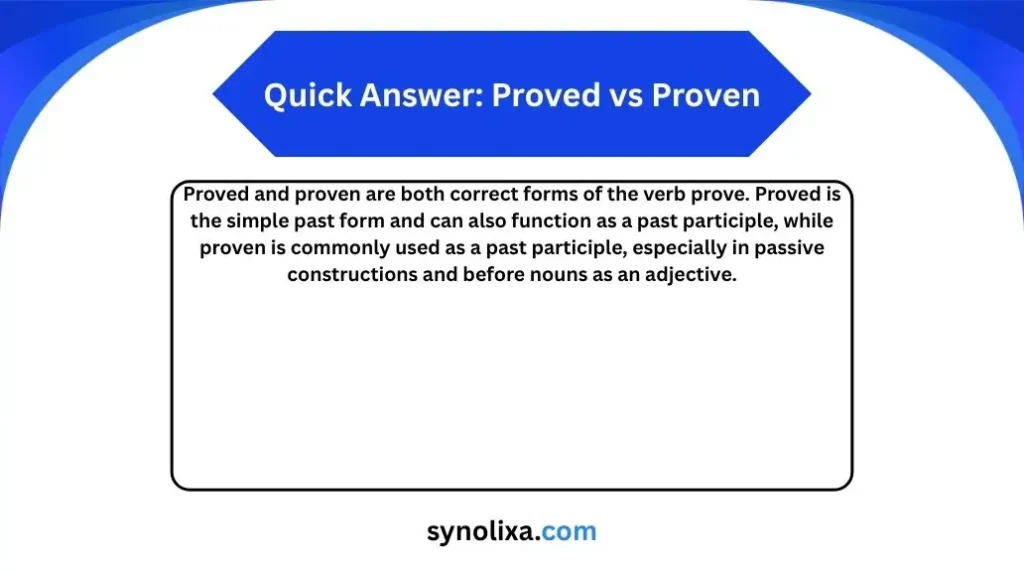
Proved and proven are both correct forms of the verb prove. Proved is the simple past form and can also function as a past participle, while proven is commonly used as a past participle, especially in passive constructions and before nouns as an adjective.
Examples:
- She proved her point during the meeting. ✅
- Her point was proven during the meeting. ✅
- This is a proven method. ✅
- He proven his theory. ❌
The key is to look at how the word functions in the sentence.
Understanding the Basics: Proved vs Proven
The verb prove means to show that something is true, correct, effective, or valid by using evidence, facts, reasoning, or experience.
The two forms can be summarized like this:
| Form | Type | Meaning | Example | Correct/Incorrect |
|---|---|---|---|---|
| Prove | Base form | To demonstrate truth or validity | I will prove my point. | Correct |
| Proved | Simple past | Demonstrated something in the past | She proved her point. | Correct |
| Proved | Past participle | Can be used with auxiliary verbs | The claim has been proved. | Correct |
| Proven | Past participle | Demonstrated or established as true | The claim has been proven. | Correct |
| Proven | Adjective | Shown to work or be reliable | It is a proven method. | Correct |
| Proven | Simple past | Past-tense verb by itself | She proven her point. | Incorrect |
The Basic Rule
If you need the ordinary past tense, use proved:
She proved that she was right.
If you need a past participle, both proved and proven can be possible:
The theory has been proved.
The theory has been proven.
If you are using the word as an adjective before a noun, proven is especially common:
This is a proven solution.
So, proved vs proven is not really a battle between a correct word and an incorrect word. The choice depends on grammar and context.
What Does “Proved” Mean?
Proved is the simple past form of prove.
It describes an action that happened in the past.
Example 1
Maria proved her point during the discussion.
Here, proved tells us that Maria demonstrated her point in the past.
Example 2
The experiment proved that the original assumption was wrong.
The experiment produced evidence in the past.
Example 3
His actions proved that he could be trusted.
The actions provided evidence of trustworthiness.
In these sentences, proved is the natural simple past form.
Proved as a Past Participle
Proved can also be used as a past participle.
For example:
The statement has been proved correct.
The structure is:
has/have/had + been + proved
Another example is:
Scientists have proved the theory through repeated experiments.
Here, have proved uses proved as the past participle.
Therefore, it would be incorrect to think that proved can only be used as a simple past verb.
What Does “Proven” Mean?
Proven is another past participle of prove. It is especially common in passive constructions and adjective-like expressions.
For example:
The method has been proven effective.
Here, proven means that evidence has established the method’s effectiveness.
You will also frequently see proven before nouns:
- proven method
- proven strategy
- proven technique
- proven solution
- proven ability
- proven track record
- proven approach
Example: Proven Method
This is a proven method for improving productivity.
Here, proven describes the noun method. It means the method has already been shown to work.
Example: Proven Ability
She has a proven ability to solve complex problems.
Here, proven describes ability.
Example: Proven Strategy
The company uses a proven strategy to improve customer service.
Again, proven functions as an adjective.
Proved vs Proven in Past Tense
One of the easiest ways to understand the difference is to separate simple past from past participle.
Simple Past: Proved
Use proved when you are describing a completed action in the past.
He proved his argument yesterday.
The test proved that the device was safe.
She proved herself during the competition.
The pattern is generally:
Subject + proved + object/complement
Past Participle: Proven or Proved
When another verb helps form the tense or passive voice, proven or proved may be possible depending on the construction and style.
The theory has been proven.
The theory has been proved.
Both can be grammatical.
However, proven is especially familiar in expressions such as:
a proven technique
a proven method
a proven solution
This distinction explains why people often notice proven in professional and formal writing.
Proved vs Proven in Passive Voice
The passive voice is one area where the choice can become confusing.
Consider:
The claim was proved false.
This is grammatical.
You can also write:
The claim was proven false.
This is also widely used.
The important point is that proven is not automatically wrong just because it appears after “was.”
For example:
The product was proven effective.
This sentence uses proven as the past participle.
Likewise:
The product was proved effective.
This is possible as well.
In modern American English, proven is very common in passive constructions, particularly when the sentence emphasizes that evidence has established something.
When Should You Use “Proved”?
Choose proved when you are talking about a completed action in the past.
Use “proved” for a clear past event
The experiment proved the hypothesis wrong.
Use “proved” after “did”
After did, use the base form prove, not proved or proven.
The experiment did prove the hypothesis wrong. ✅
The experiment did proved the hypothesis wrong. ❌
The experiment did proven the hypothesis wrong. ❌
This is a very useful grammar rule.
Use “proved” for straightforward past actions
She proved her ability to lead the team.
He proved that the accusation was false.
The evidence proved the statement incorrect.
These sentences describe completed actions.
When Should You Use “Proven”?
Choose proven when it works as a past participle or adjective.
Use “proven” before a noun
We need a proven solution.
The company follows a proven process.
He has a proven record of success.
These are extremely common patterns.
Use “proven” in passive constructions
The treatment has been proven effective.
The approach was proven successful.
The product has been proven reliable.
In these examples, proven helps express an established result.
Use “proven” for established effectiveness
When you want to emphasize that something has already demonstrated its value, proven often sounds natural:
This is a proven way to organize your work.
Here, proven suggests that the method has already been tested or shown to work.
Proved vs Proven: Sentence Breakdown
Let’s look at a few examples carefully.
“She proved her point.”
- She = subject
- proved = simple past verb
- her point = object
The sentence describes a completed action.
“Her point was proven.”
- Her point = subject of the passive construction
- was = auxiliary verb
- proven = past participle
The sentence focuses on the point rather than the person who demonstrated it.
“It is a proven method.”
- It = subject
- is = linking verb
- proven = adjective
- method = noun
Here, proven describes the method.
“She has proved her point.”
- She = subject
- has = auxiliary verb
- proved = past participle
- her point = object
This construction is also correct.
Test Tip: How to Choose Proved or Proven
When you are unsure about proved vs proven, use this quick test:
Test 1: Is it an ordinary past action?
If yes, use proved.
He proved his argument.
Test 2: Is it describing a noun?
If yes, proven is often the natural choice.
a proven argument
a proven method
a proven system
Test 3: Does the sentence use “did”?
Use prove after did.
She did prove her point. ✅
Test 4: Is it a passive construction?
Both forms can occur, but proven is especially common.
The method was proven effective. ✅
Easy Memory Trick
Think:
Past action → proved
Established quality/result → proven
This is not an absolute rule for every sentence, but it is a useful guide.
Case Study: Proved vs Proven in the Workplace
Imagine a manager writing an email about a new software system.
The manager could write:
The new system proved effective during last month’s testing.
This focuses on what happened during the testing period. The system demonstrated its effectiveness.
The manager could also write:
The new system has proven effective during testing.
This emphasizes the result or established effectiveness of the system.
Or:
We selected a proven system for the new project.
Here, proven describes the system.
Notice how all three sentences communicate related ideas, but the grammar and emphasis differ.
Workplace Email Example
Imagine the following message:
We tested the new process for three weeks. The results proved that it could reduce processing time. Because of these results, we have selected a proven approach for the next phase.
The first sentence uses proved because it describes what the results demonstrated.
The second use of proven describes approach.
This distinction makes the writing precise and natural.
Grammar Rules for Proved vs Proven
The verb prove has more than one accepted past-participle form in modern English.
The forms are:
- prove — base form
- proved — simple past
- proved — past participle
- proven — past participle
Merriam-Webster lists proved and proven among the forms associated with prove, reflecting the established use of both forms in English.
This means that the idea that “proven is always wrong” is incorrect.
Likewise, the idea that “proved is always wrong when used with has or been” is also incorrect.
Consider these examples:
She proved her case. ✅
She has proved her case. ✅
Her case has been proved. ✅
Her case has been proven. ✅
It is a proven fact. ✅
The form depends on the grammatical structure and the style you want.
Why Do People Confuse Proved and Proven?
The confusion exists because many English verbs have only one standard past form.
For example:
- walk → walked → walked
- work → worked → worked
- jump → jumped → jumped
Learners may expect prove to follow the same pattern:
prove → proved → proved
That pattern is valid, but English also allows proven as a past participle.
The word proven has become especially familiar in expressions such as:
- proven effective
- proven successful
- proven method
- proven strategy
- proven technology
- proven ability
As a result, people sometimes assume that proven is the only correct past participle.
It is not.
Common Mistakes With Proved vs Proven
Mistake 1: Using “proven” as the simple past
She proven her point yesterday. ❌
Correct:
She proved her point yesterday. ✅
Why? Because the sentence needs the simple past form.
Mistake 2: Using “proved” after “did”
He did proved his argument. ❌
Correct:
He did prove his argument. ✅
After did, use the base form.
Mistake 3: Assuming “proven” is always wrong
This is a proven method. ❌
That correction would be wrong.
The correct sentence is:
This is a proven method. ✅
Mistake 4: Assuming “proved” is always wrong
The theory has been proved. ❌
This is not necessarily incorrect.
A better understanding is that proved and proven can both function as past participles.
Similar Grammar Confusions
Many English learners face the same kind of problem with other word pairs.
| Confusion | Correct Forms | Common Mistake |
|---|---|---|
| it’s / its | It’s raining. / The dog wagged its tail. | Mixing possession and contraction |
| your / you’re | Your phone / You’re ready | Using one for the other |
| their / they’re | Their house / They’re here | Confusing possession and contraction |
| affect / effect | It affected me. / The effect was clear. | Treating them as interchangeable |
| then / than | Better than before / First this, then that | Mixing comparison and sequence |
| lie / lay | I lie down. / I lay the book down. | Confusing verb patterns |
| proved / proven | She proved it. / A proven method | Treating one as always wrong |
Why These Mistakes Happen
Common reasons include:
Fast Typing
When people type quickly, they often choose the first familiar form that comes to mind.
Autocorrect
Autocorrect can sometimes change a word without the writer noticing.
Lack of Grammar Knowledge
If someone has learned only one form of a verb, they may assume another form is incorrect.
Familiarity With One Expression
A person who often sees “proven effective” may start using proven everywhere.
The best solution is not memorizing a single word. It is understanding the grammatical role of the word.
Proved vs Proven in Everyday Conversation
In everyday speech, both forms can appear.
For example:
You proved your point.
This is natural and direct.
You might also hear:
The idea has proven successful.
This is also natural.
Another example:
That plan proved to be a mistake.
Here, proved is the simple past form.
Compare:
That plan has proven successful.
Here, proven is the past participle after has.
Both sentences are grammatically correct.
Proved vs Proven in Professional Writing
Professional writing often uses proven in phrases that describe reliability, performance, or established results.
Examples include:
- proven strategy
- proven process
- proven technology
- proven approach
- proven results
- proven expertise
For example:
The company has developed a proven process for managing customer requests.
This sounds natural because proven describes an established process.
However, proved remains useful:
The latest trial proved that the process could handle increased demand.
The difference is based on grammatical function and meaning, not simply formality.
Proved vs Proven in Creative Writing
Creative writers can use either form depending on sentence structure.
For example:
His actions proved that he had made the right decision.
This focuses on the past event.
Another example:
Years of experience had given her a proven instinct for recognizing danger.
Here, proven describes an established quality.
Writers should choose the form that fits the sentence instead of forcing one form throughout a piece of writing.
Proved vs Proven in Social Media and Texting
Social media and texting are less formal, so users may encounter both forms frequently.
Examples:
You proved them wrong! 🎯
This method has proven useful. 👍
A proven way to stay organized.
Because digital communication often involves fast typing, mistakes can happen. However, the same grammar rules still apply.
If you are writing a professional post, school assignment, application, or formal message, take a moment to check whether the word is functioning as a simple past verb, past participle, or adjective.
Why the Difference Matters
Understanding proved vs proven helps make writing clearer.
1. Clarity
Correct verb forms help readers understand when an action happened and how the sentence is structured.
Compare:
She proven the theory.
This is incorrect because proven cannot normally stand alone as the simple past verb.
The correct version is:
She proved the theory.
2. Professionalism
Grammar mistakes can distract readers in professional writing.
A sentence such as:
We selected a proven solution.
looks clear and polished.
3. Digital Communication
Online writing is often read quickly. Clear grammar makes your message easier to understand.
4. Better Word Choice
Knowing both forms gives you more flexibility.
As a simple rule:
“Proved” reports an action; “proven” often highlights an established result or quality.
That distinction can make your writing more precise.
Special Exception: “Proven” as an Adjective
One of the most important special uses of proven is its adjective-like function.
Consider:
She is a proven leader.
Here, proven describes leader.
It does not simply report one action. It tells us that her leadership ability has already been demonstrated.
Other examples include:
- a proven expert
- a proven performer
- a proven technique
- a proven approach
- a proven solution
- a proven system
This is why proven is particularly common in business, marketing, technology, and professional writing.
“Proven” Does Not Mean “More Correct”
Because proven is common in professional phrases, some writers assume it is somehow more grammatically correct than proved.
That is not the right way to understand the difference.
For example:
The experiment proved the theory.
is perfectly correct.
Likewise:
The theory has been proven.
is perfectly acceptable.
The forms serve different grammatical roles and patterns.
Proved vs Proven: Quick Recap Checklist
Use this checklist when you are unsure which word to choose.
| Question | If Yes → Use |
|---|---|
| Are you describing a simple past action? | Proved |
| Does the sentence use “did”? | Prove |
| Are you describing a noun? | Usually Proven |
| Are you using a passive construction? | Proven or Proved may work |
| Are you describing an established method or ability? | Proven |
| Are you saying someone demonstrated something? | Usually Proved |
Practice Example 1
Sarah ___ that the calculation was wrong.
Answer:
Sarah proved that the calculation was wrong.
Why? It is a simple past action.
Practice Example 2
This is a ___ method.
Answer:
This is a proven method.
Why? Proven describes the noun method.
Practice Example 3
The results have ___ that the approach works.
Answer:
The results have proved that the approach works.
Here, proved is a past participle following have. This construction is grammatical.
You could also encounter:
The approach has been proven effective.
Both structures demonstrate why context matters.
Proved vs Proven: More Examples
Here are several examples to make the distinction easier to remember:
Correct with “proved”
The test proved the theory wrong.
He proved his ability to lead.
Her actions proved that she cared.
The results proved the original prediction incorrect.
The experience proved valuable.
Correct with “proven”
This is a proven technique.
She has proven herself capable.
The approach has proven effective.
We need a proven solution.
He is a proven professional.
Incorrect Uses
She proven her point. ❌
He proven that the claim was false. ❌
They did proved the theory. ❌
The company did proven its ability. ❌
Correct them as follows:
She proved her point. ✅
He proved that the claim was false. ✅
They did prove the theory. ✅
The company did prove its ability. ✅
A Simple Way to Remember Proved vs Proven
If you remember only one thing, remember this:
Proved is the normal simple past form:
He proved it.
Proven is a common past participle and adjective:
It has been proven.
It is a proven method.
Also remember that proved can be a past participle too:
He has proved it.
So the safest approach is not to memorize “proved = correct” or “proven = correct.” Instead, look at the sentence around the word.
Ask:
- Is this a simple past action?
- Is there an auxiliary verb?
- Is the word describing a noun?
- Is the sentence passive?
- Does the phrase commonly use “proven,” such as “proven effective”?
Once you ask these questions, the choice becomes much easier.
FAQs
1. Is “proved” or “proven” correct?
Both proved and proven are correct. Proved is the simple past form and can also be a past participle. Proven is another accepted past participle and is especially common in passive constructions and adjective-like phrases.
2. Is “proven” grammatically correct?
Yes. Proven is a standard English form of prove. For example, “This is a proven method” is grammatically correct.
3. Is “proved” a past tense?
Yes. Proved is the simple past form of prove.
Example:
She proved her point.
4. Can “proved” be a past participle?
Yes. Proved can function as a past participle.
Example:
They have proved their case.
5. Can I say “has proven”?
Yes. Has proven is grammatically correct.
Example:
The method has proven effective.
6. Is “she proven it” correct?
No. In standard English, the simple past should be:
She proved it.
You cannot normally use proven by itself as the simple past verb.
Conclusion
The difference between proved vs proven is easier than it first appears. Both are legitimate forms of the verb prove. Proved is the standard simple past form, as in “She proved her point.” It can also function as a past participle, as in “They have proved the claim.” Proven is also a past participle and is especially common in passive constructions and adjective-like expressions, such as “The method has been proven effective” and “a proven solution.”
The biggest mistake is assuming that one word is always correct and the other is always wrong. Context determines the best choice. Use proved for ordinary past actions, and consider proven when describing an established result, quality, method, or ability.
When in doubt, examine the grammar around the word rather than relying on how familiar it sounds.
Remember: prove is the base form, proved is the simple past, and both proved and proven can serve as past participles.

Hi, I am Ava Mitchell. I work at Synolixa as an English content writer, creating simple and useful resources about synonyms, vocabulary, and English usage.
[…] common mistakes, practical uses, and easy ways to remember which word belongs in your sentence. Proved vs Proven | Take It or Leave It | Gases or […]