Have you ever seen the words bespeckled and bespectacled and wondered whether they mean the same thing? They look very similar, but they describe two completely different things. This confusion is easy to understand because both words begin with “bespe-” and are often used as adjectives. However, choosing the right word depends on what you are trying to describe.
Bespeckled means marked or covered with small spots, specks, or dots. Bespectacled, on the other hand, describes a person who wears eyeglasses. So, if you are talking about a wall covered with tiny marks, you might call it bespeckled. If you are describing a person wearing glasses, bespectacled is the appropriate word.
Understanding this difference can make your writing more precise. It is especially useful in descriptive writing, workplace communication, literature, and everyday English. In this guide, we will explain bespeckled or bespectacled, their meanings, examples, grammar rules, common mistakes, and practical ways to remember which word to use. 👓✨ Any Problem or Any Problems | An Hilarious or a Hilarious | Reorder or Re-order
Quick Answer: Bespeckled or Bespectacled
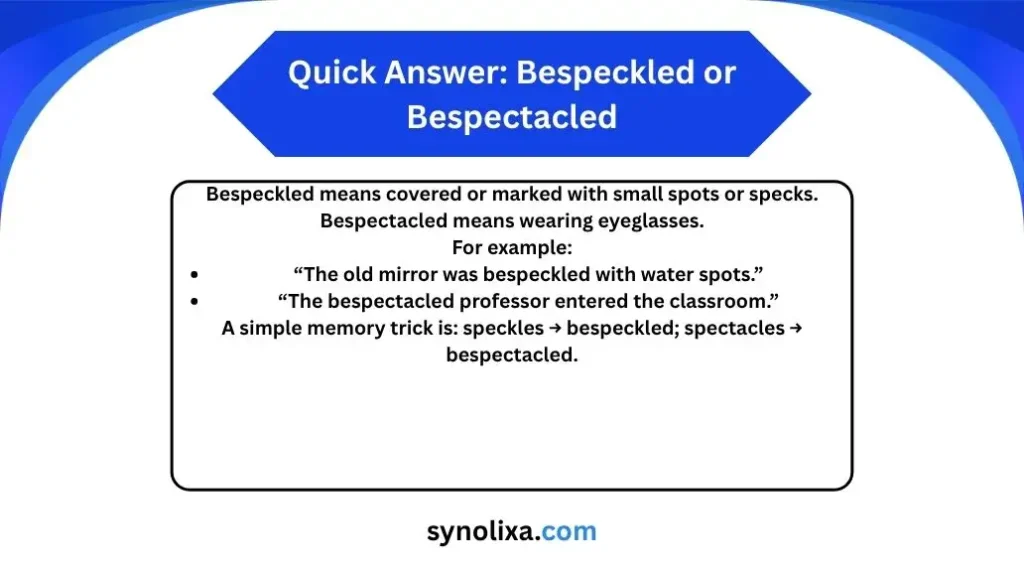
Bespeckled means covered or marked with small spots or specks. Bespectacled means wearing eyeglasses.
For example:
- “The old mirror was bespeckled with water spots.”
- “The bespectacled professor entered the classroom.”
A simple memory trick is: speckles → bespeckled; spectacles → bespectacled.
Understanding the Basics: Bespeckled or Bespectacled
The words bespeckled and bespectacled are both adjectives, but they have different meanings and origins.
Bespeckled comes from the noun speck, meaning a small spot or mark. When something is bespeckled, it has many small spots or marks on its surface.
Bespectacled comes from spectacles, an older word for eyeglasses. A person who is bespectacled is wearing glasses.
The difference becomes easy when you connect each word with its key noun:
- Speck → bespeckled
- Spectacles → bespectacled
Comparison Table
| Form | Type | Meaning | Example | Correct/Incorrect |
|---|---|---|---|---|
| bespeckled | Adjective | Covered or marked with small spots | “The window was bespeckled with rain.” | Correct |
| bespectacled | Adjective | Wearing eyeglasses | “The bespectacled man smiled.” | Correct |
| bespeckled for a person wearing glasses | Adjective | Does not mean wearing glasses | “The bespeckled teacher wore glasses.” | Usually incorrect for this intended meaning |
| bespectacled for a spotted surface | Adjective | Does not mean covered with spots | “The bespectacled wall was dirty.” | Incorrect for this intended meaning |
The key is to focus on the middle of each word. Speck refers to a spot, while spectacles refers to eyeglasses.
Correct Meanings & Uses
What Does Bespeckled Mean?
Bespeckled means marked, covered, or dotted with small spots or specks.
The spots can be natural or accidental. They might appear on clothing, glass, paper, skin, leaves, walls, or other surfaces.
Examples:
- “The white shirt was bespeckled with paint.”
- “The windshield became bespeckled with raindrops.”
- “The artist’s hands were bespeckled with blue paint.”
- “The night sky was bespeckled with stars.”
In each example, bespeckled describes something that has many small marks or points on it.
Breaking Down a Bespeckled Sentence
Consider this sentence:
“The old table was bespeckled with ink.”
Here:
- The old table = the subject
- was = the linking verb
- bespeckled = adjective describing the table
- with ink = explains what created the spots
The word tells us that the table had small spots of ink on it.
What Does Bespectacled Mean?
Bespectacled means wearing eyeglasses.
It is generally used to describe a person.
Examples:
- “A bespectacled woman answered the door.”
- “The bespectacled teacher explained the lesson.”
- “He was a quiet, bespectacled student.”
- “The photograph showed a young, bespectacled scientist.”
The word is often descriptive and can sound slightly literary or formal.
Breaking Down a Bespectacled Sentence
Consider:
“The bespectacled professor adjusted his glasses.”
Here:
- The bespectacled professor = a professor who wears glasses
- adjusted = the action
- his glasses = the object being adjusted
The adjective bespectacled gives us additional information about the professor’s appearance.
Test Tip
When deciding between bespeckled and bespectacled, ask:
Am I describing spots or glasses?
- If you mean spots, dots, or specks, use bespeckled.
- If you mean eyeglasses, use bespectacled.
This quick test works in most situations.
Bespeckled: Common Uses and Examples
Bespeckled is especially useful in descriptive writing.
Nature
You can use it to describe natural objects:
- “The leaves were bespeckled with drops of morning dew.”
- “The orange mushroom was bespeckled with white spots.”
- “The moonlit sky was bespeckled with stars.”
Clothing
It can describe clothing covered with small marks:
- “His jacket was bespeckled with mud.”
- “The apron was bespeckled with flour.”
- “Her shoes were bespeckled with paint.”
Surfaces
It can describe many kinds of surfaces:
- “The mirror was bespeckled with water.”
- “The wall was bespeckled with tiny dark marks.”
- “The glass was bespeckled with dust.”
Creative Writing
Writers often use bespeckled because it creates a vivid visual image.
For example:
“The dark blue sky was bespeckled with countless stars.”
This gives the reader a clear picture of stars appearing as tiny bright points across the sky.
Bespectacled: Common Uses and Examples
Bespectacled is mainly used when describing people who wear glasses.
Everyday Description
- “The bespectacled man was waiting outside.”
- “A bespectacled woman greeted us.”
- “The bespectacled child read the book quietly.”
Professional Writing
The word can be useful when identifying someone in a written description:
“The bespectacled speaker introduced the next presentation.”
This helps distinguish the speaker from other people in the room.
Creative Writing
Authors may use bespectacled to create a quick visual impression:
“A bespectacled librarian stood behind the desk.”
The adjective gives the reader an immediate detail about the character.
Historical or Literary Descriptions
You may also encounter bespectacled in biographies, profiles, or literary descriptions:
“The bespectacled researcher carefully examined the documents.”
It is a concise way to indicate that someone wears glasses.
Case Study: A Workplace Example
Imagine that a manager sends an email describing a meeting.
The manager writes:
“The bespeckled analyst presented the quarterly report.”
This sentence technically suggests that the analyst was covered or marked with small spots. It does not clearly mean that the analyst wore glasses.
If the manager means that the analyst wears glasses, the better sentence is:
“The bespectacled analyst presented the quarterly report.”
Now the meaning is clear.
Another Example
Suppose an employee writes:
“Please clean the bespectacled window before the meeting.”
This sounds incorrect because bespectacled describes someone wearing spectacles. A window cannot normally be described that way.
If the window has tiny spots, write:
“Please clean the bespeckled window before the meeting.”
The correct word changes the entire meaning of the sentence.
Grammar Rules: Why Are Bespeckled and Bespectacled Different?
The two words are related in appearance but not in meaning.
The Grammar of Bespeckled
Bespeckled functions as an adjective. It describes something that has small spots or specks.
The base noun is speck.
Examples:
- speck → speckled
- speck → bespeckled
The prefix be- contributes to the formation of the adjective, giving the sense of being covered or marked with something.
The Grammar of Bespectacled
Bespectacled is also an adjective. It is formed from spectacles, an established word for eyeglasses.
Examples:
- spectacles → bespectacled
So, the two words have different roots:
bespeckled → speck
bespectacled → spectacles
That difference explains why they cannot normally be substituted for one another.
Dictionary Authority
Major English dictionaries, including Merriam-Webster, distinguish these words by their meanings. Bespeckled relates to being marked with spots or specks, while bespectacled describes someone who wears spectacles or eyeglasses.
This distinction is important because dictionaries classify words according to established usage and meaning rather than visual similarity.
Common Mistakes With Bespeckled or Bespectacled
Why do people confuse these words?
The main reason is their similar spelling.
Both begin with bespec-, and both function as adjectives. When people read quickly, the difference can be easy to miss.
Fast Typing
When typing quickly, you might remember the general shape of a word without remembering its exact spelling.
For example, someone thinking “glasses” might type bespeckled simply because it looks similar to bespectacled.
Autocorrect
Autocorrect and predictive text can sometimes make word selection confusing. A typing system may recognize one word but not correctly understand the intended meaning.
Lack of Knowledge
Some writers have simply never learned the distinction.
Because bespeckled and bespectacled are not everyday words for many people, it is easy to assume that they are spelling variations of the same adjective.
Similar Grammar Confusions
This type of mistake is common in English. Several pairs look or sound similar but have different meanings.
| Confusing Words | Correct Difference |
|---|---|
| it’s / its | “It’s” = it is; “its” = possessive |
| your / you’re | “Your” = possession; “you’re” = you are |
| there / their / they’re | Location, possession, and they are |
| to / too / two | Direction, also/excessively, and number |
| affect / effect | Usually a verb vs. noun, with important exceptions |
| than / then | Comparison vs. time/order |
| bespeckled / bespectacled | Spots/specks vs. eyeglasses |
The lesson is simple: similar spelling does not guarantee similar meaning.
Usage in Different Contexts
Everyday Conversation
In casual conversation, people may be more likely to say wearing glasses than bespectacled.
For example:
“The man wearing glasses is my teacher.”
This is more common in everyday speech than:
“The bespectacled man is my teacher.”
Both can be grammatically correct, but the second sounds more descriptive or literary.
Bespeckled can also appear in everyday descriptions:
“The car was bespeckled with mud.”
Professional Writing
In professional writing, precision matters.
If you are describing a person’s appearance:
“The bespectacled presenter answered the question.”
If you are describing a document or surface with small marks:
“The printed page was bespeckled with ink.”
Choose the adjective that accurately describes the subject.
Creative Writing
Both words can be useful in creative writing.
Bespeckled can create an image of texture or pattern:
“The old window was bespeckled with rain.”
Bespectacled can quickly establish a character’s appearance:
“A bespectacled detective studied the photograph.”
These adjectives are particularly useful when you want to create a visual impression without using a long description.
Social Media and Texting
On social media, people often use shorter phrases.
Instead of:
“The bespectacled guy in the photo…”
someone might simply write:
“The guy wearing glasses…”
Still, bespectacled can work well in captions when a more descriptive or playful style is intended.
Similarly:
“A bespeckled window on a rainy morning. 🌧️”
can be a creative caption.
Why It Matters
Using the correct word helps readers understand your exact meaning.
Clarity in Communication
Imagine writing:
“The bespeckled doctor entered the room.”
A reader might understand that the doctor has spots or marks on their appearance rather than assuming they wear glasses.
If your intended meaning is glasses, bespectacled removes the ambiguity.
Professionalism
Correct word choice shows attention to detail. In professional emails, reports, articles, and other formal writing, precise vocabulary makes your writing easier to understand.
Digital Communication
Online communication moves quickly. Readers often scan rather than read every word carefully. Using the correct term helps your message communicate its meaning immediately.
A Useful Principle
“Choose the word that matches the meaning.”
This simple habit can prevent many vocabulary errors.
Special Exception and Edge Cases
There is no common grammatical exception that makes bespeckled mean “wearing glasses” or bespectacled mean “covered with spots.”
However, context can sometimes make unusual descriptions possible in creative writing.
For example, a writer might describe a person’s clothing as bespeckled with paint:
“The bespectacled artist wore a bespeckled apron.”
This sentence uses both words correctly:
- bespectacled artist = an artist wearing glasses
- bespeckled apron = an apron covered with spots
The two words can therefore appear in the same sentence while performing completely different jobs.
Bespeckled vs Bespectacled: Memory Trick
Here is one of the easiest ways to remember the difference:
Think “Speck”
Speck = small spot
Therefore:
bespeckled = covered with small spots
Example:
“The paper was bespeckled with ink.”
Think “Spectacles”
Spectacles = eyeglasses
Therefore:
bespectacled = wearing glasses
Example:
“The bespectacled professor entered the room.”
The One-Line Memory Rule
Specks are spots; spectacles are glasses.
If you remember that sentence, you can usually choose the correct word instantly. 🧠
Quick Recap Checklist
Use this checklist whenever you are unsure.
| Question | If Yes → Use |
|---|---|
| Does the subject have small spots or marks? | bespeckled |
| Does the person wear eyeglasses? | bespectacled |
| Are you describing a spotted surface? | bespeckled |
| Are you describing someone with spectacles? | bespectacled |
| Are you talking about glasses? | bespectacled |
| Are you talking about specks or dots? | bespeckled |
Practice Examples
1. The old photograph was ______ with tiny white marks.
Answer: bespeckled
The photograph has small marks.
2. The ______ librarian helped me find the book.
Answer: bespectacled
The librarian is wearing glasses.
3. His shirt was ______ with drops of paint.
Answer: bespeckled
The shirt has small spots of paint.
FAQs
1. What is the difference between bespeckled and bespectacled?
Bespeckled means covered or marked with small spots or specks. Bespectacled means wearing eyeglasses.
2. Is bespeckled correct English?
Yes. Bespeckled is a standard English adjective. It describes something marked or covered with small spots or specks.
3. Is bespectacled correct English?
Yes. Bespectacled is a standard adjective used to describe someone who wears eyeglasses or spectacles.
4. Can I use bespeckled to describe someone wearing glasses?
No, not if you mean that the person wears glasses. Use bespectacled instead.
For example:
- Correct: “The bespectacled professor smiled.”
- Incorrect for the intended meaning: “The bespeckled professor smiled.”
5. Can bespectacled describe a spotted object?
No. Bespectacled refers to wearing spectacles. If an object is covered with small spots, bespeckled is the appropriate word.
6. What is an easy way to remember bespeckled vs. bespectacled?
Connect each word to its root:
- speck → bespeckled
- spectacles → bespectacled
So, bespeckled = spots, while bespectacled = glasses.
Conclusion
The difference between bespeckled and bespectacled is simple once you connect each word to its meaning. Bespeckled describes something covered or marked with small spots, specks, or dots. Bespectacled describes a person who wears eyeglasses.
For example, you can say, “The window was bespeckled with rain,” because the window has small spots. You can also say, “The bespectacled teacher entered the classroom,” because the teacher wears glasses.
The easiest memory trick is to look at the roots: speck → bespeckled and spectacles → bespectacled. When you remember “specks are spots” and “spectacles are glasses,” the distinction becomes much easier.
Precise vocabulary makes writing clearer, more natural, and more professional. So the next time you wonder bespeckled or bespectacled, stop and ask one simple question: Am I talking about spots or glasses? That answer will point you to the right word. ✍️👓

Hi, I am Ethan Parker. I work at Synolixa as a grammar and writing specialist, helping readers understand English grammar and improve their writing skills.
[…] break down the difference in a simple way. 👇 Bespeckled or Bespectacled | Any Problem or Any Problems | An Hilarious or a […]