Have you ever paused while writing a sentence and wondered whether it should be “an hilarious or a hilarious”? You are not alone. The confusion happens because the word hilarious begins with the letter H, and many English learners remember that words beginning with vowels usually take “an.” However, English articles are based on sound, not simply on the first letter of a word.
The correct phrase in standard modern US English is “a hilarious.” For example, we say, “She told a hilarious story,” not “She told an hilarious story.” The reason is simple: hilarious begins with a clearly pronounced /h/ sound. Because that opening sound is a consonant sound, it follows the same article pattern as “a happy,” “a helpful,” and “a humorous.”
This small grammar rule can make a big difference in polished writing. Whether you are writing an email, school assignment, blog post, social media caption, or everyday message, knowing when to use a and an helps your sentences sound natural and correct.
Let’s look at the rule step by step. 😊 Reorder or Re-order | Its Called vs It Called | Team Which or Team Who or Team That
Quick Answer: An Hilarious or a Hilarious?
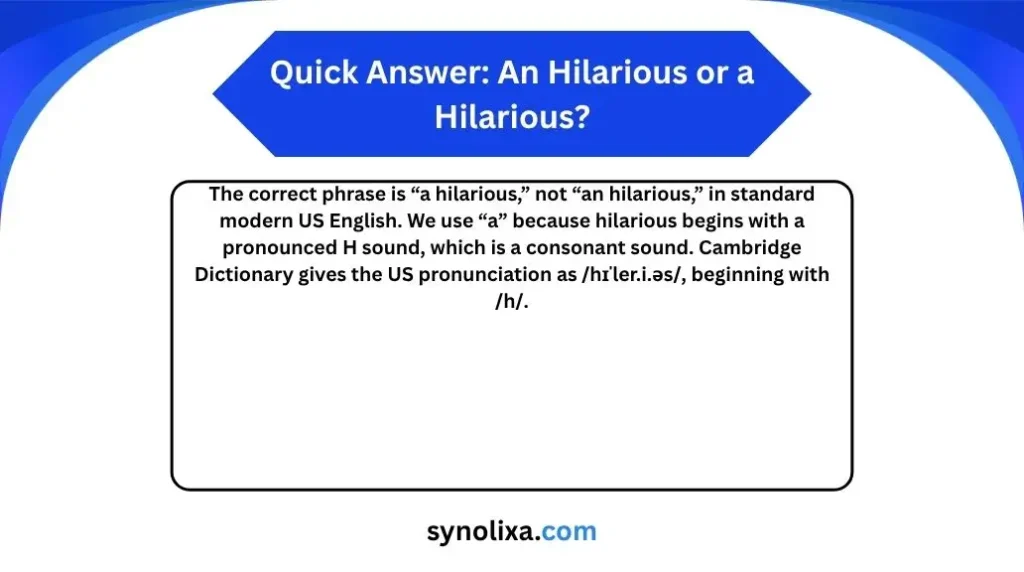
The correct phrase is “a hilarious,” not “an hilarious,” in standard modern US English. We use “a” because hilarious begins with a pronounced H sound, which is a consonant sound. Cambridge Dictionary gives the US pronunciation as /hɪˈler.i.əs/, beginning with /h/.
For example:
- ✅ a hilarious joke
- ✅ a hilarious story
- ✅ a hilarious movie
- ❌ an hilarious joke
- ❌ an hilarious story
The important rule is this:
Use “a” before a consonant sound and “an” before a vowel sound.
Understanding the Basics: An Hilarious or a Hilarious
The difference between “a hilarious” and “an hilarious” comes down to pronunciation.
Although hilarious starts with the letter H, the H is pronounced. The word does not begin with a vowel sound.
Cambridge Dictionary lists the US pronunciation as /hɪˈler.i.əs/ and the UK pronunciation as /hɪˈleə.ri.əs/. Both pronunciations begin with the /h/ sound.
That means the natural phrase is “a hilarious.”
Comparison Table
| Form | Type | Meaning | Example | Correct/Incorrect |
|---|---|---|---|---|
| a hilarious | Article + adjective | Extremely funny | She told a hilarious story. | ✅ Correct |
| an hilarious | Article + adjective | Intended to mean extremely funny | She told an hilarious story. | ❌ Not standard US usage |
| hilarious | Adjective | Extremely funny or causing laughter | The movie was hilarious. | ✅ Correct |
| a humorous | Article + adjective | Funny or amusing | He gave a humorous answer. | ✅ Correct |
| an amusing | Article + adjective | Entertaining or funny | It was an amusing story. | ✅ Correct |
Notice something important: the choice between a and an is not based only on spelling.
It is based on the sound immediately following the article.
The Simple Sound Rule
Use:
- a + consonant sound
- an + vowel sound
Examples:
- a house
- a happy child
- a hilarious story
- a useful idea
- an apple
- an interesting story
- an honest person
- an unusual event
This explains why “a hilarious” is correct.
What Does “Hilarious” Mean?
Before choosing the correct article, it helps to understand the word itself.
Hilarious is an adjective meaning extremely funny or causing a lot of laughter. Cambridge Dictionary defines it as something extremely funny and laughter-causing.
Examples include:
- That movie was hilarious.
- Her story was hilarious.
- We watched a hilarious video.
- He made a hilarious joke.
- It was a hilarious mistake.
The word describes something that makes people laugh or seems extremely funny.
Example: “A Hilarious Story”
Consider:
She told a hilarious story.
Here:
- She = subject
- told = verb
- a = indefinite article
- hilarious = adjective
- story = noun
The adjective hilarious describes the noun story.
Because hilarious begins with a pronounced /h/ sound, a is used.
Example: “A Hilarious Movie”
We watched a hilarious movie last night.
Again, hilarious starts with the consonant sound /h/.
Therefore:
a hilarious movie ✅
Not:
an hilarious movie ❌
Example: “A Hilarious Person”
You can also use the phrase to describe someone who is extremely funny:
My uncle is a hilarious person.
The article agrees with the sound at the beginning of hilarious, so a is correct.
Why “A Hilarious” Is Correct
The easiest way to understand the rule is to say the word aloud.
Say:
hilarious
You can hear the beginning:
h-
That /h/ sound is pronounced.
This is different from words such as:
- honest
- hour
- honor
- heir
In those words, the written H is silent in standard pronunciation.
Therefore, we say:
- an honest person
- an hour
- an honor
- an heir
But hilarious does not work that way.
We pronounce the H:
hilarious
So we say:
a hilarious joke
This same principle applies to other H-words:
- a happy child
- a helpful teacher
- a healthy meal
- a hilarious story
- a historical event
- a humorous comment
The spelling begins with H, but more importantly, the pronunciation begins with a consonant sound.
The Difference Between “A” and “An”
The words a and an are both indefinite articles.
We generally use a before a consonant sound:
- a dog
- a car
- a book
- a teacher
- a hilarious story
We generally use an before a vowel sound:
- an apple
- an egg
- an idea
- an interesting book
- an unusual story
The rule is about sound, not simply letters.
Why Sound Matters More Than Spelling
Look at these examples:
A university
The word university begins with the letter U, but it begins with a /y/ sound: “you-niversity.”
So we say:
a university
Not:
an university
Now look at:
An hour
The word hour begins with H, but the H is silent.
The word begins with an “ow” vowel sound.
So we say:
an hour
This gives us a useful comparison:
| Word | First Letter | First Sound | Correct Article |
|---|---|---|---|
| hilarious | H | /h/ | a |
| happy | H | /h/ | a |
| honest | H | vowel sound | an |
| hour | H | vowel sound | an |
| university | U | /y/ sound | a |
| umbrella | U | vowel sound | an |
That is why simply looking at the first letter can lead to mistakes.
Correct Meanings and Uses of “A Hilarious”
The phrase “a hilarious” normally appears before a singular countable noun.
For example:
a hilarious joke
a hilarious story
a hilarious video
a hilarious moment
a hilarious scene
a hilarious character
The word hilarious is an adjective, so it usually modifies a noun.
“A Hilarious Joke”
He told a hilarious joke during dinner.
Here, hilarious describes joke.
“A Hilarious Story”
She shared a hilarious story with her friends.
Here, hilarious describes story.
“A Hilarious Moment”
We had a hilarious moment during the trip.
Here, hilarious describes moment.
“A Hilarious Video”
I watched a hilarious video online.
Here, hilarious describes video.
The same grammar pattern works in each example:
a + hilarious + singular noun
This is the most common structure.
Can You Say Just “A Hilarious”?
Usually, “a hilarious” is followed by a noun.
For example:
She told a hilarious story.
Simply saying:
She told a hilarious.
would normally sound incomplete because hilarious is an adjective and needs a noun after it in this construction.
However, English sometimes allows adjectives to function in other structures, depending on context. That does not change the basic article rule for the phrase.
For everyday writing, remember:
a hilarious + noun
Examples:
- a hilarious joke
- a hilarious movie
- a hilarious story
- a hilarious comment
- a hilarious mistake
When “An” Is Correct Before H-Words
This is where many learners become confused.
Not every H-word takes a.
The real question is:
Is the H sound pronounced?
If the H is pronounced, use a.
If the H is silent and the next sound is a vowel sound, use an.
Pronounced H
- a happy person
- a healthy meal
- a helpful answer
- a hilarious joke
Silent H
- an honest person
- an honorable decision
- an hour
- an heir
The difference is pronunciation.
This is why memorizing only the first letter is not enough.
Test Tip: Say the Word Out Loud
Here is a quick test you can use.
Step 1: Say the word
Say:
hilarious
Step 2: Listen to the first sound
You hear the /h/ sound.
Step 3: Decide whether that sound is a consonant or vowel sound
The /h/ sound is a consonant sound.
Step 4: Choose the article
Use:
a
Therefore:
a hilarious
This test works for many confusing article choices.
Case Study: A Workplace Email
Imagine that an employee sends an email after a team meeting.
The employee writes:
“Yesterday’s presentation included a hilarious example that helped everyone understand the topic.”
This sentence is grammatically natural.
Why?
Because hilarious starts with a pronounced H sound.
Now imagine the employee writes:
“Yesterday’s presentation included an hilarious example.”
The meaning is still understandable, but the article choice is not the standard choice in modern US English.
For professional communication, the better form is:
a hilarious example
Why This Matters at Work
Small grammar choices can affect how polished writing appears.
In a workplace email, report, presentation, or business document, using standard article forms helps make the writing easier to read.
The same principle applies to:
- school assignments
- applications
- blog posts
- reports
- presentations
- formal emails
- professional websites
Correct grammar does not need to be complicated. Often, it comes down to understanding a small and repeatable rule.
Grammar Rules Explained
The rule behind “a hilarious” is the indefinite article rule.
Rule 1: Use “A” Before a Consonant Sound
Examples:
- a book
- a teacher
- a house
- a funny story
- a hilarious story
Rule 2: Use “An” Before a Vowel Sound
Examples:
- an apple
- an idea
- an answer
- an interesting story
- an unusual event
Rule 3: Focus on Pronunciation
The first written letter is not always enough.
For example:
a university
The U does not create a vowel sound at the beginning. It begins with a /y/ sound.
Similarly:
an hour
The H is silent, so the word begins with a vowel sound.
The pronunciation of hilarious begins with /h/ in both the US and UK pronunciations listed by Cambridge Dictionary.
Merriam-Webster’s pronunciation guide also demonstrates why English article choices need to account for pronunciation rather than spelling alone.
“An Hilarious” vs “A Hilarious”: Side-by-Side Examples
| Incorrect in standard US English | Correct |
|---|---|
| an hilarious joke | a hilarious joke |
| an hilarious movie | a hilarious movie |
| an hilarious story | a hilarious story |
| an hilarious comment | a hilarious comment |
| an hilarious moment | a hilarious moment |
| an hilarious video | a hilarious video |
| an hilarious mistake | a hilarious mistake |
Correct Examples
She told a hilarious story.
We watched a hilarious movie.
He made a hilarious comment.
That was a hilarious mistake.
They shared a hilarious video.
Incorrect Examples
She told an hilarious story.
We watched an hilarious movie.
He made an hilarious comment.
For standard modern US English, replace an with a.
Common Mistakes
People make this mistake for several understandable reasons.
1. Fast Typing
When people type quickly, they may choose an article automatically.
Someone may see the H and think:
H → vowel letter → an
But that shortcut does not work.
The correct process is:
first sound → consonant or vowel → choose article
2. Autocorrect
Autocorrect and predictive text can sometimes reinforce a phrase someone has already typed.
If a writer is unsure about an article, the keyboard may not always provide useful grammatical guidance.
That is why understanding the rule is better than depending completely on software.
3. Lack of Knowledge
English has many article rules, and learners may initially assume:
“A before consonant letters, an before vowel letters.”
That is a useful starting point, but it is incomplete.
The more accurate rule is:
A before consonant sounds; an before vowel sounds.
4. Confusion With Silent H Words
Learners may remember phrases such as:
an honest person
or:
an hour
and then apply the same pattern to hilarious.
But hilarious has a pronounced H.
Similar Grammar Confusions
The a/an problem belongs to a larger group of common English mistakes.
| Confusion | Correct Form | Why? |
|---|---|---|
| an hilarious / a hilarious | a hilarious | Pronounced /h/ sound |
| an hour / a hour | an hour | Silent H |
| a apple / an apple | an apple | Vowel sound |
| an university / a university | a university | Starts with /y/ sound |
| it’s / its | Depends on meaning | Contraction vs. possessive |
| your / you’re | Depends on meaning | Possessive vs. contraction |
| their / there / they’re | Depends on meaning | Different functions |
| then / than | Depends on meaning | Time vs. comparison |
These examples show why English spelling and pronunciation cannot always be treated as identical.
Usage in Different Contexts
Everyday Conversation
In normal conversation, you would naturally say:
“That was a hilarious joke!”
or:
“She told a hilarious story.”
These forms sound natural because the H is pronounced.
Professional Writing
Professional writing should use the standard form:
“The presentation included a hilarious example.”
Avoid:
“The presentation included an hilarious example.”
Using a hilarious keeps the sentence aligned with standard modern US English.
Creative Writing
Writers can use hilarious to create humor and personality:
“It was a hilarious scene that everyone remembered.”
The grammar remains the same.
Creative writing may play with unusual language for stylistic reasons, but standard grammar is still the best foundation.
Social Media and Texting
Informal writing often contains shortened forms, slang, and missing punctuation.
You may see:
“That was a hilarious video 😂”
That is completely natural.
Even in casual writing, however, a hilarious is the standard article choice.
Why It Matters
Knowing whether to write “an hilarious or a hilarious” may seem like a tiny detail. In reality, small grammar choices contribute to clear and polished communication.
1. Clarity
Correct article use makes sentences sound natural.
Compare:
She told a hilarious story.
with:
She told an hilarious story.
The first sounds standard and natural in modern US English.
2. Professionalism
Grammar matters in professional settings.
A polished sentence can help your:
- emails
- reports
- presentations
- articles
- applications
- business communication
look more carefully written.
3. Digital Communication
People write more than ever through:
- messaging apps
- social media
- websites
- online forms
- blogs
Because written communication is everywhere, knowing small grammar rules is useful.
4. Better English Habits
Learning the sound-based article rule helps with many other words.
Once you understand why we say:
a hilarious story
you can apply the same logic to other words.
a happy child
a helpful answer
an honest person
an unusual event
The goal is not to memorize hundreds of individual phrases. The goal is to understand the pattern.
A Short Quote
“Listen to the sound, not just the letter.”
That simple idea can help you solve many a vs. an questions.
Special Exception and Edge Cases
There is an important point about historical and dialectal usage.
You may occasionally encounter “an hilarious” in older writing, historical texts, or varieties of English where the initial H may have been weakened or omitted in certain speech patterns. Historical usage does not necessarily follow the pronunciation and style expected in present-day standard US English.
For modern US English, the normal form is:
a hilarious
This article is focused on contemporary standard usage.
It is also important not to confuse unusual historical examples with the grammar expected in current everyday writing.
What About British English?
British English and American English can differ in pronunciation and style. However, modern standard pronunciations of hilarious listed by Cambridge both begin with /h/.
So the ordinary modern form remains:
a hilarious
Regional pronunciation can vary, but standard pronunciation should guide standard article selection.
A Simple Memory Trick
Here is an easy way to remember the rule:
Don’t look. Listen. 👂
When choosing between a and an, say the next word aloud.
If it begins with a consonant sound:
a
If it begins with a vowel sound:
an
For hilarious:
h-i-l-a-r-i-o-u-s
Say it:
hilarious
You hear the H.
Therefore:
a hilarious
Memory Formula
Consonant sound → A
Vowel sound → AN
This is much more reliable than:
Consonant letter → A
Vowel letter → AN
The second formula can fail because English spelling does not always match pronunciation.
Quick Recap Checklist
Use this checklist whenever you are unsure.
| Question | If Yes → Use |
|---|---|
| Does the next word begin with a consonant sound? | a |
| Does the next word begin with a vowel sound? | an |
| Is the H in hilarious pronounced? | a hilarious |
| Is the H silent, as in hour? | an hour |
| Does the word begin with a /y/ sound, as in university? | a university |
| Does the word begin with a true vowel sound, as in apple? | an apple |
Practice Example 1
Choose the correct phrase:
She told ___ hilarious story.
Answer:
a hilarious story
Practice Example 2
Choose the correct phrase:
We watched ___ hilarious movie.
Answer:
a hilarious movie
Practice Example 3
Choose the correct phrase:
He shared ___ hilarious memory.
Answer:
a hilarious memory
The pattern is the same each time.
More Examples of “A Hilarious”
Here are additional examples you can use as models:
- That was a hilarious joke.
- She shared a hilarious story.
- We watched a hilarious movie.
- He posted a hilarious video.
- They had a hilarious conversation.
- It was a hilarious moment.
- She made a hilarious comment.
- He remembered a hilarious mistake.
- The comedian told a hilarious story.
- We heard a hilarious explanation.
- They described a hilarious situation.
- It became a hilarious memory.
Notice that the article remains a before hilarious.
What If the Sentence Starts Differently?
Sometimes you do not need either article.
For example:
The movie was hilarious.
There is no noun immediately following hilarious, so you do not need a or an.
Similarly:
Her joke was hilarious.
Again, no article is needed before hilarious.
Compare:
The movie was hilarious. ✅
with:
It was a hilarious movie. ✅
In the second sentence, hilarious modifies the singular noun movie, so the indefinite article a is required.
“Hilarious” as a Description
Remember that hilarious is an adjective.
It can appear after a linking verb:
The story was hilarious.
It can also appear before a noun:
It was a hilarious story.
This is why you should not automatically add an article before the word.
The article depends on the noun structure.
Compare These Sentences
The joke was hilarious.
No article before hilarious.
It was a hilarious joke.
The article a appears because joke is a singular countable noun.
This distinction is useful when writing naturally.
FAQs
1. Is it “a hilarious” or “an hilarious”?
The standard modern US English form is “a hilarious.” The word hilarious begins with a pronounced /h/ sound, so it takes a, which is used before consonant sounds.
2. Why is “a hilarious” correct?
“A hilarious” is correct because the first sound in hilarious is /h/, a consonant sound. The choice between a and an depends on pronunciation rather than simply the first written letter.
3. Is “an hilarious” grammatically correct?
“An hilarious” is not the standard choice in contemporary US English. You may encounter it in older or dialectal writing, but modern standard usage is “a hilarious.”
4. Is the H in “hilarious” silent?
No. In standard US pronunciation, the H in hilarious is pronounced. Cambridge gives the US pronunciation as /hɪˈler.i.əs/, beginning with /h/.
5. Do I say “a hilarious story” or “an hilarious story”?
Say:
a hilarious story
This is the standard form in modern US English.
6. Does the same rule apply to other H words?
Yes. If the H is pronounced, use a:
- a happy person
- a helpful answer
- a hilarious story
If the H is silent and the word begins with a vowel sound, use an:
- an honest person
- an hour
- an heir
Conclusion
When deciding between “an hilarious or a hilarious,” the correct choice in standard modern US English is “a hilarious.” The reason is simple: the word hilarious begins with a clearly pronounced /h/ sound, which is a consonant sound. Therefore, it takes the indefinite article a, not an.
Remember that the a/an rule depends on sound, not just spelling. We say “a hilarious story,” “a hilarious joke,” and “a hilarious movie.” In contrast, we say “an hour” because the H in hour is silent, and “an honest person” because honest begins with a vowel sound.
If you are ever unsure, say the word aloud and listen to its first sound. That quick test will often give you the answer.
So the next time you face the choice “an hilarious or a hilarious,” remember:
Pronounced H → “a hilarious.”
Listen to the sound, follow the rule, and your sentence will sound natural and grammatically correct. ✨

Hi, I am Ava Mitchell. I work at Synolixa as an English content writer, creating simple and useful resources about synonyms, vocabulary, and English usage.
[…] when to use any problems, why the difference matters, and how to choose the correct form quickly. An Hilarious or a Hilarious | Reorder or Re-order | Its Called vs It […]
[…] mistakes, and practical ways to remember which word to use. 👓✨ Any Problem or Any Problems | An Hilarious or a Hilarious | Reorder or […]