Have you ever written a sentence like “Do you have any problem?” and then wondered if it should be “Do you have any problems?” 🤔 Both any problem and any problems can be grammatically correct, but they are used in different situations. The choice depends on whether you are talking about one possible problem as a general idea or one or more specific problems.
The confusion around any problem or any problems is common because the word any can be used with both singular and plural count nouns in English. For example, we can say “Do you have any problem with this?” in some contexts, but “Do you have any problems with this?” is often more natural when asking whether someone has difficulties or concerns.
Understanding this small difference can make your English sound more natural and precise. It is especially useful in everyday conversations, emails, workplace communication, customer service, and academic writing.
In this guide, we will explain when to use any problem, when to use any problems, why the difference matters, and how to choose the correct form quickly. An Hilarious or a Hilarious | Reorder or Re-order | Its Called vs It Called
Quick Answer: Any Problem or Any Problems?
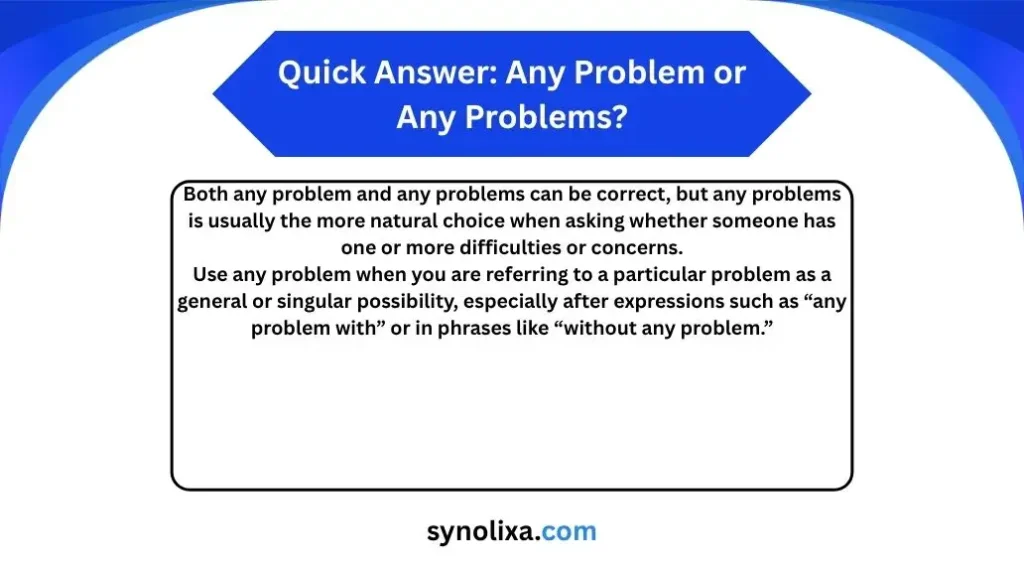
Both any problem and any problems can be correct, but any problems is usually the more natural choice when asking whether someone has one or more difficulties or concerns.
Use any problem when you are referring to a particular problem as a general or singular possibility, especially after expressions such as “any problem with” or in phrases like “without any problem.”
Examples:
- “Do you have any problems with the new system?” ✅
- “Did you have any problem finding the office?” ✅
- “Is there any problem with my application?” ✅
- “We completed the task without any problems.” ✅
The surrounding sentence tells you which form fits best.
Understanding the Basics: Any Problem or Any Problems
The easiest way to understand any problem or any problems is to look at the noun.
Problem is a countable noun. It can refer to one problem or several problems:
- one problem
- two problems
- several problems
- any problem
- any problems
The word any can work with both singular and plural countable nouns.
However, singular and plural forms can create slightly different meanings.
| Form | Type | Meaning | Example | Correct/Incorrect |
|---|---|---|---|---|
| any problem | Singular count noun | One possible problem or a general possibility | “Is there any problem with the plan?” | Correct |
| any problems | Plural count noun | One or more possible problems | “Are there any problems with the plan?” | Correct |
| any problem | Singular | Often used in fixed or specific expressions | “Call me if you have any problem.” | Correct, but context matters |
| any problems | Plural | Common when asking about difficulties or issues | “Do you have any problems?” | Correct |
| an problems | Incorrect article + plural | “An” cannot be used with a plural noun | “Do you have an problems?” | Incorrect |
| any a problem | Incorrect combination | “Any” and “a” do not normally combine this way | “Do you have any a problem?” | Incorrect |
What Does “Any Problem” Mean?
Any problem uses the singular noun problem.
It can mean a particular possible problem or one problem of any kind.
For example:
“Is there any problem with the schedule?”
Here, the speaker is asking whether there is a problem with the schedule.
Another example is:
“Let me know if you have any problem.”
This sentence can be understood, but in many everyday situations, “Let me know if you have any problems” sounds more natural.
What Does “Any Problems” Mean?
Any problems uses the plural noun problems.
It usually asks whether there are one or more difficulties, concerns, or issues.
For example:
“Are you having any problems with the software?”
The speaker is not expecting a specific number. There could be one problem, several problems, or none.
That is one reason the plural form is common in questions.
Correct Meanings and Uses
1. Use “Any Problem” for a Singular Possibility
You can use any problem when the sentence treats the problem as one possible issue.
For example:
“Is there any problem with this document?”
The structure is:
- Is there = asks whether something exists
- any = no specific amount
- problem = one possible issue
- with this document = identifies the area being discussed
This is grammatically correct.
Another example:
“If there is any problem, please contact me.”
Here, any problem means any possible issue that might occur.
2. Use “Any Problems” for One or More Difficulties
Use any problems when you are asking about possible difficulties in general.
For example:
“Did you have any problems with the assignment?”
The speaker is asking whether the person experienced one or more difficulties.
The plural is very natural because the speaker is leaving the number open.
There could have been:
- no problems
- one problem
- two problems
- several problems
The exact number is not important.
3. “Any Problem” in Negative Statements
The singular form can appear naturally in expressions such as:
“I don’t have any problem with that.”
This can be grammatically correct, although “I don’t have any problems with that” is also very common.
There can be a slight difference in emphasis.
“I don’t have any problem with that” can sound like the speaker is saying there is no objection or difficulty concerning the matter.
“I don’t have any problems with that” can sound more general and conversational.
4. “Any Problems” in Questions
The plural form is especially common in questions about difficulties.
Examples:
- “Are you having any problems?”
- “Did you have any problems?”
- “Do you see any problems?”
- “Are there any problems with the plan?”
- “Did anyone report any problems?”
These sentences ask about possible issues without specifying how many there might be.
5. “Without Any Problem” vs. “Without Any Problems”
Both forms can occur, but without any problems is often more natural when describing a task that was completed successfully.
For example:
“She finished the project without any problems.”
This means that she experienced no difficulties.
You may also hear:
“She finished the project without any problem.”
This is possible, but it can sound less natural in some contexts.
The plural form often fits because the speaker is referring broadly to possible difficulties.
Test Tip: How to Choose the Correct Form
Here is a simple test. Ask yourself:
Am I talking about one possible issue, or am I asking about difficulties in general?
If you are referring to one possible issue, any problem may fit.
If you are asking about one or more difficulties, any problems is usually natural.
Quick Test
Try these:
- “Are there ___ with the computer?”
- any problems ✅
- “Is there ___ with your account?”
- any problem ✅
- “Did you experience ___ during the trip?”
- any problems ✅
- “If there is ___, call me.”
- any problem ✅
A useful shortcut is to pay attention to the verb and sentence structure.
Case Study: Workplace Email
Imagine an employee is writing an email to a coworker.
The employee wants to ask whether the coworker experienced difficulties while using a new system.
They might write:
“Did you have any problems using the new system?”
This is natural and clear.
Why?
The writer is asking about possible difficulties. There could have been one problem or several problems. Therefore, the plural problems works well.
Now imagine a different situation.
A manager says:
“If there is any problem with the report, please let me know.”
Here, any problem is natural because the manager is referring to any possible issue that might be discovered.
The two sentences are both correct:
- “Did you have any problems with the report?”
- “If there is any problem with the report, let me know.”
The difference comes from the meaning and structure, not from one form being universally correct.
Grammar Rules: Why Does the Difference Exist?
The key grammar point is that problem is a countable noun.
A countable noun can have singular and plural forms.
For example:
- problem → problems
- question → questions
- mistake → mistakes
- issue → issues
- concern → concerns
The word any can be used with singular and plural countable nouns.
For example:
- “Is there any problem?”
- “Are there any problems?”
- “Is there any question?”
- “Are there any questions?”
The choice between singular and plural depends on the intended meaning and the structure of the sentence.
Merriam-Webster is a major American dictionary and language reference source. Its dictionary resources distinguish grammatical information such as noun forms and usage.
Singular “Problem”
A singular count noun often focuses on one item or one possible situation.
Example:
“If there is any problem, tell me.”
The speaker treats the possible issue as a singular event or condition.
Plural “Problems”
The plural form can refer to multiple possible issues or to problems generally.
Example:
“If you have any problems, tell me.”
This is also completely natural.
It leaves open the possibility of one or more problems.
Why Both Can Be Correct
English does not require any to be followed only by a plural noun.
Compare:
- “Is there any problem?”
- “Are there any problems?”
Both are grammatically possible.
The first uses a singular noun.
The second uses a plural noun.
The sentence structure and intended meaning determine the better choice.
Common Mistakes With “Any Problem or Any Problems”
Many learners make mistakes with this expression because English has several similar structures.
Mistake 1: Assuming “Any” Always Requires a Plural
Some learners think:
any + plural noun
must always be the rule.
That is not true.
You can say:
“Is there any problem?”
You can also say:
“Are there any problems?”
Both structures exist.
Mistake 2: Assuming the Singular Is Always Better
The opposite mistake also happens.
A learner may write:
“Did you have any problem?”
This is understandable, but “Did you have any problems?” is often more natural when asking about difficulties in general.
Mistake 3: Using “Any” With “A”
Do not normally combine any and a/an directly before the same noun.
Incorrect:
“Do you have any a problem?”
Correct:
“Do you have any problem?”
or:
“Do you have a problem?”
The meanings are different, but the structures are grammatical.
Mistake 4: Confusing “Problem” With “Problems”
Fast typing can cause people to forget whether the noun should be singular or plural.
For example:
“Are there any problem?”
This is incorrect because are there asks about things in the plural context, and the intended noun is normally plural.
Correct:
“Are there any problems?”
Mistake 5: Trusting Autocorrect Too Much
Autocorrect may fix spelling, but it does not always understand the intended meaning.
For example, it may not tell you whether your sentence should say:
“any problem”
or
“any problems.”
That choice depends on context.
Mistake 6: Lack of Grammar Knowledge
Some errors happen because learners memorize phrases without understanding the underlying rule.
Learning how countable nouns work makes these choices easier.
Similar Grammar Confusions
The confusion around any problem or any problems is part of a larger group of common English mistakes.
| Common Confusion | Correct Forms | Basic Difference |
|---|---|---|
| it’s / its | it’s, its | “It’s” = it is/it has; “its” shows possession |
| your / you’re | your, you’re | “Your” shows possession; “you’re” = you are |
| their / there / they’re | their, there, they’re | Possession, place, and “they are” |
| then / than | then, than | Time/order vs. comparison |
| affect / effect | affect, effect | Usually verb vs. noun, depending on context |
| advice / advise | advice, advise | Noun vs. verb |
| fewer / less | fewer, less | Countable vs. generally uncountable quantities |
| problem / problems | problem, problems | Singular vs. plural count noun |
Learning these pairs helps improve overall writing accuracy.
Usage in Different Contexts
Everyday Conversation
In casual conversation, any problems is very common.
Examples:
“Any problems?”
“Did you have any problems getting here?”
“Are you having any problems?”
These expressions sound natural because everyday conversation often asks about difficulties in a general way.
You can also use any problem:
“Is there any problem?”
This may sound more direct or specific.
Professional Writing
In professional communication, context is especially important.
For example:
“Please let me know if you have any problems accessing the file.”
This is natural and polite.
Another example:
“If there is any problem with the invoice, please contact our office.”
This focuses on a possible issue with the invoice.
Both forms can work in professional writing.
Creative Writing
Creative writing gives authors more freedom.
For example:
“He knew there was no problem he could not solve.”
Here, any problem can be used to express a broad idea.
Another example:
“She had faced any number of problems during the journey.”
This is a different construction, but it shows how English can use any with plural nouns in a broad sense.
Social Media and Texting
Informal digital communication often shortens these expressions.
You might see:
“Any problems?”
or:
“Any problem?”
Both may appear in texts.
However, “Any problems?” is often the more natural conversational question when someone is checking whether everything is okay.
In very casual texting, people may also write:
“Any issues?”
or:
“Everything okay?”
These are alternatives rather than strict replacements.
“Any Problem” vs “Any Problems” in Questions
Question structure is one of the easiest ways to understand the difference.
Singular Question
“Is there any problem?”
This asks whether one problem exists or whether there is an issue with something.
Plural Question
“Are there any problems?”
This asks whether one or more problems exist.
Notice the verb changes:
- Is there any problem?
- Are there any problems?
The singular noun goes with is there.
The plural noun goes with are there.
This agreement makes the sentence easier to understand.
“Do You Have Any Problem?” vs “Do You Have Any Problems?”
This is one of the most common searches related to this grammar topic.
“Do You Have Any Problems?”
This is generally the more natural choice when asking someone whether they have difficulties.
Example:
“Do you have any problems with the new software?”
The speaker wants to know whether the person is experiencing any difficulties.
“Do You Have Any Problem?”
This sentence is possible in certain contexts, but it is less natural for a broad question about difficulties.
If you mean a particular issue, you may prefer:
“Do you have a problem with the new software?”
That sentence asks about a specific problem or objection.
So these three sentences have slightly different uses:
- Do you have any problems? → one or more difficulties
- Do you have any problem with this? → any possible issue with this
- Do you have a problem with this? → a particular issue or objection
“Is There Any Problem?” vs “Are There Any Problems?”
These questions are both useful.
Is There Any Problem?
Use this when treating the possible issue as singular.
“Is there any problem with my application?”
The question focuses on whether there is an issue.
Are There Any Problems?
Use this when asking about possible issues in general.
“Are there any problems with my application?”
This can suggest that the application might have one or more issues.
In everyday English, both can sound natural depending on context.
Why the Difference Matters
Small grammar choices can improve communication.
1. Clarity
Choosing singular or plural helps readers understand what you mean.
Compare:
“Are there any problems?”
with:
“Is there any problem?”
The first sounds like a broad check for issues.
The second can sound more focused on one possible issue.
2. Professionalism
Correct grammar can make emails, reports, applications, and workplace messages clearer.
For example:
“Please let me know if you have any problems accessing the document.”
This sounds clear and professional.
3. Digital Communication
Online messages are often short. Because there is less context, small grammatical choices can matter.
A clear sentence reduces the chance of misunderstanding.
4. Confidence
Understanding grammar makes it easier to write without second-guessing every sentence.
As a simple writing principle:
“Clear words make clear messages.”
Good grammar supports that goal.
Special Exceptions and Edge Cases
There is no major grammatical exception that makes any problem or any problems universally correct or incorrect.
However, some fixed expressions strongly favor one form.
“Without Any Problem”
You may see:
“He completed the task without any problem.”
This is possible.
But the plural is also common:
“He completed the task without any problems.”
The plural often sounds more natural when referring to difficulties generally.
“No Problem”
The expression no problem is extremely common.
For example:
“No problem!”
“There was no problem.”
“We had no problem finding the place.”
This does not mean that any problem and any problems follow exactly the same pattern as no problem.
Learn each construction in its full sentence context.
Brand Names and Special Names
A brand, product, organization, title, or username may use unusual grammar or spelling for stylistic reasons.
If Problem or Problems appears as part of an official name, do not automatically change it according to ordinary grammar rules.
Proper names follow their official spelling.
Quick Recap Checklist
Use this checklist whenever you are unsure about any problem or any problems.
| Question | If Yes → Use |
|---|---|
| Am I talking about one possible issue? | any problem |
| Am I asking about difficulties in general? | any problems |
| Am I asking whether one or more issues exist? | Usually any problems |
| Am I using “if there is”? | any problem is often natural |
| Am I using “are there”? | any problems |
| Am I describing several possible difficulties? | any problems |
| Am I referring to a particular possible issue? | any problem |
Practice Example 1
“Are there any ___ with the computer?”
Answer:
problems ✅
Complete sentence:
“Are there any problems with the computer?”
Practice Example 2
“If there is any ___, please call me.”
Answer:
problem ✅
Complete sentence:
“If there is any problem, please call me.”
Practice Example 3
“Did you have any ___ during the trip?”
Answer:
problems ✅
Complete sentence:
“Did you have any problems during the trip?”
FAQs
1. Is “any problem” grammatically correct?
Yes. Any problem is grammatically correct when the context calls for a singular countable noun. For example, “If there is any problem, let me know” is correct.
2. Is “any problems” grammatically correct?
Yes. Any problems is correct when referring to one or more possible problems. For example, “Are there any problems with the computer?” is correct.
3. Which is more natural: “any problem” or “any problems”?
It depends on the sentence. Any problems is often more natural when asking about difficulties in general, while any problem is common when referring to a singular possible issue.
4. Should I say “Do you have any problem?” or “Do you have any problems?”
When asking generally whether someone is experiencing difficulties, “Do you have any problems?” is usually the more natural choice.
5. Is “Is there any problem?” correct?
Yes. “Is there any problem?” is grammatically correct. It asks whether there is a problem or issue. Depending on the context, “Are there any problems?” may be more natural when asking about possible difficulties in general.
6. Is “without any problem” correct?
Yes, “without any problem” can be grammatically correct. However, “without any problems” is also very common and may sound more natural when talking generally about the absence of difficulties.
Conclusion
Understanding any problem or any problems becomes easy once you remember that problem is a countable noun. The singular form any problem can describe one possible issue, especially in structures such as “If there is any problem.” The plural form any problems commonly describes one or more difficulties, especially in questions such as “Are there any problems?”
Neither form is automatically wrong. The sentence, meaning, and surrounding words determine which form sounds most natural.
When you are asking about difficulties in general, any problems is often the safer and more conversational choice. When you are referring to one possible issue, any problem may be the better fit.
So, when you see any problem or any problems, do not simply memorize one answer. Look at the meaning first, then choose the singular or plural noun that matches it.
Remember: context chooses the number. Clear grammar makes the meaning clear.

Hi, I am Clara Anderson. I work at Synolixa as a vocabulary writer, focusing on synonyms, word meanings, and easy-to-understand English learning content.
[…] examples, grammar rules, common mistakes, and practical ways to remember which word to use. 👓✨ Any Problem or Any Problems | An Hilarious or a Hilarious | Reorder or […]
[…] Understanding giving or given becomes much easier once you know what comes before each word. In this guide, we will explain the difference, grammar rules, common mistakes, real-life examples, and easy tests you can use to choose the correct form every time. 😊 Who to Contact or Whom to Contact | Bespeckled or Bespectacled | Any Problem or Any Problems […]