Have you ever typed “its self” and wondered whether it should actually be “itself”? You are not alone. This is a common spelling and grammar confusion because the phrase sounds like two separate words when we say it aloud. English has many words that combine smaller parts into one word, and itself is one of them.
The correct form in standard English is usually “itself” as one word. It is a reflexive pronoun used when the subject and object of a sentence refer to the same thing. For example, you can say, “The machine turned itself off.” Here, itself refers back to “the machine.”
The form “its self” is normally incorrect when you simply mean the reflexive pronoun. However, there are rare situations where “its self” can appear as two separate words because self is being used as a noun and its functions as a possessive word.
So, should you write its self or itself? In ordinary English, choose itself. When I Can or When Can I | Mine as Well or Might as Well or Mind as Well | To Fast or Too Fast
Quick Answer: Its Self or Itself
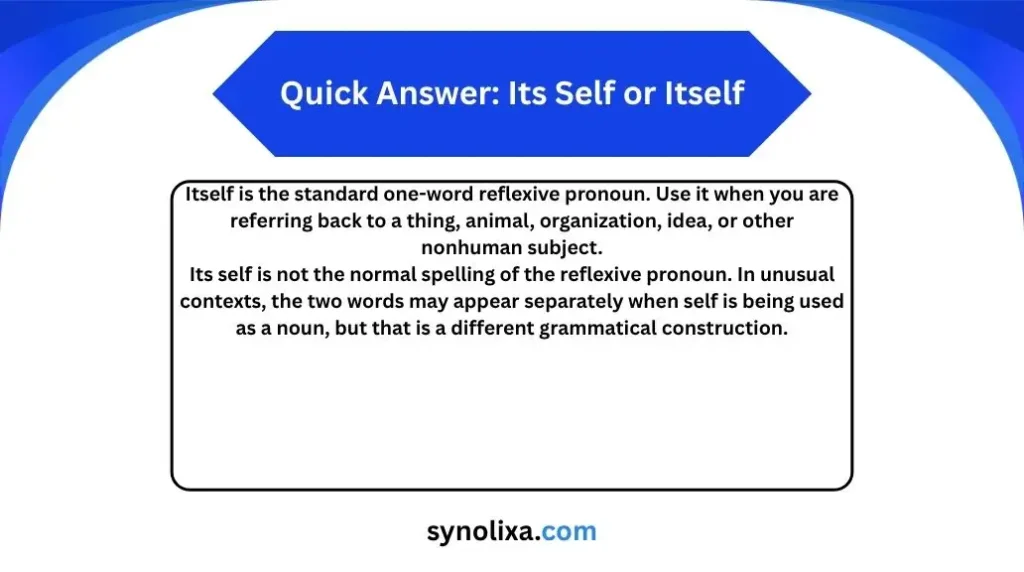
Itself is the standard one-word reflexive pronoun. Use it when you are referring back to a thing, animal, organization, idea, or other nonhuman subject.
For example:
- The dog hurt itself.
- The computer restarted itself.
- The company presented itself professionally.
Its self is not the normal spelling of the reflexive pronoun. In unusual contexts, the two words may appear separately when self is being used as a noun, but that is a different grammatical construction.
Simple rule: If you mean the reflexive pronoun, write itself.
Understanding the Basics: Its Self or Itself
The main difference between itself and its self is grammatical.
Itself is a single word. It is a reflexive pronoun and can also be used as an emphatic pronoun.
Its self consists of two separate words:
- its — a possessive form
- self — a noun
In normal sentences, you almost always need the one-word form itself.
Comparison Table
| Form | Type | Meaning | Example | Correct/Incorrect |
|---|---|---|---|---|
| itself | Reflexive pronoun | Refers back to a nonhuman subject | The cat cleaned itself. | ✅ Correct |
| itself | Emphatic pronoun | Adds emphasis | The machine itself stopped. | ✅ Correct |
| its self | Possessive + noun | Refers literally to something’s self or nature | The discussion focused on its self. | ⚠️ Rare |
| its self | Intended reflexive pronoun | Usually meant to replace “itself” | The machine repaired its self. | ❌ Incorrect |
The important point is that itself is already a complete word. You do not normally separate it and self when using the reflexive pronoun.
Correct Meanings and Uses of Itself
Itself as a Reflexive Pronoun
The most common use of itself is as a reflexive pronoun.
A reflexive pronoun refers back to the subject of a sentence.
Compare:
The robot repaired itself.
The subject is the robot.
The word itself refers back to the robot.
The basic pattern is:
Subject + verb + itself
Examples:
- The bird cleaned itself.
- The phone turned itself off.
- The door opened itself.
- The computer restarted itself.
- The company introduced itself to the new customers.
In each example, itself points back to the subject.
Itself for Animals and Things
We often use itself when the subject is an object, animal, organization, or concept that takes the pronoun it.
Examples:
- The puppy scratched itself.
- The machine shut itself down.
- The box opened itself.
- The program updated itself.
- The organization described itself as independent.
The exact choice of pronoun can depend on context. When an animal is treated as an individual with a known gender, writers may use himself or herself instead.
Itself as an Emphatic Pronoun
Itself can also add emphasis.
For example:
The building itself is beautiful.
Here, itself does not mean that the building did something to itself. Instead, it emphasizes the building.
Another example:
The problem itself is easy to solve.
The word itself emphasizes “the problem.”
This is different from:
The machine repaired itself.
In that sentence, itself receives the action and refers back to the subject.
Itself After a Preposition
You may also see itself after a preposition.
Examples include:
- The idea speaks for itself.
- The situation resolved itself.
- The problem is not important in itself.
- The document is clear in itself.
Again, the spelling remains itself.
Why “Its Self” Usually Looks Wrong
The confusion comes from the fact that itself can be understood historically as a combination of it + self.
However, modern English treats itself as a single pronoun.
The same pattern appears with other reflexive pronouns:
- myself
- yourself
- himself
- herself
- itself
- ourselves
- yourselves
- themselves
You would not normally write:
- my self ❌
- your self ❌
- her self ❌
- our selves ❌
when you mean the standard reflexive pronouns.
Instead, you write:
- myself
- yourself
- herself
- ourselves
The same principle applies to itself.
Sentence Breakdown
Consider:
The phone turned itself off.
The phone = subject
turned off = verb phrase
itself = reflexive pronoun referring to the phone
Writing:
The phone turned its self off.
would incorrectly split the standard reflexive pronoun.
Test Tip: How to Choose Itself
Try replacing the word with another reflexive pronoun.
For example:
The dog hurt itself.
Could you say:
The dog hurt himself.
if the dog is known to be male?
Yes.
That tells you the word is functioning as a reflexive pronoun.
Another quick test is to ask:
“Does the word refer back to the subject?”
If the answer is yes, itself is usually the correct form.
Easy Test
Ask:
Am I using “it + self” as a reflexive pronoun?
If yes → use itself.
Examples:
- The machine fixed itself. ✅
- The company promoted itself. ✅
- The animal protected itself. ✅
Case Study: A Workplace Email
Imagine an employee is writing an email about a software problem.
Incorrect:
The system restarted its self after the update.
Correct:
The system restarted itself after the update.
Why?
The subject is the system. The word itself refers back to that subject.
Another example:
The software can update itself automatically.
Here, itself means the software performs the action without another person manually doing it.
Professional Conversation
A manager might say:
The department will organize itself around the new workflow.
Here, itself refers back to the department.
Using its self would make the sentence look incorrect and distract the reader.
This matters in workplace writing because small spelling mistakes can make otherwise clear communication look less polished.
Grammar Rules: Why Itself Is Correct
Standard English recognizes itself as the reflexive form of it.
Merriam-Webster’s dictionary resources distinguish established English word forms and usage, and itself is the standard spelling used for the reflexive pronoun.
The grammar rule is straightforward:
Personal Pronoun → Reflexive Pronoun
| Pronoun | Reflexive Form |
|---|---|
| I | myself |
| you | yourself |
| he | himself |
| she | herself |
| it | itself |
| we | ourselves |
| they | themselves |
The reflexive form of it is therefore itself, not its self.
What About Its?
The word its is different.
Its is a possessive form.
Examples:
- The dog wagged its tail.
- The company changed its policy.
- The phone lost its connection.
- The tree lost its leaves.
Notice the difference:
The company changed its policy.
Its tells us that the policy belongs to or is associated with the company.
But:
The company introduced itself.
Itself refers back to the company.
This distinction is important.
Itself vs. Its: Do Not Confuse Them
One of the easiest ways to understand itself is to compare it with its.
Its
Its shows possession or association.
Example:
The cat moved its paw.
The paw belongs to the cat.
Itself
Itself is reflexive.
Example:
The cat cleaned itself.
The cat is both the subject and the receiver of the action.
Compare
The machine damaged its screen.
The screen belongs to the machine.
The machine damaged itself.
The machine caused damage to the machine.
The meanings are very different.
Itself vs. It’s
Another common confusion is its versus it’s.
Its
Its indicates possession.
The company changed its name.
It’s
It’s is a contraction of it is or it has.
It’s ready.
This means:
It is ready.
Another example:
It’s been repaired.
This means:
It has been repaired.
Itself
Itself is the reflexive form.
The machine repaired itself.
A useful memory trick is:
its = possession
it’s = it is / it has
itself = reflexive
Common Mistakes
Why do people write its self instead of itself?
There are several common reasons.
Fast Typing
When people type quickly, they may mentally separate the word into its + self.
This can lead to:
The device fixed its self.
instead of:
The device fixed itself.
Autocorrect
Autocorrect and predictive text can sometimes reinforce mistakes, especially when a writer pauses or changes a sentence.
It is always useful to reread important writing before sending it.
Lack of Knowledge
Some learners simply have not learned that itself is written as one word.
Once the rule is understood, the correction is easy.
Sound-Based Spelling
When people hear itself, they may imagine two words because the word contains the sounds of it and self.
English has many words whose pronunciation does not clearly reveal their written form.
Similar Grammar Confusions
The its self or itself question belongs to a larger group of common English mistakes.
| Confusion | Correct Form | Rule |
|---|---|---|
| its / it’s | its / it’s | Possession vs. contraction |
| your / you’re | your / you’re | Possession vs. “you are” |
| their / they’re | their / they’re | Possession vs. “they are” |
| there / their / they’re | Depends on meaning | Place vs. possession vs. contraction |
| your self / yourself | yourself | Reflexive pronoun |
| her self / herself | herself | Reflexive pronoun |
| our selves / ourselves | ourselves | Reflexive pronoun |
| its self / itself | itself | Standard reflexive pronoun |
Learning these patterns can make proofreading much easier.
Usage in Different Contexts
Everyday Conversation
In everyday speech, itself is common.
Examples:
- The door closed itself.
- The TV turned itself off.
- The dog hurt itself.
- The toy moves by itself.
The phrase by itself is especially common.
The computer restarted by itself.
This means the computer restarted without someone directly causing the action.
Professional Writing
Use itself in emails, reports, presentations, and workplace documents.
Examples:
The system can monitor itself for errors.
The company introduced itself to the new clients.
The process itself is relatively simple.
Professional writing benefits from using the standard spelling.
Creative Writing
Writers may use itself in descriptions, stories, and dialogue.
Examples:
The old house seemed to repair itself over time.
The forest appeared to change itself with every season.
Creative writing may use unusual expressions for style, but the ordinary reflexive pronoun remains itself.
Social Media and Texting
Informal writing may contain spelling errors, but the standard form is still itself.
Examples:
The app updated itself 😂
The phone turned itself off again.
The problem solved itself.
Even in casual writing, itself should be written as one word when it functions as the reflexive pronoun.
Common Expressions With Itself
Several common English expressions use itself.
By Itself
The machine started by itself.
Meaning: without direct human action.
In Itself
The idea is not bad in itself.
Meaning: considered on its own.
Of Itself
The situation will not change of itself.
Meaning: without outside intervention.
Itself as Emphasis
The product itself is not the problem.
Here, itself emphasizes the product.
These expressions are standard uses of itself, not its self.
Why It Matters
Using the correct form improves clarity, accuracy, and professionalism.
A sentence such as:
The program updated its self.
may still be understandable, but it does not follow standard spelling for the reflexive pronoun.
The corrected version is:
The program updated itself.
The difference is small, but correct grammar helps readers understand your writing without distraction.
As a simple principle:
“Clear writing makes the meaning easier to see.”
This is especially important in:
- School assignments
- Professional emails
- Reports
- Websites
- Blog posts
- Resumes
- Business communication
- Social media posts
A single spelling correction can make a sentence look much more polished.
Special Exception: Can “Its Self” Ever Be Used?
There is an important nuance.
Although itself is the normal reflexive pronoun, its self can theoretically appear as two separate words when self is being treated as a noun and its modifies that noun.
For example:
The philosophy examines the machine and its self as separate concepts.
Here, the writer is using self as a noun. The construction is unusual and may sound philosophical, technical, or deliberately stylized.
Another possible example is:
The character’s transformation affected its sense of self.
Notice that sense of self is a noun phrase.
However, these unusual constructions do not change the standard rule.
If you simply mean the reflexive pronoun, use:
itself
Do not use:
its self
The two-word construction should not be used as a replacement for the ordinary reflexive pronoun.
Its Self or Itself in a Sentence
Here are several examples to make the distinction clear.
Example 1
❌ The cat washed its self.
✅ The cat washed itself.
Why? The cat is the subject, and itself refers back to the cat.
Example 2
❌ The computer restarted its self.
✅ The computer restarted itself.
Why? The computer is performing the action on itself.
Example 3
❌ The organization introduced its self.
✅ The organization introduced itself.
Why? The reflexive pronoun refers back to the organization.
Example 4
❌ The door closed its self.
✅ The door closed itself.
Why? Itself is the standard reflexive form.
Example 5
✅ The problem itself is simple.
Here, itself emphasizes the problem.
Quick Recap Checklist
Use this checklist whenever you are unsure.
| Question | If Yes → Use |
|---|---|
| Does the word refer back to a thing or animal? | itself |
| Is it the reflexive form of “it”? | itself |
| Does it mean “the thing itself”? | itself |
| Does it emphasize a noun? | itself |
| Are you talking about possession? | its |
| Do you mean “it is” or “it has”? | it’s |
| Are you deliberately using “self” as a separate noun? | its self may be possible in a rare construction |
Practice Examples
Choose the correct form:
- The machine repaired ______ after detecting the problem.
- The company changed ______ website.
- The phone turned ______ off.
Answers
- itself
- its
- itself
Remember:
itself = reflexive
its = possessive
it’s = it is / it has
FAQs About Its Self or Itself
Is “its self” correct?
Usually, no. When you mean the standard reflexive pronoun, the correct form is itself, written as one word. Its self may appear in rare constructions where self is being used separately as a noun.
Is it “itself” or “its self”?
Use itself in ordinary English. For example, “The dog cleaned itself.” The two-word form is not the standard spelling of the reflexive pronoun.
What is the difference between “its” and “itself”?
Its is possessive, while itself is reflexive or emphatic. For example, “The dog wagged its tail” uses its for possession, while “The dog cleaned itself” uses itself because the action refers back to the dog.
Is “itself” one word?
Yes. Itself is normally written as one word when it functions as the reflexive pronoun or an emphatic pronoun.
Can “its self” ever be written as two words?
Yes, but only in unusual constructions where self is functioning as a separate noun. This is different from using itself as a reflexive pronoun. In ordinary sentences, use itself.
What is the easiest way to remember “itself”?
Think of the standard reflexive pronoun pattern:
myself, yourself, himself, herself, itself, ourselves, yourselves, themselves.
If you need the reflexive form of it, choose itself.
Conclusion
The difference between its self or itself is simple once you understand the grammar behind it. In normal English, itself is the correct one-word reflexive pronoun. Use it when the word refers back to a nonhuman subject, as in “The machine repaired itself” or “The dog cleaned itself.”
The word its has a different job. It shows possession, as in “The company changed its policy.” Meanwhile, it’s is a contraction meaning “it is” or “it has.” Keeping these forms separate will prevent many common grammar mistakes.
Although its self can appear in rare situations where self is deliberately used as a separate noun, it should not be used as the ordinary spelling of itself.
So, when you are asking “its self or itself?”, remember the easiest rule:
If you mean the reflexive pronoun, write “itself”—one word.
That small rule can make your writing clearer, cleaner, and more professional.

Hi, I am Clara Anderson. I work at Synolixa as a vocabulary writer, focusing on synonyms, word meanings, and easy-to-understand English learning content.
[…] terms, explain their meanings, give practical examples, and show you how to avoid common mistakes. Its Self or Itself | When I Can or When Can I | Mine as Well or Might as Well or Mind as […]