Have you ever typed “time slot” and wondered whether it should actually be written as “timeslot”? 🤔 This is a surprisingly common English question because both forms appear online, in workplace messages, scheduling apps, and everyday communication. When two words frequently appear together, it is natural to wonder whether they should eventually become one word.
The good news is that the answer is straightforward: “time slot” is the standard form to use in American English when you mean a specific period of time reserved for an activity, appointment, event, or broadcast. The two words work together as a compound noun, but they are normally written separately.
For example, you can write, “Please choose a time slot for your appointment.” You can also say, “The television program has a 9 p.m. time slot.”
What about “timeslot”? You may encounter it in informal writing, specialized contexts, or as a stylistic variation, but it is not the preferred standard spelling for general US English.
Let’s examine the difference, understand why the confusion happens, and learn exactly when to use time slot in professional, academic, conversational, and digital writing. ✍️ Sweeped vs Swept | Sell vs Sale | Homophone vs Homograph vs Homonym
Quick Answer: Time Slot or Timeslot?
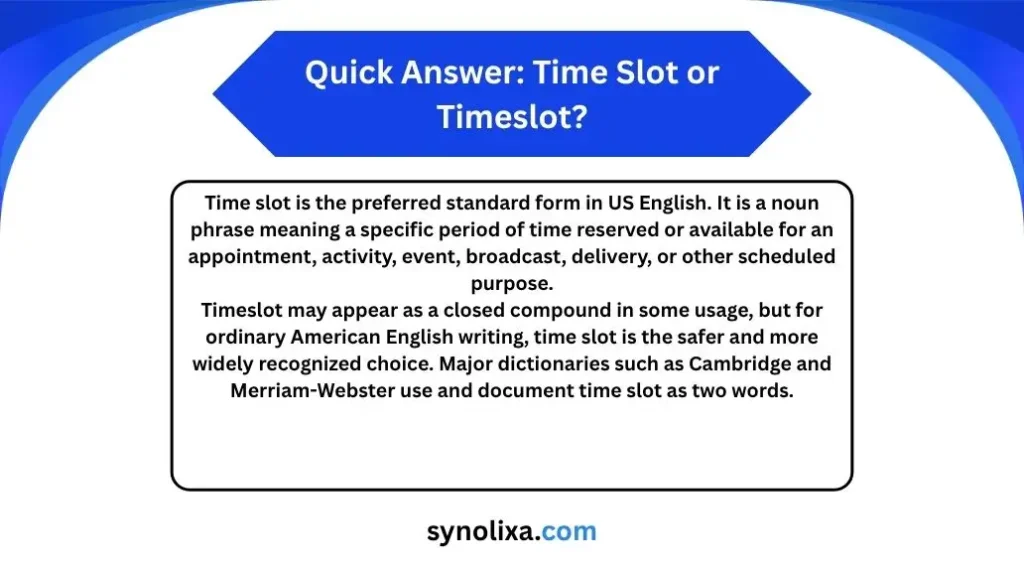
Time slot is the preferred standard form in US English. It is a noun phrase meaning a specific period of time reserved or available for an appointment, activity, event, broadcast, delivery, or other scheduled purpose.
Timeslot may appear as a closed compound in some usage, but for ordinary American English writing, time slot is the safer and more widely recognized choice. Major dictionaries such as Cambridge and Merriam-Webster use and document time slot as two words.
Correct: Please select a time slot.
Preferred: We have a 3:00 p.m. time slot available.
Usually avoid in standard US English: Please select a timeslot.
Understanding the Basics: Time Slot or Timeslot
The central issue is not meaning. Both time slot and timeslot are intended to communicate essentially the same idea: a designated or available period of time.
The main difference is spelling and standard usage.
What Does “Time Slot” Mean?
A time slot is a particular amount or period of time assigned to something.
For example:
- I booked a time slot for my dentist appointment.
- The interview is scheduled for a 30-minute time slot.
- The show airs in the 8 p.m. time slot.
- Choose an available time slot online.
- Each speaker receives a 15-minute time slot.
Cambridge Dictionary defines time slot as a time when something can happen or is planned to happen, especially when it is one of several possible times.
What About “Timeslot”?
Timeslot is a closed version of the compound. You may see it used in some online writing, software interfaces, technical discussions, or informal contexts.
However, that does not mean it is the best choice for standard American English.
When you are writing an article, business email, school assignment, professional document, website page, or formal message, time slot is the clearest choice.
Comparison Table
| Form | Type | Meaning | Example | Correct/Incorrect |
|---|---|---|---|---|
| time slot | Compound noun phrase | A designated period of time | Please choose a time slot. | ✅ Preferred |
| timeslot | Closed compound variation | A designated period of time | Choose a timeslot. | ⚠️ Less standard |
| time-slot | Hyphenated form | A time period used for a particular purpose | The time-slot arrangement changed. | ⚠️ Context-dependent |
| time | Noun | A period or point in time | What time is the meeting? | ✅ Correct |
| slot | Noun | An available position or period | I have an open slot. | ✅ Correct |
The important point is simple:
For general US English, write “time slot” as two words.
Correct Meanings & Uses of Time Slot
The expression time slot is useful because it can describe many different scheduling situations. Understanding these uses makes the spelling easier to remember.
Time Slot for an Appointment
One of the most common uses refers to an appointment.
For example:
“I booked a time slot for 10:30 a.m.”
Here is the sentence breakdown:
- I = subject
- booked = verb
- a time slot = noun phrase
- for 10:30 a.m. = tells us when the slot occurs
The phrase tells the reader that 10:30 a.m. is a designated period reserved for the appointment.
Another example:
“The clinic has several time slots available.”
The word slots is plural because more than one period is available.
Time Slot for a Meeting
Businesses frequently use time slot when arranging meetings.
Examples include:
- Do you have a time slot available tomorrow?
- I can offer you a 30-minute time slot.
- Please select a convenient time slot.
- We need to find a time slot that works for everyone.
This usage is particularly common in professional communication.
Time Slot for Television
The expression is also common in broadcasting.
For example:
“The program received a prime-time time slot.”
A television time slot is the period during which a program is scheduled to air.
Cambridge provides examples involving a show’s 9 p.m. time slot and explains that a slot can represent an amount of time officially allowed for a scheduled event.
Time Slot for Deliveries
Companies may also assign delivery windows.
For example:
“The customer selected a delivery time slot.”
This means the customer selected a specific period during which the delivery is expected.
You might see:
- morning delivery time slot
- afternoon delivery time slot
- two-hour delivery time slot
- available delivery time slot
Time Slot for Events
Events often divide their schedules into separate periods.
For example:
“Each presenter received a 20-minute time slot.”
The phrase tells us that each presenter was assigned a specific amount of time.
Time Slot for Classes
Schools, colleges, and training programs can also use this phrase.
Examples:
- The class has been moved to a later time slot.
- Students can choose a time slot for their presentations.
- The lab uses a two-hour time slot.
- Your assigned time slot begins at 9 a.m.
A Simple Test Tip
Here is an easy way to check whether you should use time slot.
Test Tip 🧠
Ask yourself:
“Am I talking about a period of time reserved for something?”
If the answer is yes, use:
time slot
For example:
“I need to schedule an interview.”
Ask:
“Do I need a designated period of time?”
Yes.
Therefore:
“I need to schedule an interview time slot.”
Even better in natural English:
“I need to schedule a time slot for the interview.”
This test works because time slot functions as a standard noun phrase for a scheduled period.
Case Study: Using Time Slot in a Real Workplace
Imagine that Sarah works as a project manager. She needs to arrange meetings with five clients.
Her scheduling system shows several available periods:
- 9:00–9:30 a.m.
- 10:00–10:30 a.m.
- 1:00–1:30 p.m.
- 3:00–3:30 p.m.
Sarah emails a client:
“Please let me know which time slot works best for you.”
This sentence is natural, professional, and grammatically clear.
The client responds:
“The 1:00 p.m. time slot works best for me.”
Notice that time slot remains two words in both sentences.
Why This Works
The phrase describes an available period reserved for a particular activity.
The structure is:
time + slot = time slot
Here, time modifies slot, while slot is the main noun.
This is similar to many other English combinations in which two words work together without necessarily becoming one word.
Grammar Rules: Why “Time Slot” Is Preferred
The key grammatical point is that time slot functions as a compound noun phrase.
A compound noun is made from two or more words that work together as a single concept. English contains many compound nouns that remain open, meaning they are written as separate words.
Examples include:
- school bus
- coffee shop
- post office
- swimming pool
- dining room
- time zone
- time slot
Some compound nouns are written as one word:
- bedroom
- notebook
- keyboard
- football
Others use a hyphen in particular contexts.
This means there is no universal rule saying that two frequently connected words must eventually become one word.
Dictionary Evidence
Cambridge Dictionary lists time slot as a noun and defines it as a time when something can happen or is planned to happen. Its examples include phrases such as a show’s 9 p.m. time slot.
Cambridge also lists time slot as a form of slot, explaining that a slot can mean an amount of time allowed for a single event or an amount of time available for an appointment or delivery.
Merriam-Webster likewise uses the plural form time slots in its example sentences, including examples involving businesses scheduling time slots and television programs occupying a time slot.
So if your goal is accurate, standard American English, time slot is the best choice.
Why Do People Write “Timeslot”?
The confusion is understandable. English regularly changes compound expressions over time.
Writers sometimes combine two related words because:
- they appear together frequently;
- typing them as one word feels faster;
- software or websites may display them differently;
- autocorrect or spell-check systems may influence the spelling;
- people assume frequent word combinations should become closed compounds;
- different industries may develop their own terminology.
This does not automatically make timeslot the preferred spelling.
English has many compounds whose spelling varies across dictionaries, industries, regions, and periods. That is why checking a reliable dictionary is more useful than assuming that a closed form is correct simply because you have seen it online.
Common Mistakes With Time Slot
The most common mistake is simply writing the expression as one word.
Mistake 1: Writing “Timeslot” Automatically
❌ Please choose a timeslot.
For general US English:
✅ Please choose a time slot.
Mistake 2: Assuming Frequent Use Means One Word
A word combination can be common without becoming a closed compound.
For example, English speakers frequently say:
- time zone
- credit card
- high school
- coffee shop
Their frequency does not mean they should automatically be combined.
Mistake 3: Trusting Autocorrect
Autocorrect can create confusion because different applications have different dictionaries.
A writing tool might accept timeslot without necessarily recommending it as the best standard form for every context.
Mistake 4: Fast Typing
When people type quickly, they often remove spaces accidentally.
For example:
timeslot
may simply be a typing habit rather than a deliberate grammatical choice.
Mistake 5: Lack of Familiarity
Someone who has never checked the dictionary entry may reasonably assume that timeslot is standard because the expression is frequently used.
That is why learning common compound nouns is useful for improving writing accuracy.
Similar Grammar and Spelling Confusions
The time slot vs. timeslot question belongs to a larger group of English word-form questions.
| Confusion | Preferred Standard Form | Why? |
|---|---|---|
| its / it’s | Depends on meaning | Possessive vs. contraction |
| your / you’re | Depends on meaning | Possessive vs. contraction |
| everyday / every day | Depends on function | Adjective vs. time expression |
| a lot / alot | a lot | “Alot” is not standard |
| all right / alright | all right in formal standard usage | Traditional standard form |
| time slot / timeslot | time slot | Standard open compound |
| online / on line | Usually online | Modern standard closed form |
| email / e-mail | email is now widely standard | Modern usage has shifted |
These examples show why spelling cannot always be predicted logically.
English is full of compounds whose forms have developed differently.
Time Slot in Different Contexts
Everyday Conversation
In everyday speech, time slot is completely natural.
You might say:
- What time slot works for you?
- I have a free time slot this afternoon.
- Can we change my time slot?
- What time slot did you book?
The expression is easy to understand and commonly used for scheduling.
Professional Writing
Professional writing strongly benefits from using the standard form.
For example:
“Please select an available time slot from the calendar.”
This sounds polished and clear.
You can use it in:
- business emails
- appointment notices
- reports
- meeting invitations
- customer-service messages
- scheduling documents
- workplace policies
Academic Writing
Students and researchers may use time slot when describing scheduled activities.
For example:
“Each participant was assigned a 15-minute time slot.”
Another example:
“The presentations were organized into three time slots.”
The phrase works well in formal academic contexts.
Creative Writing
Creative writers can also use time slot when discussing schedules.
For example:
“She had only one time slot left before sunset.”
However, creative writing may use more expressive alternatives depending on the style:
- window of time
- brief period
- scheduled period
- available hour
Social Media and Texting
On social media, people may use informal spelling freely.
Someone might write:
“Anyone know a good timeslot for tomorrow?”
Readers will probably understand the intended meaning.
However, if you are writing a professional LinkedIn post, business announcement, website page, or public-facing content, time slot is the safer standard choice.
Singular and Plural Forms
Another useful point is knowing how to make time slot plural.
Singular
time slot
Example:
“I selected a time slot.”
Plural
time slots
Example:
“Several time slots are available.”
Do not normally write:
❌ timeslots
when following the preferred standard open-compound spelling.
Use:
✅ time slots
The same principle applies to many open compound nouns.
How to Use Time Slot With Numbers
Time slot can be followed by a specific time or duration.
Specific Clock Time
- the 9 a.m. time slot
- the 2:30 p.m. time slot
- the evening time slot
- the Monday morning time slot
Example:
“The 2:30 p.m. time slot is already booked.”
Duration
You can also describe the length of the slot.
- a 15-minute time slot
- a 30-minute time slot
- a one-hour time slot
- a two-hour time slot
Example:
“Each candidate receives a 30-minute time slot.”
Natural Alternative
Sometimes you can make the sentence less repetitive by using slot alone.
Instead of:
“I have a 30-minute time slot available.”
You could say:
“I have a 30-minute slot available.”
Both can be correct. The shorter version works when the context already makes it clear that slot refers to time.
Time Slot vs. Time Window
These expressions are related but not always identical.
A time slot usually suggests a designated or allocated period.
A time window often emphasizes a range during which something can happen.
Compare:
“Choose a delivery time slot.”
This suggests that the company has designated available periods.
“Your delivery time window is 10 a.m. to noon.”
This emphasizes the range within which delivery may occur.
In many practical situations, the expressions overlap, but time slot often feels more structured or scheduled.
Time Slot vs. Appointment
These words are also related but have different meanings.
An appointment is an arranged meeting or engagement.
A time slot is the period allocated for that appointment.
For example:
“I have an appointment at 3 p.m.”
The appointment is the scheduled event.
“My appointment has a 30-minute time slot.”
The time slot describes the period assigned to the appointment.
Understanding this distinction can make scheduling language much clearer.
Why It Matters
Using the standard spelling time slot matters because clear writing makes communication easier. ✨
Clarity
When you use a familiar standard form, readers do not have to pause and wonder whether the spelling is intentional.
Professionalism
Business writing benefits from conventional spelling. A customer-facing scheduling page looks more polished when it follows standard dictionary usage.
Digital Communication
Emails, websites, forms, calendars, and booking systems depend on quick comprehension.
A simple phrase such as:
“Choose a time slot”
immediately tells the reader what action to take.
Writing Accuracy
Small spelling choices may seem insignificant, but consistent standard usage helps establish credibility.
A useful principle is:
When clarity and standard usage agree, choose the clearer standard form.
For general US English, that means time slot.
Special Exception: Is “Timeslot” Ever Used?
Yes, you may encounter timeslot as a closed compound in real-world writing.
That does not mean every occurrence is a spelling error. Language varies across industries, organizations, software products, publications, and regional usage.
Some specialized systems may use timeslot as a technical label or internal term. A company may also choose a particular spelling for branding or interface terminology.
However, this is different from asking:
“What spelling should I use in standard American English?”
For that question, time slot is the safest and most conventional answer.
When a specific organization’s style guide tells you to use timeslot, follow that organization’s established terminology. Otherwise, choose time slot.
Time Slot in Modern Digital Scheduling
The expression has become especially common as online scheduling has grown.
Today, people routinely select periods for:
- doctor appointments
- video calls
- interviews
- deliveries
- consultations
- classes
- customer support
- photography sessions
- online meetings
- exams
- event registrations
A booking website might display:
Available Time Slots
Then the user chooses one:
10:00–10:30 a.m.
This is a perfect example of how the expression functions in modern English.
Why “Time Slot” Works So Well Online
Digital scheduling requires language that is:
- short
- familiar
- specific
- easy to scan
- difficult to misunderstand
Time slot meets all of these requirements.
Examples: Correct vs. Less Standard
Here are practical examples you can use as a reference.
Scheduling an Appointment
❌ Please select your preferred timeslot.
✅ Please select your preferred time slot.
Booking a Meeting
❌ Is there another timeslot available?
✅ Is there another time slot available?
Workplace Email
❌ The 2 p.m. timeslot is no longer available.
✅ The 2 p.m. time slot is no longer available.
Television
❌ The program moved to a later timeslot.
✅ The program moved to a later time slot.
Delivery
❌ Your delivery timeslot has been confirmed.
✅ Your delivery time slot has been confirmed.
Multiple Options
❌ We have three timeslots available.
✅ We have three time slots available.
Quick Recap Checklist
Use this checklist whenever you are unsure.
| Question | If Yes → Use |
|---|---|
| Are you referring to a scheduled period of time? | time slot |
| Are you writing standard US English? | time slot |
| Are you writing a professional email? | time slot |
| Are you writing an academic assignment? | time slot |
| Are you describing an appointment period? | time slot |
| Are you describing a TV broadcasting period? | time slot |
| Is a company specifically using “timeslot” as its established terminology? | Follow that style |
| Are you simply typing informally? | time slot is still the safer choice |
Practice Example 1
Choose the correct form:
Please choose an available ______ for your interview.
Answer:
✅ time slot
Practice Example 2
We have several ______ open tomorrow morning.
Answer:
✅ time slots
Practice Example 3
The program moved to a different ______.
Answer:
✅ time slot
FAQs About Time Slot or Timeslot
Is “time slot” one word or two?
Time slot is normally written as two words. It is a standard compound noun phrase referring to a particular period of time reserved or available for an activity, appointment, event, or broadcast. Cambridge Dictionary lists time slot as two words.
Is “timeslot” grammatically correct?
Timeslot may be encountered as a closed compound, but it is not the preferred general form for standard US English. For professional, academic, and general-purpose writing, time slot is the safer choice.
What is the plural of time slot?
The standard plural is time slots.
Example:
“Several time slots are available.”
Because time slot is normally written as two words, its plural form keeps the space.
What does time slot mean?
A time slot is a particular period of time assigned or made available for something. It can refer to an appointment, meeting, delivery, class, television program, presentation, or other scheduled activity. Cambridge defines it as a time when something can happen or is planned to happen, particularly when several possible times exist.
Should I use “time slot” in a professional email?
Yes. Time slot is an appropriate and natural choice for professional emails.
For example:
“Please let me know which time slot works best for you.”
This is clear, polite, and professional.
Is “time slot” better than “time window”?
Not always. They can have slightly different meanings. Time slot usually suggests a designated period allocated to an activity, while time window often emphasizes a range during which something can occur. Choose the term that best matches your situation.
Conclusion
The answer to “time slot or timeslot?” is simple: use “time slot” as two words in standard US English. It is the conventional form for describing a designated period reserved for an appointment, meeting, delivery, television program, class, presentation, or other scheduled activity.
Although timeslot can be found in real-world usage, it is not the safest choice when you want polished, standard English. Major dictionary sources document time slot as the standard expression, and Merriam-Webster’s examples also use the two-word form.
The easiest way to remember the rule is this:
A scheduled period is a time slot—not usually a timeslot.
Whether you are writing a business email, school assignment, website, calendar invitation, or everyday message, choosing time slot keeps your writing clear, professional, and easy to understand. ✍️
When in doubt, leave the space: time slot.

Hi, I am Noah Harrison. I work at Synolixa as an English language editor, reviewing and creating helpful content to make English learning easier and clearer.
[…] the difference between at and in, choosing the right expression becomes much easier. 🏠 Time Slot or Timeslot | Sweeped vs Swept | Sell vs […]