Have you ever started writing a sentence such as “She is ___ the house” and suddenly wondered whether you should use “at the house” or “in the house”? 🤔 Both expressions are grammatically correct, but they do not always communicate the same idea. The difference is small, yet it can change the meaning of a sentence.
The key is to think about what you want to emphasize. “In the house” usually focuses on being physically inside a house or building. “At the house” usually identifies the house as a particular location or meeting point without emphasizing whether someone is physically inside it.
For example, “Tom is in the house” normally means Tom is inside the building. “Tom is at the house” can simply mean Tom is at that location, perhaps outside, in the yard, near the entrance, or somewhere on the property.
Understanding at the house or in the house becomes especially useful in everyday conversations, workplace messages, emails, storytelling, and digital communication. Once you understand the difference between at and in, choosing the right expression becomes much easier. 🏠 Time Slot or Timeslot | Sweeped vs Swept | Sell vs Sale
Quick Answer: At the House or In the House?
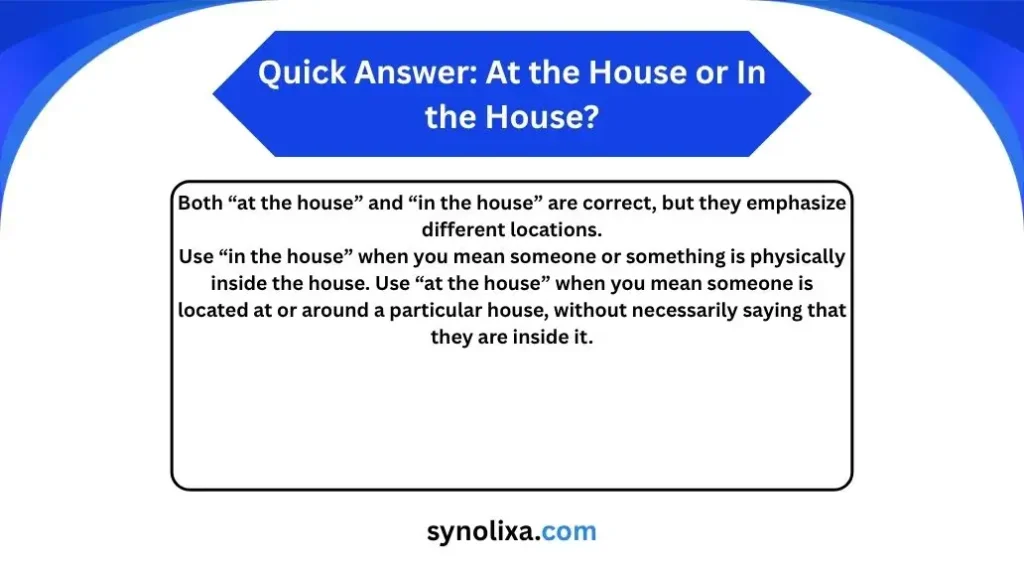
Both “at the house” and “in the house” are correct, but they emphasize different locations.
Use “in the house” when you mean someone or something is physically inside the house. Use “at the house” when you mean someone is located at or around a particular house, without necessarily saying that they are inside it.
Example:
- “Sarah is in the house.” → Sarah is inside.
- “Sarah is at the house.” → Sarah is at that location, but her exact position is not specified.
Understanding the Basics: At the House or In the House
The easiest way to understand the difference is to focus on specificity of location.
The preposition in commonly expresses inclusion or a position within limits. Merriam-Webster defines in as a word used to indicate inclusion, location, or position within limits.
The preposition at, by contrast, can indicate presence or occurrence at a particular place. Merriam-Webster gives examples such as being “at a hotel” or “at a party.”
Comparison Table
| Form | Type | Meaning | Example | Correct/Incorrect |
|---|---|---|---|---|
| at the house | Prepositional phrase | At or around a particular house/location | “We met at the house.” | ✅ Correct |
| in the house | Prepositional phrase | Physically inside the house | “The children are in the house.” | ✅ Correct |
| at house | Prepositional phrase | Intended as a location | “He is at house.” | ❌ Usually incorrect |
| in house | Prepositional phrase | Inside a house, when referring to a specific house | “She is in house.” | ❌ Usually incorrect |
| at home | Prepositional phrase | At one’s home | “I am at home.” | ✅ Correct |
| in the house | Prepositional phrase | Inside the building | “There is someone in the house.” | ✅ Correct |
The important point is that “at the house” is not wrong, and “in the house” is not automatically better. Your choice depends on the meaning you want to communicate.
When to Use “In the House”
1. Use “In the House” for Physical Interior Location
The most common use of “in the house” is to describe someone or something physically located inside a house.
For example:
- “My brother is in the house.”
- “The dog is in the house.”
- “There is a strange noise in the house.”
- “The keys are in the house.”
- “Everyone stayed in the house during the storm.”
In each sentence, the speaker is emphasizing the interior of the building.
Think of in as creating an imaginary boundary around the house. If the person or object is inside that boundary, in is often the natural choice. 🏠
2. Use “In the House” When Inside Matters
Sometimes the fact that someone is inside is important to the meaning.
Consider:
“The children are in the house, so they are safe from the rain.”
Here, in the house matters because the children are protected by being indoors.
Compare it with:
“The children are at the house.”
This second sentence only tells us their general location. They could be inside, outside, in the driveway, or in the backyard.
3. “In the House” Can Identify Something Inside
The phrase also works for objects, animals, sounds, smells, and events.
Examples:
- “There is smoke in the house.”
- “We found a spider in the house.”
- “Someone left their phone in the house.”
- “The party is happening in the house.”
- “I heard music in the house.”
The common idea is inside the physical structure.
When to Use “At the House”
1. Use “At the House” for a General Location
“At the house” treats the house as a location or destination.
For example:
“I am waiting at the house.”
This does not necessarily tell us whether the person is inside. They might be standing near the front door or waiting in the driveway.
Similarly:
“Meet me at the house at 7 p.m.”
The house functions as the meeting location.
2. Use “At the House” When the Exact Position Is Not Important
Imagine that a delivery driver says:
“I am at the house.”
The driver is communicating that they have reached the relevant property. They are not necessarily saying, “I am physically inside the building.”
This distinction is useful in everyday American English.
3. Use “At the House” for Activities Connected With a Property
You can also use at the house when talking about an event or activity occurring at that location.
Examples include:
- “We had dinner at the house.”
- “They are working at the house today.”
- “The contractor is at the house.”
- “We met at the house before going downtown.”
- “There were several guests at the house.”
The phrase gives attention to the location rather than the interior.
At the House vs In the House: The Main Difference
The easiest rule is:
At = general location
In = inside location
Consider this simple example:
“John is at the house.”
We know John is at the house.
But:
“John is in the house.”
We know John is inside the house.
This is why the two phrases cannot always be exchanged without changing the meaning.
Compare These Examples
“The children are at the house.”
This means the children are at that location. They could be inside or outside.
“The children are in the house.”
This specifically places the children inside the building.
Another example:
“The repairman is at the house.”
The repairman has arrived at the property.
“The repairman is in the house.”
The repairman is physically inside.
The difference is subtle but meaningful. 👍
Correct Meanings and Uses
“At the House” as a Destination
When the house is treated as a destination, at can be natural.
“I’ll see you at the house.”
The speaker is identifying the house as the meeting location.
“In the House” as an Interior Space
When you want to emphasize the inside area, use in.
“I’ll see you in the house.”
This suggests that both people will meet somewhere inside.
“At the House” for Property-Level Location
A person can be at the house without being in the house.
For example:
“The workers are at the house.”
They could be repairing the roof, painting the exterior, working in the garage, or landscaping the yard.
“In the House” for Interior Activities
If the activity clearly occurs inside, in is usually more precise.
“The family is eating dinner in the house.”
This tells us the family is inside.
Test Tip 📝
Ask yourself:
“Am I emphasizing the location or the inside?”
- If you mean the location/property, choose at the house.
- If you mean inside the building, choose in the house.
This simple test works in many everyday situations.
At the House or In the House in Everyday Conversation
Native speakers use both expressions naturally.
Imagine two friends talking:
“Where’s Mike?”
One friend might answer:
“He’s at the house.”
This gives a general location.
If the friend knows Mike is indoors, they might say:
“He’s in the house.”
The second answer provides more specific information.
Another conversation could be:
“Where should we meet?”
“Let’s meet at the house.”
Here, at identifies the meeting point.
But if someone says:
“Come in the house.”
The intended meaning is that the listener should enter the building. In formal Standard American English, “Come into the house” or “Come inside the house” can make the movement clearer.
Case Study: A Workplace Conversation
Imagine a construction company has sent an employee to inspect a property.
The manager calls and asks:
“Where are you?”
The employee replies:
“I’m at the house.”
This is useful because the manager mainly wants to know whether the employee has arrived at the property.
Now imagine the manager asks:
“Have you spoken with the homeowner?”
The employee replies:
“Yes. She’s in the house.”
Here, in the house is more specific. It tells the manager where the homeowner physically is.
What This Example Shows
The two phrases can appear in the same conversation because they provide different information.
- At the house → location of the property
- In the house → interior location
- At → broader location
- In → inside boundary
This distinction is especially useful in workplace communication because precise location can prevent misunderstandings.
Grammar Rules: Why “At” and “In” Are Different
Prepositions are small words, but they can express important relationships between people, objects, places, and actions. Merriam-Webster explains that prepositions can show location, direction, or time.
The preposition at commonly identifies a point, place, or location.
For example:
- “She is at the door.”
- “He is at work.”
- “They are at the station.”
- “We met at the restaurant.”
Merriam-Webster’s definition of at includes indicating presence or occurrence in, on, or near a location.
The preposition in generally emphasizes inclusion or position within something.
Examples include:
- “She is in the room.”
- “The keys are in the drawer.”
- “They are in the building.”
- “The children are in the house.”
Merriam-Webster defines in in part as indicating inclusion, location, or position within limits.
So the grammar difference is based on the relationship between the subject and the location.
“At the House” Does Not Mean “Inside the House”
This is one of the most important points.
Many learners assume:
at the house = in the house
But the expressions can communicate different levels of location.
If someone says:
“I’m at the house.”
You cannot always conclude:
“I’m inside the house.”
The person could be:
- in the driveway 🚗
- on the porch
- in the yard
- near the front door
- inside the garage
- somewhere else on the property
By contrast:
“I’m in the house.”
normally tells you that the person is inside the building.
This distinction makes in more specific when physical interior location matters.
Common Mistakes With At the House or In the House
Why do people confuse these expressions? There are several reasons.
Fast Typing
When people type quickly, they often choose the first preposition that comes to mind.
A person may type:
“I’m at the house.”
when they actually mean:
“I’m in the house.”
The sentence may still be grammatically correct, but it may not express the intended meaning.
Autocorrect
Autocorrect can also create confusion. Although modern keyboards usually recognize common prepositions, suggestions can influence what people type.
Always reread the sentence before sending an important message.
Lack of Knowledge
English learners often struggle with prepositions because there is no single translation that works in every situation.
The best approach is to learn prepositions through meaning and context, not through word-for-word translation.
Similar Grammar Confusions
| Common Confusion | Correct Forms | Main Difference |
|---|---|---|
| it’s / its | “It’s cold.” / “The dog wagged its tail.” | Contraction vs. possessive |
| your / you’re | “Your phone.” / “You’re late.” | Possession vs. “you are” |
| there / their / they’re | “There it is.” / “Their car.” / “They’re here.” | Place, possession, contraction |
| then / than | “Then we left.” / “Taller than me.” | Time vs. comparison |
| to / too / two | “Go to school.” / “Too much.” / “Two books.” | Direction, excess/addition, number |
| at / in | “At the house.” / “In the house.” | General location vs. interior location |
These mistakes are common because English contains many short words that sound similar or perform different grammatical jobs.
Usage in Different Contexts
Everyday Conversation
In casual conversation, both phrases are common.
Examples:
“I’m at the house right now.”
“I’m in the house right now.”
The first gives a broader location. The second specifically indicates that the speaker is indoors.
Professional Writing
In professional communication, choose the phrase that communicates the exact intended meaning.
For example:
“The technician is at the house and will begin the inspection shortly.”
This is appropriate when the technician has arrived at the property.
If the technician is already inside:
“The technician is in the house and is completing the inspection.”
The added precision can make professional communication clearer.
Creative Writing
Writers can use the distinction to create a stronger mental picture.
For example:
“He waited at the house until sunset.”
This leaves the reader wondering where exactly he waited.
Compare:
“He waited in the house until sunset.”
Now the reader knows he was indoors.
Creative writing often benefits from this kind of subtle distinction because location can influence mood and imagery. ✍️
Social Media and Texting
Informal messages often use shorter expressions.
Examples:
“I’m at the house. Come over!”
“I’m in the house. Knock when you get here.”
Both are natural, but the second provides a more specific physical location.
At the House or In the House With “Home”
Another important distinction is between house and home.
English commonly uses:
“I am at home.”
rather than:
“I am at the home.”
When home means one’s usual place of residence, it often behaves differently from house.
Merriam-Webster defines home as a place of residence and also lists at home as an established phrase.
For example:
- “I’m at home.”
- “She stayed at home.”
- “He came home late.”
- “They went home after dinner.”
However, when you use the noun house, the article the is normally needed when referring to a specific house:
“I’m at the house.”
“I’m in the house.”
This is an important difference for English learners.
“At Home” vs “In the House”
These expressions can overlap, but they are not identical.
At home focuses on someone’s residence or familiar place of living.
In the house focuses on physical interior location.
For example:
“I’m at home.”
This does not necessarily emphasize where you are inside your home.
You could be in the backyard and still naturally say:
“I’m at home.”
But:
“I’m in the house.”
specifically places you inside the building.
Merriam-Webster also recognizes at home as a phrase connected with being relaxed, comfortable, or familiar with something.
“At the House” vs “At Home”
Consider these sentences:
“I’m at home.”
This usually means you are at your residence.
“I’m at the house.”
This usually points to a particular house, often one that has already been identified.
For example:
“Where is the repair crew?”
“They’re at the house.”
Here, the house refers to a particular property.
But:
“Where are you?”
“I’m at home.”
Here, home refers to the speaker’s residence.
Special Exception and Edge Cases
There is no special grammatical exception that makes “at the house” or “in the house” universally correct. Both are standard expressions, and context determines which one is appropriate.
However, English has several fixed expressions involving house and home that should be learned as complete phrases.
For example:
- “at home”
- “in the house”
- “around the house”
- “outside the house”
- “near the house”
- “behind the house”
- “across from the house”
Another useful expression is “in-house.” It has a different meaning in professional English.
For example:
“The company has an in-house designer.”
Here, in-house means something is handled within an organization rather than being outsourced. It does not simply mean “inside a house.”
Similarly, “in-home” can describe something occurring in a person’s home, such as in-home services. Merriam-Webster defines in-home as occurring in one’s home.
These forms should not be confused with the ordinary location phrases in the house and at the house.
A Simple Visualization Trick
Imagine a house drawn on a piece of paper. 🏠
Now place a person:
Outside the house, near it:
→ “She is at the house.”
Inside the building:
→ “She is in the house.”
At her residence generally:
→ “She is at home.”
This mental picture can make the difference much easier to remember.
Think of at as pointing to a location:
📍 AT = location
Think of in as placing something within boundaries:
📦 IN = inside
This is not a perfect rule for every English expression, but it works extremely well for at the house or in the house.
Why This Difference Matters
Clarity in Communication
Choosing the right preposition can give your reader or listener a more accurate mental picture.
Compare:
“The children are at the house.”
with:
“The children are in the house.”
The first does not tell us exactly where they are. The second tells us they are indoors.
Professionalism
Correct preposition use makes workplace communication more polished.
Instead of sending:
“The technician is in the property.”
you might say:
“The technician is at the house.”
if you mean the technician has arrived at the property.
If the technician is physically inside, then:
“The technician is in the house.”
is clearer.
Digital Communication
Text messages are often brief, so every word can matter.
For example:
“I’m at the house.”
could mean, “I’ve arrived.”
But:
“I’m in the house.”
could mean, “I’m already indoors.”
That small preposition can prevent unnecessary follow-up questions.
A Useful Reminder
“At” identifies a place; “in” places something within it.
That simple idea can help you choose correctly in many situations.
Quick Recap Checklist
Use this checklist whenever you are unsure.
| Question | If Yes → Use |
|---|---|
| Am I talking about a general location? | at the house |
| Am I talking about being physically inside? | in the house |
| Am I identifying a meeting point? | at the house |
| Am I emphasizing the interior? | in the house |
| Am I talking about my own residence generally? | at home |
| Could the person be outside but still at the property? | at the house |
Practice Example 1
Sentence: “The kids are ___ because it is raining.”
If you mean they are indoors:
✅ The kids are in the house because it is raining.
Practice Example 2
Sentence: “I’ll meet you ___ at 6 p.m.”
If the house is the meeting location:
✅ I’ll meet you at the house at 6 p.m.
Practice Example 3
Sentence: “The dog is ___, not in the yard.”
Because the dog is physically inside:
✅ The dog is in the house, not in the yard.
FAQs
Is “at the house” grammatically correct?
Yes. “At the house” is grammatically correct when you mean someone or something is at a particular house or property. It usually gives a general location rather than specifically stating that the person is inside.
Is “in the house” grammatically correct?
Yes. “In the house” is correct when you mean someone or something is physically inside the house. It emphasizes interior location.
What is the difference between “at the house” and “in the house”?
“At the house” refers to being at or around a particular house. “In the house” specifically means being inside the building. For example, “He is at the house” does not necessarily mean he is indoors, while “He is in the house” normally does.
Which is better: “I am at the house” or “I am in the house”?
Neither is always better. Choose “I am at the house” if you want to identify the house as your general location. Choose “I am in the house” if you want to make clear that you are physically inside.
Can I say “I am at home” instead of “I am in the house”?
Yes, but the meaning is slightly different. “I am at home” focuses on being at your residence, while “I am in the house” focuses specifically on being inside the building.
Should I say “at house” or “at the house”?
For ordinary Standard American English, “at the house” is the normal form when referring to a specific house. “At house” is generally not the standard expression for this meaning.
Is “in the house” more specific than “at the house”?
Yes. “In the house” normally gives more precise physical information because it indicates an interior location. “At the house” gives a broader location.
Final Comparison: At the House or In the House
The difference can be summarized in one sentence:
Use “at the house” for the house as a location, and use “in the house” for the inside of the house.
Here are the core examples one more time:
- 📍 “We are at the house.” → We are at that location.
- 🏠 “We are in the house.” → We are physically inside.
- 📍 “Meet me at the house.” → The house is the meeting point.
- 🏠 “Meet me in the house.” → Meet me somewhere inside.
- 🏡 “I am at home.” → I am at my residence.
Once you understand the difference between location and interior space, the choice becomes much easier.
Conclusion
The choice between “at the house” and “in the house” depends on what you want to communicate. Both expressions are grammatically correct, but they serve different purposes. “At the house” usually describes a general location or a particular property. “In the house” specifically tells the reader or listener that someone or something is inside the building.
A simple memory trick is to think “at = location” and “in = inside.” So, if you are waiting outside, standing in the driveway, or simply identifying the property as your destination, “at the house” may be the better choice. If you are physically inside the building, “in the house” is usually more precise.
You can also remember that “at home” is a separate, very common expression for being at your residence. Merriam-Webster recognizes home as a place of residence and lists established uses such as at home.
Ultimately, the best preposition is the one that communicates your intended location clearly.
Remember: At points to the place; in puts you inside the place. 🏠✨

Hi, I am Clara Anderson. I work at Synolixa as a vocabulary writer, focusing on synonyms, word meanings, and easy-to-understand English learning content.
[…] practical examples, and give you simple tests to choose the correct form with confidence. 😊 At the House or In the House | Time Slot or Timeslot | Sweeped vs […]