Have you ever finished a conversation, email, or group project and paused because you were unsure whether to write “thank you both” or “thanks to both of you”? 🤔 These phrases look almost identical, but they do not always work in the same way.
The good news is that the difference is simple once you understand the grammar behind thank, thanks, and both of you. “Thank you both” is a direct expression of gratitude to two people. “Thanks to both of you” can also express gratitude, but thanks to has another important meaning: it can mean “because of” or “with the help of.” That second meaning can change the entire sentence.
For example, you can say, “Thank you both for helping me.” You can also say, “Thanks to both of you, we finished the project on time.” Both are correct, but they have slightly different structures and uses.
This guide explains the difference between thank you both or thanks to both of you, shows when to use each expression, and gives practical examples for conversations, emails, school writing, workplaces, and social media. Openned or Opened | Targetted or Targeted | Reinforce vs Reenforce
Quick Answer: Thank You Both or Thanks to Both of You?
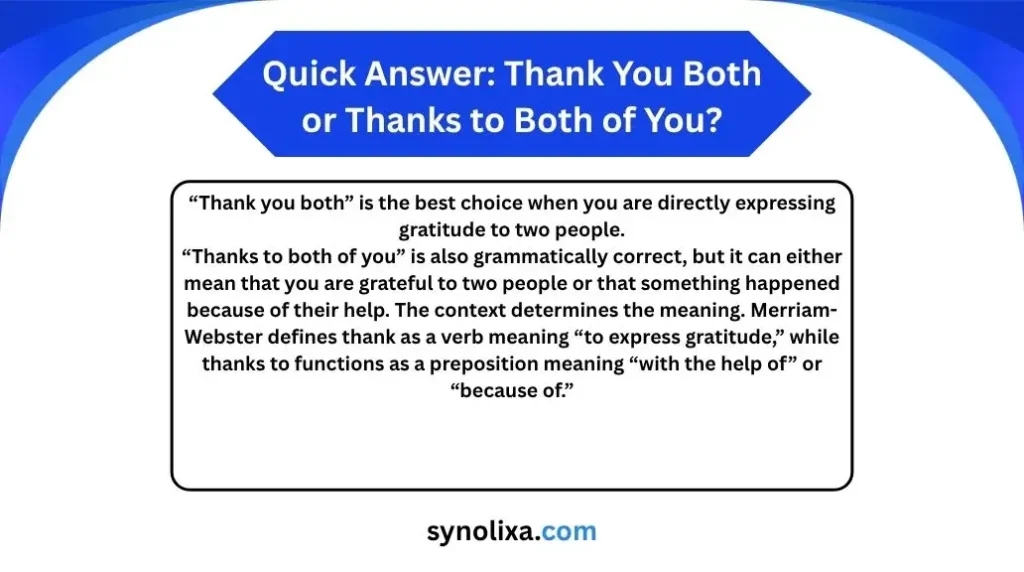
“Thank you both” is the best choice when you are directly expressing gratitude to two people.
“Thanks to both of you” is also grammatically correct, but it can either mean that you are grateful to two people or that something happened because of their help. The context determines the meaning. Merriam-Webster defines thank as a verb meaning “to express gratitude,” while thanks to functions as a preposition meaning “with the help of” or “because of.”
Simple rule
- Thank you both = I am directly thanking two people.
- Thanks to both of you = I am expressing thanks to two people, often for their contribution, or saying that a result happened because of them.
- Thank to both of you = ❌ Incorrect.
- Thanks both of you = ❌ Usually incorrect as a standard direct-thanking construction.
If you are simply speaking to two people and want to thank them, “Thank you both” is usually the clearest and most natural option.
Understanding the Basics: Thank You Both or Thanks to Both of You
The key difference comes from the words thank and thanks.
Thank is a verb. It describes the action of expressing gratitude.
Thanks is a noun used in the expression “thanks” to show gratitude. Merriam-Webster identifies thank as a verb meaning to express gratitude, while Cambridge Dictionary explains that thank you and thanks are expressions used to show that you are grateful.
The word both simply tells us that two people are included.
Comparison Table
| Form | Type | Meaning | Example | Correct/Incorrect |
|---|---|---|---|---|
| Thank you both | Verb phrase/expression | Directly thanking two people | Thank you both for your help. | ✅ Correct |
| Thanks to both of you | Noun phrase + preposition | Giving thanks to two people; sometimes because of their help | Thanks to both of you, we succeeded. | ✅ Correct |
| I thank you both | Verb phrase | A formal way to directly thank two people | I thank you both for your support. | ✅ Correct |
| Thank to both of you | Incorrect verb construction | Attempts to use thank with to | Thank to both of you for helping. | ❌ Incorrect |
| Thanks both of you | Nonstandard direct construction | Missing the normal preposition or punctuation | Thanks both of you for coming. | ❌ Usually avoid |
| Thanks, both of you | Informal expression | Directly thanking two people | Thanks, both of you, for helping! | ✅ Correct |
| Thank you to both of you | Verb + preposition construction | Thanking two people | Thank you to both of you for your kindness. | ✅ Correct |
The most important point is that “thank” and “thanks” do different grammatical jobs.
What Does “Thank You Both” Mean?
“Thank you both” is a direct expression of gratitude
When you say “Thank you both,” you are directly addressing two people and thanking them.
For example:
Thank you both for coming today.
Here is the structure:
- Thank = the verb expressing gratitude.
- you = the people receiving the thanks.
- both = identifies the two people.
The sentence means:
I am grateful to both of you for coming today.
You can add a reason after for:
- Thank you both for helping me.
- Thank you both for your advice.
- Thank you both for coming.
- Thank you both for your support.
- Thank you both for explaining everything.
Cambridge notes that thank you for can be followed by a noun or an -ing form, such as “Thank you for helping us.”
Why “both” works so naturally
Both refers specifically to two people or things. Cambridge explains that both is used to refer to two people or things together.
So:
Thank you both.
means:
Thank you, both of you.
The shorter version is often more natural in everyday English.
Examples
Example 1:
Thank you both for helping me move.
The speaker is directly thanking two people.
Example 2:
Thank you both for the thoughtful gifts.
The speaker is grateful to two people for their gifts.
Example 3:
Thank you both for staying late.
The speaker is thanking two people for staying late.
Example 4:
Thank you both. I really appreciate your help.
The first sentence gives direct thanks, while the second explains the feeling.
What Does “Thanks to Both of You” Mean?
Meaning 1: Direct gratitude
“Thanks to both of you” can mean that the speaker is giving thanks to two people.
For example:
Thanks to both of you for helping me.
This communicates gratitude.
However, in many everyday situations, “Thank you both for helping me” sounds more direct and natural.
Meaning 2: Because of both people
The phrase “thanks to” also has a different meaning.
It can mean:
because of
or:
with the help of
Merriam-Webster defines thanks to as a preposition meaning “with the help of” or “because of.”
For example:
Thanks to both of you, we finished the project early.
This does not simply mean:
I am saying thank you to you.
Instead, it emphasizes that the two people helped make the successful result possible.
The sentence could be understood as:
Because of both of you, we finished the project early.
That distinction is important.
Compare these two sentences
Sentence A:
Thank you both for helping with the project.
This is a direct thank-you.
Sentence B:
Thanks to both of you, we finished the project early.
This highlights the result and the role the two people played in achieving it.
Both sentences are correct, but the focus is different.
“Thank You Both” vs. “Thanks to Both of You”
The easiest way to remember the difference is to focus on the speaker’s intention.
Use “Thank you both” when you are speaking directly to two people
Examples:
- Thank you both for your kindness.
- Thank you both for being here.
- Thank you both for helping us.
- Thank you both for your advice.
- Thank you both for making today special.
These sentences directly express gratitude.
Use “Thanks to both of you” when you want to emphasize their contribution or a result
Examples:
- Thanks to both of you, the event went smoothly.
- Thanks to both of you, we completed the work early.
- Thanks to both of you, everything worked out.
- Thanks to both of you, the team stayed organized.
- Thanks to both of you, we found the solution.
Here, thanks to connects the two people with an outcome.
A useful contrast
Thank you both for your help.
Focus: gratitude.
Thanks to both of you, we solved the problem.
Focus: the result caused or helped by their contribution.
This small difference makes the phrases easier to choose.
Grammar Rules Behind the Expressions
Understanding the grammar makes this choice much easier.
“Thank” is a verb
Merriam-Webster defines thank as a transitive verb meaning “to express gratitude to.”
A verb can describe an action.
For example:
- I thank her.
- We thanked them.
- I want to thank you.
- Thank you.
In “Thank you both,” the expression works as a conventional polite expression of gratitude.
You do not normally insert to between thank and the people being thanked.
Therefore:
Thank you both. ✅
but:
Thank to both of you. ❌
“Thanks” is different
Thanks is used as an expression of gratitude.
For example:
Thanks for your help.
or:
Thanks to both of you.
The word to belongs naturally to the construction thanks to.
That is why these two structures should not be mixed:
Thank you both. ✅
Thanks to both of you. ✅
Thank to both of you. ❌
“Thank you to both of you” is also possible
There is another correct construction:
Thank you to both of you for your support.
This is grammatically acceptable, especially when the speaker is treating thank you as the expression being directed toward particular people.
However, if you are directly addressing the two people, the simpler form is often better:
Thank you both for your support.
Test Tip: How Can You Check Which Phrase to Use?
Try this simple test. 🧠
Test 1: Are you directly thanking two people?
If yes, use:
Thank you both.
Example:
Thank you both for coming.
Test 2: Are you explaining why something happened successfully?
If yes, thanks to both of you may be the better choice.
Example:
Thanks to both of you, we finished early.
Test 3: Can you replace “thanks to” with “because of”?
If yes, thanks to is probably being used in its causal sense.
Thanks to both of you, we finished early.
→ Because of the help of both of you, we finished early.
Test 4: Are you about to say “for” followed by an action?
Then thank you both for is usually the easiest structure.
Thank you both for helping.
Thank you both for coming.
Thank you both for explaining the problem.
Case Study: A Real-Life Workplace Example
Imagine two coworkers help a team prepare an important presentation.
After the presentation, the team leader says:
Thank you both for staying late and helping me prepare the slides.
This is a direct expression of gratitude. The leader is speaking directly to the two coworkers.
Now imagine the presentation goes extremely well. The leader tells the rest of the team:
Thanks to both of you, we were ready before the meeting started.
This sentence emphasizes the result.
What changed?
The people being thanked are still the same.
The difference is the focus:
| Sentence | Main focus |
|---|---|
| Thank you both for helping. | Direct gratitude |
| Thanks to both of you, we were ready. | Their contribution caused a good result |
This distinction is useful in emails, meetings, conversations, and written messages.
Using “Thank You Both” in Professional Writing
“Thank you both” works very well in professional communication.
For example:
Thank you both for reviewing the report.
Thank you both for your valuable feedback.
Thank you both for taking the time to meet with me.
Thank you both for your quick responses.
These sentences are polite without sounding overly formal.
In a work email
You might write:
Hi Sarah and Daniel,
Thank you both for reviewing the proposal. Your feedback helped me make several important changes.
Best,
Alex
This is clear, professional, and natural.
When “thanks to both of you” works better
Suppose a manager is describing the successful completion of a task:
Thanks to both of you, we were able to submit the report before the deadline.
Here, the phrase highlights the coworkers’ contribution to the result.
Using the Phrases in Everyday Conversation
In casual conversation, “Thank you both” is very common.
Examples:
Thank you both for coming!
Thank you both so much!
Thank you both for helping me out.
Thanks to both of you!
The shorter “Thanks” is generally more informal than “thank you.” Cambridge specifically notes that thanks is more informal than thank you.
So you can think of the expressions like this:
- Thank you both. → warm and polite
- Thanks to both of you. → appreciative, with a focus on contribution
- Thanks, both of you! → informal and friendly
Using Them in Creative Writing
Writers can use both constructions to create different effects.
Direct gratitude
“Thank you both for believing in me,” she said.
The character is directly expressing gratitude.
Emphasis on a result
Thanks to both of them, the village had enough food for the winter.
Here, the writer is emphasizing the effect of their actions.
This difference can help writers avoid repetitive language.
Instead of repeatedly writing:
Thank you both.
a writer can sometimes use:
Thanks to both of you, we finally made it happen.
The second sentence shifts attention from the feeling of gratitude to the result.
Using Them in Texting and Social Media
Digital communication is usually more relaxed, so short forms are common. 📱
Examples:
Thank you both!! ❤️
Thanks, both of you!
Thank you both for everything!
Thanks to both of you, we did it!
In texting, punctuation is often flexible. However, correct grammar still matters when you want your message to sound polished.
A useful social-media distinction
If you are tagging or addressing two people directly:
Thank you both for making this day amazing!
If you are explaining that two people helped make something possible:
Thanks to both of you, this project came together perfectly!
Both can work naturally online.
Common Mistakes
People often confuse these expressions because thank, thanks, to, and both of you appear together in several common constructions.
Mistake 1: “Thank to both of you”
❌ Thank to both of you for your help.
This is incorrect.
The problem is that thank is being incorrectly combined with to.
Use:
✅ Thank you both for your help.
or:
✅ Thanks to both of you for your help.
Mistake 2: “Thanks both of you”
❌ Thanks both of you for coming.
In standard English, this is not the usual construction for directly thanking two people.
Better choices are:
✅ Thanks, both of you, for coming.
or:
✅ Thank you both for coming.
Mistake 3: Confusing “thanks to” with simple gratitude
Consider:
Thanks to both of you, the event was successful.
This can mean that their help contributed to the success.
If you simply want to thank them directly, say:
Thank you both for helping make the event successful.
Mistake 4: Adding unnecessary words
Some writers produce complicated sentences when a simple one is clearer.
Instead of:
I would like to take this opportunity to express my sincere thanks to both of you for everything that you have done.
You can write:
Thank you both for everything you have done.
The shorter version is often clearer.
Why Do These Mistakes Happen?
Fast typing
When people type quickly, they may combine familiar expressions.
For example:
Thank you both
and:
Thanks to both of you
can blend together mentally and produce:
Thank to both of you.
Autocorrect
Autocorrect can also create unusual combinations. A person may type one phrase quickly and then accept an automatic correction without checking the entire sentence.
Lack of grammar knowledge
The biggest reason is often simple: learners may not know that thank is a verb while thanks to is a separate construction.
Once that difference is clear, the problem becomes much easier.
Similar Grammar Confusions
The confusion between “thank you both” and “thanks to both of you” is similar to many other English word-choice problems.
| Confusing Forms | Correct Usage | Main Difference |
|---|---|---|
| its / it’s | Its = possessive; it’s = it is | Apostrophe changes the meaning |
| your / you’re | Your = possessive; you’re = you are | Different grammatical roles |
| their / they’re | Their = possessive; they’re = they are | Different meanings |
| then / than | Then = time; than = comparison | Different functions |
| affect / effect | Affect is usually a verb; effect is usually a noun | Different grammatical roles |
| advice / advise | Advice = noun; advise = verb | Word class differs |
| compliment / complement | Compliment = praise; complement = complete or match | Different meanings |
| thank / thanks | Thank = verb; thanks = expression/noun | Different structures |
Learning the role of each word is often more useful than memorizing individual sentences.
Why “Thank You Both” Is Usually the Best Direct Choice
If your goal is simply to thank two people, “Thank you both” has several advantages.
It is clear
The reader immediately understands that two people are being thanked.
It is natural
Native speakers commonly use this structure in conversations and writing.
It is concise
You do not need extra words to communicate the idea.
It works in many settings
You can use it in:
- Emails
- Conversations
- Meetings
- Messages
- Speeches
- Notes
- Social media
- Everyday situations
For example:
Thank you both for your help.
This works almost anywhere.
Why “Thanks to Both of You” Can Be More Specific
Although “thank you both” is often the safest choice for direct gratitude, “thanks to both of you” can communicate an additional idea.
Consider:
Thanks to both of you, we found the missing document.
The phrase does more than express gratitude. It connects the two people’s actions with the successful result.
This is why thanks to can be especially useful when discussing:
- Achievements
- Successful projects
- Solutions
- Improvements
- Positive outcomes
- Help received
Examples
Thanks to both of you, the event ran smoothly.
Thanks to both of you, I understood the problem.
Thanks to both of you, we completed the assignment early.
In these examples, the phrase emphasizes what happened because of their help.
Why It Matters: Clarity and Professionalism
Choosing the right expression may seem like a tiny grammar issue, but small choices can make writing much clearer.
Clarity in communication
Compare:
Thank you both for helping.
with:
Thanks to both of you, we finished the task.
The first directly expresses gratitude. The second emphasizes the result.
Knowing the difference lets you communicate exactly what you mean.
Professionalism
In professional emails, small grammar mistakes can distract from your message.
A polished sentence such as:
Thank you both for your feedback.
sounds confident and professional.
Digital communication
Emails, messages, and social posts are often read quickly. Clear wording helps readers understand your meaning without stopping to interpret the sentence.
A useful reminder
Good grammar does not make a message colder; it makes the message clearer.
That is especially true for short expressions of appreciation.
Special Exception: “Thanks to” Does Not Always Mean “Thank You”
The phrase “thanks to” has an important special use.
It can mean “because of” or “with the help of.” Merriam-Webster lists this as the prepositional meaning of thanks to.
For example:
Thanks to the rain, the garden grew quickly.
Nobody is being thanked directly here.
The sentence means:
Because of the rain, the garden grew quickly.
Another example:
Thanks to careful planning, the event went well.
Again, there is no person receiving direct thanks.
This is why you should not automatically treat “thanks to” as a simple replacement for “thank you.”
Punctuation With “Thanks, Both of You”
There is another useful construction:
Thanks, both of you, for helping me.
Here, “both of you” directly addresses the two people and functions as an interruption in the sentence.
The commas help show that the phrase is being used as a direct address.
You can also avoid the more complicated punctuation by saying:
Thank you both for helping me.
This is one reason the second version is often preferable in polished writing.
Can You Say “Thank You to Both of You”?
Yes. “Thank you to both of you” can be grammatically correct.
For example:
Thank you to both of you for your support.
This is understandable and commonly used.
However, if you are speaking directly to the two people, “Thank you both” is usually more concise:
Thank you both for your support.
The choice is therefore not always about one phrase being absolutely correct and the other being wrong. Sometimes it is about choosing the most natural structure for the situation.
Can You Say “I Thank You Both”?
Yes.
I thank you both for your assistance.
This is grammatically correct, but it sounds more formal or ceremonial than ordinary conversation.
For everyday communication, most people would naturally say:
Thank you both for your help.
The shorter expression is friendly, direct, and natural.
You might see “I thank you both” in:
- Formal speeches
- Ceremonial language
- Very formal writing
- Deliberately old-fashioned or elevated prose
For normal emails and conversations, “Thank you both” is usually better.
Quick Recap Checklist
Use this table when you are unsure.
| Question | If Yes → Use |
|---|---|
| Are you directly thanking two people? | Thank you both |
| Are you thanking two people for something they did? | Thank you both for… |
| Are you emphasizing that their help caused a positive result? | Thanks to both of you… |
| Can “thanks to” be replaced with “because of”? | Thanks to… |
| Are you writing a short, friendly message? | Thank you both or Thanks, both of you |
| Are you writing a formal sentence? | Thank you both |
| Are you tempted to write “Thank to both of you”? | ❌ Don’t use it |
Practice Example 1
You want to thank two friends for helping you study.
Best answer:
Thank you both for helping me study.
Practice Example 2
Two coworkers helped you finish a project before the deadline.
Best answer:
Thanks to both of you, we finished the project early.
Practice Example 3
You are writing a short message after receiving help.
Best answer:
Thank you both! I really appreciate it.
Frequently Asked Questions
Is “thank you both” grammatically correct?
Yes. “Thank you both” is grammatically correct and is a natural way to directly express gratitude to two people.
Is “thanks to both of you” grammatically correct?
Yes. “Thanks to both of you” is grammatically correct. Depending on context, it can express gratitude or emphasize that something happened because of the two people’s help. Merriam-Webster defines thanks to as “with the help of” or “because of.”
Which is better: “thank you both” or “thanks to both of you”?
If you are simply thanking two people directly, “thank you both” is usually the clearest and most natural choice.
If you want to emphasize their contribution to a result, “thanks to both of you” may be more appropriate.
Is “thank to both of you” correct?
No. “Thank to both of you” is not standard English.
Use:
Thank you both.
or:
Thanks to both of you.
Can I say “thank you to both of you”?
Yes. “Thank you to both of you” is possible and understandable. However, “Thank you both” is usually shorter and more direct when speaking to the two people.
Is “thanks” more informal than “thank you”?
Yes. Cambridge Dictionary explains that thanks is more informal than thank you.
For example:
Thanks for your help.
is generally more casual than:
Thank you for your help.
Both are polite.
Can “thanks to” mean “because of”?
Yes. This is one of its main grammatical uses.
For example:
Thanks to your advice, I solved the problem.
This means:
Because of your advice, I solved the problem.
That meaning is different from simply saying:
Thank you for your advice.
Final Conclusion
When choosing between “thank you both” and “thanks to both of you,” focus on what you want your sentence to do. If you are directly expressing gratitude to two people, “thank you both” is usually the best and most natural choice. For example, “Thank you both for your help” clearly tells two people that you appreciate what they did.
“Thanks to both of you” is also correct, but it can have a different emphasis. It may express gratitude, or it may mean “because of both of you” or “with the help of both of you.” This makes it especially useful when describing a successful result.
Remember the simplest rule: thank you both directly thanks two people; thanks to both of you often highlights their contribution or the result of their help. And never write “thank to both of you.”
When in doubt, keep it simple: Thank you both. That short phrase is clear, correct, polite, and natural. 😊
Remember: Choose “thank you both” for direct gratitude, and “thanks to both of you” when the result matters too.

Hi, I am Ethan Parker. I work at Synolixa as a grammar and writing specialist, helping readers understand English grammar and improve their writing skills.
[…] common mistakes, practical examples, memory tricks, and answers to frequently asked questions. Thank You Both or Thanks to Both of You | Openned or Opened | Targetted or […]