Have you ever stopped while writing because you were unsure whether to use “in which” or “where”? You are not alone. Many English learners and native speakers confuse these expressions because both can refer to places, situations, and circumstances. Understanding in which vs where will help you choose the correct expression and make your writing clearer.
For example, consider these two sentences: “This is the room where we met” and “This is the room in which we met.” Both sentences are grammatically correct and communicate almost the same idea. However, they use different grammatical structures and can create slightly different tones.
The main difference is that “where” is a relative adverb commonly used to refer to a place, while “in which” combines the preposition “in” with the relative pronoun “which.” The expression “where” usually sounds more natural in everyday conversation, while “in which” often sounds more formal in academic and professional writing.
In this complete guide to in which vs where, you will learn the meanings, grammar rules, correct usage, common mistakes, and practical examples. You will also discover when these expressions are interchangeable and when another preposition is necessary. Stay in Touch or Keep in Touch | Grammar or Grammer | Say Your Peace or Say Your Piece
Quick Answer: In Which vs Where
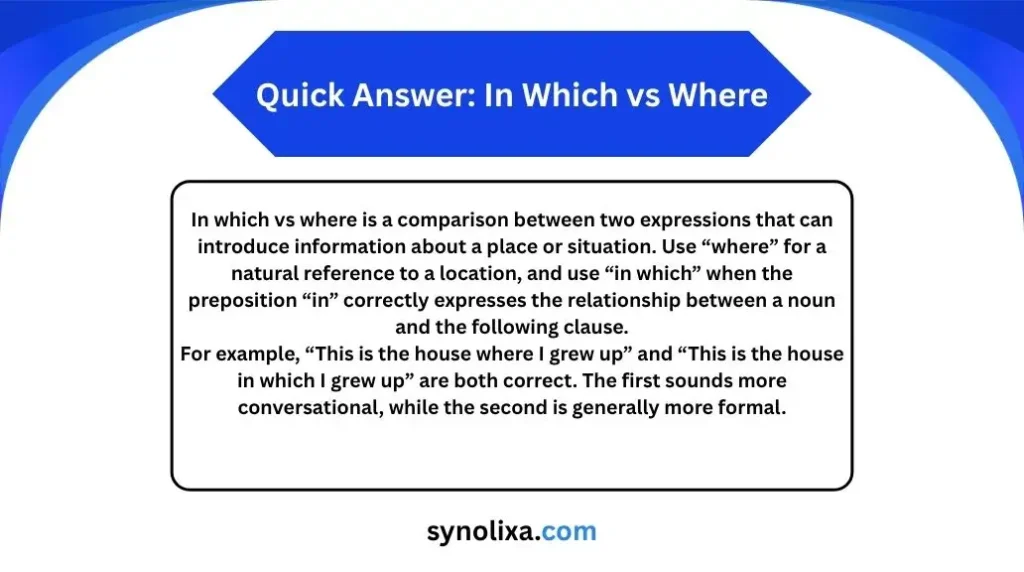
In which vs where is a comparison between two expressions that can introduce information about a place or situation. Use “where” for a natural reference to a location, and use “in which” when the preposition “in” correctly expresses the relationship between a noun and the following clause.
For example, “This is the house where I grew up” and “This is the house in which I grew up” are both correct. The first sounds more conversational, while the second is generally more formal.
Understanding the Basics of In Which vs Where
To understand in which vs where, you need to know how each expression works in a sentence. Although they can sometimes express the same meaning, they are not grammatically identical.
What Does “Where” Mean?
“Where” is commonly used as a relative adverb to introduce information about a place. It can refer to a location where an action happens or an event takes place.
Examples:
- This is the school where I studied.
- That is the park where we play soccer.
- I remember the restaurant where we had dinner.
- She returned to the town where she was born.
- This is the office where my brother works.
In each example, “where” connects a place with information about that place.
For instance, in “This is the school where I studied,” the main clause identifies the school, while the relative clause explains which school the speaker means.
“Where” can also introduce indirect questions, as in “Do you know where she lives?” In that sentence, it asks about a location rather than describing a noun.
What Does “In Which” Mean?
“In which” combines two grammatical elements:
- In: A preposition that can express location, inclusion, or a relationship.
- Which: A relative pronoun that refers to a previously mentioned noun.
Together, they introduce a clause that gives additional information about a noun.
Examples:
- This is the room in which we held the meeting.
- She opened the box in which she kept her letters.
- The building in which he works is very old.
- They discussed the situation in which the mistake occurred.
- The country in which she was born has beautiful mountains.
In the sentence “This is the room in which we held the meeting,” the phrase “in which we held the meeting” describes the room.
The expression often sounds more formal than “where,” but it is not automatically better or more correct. The preposition must match the intended meaning.
In Which vs Where: Comparison Table
| Feature | Where | In Which |
|---|---|---|
| Grammatical type | Relative adverb in place-related clauses | Preposition + relative pronoun |
| Main function | Refers to a place or setting | Expresses a relationship involving “in” |
| Meaning | At, in, or within a place, depending on context | In a place, situation, period, or other setting |
| Tone | Usually natural and direct | Often more formal |
| Common use | Conversation and general writing | Formal, academic, and professional writing |
| Example | This is the house where I live. | This is the house in which I live. |
| Correctness | Correct when the structure fits | Correct when “in” fits the intended meaning |
Both expressions are correct in many sentences about locations. The important point in in which vs where is to choose the expression that fits the sentence’s structure and meaning.
Correct Meanings and Uses of In Which vs Where
The best way to learn in which vs where is to examine how these expressions work in different situations.
1. Use “Where” for Physical Places
Use “where” when you want to identify a physical location associated with an action or event.
Examples:
- This is the library where I study.
- We visited the beach where the festival took place.
- He showed us the restaurant where he works.
- That is the house where my grandparents lived.
- The hotel where we stayed was comfortable.
Sentence breakdown:
“This is the library where I study.”
- Main clause: This is the library.
- Relative clause: where I study.
- Purpose: The relative clause identifies the library.
You could also write, “This is the library in which I study.” Both versions are correct, although the second sounds more formal.
2. Use “In Which” for Formal Writing
“In which” is useful when you want a formal and precise sentence.
Examples:
- The laboratory in which the experiment took place was secure.
- The conference room in which the interview occurred was quiet.
- The institution in which she studied has an excellent reputation.
- The apartment in which they lived needed repairs.
- The building in which the documents were stored was inspected.
Sentence breakdown:
“The laboratory in which the experiment took place was secure.”
- Main clause: The laboratory was secure.
- Relative clause: in which the experiment took place.
- Purpose: The relative clause identifies the laboratory.
The sentence could also use “where” instead of “in which.” Both expressions can work because the experiment took place inside the laboratory.
3. In Which vs Where in Everyday Conversation
In everyday English, “where” is usually the more natural choice.
Examples:
- This is where I left my phone.
- Do you remember where we parked?
- I know where she lives.
- Tell me where the meeting is.
- That is the café where we first met.
Notice that “where” does not perform exactly the same grammatical function in every example. In “That is the café where we first met,” it introduces a relative clause. In “Do you remember where we parked?” it introduces an indirect question.
Understanding this difference will help you use the word accurately.
4. In Which vs Where for Situations and Circumstances
These expressions can refer to situations as well as physical places.
Examples:
- The company faced a situation in which quick decisions were necessary.
- We reached a stage where careful planning was essential.
- She described a period in which she learned valuable lessons.
- They discussed the circumstances in which the agreement was signed.
- This is where our opinions differ.
In these examples, “in which” can describe circumstances or a period, while “where” can refer figuratively to a stage, point, or situation.
However, the best choice depends on the noun and the intended relationship. For example, “at which” may be more precise when referring to a particular point or stage.
5. In Which vs Where: Choosing the Right Preposition
One of the most important rules is that “in which” is not a universal replacement for “where.”
Consider these examples:
- The town in which she lives is beautiful.
- The town to which she traveled is beautiful.
- The town from which she came is beautiful.
- The town near which the river flows is beautiful.
Each preposition expresses a different relationship.
“In which” suggests being within a place or setting. “To which” expresses movement toward a destination. “From which” expresses origin. “Near which” expresses proximity.
You should choose the preposition based on the meaning rather than selecting the longest expression.
6. In Which vs Where: Simple Examples for Beginners
If you are learning English, start with short sentences.
| Sentence | Correct Expression | Reason |
|---|---|---|
| This is the house ___ I live. | Where / in which | Both can describe the location. |
| The box ___ I kept the keys is missing. | In which | “In” expresses the keys’ location inside the box. |
| Do you know ___ he lives? | Where | This is an indirect question. |
| The school ___ she studies is nearby. | Where / in which | Both can describe the school. |
| The city ___ we traveled was beautiful. | To which | “To” expresses movement toward the city. |
Test Tip for In Which vs Where
When deciding between these expressions, follow these steps:
- Identify the noun being described.
- Determine whether you are talking about a location, situation, or movement.
- Check whether “where” naturally expresses the intended meaning.
- If you need the preposition “in,” use “in which.”
- If another preposition is necessary, use the appropriate construction, such as “to which” or “from which.”
This simple test will help you avoid many common grammar mistakes.
In Which vs Where: A Real-Life Case Study
Imagine that Maya works for a company preparing a report about a training session. She needs to describe the location where the session took place.
She writes:
“The conference room where the training session took place was equipped with modern technology.”
Her manager suggests a more formal alternative:
“The conference room in which the training session took place was equipped with modern technology.”
Both sentences are grammatically correct. The change affects the tone, not the essential meaning.
Example of In Which vs Where in a Workplace Email
Subject: Training Session Report
Hello Team,
The training session took place in the conference room where we usually hold our weekly meetings. The room was fully equipped, and all participants had access to the required materials.
For the final report, I have included a description of the conference room in which the session was conducted.
Best regards,
Maya
What Does This Case Study Teach Us?
This example demonstrates three important lessons:
- “Where” sounds natural in everyday workplace communication.
- “In which” can suit a formal report.
- Both expressions can be correct when the grammar and meaning support them.
Professional writing does not require every sentence to sound formal. The best choice depends on the audience, purpose, and context.
In Which vs Where: Essential Grammar Rules
Understanding the grammar behind in which vs where helps you choose correctly instead of relying only on how a sentence sounds.
Rule 1: “Where” Can Introduce a Relative Clause
A relative clause gives additional information about a noun.
Example:
“This is the garden where the children play.”
The clause “where the children play” identifies the garden by explaining what happens there.
A similar sentence is:
“This is the garden in which the children play.”
Both constructions are correct because the children play within the garden.
Rule 2: “In Which” Requires the Correct Preposition
Use “in which” only when the preposition “in” expresses the intended relationship.
Correct examples:
- The box in which I stored the documents is locked.
- The country in which he was born is famous for its mountains.
- The situation in which we found ourselves was difficult.
Now compare:
“The destination to which we traveled was beautiful.”
Here, “to which” is appropriate because the sentence refers to movement toward a destination.
Using “in which” without considering the meaning can produce an awkward or incorrect sentence.
Rule 3: Avoid “In Where” in Standard English
In ordinary standard English, do not combine “in” directly with “where” in a relative clause.
Incorrect: This is the room in where we met.
Correct: This is the room where we met.
Also correct: This is the room in which we met.
The problem is not the spelling of the words. It is the grammatical construction. Choose either “where” or the appropriate preposition followed by “which.”
Rule 4: “Which” Does Not Automatically Express Location
“Which” can introduce a relative clause about a thing, but it does not always replace “where.”
Compare:
- This is the house which my uncle built.
- This is the house in which my uncle lives.
- This is the house where my uncle lives.
In the first sentence, “which” is the object of “built.” In the other two, the sentence describes the location where the uncle lives.
The sentence structure determines which expression is appropriate.
Rule 5: In Which vs Where Depends on the Intended Relationship
A noun that names a place does not automatically require “where.”
Examples:
- The city where she lives is crowded.
- The city to which she moved is crowded.
- The city from which she came is crowded.
- The city near which the highway passes is crowded.
Each sentence describes a different relationship with the city.
Grammar Authority and Standard Usage
Major dictionaries, including Merriam-Webster, document the meanings and grammatical functions of words such as “where” and “which.” Standard English grammar distinguishes relative adverbs from relative pronouns and recognizes constructions that combine prepositions with relative pronouns.
These distinctions explain why “where” and “in which” can sometimes express the same idea while remaining grammatically different.
The safest approach is to select the expression that accurately communicates the intended relationship. Clarity, sentence structure, and the requirements of the relevant style guide should also influence your choice.
In Which vs Where: Common Mistakes to Avoid
Even experienced writers sometimes confuse these expressions. The most common mistakes involve unnecessary prepositions, incorrect sentence structure, and attempts to make ordinary writing sound more formal.
Mistake 1: Using “In Where”
Incorrect: The office in where I work is downtown.
Correct: The office where I work is downtown.
Also correct: The office in which I work is downtown.
Why does this happen? Writers sometimes assume that “where” needs the preposition “in” because the sentence refers to a location.
Remember that “where” can already express the location relationship. Use “in which” if the preposition “in” is appropriate.
Mistake 2: Using “In Which” Without Checking the Meaning
Incorrect for the intended meaning: The city in which we traveled was beautiful.
Better: The city to which we traveled was beautiful.
Another natural option, depending on the intended meaning, is “The city where we traveled was beautiful.”
The problem occurs when writers use “in which” simply because they believe it is more formal than “where.”
Always identify the relationship first. Traveling to a city involves movement toward a destination, so “to which” is appropriate when describing that destination.
Mistake 3: Using “Where” When a Specific Preposition Is Needed
Consider this sentence:
“The website ___ I uploaded the document.”
Depending on the intended meaning, possible versions include:
- The website to which I uploaded the document.
- The website on which I uploaded the document.
- The website where I uploaded the document.
The first two identify a more specific relationship. The third is also common in everyday English.
For formal writing, choose the expression that most precisely conveys your meaning.
Mistake 4: Assuming “In Which” Is Always More Correct
It is incorrect to assume that “where” should never appear in academic or professional writing.
For example:
“The study examines the environment where the animals live.”
This sentence is grammatically sound. A writer may choose “in which” for stylistic reasons, but the longer expression is not automatically superior.
Good writing depends on accuracy and clarity, not unnecessary complexity.
Mistake 5: Creating an Unclear Relative Clause
Consider:
“The manager spoke to the employee in which the problem occurred.”
This sentence is unclear because “in which” appears to refer to the employee rather than the situation.
A clearer version is:
“The manager spoke to the employee about the situation in which the problem occurred.”
The relative clause must refer clearly to the intended noun.
Similar Grammar Confusions
| Confusing Forms | Correct Usage | Example |
|---|---|---|
| In which / where | Select the expression that fits the sentence. | The room where we met. |
| It’s / its | “It’s” means “it is” or “it has”; “its” shows possession. | It’s raining. The dog wagged its tail. |
| Your / you’re | “Your” shows possession; “you’re” means “you are.” | You’re holding your book. |
| There / their / they’re | Location, possession, and “they are.” | They’re leaving their bags there. |
| To / too / two | Direction, also or excessively, and the number 2. | We went to two stores, too. |
| Who / whom | Subject and object forms in formal grammar. | Who called? To whom did you speak? |
| In which / on which | Select the preposition that fits the relationship. | The room in which we met; the page on which it appears. |
Why Do These Mistakes Happen?
Several factors can cause these errors:
- Fast typing: People may overlook unnecessary words or prepositions when typing quickly.
- Autocorrect: Spell-checking tools may not detect grammatical mistakes when every word is spelled correctly.
- Lack of knowledge: Writers may understand the general meaning without knowing how relative adverbs and relative pronouns work.
- Overly formal writing: Some people believe that longer expressions always sound more professional.
- Translation habits: Translating directly from another language can lead to sentence structures that do not match standard English.
To avoid these problems, check the entire sentence instead of focusing on a single word.
In Which vs Where in Different Writing Contexts
The best choice can depend on your audience, purpose, and writing style.
1. Everyday Conversation
In everyday conversation, “where” is usually direct and natural.
Examples:
- This is the café where we met.
- Do you remember where we parked?
- That is the house where my friend lives.
- I know where she works.
“In which” is also correct in appropriate sentences, but it may sound more formal than necessary in casual speech.
2. Professional Writing
Professional writing requires clarity, accuracy, and an appropriate tone.
Examples:
- The office where the interviews took place will reopen Monday.
- The office in which the interviews took place will reopen Monday.
- The report describes the conditions in which the project was completed.
The first two examples are correct. The third uses “in which” to describe the circumstances surrounding the project.
Use the version that best suits the document. A short business email may benefit from direct language, while a formal report may use a more structured style.
3. Academic Writing
Academic writing often uses precise relative clauses to describe research settings, methods, and circumstances.
Examples:
- The laboratory in which the samples were tested followed strict safety procedures.
- The conditions in which the experiment was conducted were carefully controlled.
- The region where the study took place has a varied climate.
All three sentences are appropriate. Academic writing does not require replacing every occurrence of “where” with “in which.”
4. Creative Writing
Creative writing allows flexibility in tone and rhythm.
Examples:
- She returned to the village where she had spent her childhood.
- She returned to the village in which she had spent her childhood.
Both sentences work. The first sounds more conversational, while the second may suit a formal narrator or a deliberate literary style.
Writers should consider the character’s voice, the pace of the passage, and the atmosphere they want to create.
5. Social Media and Texting
Digital communication usually favors short, clear sentences.
Examples:
- This is where the magic happens!
- Remember where we first met?
- Here’s the place where we took those photos.
“In which” is useful when the sentence requires it, but it may sound unnecessarily formal in a casual caption.
For example, “Here is the café in which we took our first photo” is grammatically correct. However, “Here is the café where we took our first photo” sounds more natural for most social media posts.
6. Instructions and Educational Materials
Instructions should be clear and easy to follow.
Examples:
- Open the folder where you saved the file.
- Read the section in which the procedure is explained.
- Find the page on which the chart appears.
These examples show that the correct expression depends on the noun and the relationship being described.
Why In Which vs Where Matters
Choosing between in which vs where may seem like a small detail, but careful word choice helps readers understand your message.
Clarity in Communication
A sentence should tell readers exactly what you mean.
For example:
“The room where the incident happened was closed.”
This clearly identifies the location.
You could also write, “The room in which the incident happened was closed.” Both sentences communicate the same basic idea.
The goal is to use a structure that connects the relative clause to the intended noun without creating confusion.
Professionalism
Correct grammar helps readers focus on your message instead of noticing avoidable errors.
In reports, applications, emails, and presentations, selecting the appropriate relative expression can make your writing more polished.
However, professionalism does not mean using the longest possible phrase. Direct, accurate English is often the strongest choice.
Writing Accuracy
Understanding the difference between a relative adverb and a preposition-plus-relative-pronoun construction helps you build accurate sentences.
It also helps you identify errors such as “in where” and recognize when another preposition is needed.
Digital Communication
Online writing is often brief, and readers may scan it quickly. Clear sentence structure makes instructions, captions, explanations, and posts easier to understand.
Using “where” naturally or “in which” precisely can improve readability without making your message unnecessarily complicated.
A Short Quote to Remember
“Clarity is the key to effective communication.”
This simple principle applies to grammar and every other part of writing. Choose words that express your meaning accurately and make your sentences easy to understand.
In Which vs Where: Special Exceptions and Edge Cases
Although in which vs where often involves two interchangeable expressions, some situations require extra care.
1. “Where” Can Refer to an Abstract Setting
“Where” can describe more than a physical location.
Examples:
- We are at a stage where careful planning is necessary.
- She reached a point where she needed to make a decision.
- This is where our opinions differ.
These sentences use “where” figuratively to describe a stage, point, or situation.
In formal writing, alternatives such as “at which” or “in which” may be more precise, depending on the noun.
For example:
“She reached a point at which she needed to make a decision.”
This is a formal alternative to “She reached a point where she needed to make a decision.”
2. “In Which” Can Refer to a Period or Situation
Examples:
- The decade in which the building was constructed was economically difficult.
- The circumstances in which the decision was made remain unclear.
- The process in which the participants were involved took several months.
In these examples, “in which” introduces information about a period, circumstances, or process.
The correct preposition depends on the meaning of the full sentence.
3. “Where” Can Appear in Indirect Questions
Consider:
“I know where the keys are.”
Here, “where” introduces an indirect question. It does not describe a noun in the same way as the relative clause in “This is the drawer where I keep the keys.”
Another example is:
“Can you tell me where the station is?”
You cannot simply replace “where” with “in which” in these sentences without changing the grammatical structure.
4. Website and Brand References
Modern English often uses “where” to refer to websites, platforms, and online spaces.
Examples:
- This is the website where I found the article.
- That is the platform where the discussion took place.
These constructions are common in contemporary English.
In more formal or technical writing, a writer may choose “on which” when the intended relationship is specifically that something appears or happens on a platform.
For example:
“This is the website on which the article was published.”
Both forms may be acceptable, depending on context and style.
5. In Which vs Where: The Importance of Meaning
Consider these three sentences:
- The room where we met was bright.
- The room in which we met was bright.
- The room through which we walked was bright.
The first two describe the meeting location. The third describes a room that people walked through.
The preposition changes the relationship. This is one of the most important principles for choosing between in which vs where.
In Which vs Where: Quick Recap Checklist
Use this table whenever you are unsure which expression belongs in your sentence.
| Question | If Yes → Use |
|---|---|
| Are you referring to a place in a natural, direct way? | Where |
| Do you need the specific preposition “in” before “which”? | In which |
| Are you writing a formal sentence about a place or situation? | In which, when “in” fits the meaning |
| Does the sentence require another preposition, such as “to” or “from”? | To which or from which |
| Have you written “in where” in an ordinary relative clause? | Revise to “where” or “in which” |
| Are you asking an indirect question about a location? | Where |
Practice Examples for In Which vs Where
Choose the correct expression for each sentence. In some cases, both options may be correct.
1. This is the restaurant ___ we celebrated my birthday.
- A. where
- B. in where
Correct answer: A. where
Explanation: “Where” naturally introduces the location. “In where” is not standard in this construction. You could also write, “This is the restaurant in which we celebrated my birthday.”
2. The conditions ___ the experiment took place were unusual.
- A. in which
- B. in where
Correct answer: A. in which
Explanation: “In which” is a standard way to introduce a relative clause describing the conditions.
3. Do you know ___ the meeting will be held?
- A. where
- B. in which
Correct answer: A. where
Explanation: This is an indirect question about a location, so “where” is the appropriate choice.
4. The destination ___ we traveled was beautiful.
- A. in which
- B. to which
Correct answer: B. to which
Explanation: “To which” expresses movement toward the destination.
5. This is the room ___ we held the interview.
- A. where
- B. in which
Correct answer: Both A and B
Explanation: Both expressions are correct because the interview took place in the room.
Final Self-Check
Before submitting an email, report, essay, or article, ask yourself:
- Does the expression communicate the intended location or relationship?
- Have I used the correct preposition?
- Does the relative clause refer to the correct noun?
- Would a simpler expression make the sentence easier to understand?
- Have I avoided unnecessary combinations such as “in where”?
If you can answer these questions confidently, you are much less likely to make mistakes.
FAQs
1. What is the main difference between in which and where?
“Where” is a relative adverb commonly used to refer to a place. “In which” combines the preposition “in” with the relative pronoun “which.” Both can refer to the same place when the sentence structure allows it, but “in which” often sounds more formal.
2. Are in which and where interchangeable?
Sometimes. For example, “The room where we met” and “The room in which we met” are both correct. However, they are not interchangeable in every context because “in which” requires the preposition “in” to match the intended meaning.
3. Is “in where” grammatically correct?
“In where” is generally incorrect in ordinary standard English when used to introduce a relative clause about a place. Write “where” or “in which” instead.
Incorrect: This is the office in where I work.
Correct: This is the office where I work.
Also correct: This is the office in which I work.
4. Is “in which” more formal than “where”?
Yes. “In which” often sounds more formal, especially in academic and professional writing. However, “where” is also appropriate in formal writing when it clearly expresses the intended meaning. Choose the expression that best fits your sentence and audience.
5. Can I use “where” for situations instead of places?
Yes. In modern English, “where” can refer figuratively to a situation, stage, or point. For example, “We reached a point where a decision was necessary.” In more formal writing, “at which” or “in which” may be preferable when it accurately expresses the intended relationship.
6. How do I know whether to use “where” or “in which”?
First, identify the noun or idea you are describing. If “where” naturally expresses the intended location, you can usually use it. If the sentence requires the preposition “in,” use “in which.” If another preposition is needed, choose a construction such as “to which,” “from which,” or “on which.”
Conclusion
Understanding in which vs where helps you write accurate, natural, and professional English. Although these expressions can communicate the same idea in many sentences, they have different grammatical structures. “Where” is a relative adverb commonly used to refer to a place or setting, while “in which” combines a preposition with a relative pronoun.
Use “where” when you want a clear, direct, and natural expression. Choose “in which” when the preposition “in” accurately describes the relationship and a more formal structure suits your writing. Remember that “in which” is not a universal replacement for “where,” and you should avoid using “in where” in ordinary standard English.
The most reliable strategy is to understand the meaning of the sentence, select the appropriate preposition, and make sure the relative clause clearly refers to the correct noun. With practice, you will recognize the right structure more easily.
Final takeaway: Good grammar is not about choosing the longest expression. It is about choosing the clearest and most accurate one.

Hi, I am Noah Harrison. I work at Synolixa as an English language editor, reviewing and creating helpful content to make English learning easier and clearer.


[…] rules, explore practical examples, and discover how to choose the right form for your audience. In Which vs Where | Stay in Touch or Keep in Touch | Grammar or […]