Have you ever typed “heard,” “herd,” or “hurd” and suddenly wondered which spelling is correct? You are not alone. This guide to heard vs herd vs hurd explains the differences between these commonly confused words. Heard and herd sound almost identical in standard American English, while hurd looks like it could be another spelling of the same word. However, they do not have the same meaning or grammatical use.
The key difference is simple: heard is the past tense and past participle of the verb hear, while herd is a noun or verb related to a group of animals or the act of gathering or guiding them. Hurd is generally not a standard English word used as an ordinary replacement for either heard or herd.
This guide explains heard vs herd vs hurd in simple terms. You will learn their meanings, pronunciation, grammatical roles, common mistakes, examples, and practical ways to remember the difference. Whether you are writing an email, completing schoolwork, posting online, or having a conversation, understanding these words will help you choose the correct spelling with confidence. ✍️ As Evidenced By or As Evident By | Envolved or Involved | Introduction to or Introduction of
Quick Answer: Heard vs Herd vs Hurd
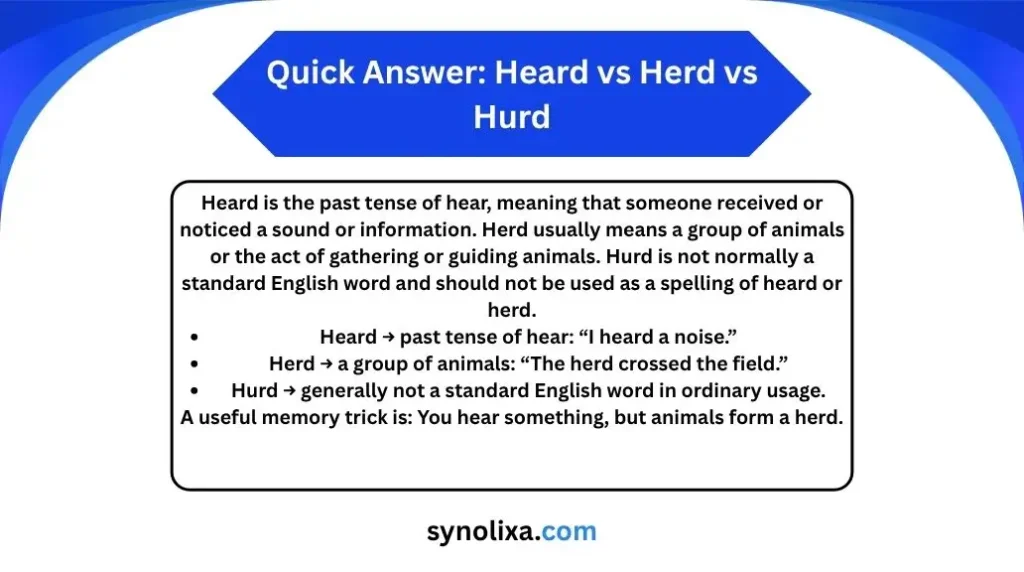
Heard is the past tense of hear, meaning that someone received or noticed a sound or information. Herd usually means a group of animals or the act of gathering or guiding animals. Hurd is not normally a standard English word and should not be used as a spelling of heard or herd.
- Heard → past tense of hear: “I heard a noise.”
- Herd → a group of animals: “The herd crossed the field.”
- Hurd → generally not a standard English word in ordinary usage.
A useful memory trick is: You hear something, but animals form a herd.
Understanding the Basics: Heard vs Herd vs Hurd
The easiest way to understand heard vs herd vs hurd is to focus on meaning rather than pronunciation.
Basic Comparison Table
| Form | Type | Meaning | Example | Correct/Incorrect |
|---|---|---|---|---|
| heard | Verb | Past tense/past participle of hear | “I heard your message.” | ✅ Correct |
| herd | Noun | A group of animals | “A herd of cattle moved across the field.” | ✅ Correct |
| herd | Verb | To gather, drive, or guide a group | “The farmer herded the sheep.” | ✅ Correct |
| hurd | Usually not a standard common English word | Not a normal replacement for heard or herd | “I hurd the announcement.” | ❌ Incorrect |
| hurd | Proper name/surname in some contexts | May appear as a name | “Mr. Hurd attended the meeting.” | ⚠️ Context-dependent |
The biggest mistake is treating heard, herd, and hurd as interchangeable spellings. They are not.
Heard: Connected to Hearing
Heard is the past tense and past participle of hear.
The verb hear means to perceive a sound or receive information through listening.
Examples:
- “I heard a strange sound.”
- “She heard the news yesterday.”
- “We heard the announcement.”
- “Have you heard about the new schedule?”
In each example, heard is connected to listening, sounds, or information.
Herd: Connected to Animals or Groups
Herd has a completely different meaning.
As a noun, a herd is a group of animals, especially animals such as cattle, elephants, deer, or sheep.
Examples:
- “The herd of cattle moved slowly.”
- “We saw a herd of elephants.”
- “A large herd of deer crossed the road.”
As a verb, herd means to gather, drive, or guide a group.
Example:
- “The farmer herded the sheep into the pen.”
Hurd: Usually Not the Word You Want
For ordinary English writing, hurd is not the correct spelling of heard or herd.
If you mean that someone listened to or received a sound, use heard.
❌ “I hurd the announcement.”
✅ “I heard the announcement.”
If you mean a group of animals, use herd.
❌ “The hurd crossed the field.”
✅ “The herd crossed the field.”
However, Hurd can appear as a proper name or surname. In that situation, it is capitalized and functions as a name rather than as the ordinary English word heard or herd.
What Does “Heard” Mean?
Heard is the past tense and past participle of hear.
The basic forms are:
- Present: hear
- Past: heard
- Past participle: heard
For example:
- Present: “I hear music.”
- Past: “I heard music.”
- Perfect: “I have heard that song before.”
Heard as the Past Tense of Hear
When something happened in the past, heard can describe the action.
Example:
“I heard a loud noise last night.”
The sentence means that the person perceived a sound in the past.
Another example:
“She heard someone calling her name.”
Here, heard tells us that she perceived the sound of someone calling her.
Heard Can Also Mean Receiving Information
You do not have to physically hear a sound for heard to be correct.
It can also describe receiving information.
For example:
“I heard that the meeting was canceled.”
This means the speaker received information about the canceled meeting.
Similarly:
“Have you heard the news?”
Here, heard means “have you received or learned this information?”
Sentence Breakdown
Consider:
“I heard your message.”
- I = subject
- heard = past-tense verb
- your message = object
The word heard tells us that the person received the message through hearing or listening.
Test Tip
Ask yourself:
“Am I talking about listening, sound, or receiving information?”
If the answer is yes, heard is probably the word you need.
For example:
“I ___ the announcement.”
Are you talking about receiving an announcement?
Yes.
Therefore:
“I heard the announcement.”
What Does “Herd” Mean?
Herd is most commonly used for a group of animals.
Herd as a Noun
As a noun, herd refers to a group of animals that live, move, or feed together.
Examples include:
- a herd of cattle
- a herd of deer
- a herd of elephants
- a herd of buffalo
- a herd of horses
Example:
“The herd moved toward the water.”
Here, herd is the subject of the sentence.
Herd as a Verb
Herd can also function as a verb.
It means to gather, direct, or move a group.
Example:
“The farmer herded the cattle into the barn.”
In this sentence, herded is the past tense of the verb herd.
Another example:
“The guide herded the children toward the bus.”
The word does not necessarily have to refer to animals when used as a verb. It can sometimes describe moving a group of people together.
Common Expressions With Herd
One well-known expression is:
“Follow the herd.”
This means to follow what most other people are doing instead of making an independent choice.
Another expression is:
“The herd mentality.”
This describes a tendency for people to behave like others in a group.
Test Tip
Ask:
“Am I talking about a group of animals or moving a group together?”
If yes, herd is likely correct.
For example:
“The ___ of cattle entered the field.”
The answer is:
“The herd of cattle entered the field.”
What Does “Hurd” Mean?
This is where many learners become confused.
In normal modern English, hurd is not a standard spelling for the past tense of hear, nor is it the normal spelling for a group of animals.
Therefore:
- ❌ “I hurd the song.”
- ✅ “I heard the song.”
And:
- ❌ “The hurd of cattle moved away.”
- ✅ “The herd of cattle moved away.”
Why Might You See “Hurd”?
You may encounter Hurd as a surname or proper name.
For example, a person’s last name may be Hurd. In that case, it should be treated as a name, not as a normal vocabulary word.
This distinction is important because a word that appears as a name does not automatically become a standard alternative spelling for another English word.
The Simple Rule
If you are writing a normal sentence and you are unsure whether to use heard, herd, or hurd, remember:
Hearing → heard
Animals/group → herd
Ordinary English replacement → not hurd
Heard vs Herd: Why Do They Sound the Same?
One reason heard vs herd causes so many mistakes is pronunciation.
In standard American English, heard and herd are commonly pronounced alike or extremely similarly. They are therefore homophones in many varieties of English.
A homophone is a word that sounds the same as another word but has a different meaning or spelling.
Other familiar examples include:
- to / too / two
- there / their / they’re
- your / you’re
- right / write
- hear / here
English spelling does not always perfectly predict pronunciation. Merriam-Webster’s pronunciation guidance notes that English has many mismatches between spelling and sound, which helps explain why words that sound alike can have very different spellings.
This is why listening alone cannot always tell you which spelling to use.
A Simple Memory Trick
Think of these two sentences:
“I heard the animals.”
and
“I saw the herd.”
Heard = hearing
Herd = animals
The different meanings determine the spelling.
Correct Meanings and Uses of Heard
Let’s look at several common situations where heard is correct.
Talking About a Sound
“I heard a strange noise.”
Use heard because the sentence describes something perceived through hearing.
Talking About Music
“I heard that song yesterday.”
The speaker listened to the song in the past.
Talking About News
“I heard the good news.”
The speaker received the information.
Talking About Someone Speaking
“I heard Sarah explain the problem.”
The person listened to Sarah explaining something.
Using Heard in the Present Perfect
“I have heard that story before.”
Here, heard is the past participle of hear.
Using Heard in Questions
“Have you heard about the new project?”
This asks whether the listener has received the information.
Correct Meanings and Uses of Herd
Now consider situations where herd is correct.
A Group of Cattle
“The herd of cattle was resting.”
Herd is a noun referring to the group.
A Group of Deer
“We watched a herd of deer from a distance.”
Again, herd identifies a group of animals.
Moving Animals
“The farmer herded the cows toward the barn.”
Here, herded is a verb.
Moving People as a Group
“The staff herded everyone toward the exit.”
Here, herded is used figuratively to describe moving people together.
Herd as a Figurative Noun
“He did not want to follow the herd.”
The sentence does not necessarily mean actual animals. The herd can represent the majority or a group whose behavior someone follows.
Heard vs Herd in Everyday Sentences
Here are some side-by-side examples:
| Sentence | Correct Word | Why? |
|---|---|---|
| “I ___ a noise.” | heard | The sentence is about sound. |
| “The ___ crossed the field.” | herd | The sentence is about a group of animals. |
| “Have you ___ the news?” | heard | It means received information. |
| “The farmer moved the ___.” | herd | It refers to animals. |
| “I ___ someone outside.” | heard | It describes hearing. |
| “The ___ of elephants was enormous.” | herd | It refers to a group of elephants. |
The context makes the correct spelling clear.
Case Study: A Workplace Conversation
Imagine an employee sends this message:
“I hurd that the meeting was moved to Friday.”
The meaning is understandable, but the spelling is incorrect in standard English.
The corrected sentence is:
“I heard that the meeting was moved to Friday.”
Why?
Because the employee means that they received information about the meeting.
Now imagine a different message:
“The herd of cattle was moved to a different field.”
Here, herd is correct because the sentence refers to a group of cattle.
Workplace Lesson
In professional writing, spelling mistakes can make a message look rushed or careless. A simple error such as hurd instead of heard may distract the reader even when the intended meaning is obvious.
Before sending an email, quickly check whether you are talking about:
- hearing information → heard
- a group of animals → herd
Grammar Rules: Heard vs Herd vs Hurd
The grammar behind these words is straightforward.
Rule 1: Heard Is a Verb Form
Heard comes from the irregular verb hear.
The verb changes from:
hear → heard
It does not become heared.
Examples:
- “I hear music.”
- “I heard music.”
- “I have heard music.”
Rule 2: Herd Is a Separate Word
Herd is not a form of hear.
It is an independent word that can be a noun or verb.
As a noun:
“The herd is moving.”
As a verb:
“They herd the cattle.”
As a past-tense verb:
“They herded the cattle.”
Rule 3: Hurd Is Not the Standard Choice
Hurd should not be used as a spelling substitute for either word in ordinary English.
Writing:
“I hurd the announcement.”
is incorrect.
Writing:
“The hurd entered the field.”
is also incorrect when you mean a group of animals.
Dictionary Authority
Standard dictionaries distinguish words based on spelling, pronunciation, meaning, and grammatical function. Merriam-Webster’s pronunciation resources also explain that English has many cases where spelling and pronunciation do not line up neatly.
That is exactly what makes heard and herd easy to confuse: their sounds can be the same even though their meanings and spellings are different.
Common Mistakes With Heard, Herd, and Hurd
Why do people make these mistakes?
1. Fast Typing
When people type quickly, they may spell words based on sound instead of checking the actual spelling.
Someone may think:
“It sounds like ‘hurd,’ so I will type hurd.”
But English spelling does not always work that way.
2. Autocorrect
Autocorrect can sometimes create confusion, especially when a person types quickly or uses unusual names.
A proper name such as Hurd may also appear in contexts where a normal word would be expected.
3. Lack of Vocabulary Knowledge
If someone has never clearly learned the difference between heard and herd, the words can seem interchangeable.
4. Homophone Confusion
Because heard and herd sound alike, learners may remember the pronunciation but forget which spelling matches which meaning.
Common Grammar Confusions
| Confusing Words | Correct Difference |
|---|---|
| heard / herd | Hearing vs. group of animals |
| your / you’re | Possession vs. “you are” |
| its / it’s | Possession vs. “it is” |
| there / their / they’re | Place vs. possession vs. “they are” |
| to / too / two | Direction/infinitive vs. also/excessively vs. number |
| right / write | Correct direction/side vs. putting words on paper |
| hear / here | Perceive sound vs. location |
| weather / whether | Atmospheric conditions vs. choice/possibility |
The pattern is important: sound does not always determine spelling.
Usage in Different Contexts
Everyday Conversation
In everyday speech, people usually do not notice the difference between heard and herd because they rely on context.
For example:
“I heard something outside.”
Everyone understands that the sentence is about sound.
But in writing, the spelling matters.
Professional Writing
Professional communication requires greater attention to spelling and word choice.
Correct:
“I heard that the deadline has changed.”
Incorrect:
“I hurd that the deadline has changed.”
If you are writing an email, report, application, or workplace message, always use heard when discussing information or sounds.
Creative Writing
Creative writers may use heard and herd in vivid descriptions.
For example:
“She heard the distant thunder.”
And:
“The herd moved silently across the valley.”
The two words can appear close together in a story because they describe completely different things.
Social Media and Texting
Informal texting often contains spelling shortcuts and mistakes. However, using the correct word can still make your posts easier to understand.
For example:
“I heard this song yesterday 🎵”
is correct.
“The herd looked amazing 🐘”
is correct when referring to animals.
Avoid using hurd unless it is intentionally being used as a proper name or another specific context requires it.
Why the Difference Matters
You might wonder: If everyone understands what I mean, why does spelling matter?
The answer is clarity.
Correct word choice helps readers understand your meaning immediately.
1. Clarity in Communication
Compare:
“I heard the news.”
with:
“I hurd the news.”
The first sentence is immediately recognized as standard English. The second makes the reader stop and wonder whether the spelling is intentional.
2. Professionalism
Correct spelling can make emails, applications, school assignments, and reports look more polished.
3. Digital Communication
Online writing moves quickly. Messages are often short, and context can be limited. Correct spelling helps prevent unnecessary confusion.
4. Better Writing Habits
Learning one homophone pair at a time can significantly improve writing accuracy.
“When sound is the same, let meaning choose the spelling.”
That is a useful rule to remember.
Special Exceptions: When “Hurd” May Be Correct
There is one important edge case.
Hurd can appear as a proper name or surname.
For example, if someone’s family name is Hurd, you would preserve the spelling:
“Mr. Hurd joined the meeting.”
In that sentence, Hurd is a name.
It is not being used as a substitute for heard.
Similarly, names of businesses, organizations, places, or other entities may use unusual spellings. Proper names follow their established spelling and should not automatically be corrected to a more common English word.
So the rule is not:
“Hurd can never appear.”
The better rule is:
“Hurd is not the standard ordinary-English spelling of heard or herd.”
That distinction keeps the grammar rule accurate.
How to Remember Heard vs Herd vs Hurd
Here are some simple memory tricks.
Memory Trick #1: Heard Has “Hear” Inside It
Look at:
hear → heard
Both are connected to listening.
If the sentence is about sound or information you received:
👉 heard
Memory Trick #2: Herd = Animals
Think:
Herd = animals
Examples:
- herd of cattle
- herd of deer
- herd of elephants
Memory Trick #3: Hurd Is Usually Not the Answer
If you are trying to write an ordinary English sentence and your choice is between heard, herd, and hurd, hurd is normally not the word you want.
Memory Trick #4: Ask a Question
Ask:
“Did someone hear something?”
Yes → heard
Ask:
“Is this a group of animals?”
Yes → herd
If neither meaning fits, check the context before choosing a spelling.
Quick Recap Checklist
Use this checklist whenever you are unsure.
| Question | If Yes → Use |
|---|---|
| Did someone perceive a sound? | heard |
| Did someone receive information? | heard |
| Is the sentence about a group of animals? | herd |
| Does the sentence describe gathering or guiding a group? | herd |
| Are you using a person’s surname or another proper name? | Hurd, if that is the established name |
| Are you simply trying to spell the past tense of hear? | heard, not hurd |
Practice Example 1
“I ___ someone knocking.”
The sentence is about hearing.
✅ I heard someone knocking.
Practice Example 2
“The ___ of buffalo moved across the plain.”
The sentence is about a group of animals.
✅ The herd of buffalo moved across the plain.
Practice Example 3
“I ___ that the event was canceled.”
The sentence is about receiving information.
✅ I heard that the event was canceled.
More Examples of Heard vs Herd
Examples With Heard
- “I heard a strange noise.”
- “She heard the announcement.”
- “We heard the news this morning.”
- “Have you heard from your teacher?”
- “He heard someone calling.”
- “I have heard that story before.”
- “They heard the music from outside.”
- “She heard the instructions clearly.”
- “We heard about the change yesterday.”
- “I heard your question.”
Examples With Herd
- “The herd crossed the road.”
- “A herd of cattle stood near the fence.”
- “We watched the herd from a distance.”
- “The elephants moved as a herd.”
- “The farmer herded the sheep.”
- “The rancher herded the cattle into the field.”
- “The herd moved toward the river.”
- “A large herd of deer appeared at sunset.”
- “The animals stayed together in a herd.”
- “He did not want to follow the herd.”
Examples With Hurd
In ordinary English:
❌ “I hurd the announcement.”
Correct:
✅ “I heard the announcement.”
In a proper-name context:
✅ “Hurd was the person’s surname.”
The capitalization and context matter.
Heard vs Herd in Questions
Questions can make the difference especially clear.
Heard
“Have you heard the news?”
“Did you hear that noise?”
“Have you heard from your friend?”
These questions are about sound or information.
Herd
“Did you see the herd?”
“Where is the herd?”
“How large was the herd?”
These questions refer to a group, usually animals.
Heard vs Herd in Past-Tense Sentences
Another useful distinction is verb form.
Hear → heard
Example:
“I hear the music.”
Past:
“I heard the music.”
But herd is a different verb.
Present:
“They herd the cattle.”
Past:
“They herded the cattle.”
Notice that the past form of the verb herd is herded, not heard.
This is a useful grammatical clue.
| Present | Past |
|---|---|
| hear | heard |
| herd | herded |
That single table can help prevent many mistakes.
A Simple Decision Process
When you see a blank in a sentence, follow these steps.
Step 1: Read the Entire Sentence
Do not choose a word just because it sounds right.
Step 2: Identify the Meaning
Is the sentence about:
- hearing?
- information?
- animals?
- gathering a group?
- a person’s name?
Step 3: Choose the Word
- Hearing/information → heard
- Animal group → herd
- Guiding/gathering a group → herd
- Proper name → Hurd, if that is the actual name
Step 4: Read It Again
Make sure the sentence still makes sense.
This four-step process is especially helpful during proofreading.
Why “Hurd” Sounds Plausible
English spelling can be frustrating because pronunciation and spelling do not always match.
If you hear:
“I heard it.”
you might mentally spell the sound as hurd.
But spelling is based on established word forms, not simply on how a sound might be represented.
This is why learning common homophones is valuable.
The same issue occurs with:
- hear / here
- sea / see
- break / brake
- flower / flour
- one / won
The sound alone does not tell you the spelling. Context and vocabulary knowledge do.
FAQs
1. What is the difference between heard and herd?
Heard is the past tense and past participle of hear, while herd is a noun meaning a group of animals or a verb meaning to gather or guide a group. They may sound the same, but their meanings and spellings are different.
2. Is “hurd” a correct spelling of heard?
No. Hurd is not the standard spelling of the past tense of hear. The correct spelling is heard.
3. Is “hurd” a word in English?
Hurd can appear as a proper name or surname, but it is not the standard everyday spelling of either heard or herd.
4. Is heard a verb?
Yes. Heard is the past tense and past participle of the irregular verb hear.
Example:
“I heard the announcement.”
5. Is herd a noun or a verb?
Herd can be both a noun and a verb. As a noun, it means a group of animals. As a verb, it means to gather, drive, or guide a group.
6. Are heard and herd homophones?
In many varieties of English, including standard American English, heard and herd are pronounced the same or nearly the same. Their meanings and spellings, however, are different.
Conclusion
The difference between heard vs herd vs hurd becomes easy once you focus on meaning instead of sound. Heard is the past tense and past participle of hear, so use it when you are talking about listening, sounds, or receiving information. For example, “I heard the news yesterday.” Herd refers to a group of animals or, as a verb, the act of gathering or guiding a group. For example, “The herd crossed the field.” Hurd is not the standard spelling for either word in ordinary English, although it may appear as a proper name or surname.
The best memory trick is simple: if you hear something, you heard it; if animals are together, they form a herd. 📝
When two words sound alike, do not let pronunciation decide the spelling. Let meaning and context make the choice. Once you remember that rule, heard, herd, and hurd are much easier to keep apart.
Same sound, different meaning—let the meaning choose the spelling.

Hi, I am Ethan Parker. I work at Synolixa as a grammar and writing specialist, helping readers understand English grammar and improve their writing skills.

[…] Let’s look at the difference in detail so you can confidently choose the right word. Heard vs Herd vs Hurd […]