Have you ever written a sentence and suddenly stopped because you were unsure whether the correct word is “emasculate” or “demasculate”? 🤔 You are not alone. These two words look similar, and both seem to suggest the idea of removing masculinity or strength. However, they do not have the same status in standard English.
The correct and established word is emasculate. It can mean to weaken someone’s confidence, strength, authority, or sense of masculinity. It can also have more literal or technical meanings, including castration and the removal of certain male reproductive structures from a flower during controlled pollination. Merriam-Webster lists emasculate as a verb and adjective and gives several established meanings.
Demasculate does appear occasionally, especially in informal or specialized writing, but it is far less established. It is not the normal word to use when you mean “emasculate.” For clear, professional, and standard US English, choose emasculate. Impatient vs Inpatient | Reevaluation or Re-Evaluation | Propose or Purpose
Quick Answer: Emasculate or Demasculate?
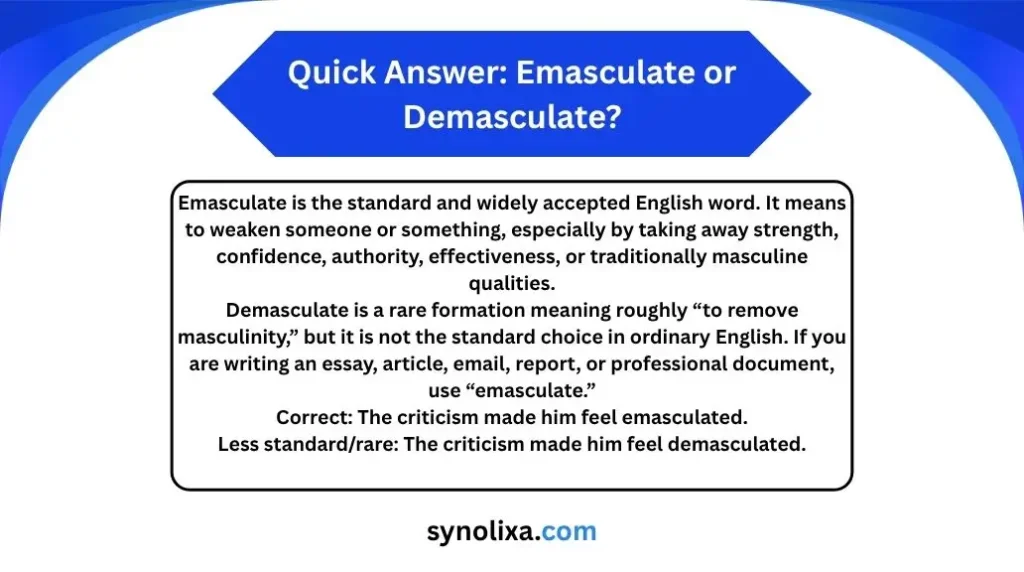
Emasculate is the standard and widely accepted English word. It means to weaken someone or something, especially by taking away strength, confidence, authority, effectiveness, or traditionally masculine qualities.
Demasculate is a rare formation meaning roughly “to remove masculinity,” but it is not the standard choice in ordinary English. If you are writing an essay, article, email, report, or professional document, use “emasculate.”
Correct: The criticism made him feel emasculated.
Less standard/rare: The criticism made him feel demasculated.
Understanding the Basics: Emasculate or Demasculate
The easiest way to remember the difference is simple:
Use “emasculate” in standard English.
The word emasculate has a long history in English. Merriam-Webster traces it to Latin emasculatus, from emasculare, related to masculus, meaning “male.” Its first known English use dates to the early 17th century.
The word can describe a person who feels deprived of confidence, authority, or traditionally masculine strength. It can also describe something that has been weakened or made less effective.
For example:
- The public criticism emasculated his confidence.
- The new policy emasculated the agency’s authority.
- He felt emasculated after being publicly dismissed.
- The amendment emasculated the original protections.
By contrast, demasculate is a much rarer formation. It may be understandable because English sometimes creates words with the prefix de-, which can suggest removal or reversal. However, being understandable does not automatically make a word standard or preferred.
Comparison Table
| Form | Type | Meaning | Example | Correct/Incorrect |
|---|---|---|---|---|
| emasculate | Verb | To weaken, deprive of strength, or remove masculine power or qualities | The decision emasculated his authority. | ✅ Correct |
| emasculated | Past tense/past participle | Weakened or deprived of strength/confidence | He felt emasculated by the criticism. | ✅ Correct |
| emasculating | Present participle/adjective | Causing someone to feel weakened or deprived of confidence | The experience was emasculating. | ✅ Correct |
| emasculation | Noun | The act or result of emasculating | The policy led to the emasculation of the department. | ✅ Correct |
| demasculate | Verb | Rare formation meaning roughly to remove masculinity | The writer used “demasculate” in an unusual context. | ⚠️ Rare/nonstandard |
| demasculated | Past form | Rare form of “demasculate” | The unusual word appeared in the text. | ⚠️ Avoid in standard writing |
Correct Meanings and Uses of Emasculate
1. Emasculate Can Mean “To Weaken”
One of the most important modern uses of emasculate is to weaken something or make it less effective.
This meaning does not necessarily involve gender.
For example:
The changes would emasculate the new regulations.
Here, emasculate means that the changes would reduce the regulations’ power or effectiveness.
Merriam-Webster specifically recognizes this broader meaning: to deprive something of strength, vigor, or effectiveness.
Sentence Breakdown
The changes = subject
would emasculate = verb
the new regulations = object
The sentence means that the changes would make the regulations weaker.
This usage is especially common in formal writing, journalism, law, politics, and academic discussions.
2. Emasculate Can Describe a Loss of Confidence
Another common meaning relates to a person’s confidence or sense of power.
For example:
He felt emasculated when his ideas were dismissed in front of the entire team.
In this sentence, emasculated describes an emotional reaction. The person feels that their confidence, authority, or sense of competence has been undermined.
Oxford describes this use as making a man feel that he has lost his male role or qualities.
It is worth remembering that the word can carry strong cultural or gender-related implications in this context. Therefore, writers should use it carefully and only when it accurately communicates the intended meaning.
3. Emasculate Can Mean to Castrate
Emasculate also has a literal biological meaning related to removing male reproductive capacity.
Merriam-Webster lists “to deprive of virility or procreative power” and “castrate” among its definitions.
This is a specialized meaning, so context matters.
For example:
The historical text used the term “emasculate” in its literal biological sense.
In ordinary modern conversation, however, people often use emasculate figuratively rather than literally.
4. Emasculate Has a Botanical Meaning
There is another specialized use that many people do not know.
In botany, emasculate can mean removing the androecium—the male reproductive part of a flower—as part of artificial cross-pollination. Merriam-Webster explicitly lists this technical meaning.
For example:
Researchers emasculated the flowers before controlled pollination.
Here, the word has nothing to do with someone’s confidence or social identity. It is a technical botanical term.
What Does Demasculate Mean?
Demasculate can be understood as a formation meaning something like “to remove masculinity.”
The word does appear in some English-language sources. For example, Wiktionary records demasculate as a transitive verb meaning “to remove the masculinity from” someone.
However, there is an important difference between a word being understandable or occasionally recorded and a word being the normal choice in standard edited English.
For most readers, emasculate is the established and recognizable form.
Compare:
The experience emasculated him.
with:
The experience demasculated him.
The first sentence sounds natural to an English-speaking reader. The second may sound unusual or invented.
That is why writers should generally choose emasculate.
Why Do People Write “Demasculate”?
There is a logical reason for the confusion.
English frequently uses de- to indicate removal, reversal, or reduction:
- deactivate
- defrost
- devalue
- decentralize
- deconstruct
- de-escalate
Because masculine refers to male characteristics, someone may naturally reason:
de + masculine → demasculate
That formation looks logical.
But English vocabulary does not work entirely by mathematical formulas. A word can look logical and still not be the established form.
This is why emasculate should be learned as a vocabulary item rather than trying to construct it from familiar prefixes.
Emasculate vs. Demasculate: The Key Difference
The main difference is standard usage and recognition.
Emasculate
- Established English word
- Widely recognized
- Listed by major dictionaries
- Used in everyday, professional, academic, legal, literary, and technical contexts
- Can describe weakening a person or thing
- Can have literal, figurative, and technical meanings
Demasculate
- Rare
- Understandable from its structure
- Occasionally used
- Not the normal choice in standard edited English
- Can sound invented or awkward to many readers
Therefore:
When in doubt, use “emasculate.”
Test Tip: How to Choose the Right Word
Here is a quick test.
Ask yourself:
Am I trying to say “weaken,” “undermine,” or “deprive of masculine strength”?
If yes, use emasculate.
For example:
The decision emasculated the committee.
He felt emasculated by the public criticism.
The proposed amendment could emasculate the law.
If you are tempted to write demasculate, replace it with emasculate unless you have a very specific reason to reproduce an unusual term from a source.
Easy Memory Trick 🧠
Think:
EMAsculate = Established Masculine weakening
You do not need to remember the exact etymology every time. Just remember that emasculate is the standard form.
Case Study: Emasculate in a Workplace Conversation
Imagine a manager gives an employee an important project.
The employee spends several weeks developing a plan. During a meeting, another manager rejects nearly every part of the plan without allowing the employee to explain the reasoning.
Later, the employee says:
“That meeting made me feel emasculated.”
In this context, the employee is not necessarily saying that anyone literally removed a physical part of their body. The word is being used figuratively to describe a loss of confidence, authority, or traditionally masculine self-image.
A workplace writer could also use emasculate to describe an organization:
“The restructuring could emasculate the department by removing most of its decision-making authority.”
Here, the word describes organizational weakness rather than a person’s feelings.
This demonstrates an important feature of emasculate: its meaning depends heavily on context.
Grammar Rules: Why “Emasculate” Is the Standard Choice
Emasculate functions primarily as a transitive verb.
A transitive verb normally takes an object.
For example:
The criticism emasculated him.
“Criticism” is the subject, “emasculated” is the verb, and “him” is the object.
Another example:
The new rule emasculated the organization.
Here:
- The new rule = subject
- emasculated = verb
- the organization = object
Merriam-Webster lists emasculate as a transitive verb and provides meanings that include weakening, depriving someone of virility, and removing the male parts of a flower.
The word can also appear in passive constructions:
He was emasculated by the public criticism.
The adjective emasculated can describe a person or thing that has been deprived of strength, vigor, or traditionally masculine qualities.
Oxford likewise lists the verb and its forms as emasculate, emasculates, emasculated, and emasculating.
Common Forms of Emasculate
| Form | Example |
|---|---|
| Base verb | They may emasculate the proposal. |
| Third-person singular | The change emasculates the agency. |
| Past tense | The decision emasculated the committee. |
| Past participle | He felt emasculated by the criticism. |
| Present participle | The policy is emasculating the department. |
| Noun | The emasculation of the program caused concern. |
Notice that these forms are built from the established base word emasculate.
Common Mistakes With Emasculate and Demasculate
Several factors can cause people to choose demasculate.
1. Fast Typing
When people type quickly, they may create words based on what sounds logical.
Someone who knows the word masculine may automatically type demasculate.
2. Prefix Confusion
The prefix de- often suggests removal or reversal. This makes demasculate look reasonable at first glance.
However, established vocabulary must be learned according to actual usage.
3. Lack of Familiarity
Emasculate is not an everyday word for many speakers. Because it is relatively formal, writers may hesitate when spelling or using it.
4. Autocorrect
Autocorrect can sometimes make unfamiliar words even more confusing. If a writer has typed an unusual form before, a device may not necessarily identify it as incorrect.
5. Sound-Based Spelling
People sometimes spell words based on how they think they sound.
The pronunciation of emasculate can make the word seem less obvious when heard rather than read.
Similar Grammar and Vocabulary Confusions
The confusion between emasculate and demasculate is similar to many other English word-choice problems.
| Confusion | Correct Choice | Why? |
|---|---|---|
| it’s / its | Depends on meaning | “It’s” = it is; “its” = possessive |
| your / you’re | Depends on meaning | “Your” = possession; “you’re” = you are |
| their / they’re | Depends on meaning | “Their” = possession; “they’re” = they are |
| affect / effect | Depends on function | Usually “affect” is a verb; “effect” is often a noun |
| advice / advise | Depends on function | “Advice” is a noun; “advise” is a verb |
| principal / principle | Depends on meaning | Different words with different meanings |
| emigrate / immigrate | Depends on direction | Different perspectives on movement |
| Emasculate / demasculate | Use emasculate | It is the established standard form |
These examples show why English cannot always be solved by looking at spelling patterns alone.
Emasculate in Different Contexts
Everyday Conversation
The word emasculate is somewhat formal, so it may not be the first choice in casual conversation.
Instead of:
“That really emasculated me.”
A speaker might say:
“That really hurt my confidence.”
However, emasculate is perfectly grammatical in conversation when its meaning fits.
Professional Writing
Professional writing can use emasculate when discussing authority, effectiveness, or organizational power.
For example:
The proposed changes could emasculate the committee’s authority.
This usage is especially useful when a writer wants to say that something has been significantly weakened.
However, writers should avoid using sophisticated words simply to sound formal. If weaken, reduce, or undermine communicates the idea more clearly, one of those words may be better.
Creative Writing
Creative writers may use emasculate to describe a character’s emotional experience.
For example:
The public failure left him feeling emasculated and uncertain.
This can communicate a stronger idea than simply saying that the character was “sad.”
Creative writers should still consider the word’s gender-related associations and use it intentionally.
Social Media and Texting
On social media, people may use emasculate in discussions about confidence, relationships, gender expectations, or power.
For example:
“Being told you cannot do something can feel emasculating.”
The word emasculating is the adjective-like participial form commonly used to describe an experience.
Still, simpler words such as humiliating, discouraging, or disempowering may sometimes communicate the idea more directly.
Emasculate Does Not Always Mean “Make Less Masculine”
This is one of the most important points.
Many people see emasculate and assume that it only means:
“to make someone less masculine.”
That is incomplete.
Merriam-Webster also defines it as depriving something of strength, vigor, or effectiveness.
For example:
The amendments emasculated the legislation.
A law cannot literally become “less masculine.” Here, emasculated means weakened or made less effective.
This broader meaning is particularly important in formal writing.
Why Emasculate Matters in Clear Communication
Choosing the correct word matters because readers rely on vocabulary to understand your exact meaning.
1. Clarity
Using emasculate makes your meaning immediately recognizable to readers familiar with standard English.
Using the rare demasculate may force the reader to stop and interpret what you mean.
2. Professionalism
In professional documents, established vocabulary is usually preferable to unusual formations.
A report that says:
“The proposal may emasculate the agency’s authority”
sounds conventional and clear.
A report that says:
“The proposal may demasculate the agency’s authority”
may distract readers because the second form is unusual.
3. Accuracy in Digital Communication
Digital writing moves quickly. A word can appear in an email, blog post, social media caption, school assignment, or business document within seconds.
That makes vocabulary accuracy even more important.
A Useful Principle
Choose the word your reader will understand immediately, not merely the word that looks logically constructed.
Special Exception: Is “Demasculate” Ever Used?
Yes, demasculate can be found in English-language usage, and some sources record it as a rare verb. Wiktionary, for example, lists it with the meaning “to remove the masculinity from” someone.
However, that does not make it interchangeable with emasculate in ordinary standard English.
For most writing situations, including:
- school assignments
- professional emails
- business reports
- articles
- essays
- formal correspondence
- general web content
emasculate is the safer and more established choice.
If you are quoting a particular source that uses demasculate, preserve the original wording when necessary. Otherwise, use emasculate.
Emasculate vs. Demasculate: Synonyms You Can Use
Sometimes the best solution is not to choose either word.
Depending on your meaning, consider these alternatives:
If you mean “weaken”
- weaken
- undermine
- reduce
- diminish
- impair
If you mean “damage confidence”
- discourage
- undermine confidence
- embarrass
- humiliate
- dishearten
If you mean “reduce authority”
- weaken authority
- limit
- undermine
- diminish power
- reduce effectiveness
If you mean “make someone feel less powerful”
- disempower
- undermine
- discourage
- diminish confidence
Using a simpler synonym can often improve readability.
Quick Recap Checklist
Use this table when you are unsure.
| Question | If Yes → Use |
|---|---|
| Do you mean “weaken”? | Emasculate |
| Do you mean “reduce effectiveness”? | Emasculate |
| Do you mean “undermine someone’s confidence”? | Emasculate |
| Do you mean “make someone feel less masculine”? | Emasculate |
| Are you writing formal or professional English? | Emasculate |
| Did you invent “demasculate” from “de- + masculine”? | Replace it with emasculate |
| Are you reproducing an unusual source that specifically says “demasculate”? | Keep the source’s wording if quoting |
Practice Examples
Example 1
Incorrect or unusual:
The decision demasculated the department.
Better:
The decision emasculated the department.
Example 2
Correct:
He felt emasculated when his contribution was dismissed.
Example 3
Correct:
The proposed amendment could emasculate the law by removing its strongest protections.
FAQs
1. Is “emasculate” the correct word?
Yes. Emasculate is the established standard English word. It can mean to weaken someone’s confidence or masculine strength, weaken something’s effectiveness, or have certain literal and technical meanings.
2. Is “demasculate” a real word?
Demasculate is a rare English formation that has been recorded with the meaning of removing masculinity, but it is not the normal standard choice. Wiktionary records the word, while major dictionaries such as Merriam-Webster prominently document emasculate.
3. Should I use “emasculate” or “demasculate” in formal writing?
Use emasculate. It is the established form and will be more familiar to readers.
4. What does “emasculate” mean?
Emasculate can mean to weaken, deprive someone of strength or confidence, remove traditionally masculine qualities, or reduce the effectiveness of something. It also has literal and technical meanings.
5. What is the adjective form of emasculate?
The common adjective or past-participle form is emasculated.
Example:
He felt emasculated by the criticism.
Merriam-Webster defines emasculated as deprived of or lacking virility, strength, or vigor.
6. What is the noun form of emasculate?
The noun is emasculation.
Example:
The proposal would result in the emasculation of the committee’s authority.
Merriam-Webster lists emasculation as the noun form.
7. Can “emasculate” describe something other than a person?
Yes. This is an important use of the word.
For example:
The new restrictions could emasculate the organization.
Here, emasculate means to weaken the organization’s power or effectiveness. Merriam-Webster specifically recognizes this broader sense.
8. Is “emasculate” always related to masculinity?
No. Although the word has a historical connection to masculinity and can describe a loss of masculine strength or qualities, it can also mean to weaken or make something less effective.
For example:
The amendment emasculated the law.
In this sentence, the meaning is about effectiveness, not gender.
Conclusion
When choosing between emasculate or demasculate, the safest and most accurate choice in standard US English is emasculate. It is the established English verb and can mean to weaken, undermine, deprive someone of confidence or traditionally masculine strength, or reduce something’s effectiveness. It also has specialized biological and botanical meanings.
Demasculate is understandable and does appear occasionally, but it is rare and is not the usual word for standard edited English. If your goal is clear, professional, and widely recognized writing, choose emasculate.
Remember the simple rule:
Use “emasculate” when you mean to weaken, undermine, or deprive of masculine strength.
When a word looks like it should exist but feels unfamiliar, do not rely only on its construction. Check established usage and choose the form your readers will recognize.
In standard English, “emasculate” is the clear choice. ✅

Hi, I am Noah Harrison. I work at Synolixa as an English language editor, reviewing and creating helpful content to make English learning easier and clearer.
[…] style of English you want, and the meaning you want to emphasize. Let’s break it down clearly. Emasculate or Demasculate | Impatient vs Inpatient | Reevaluation or […]