Have you ever attended a meeting filled with impressive slides, confident speeches, and exciting promises, only to leave without getting any useful answers? Or have you watched a company spend more time making a project look impressive than explaining how it actually works? These situations can be described with a familiar American English expression: dog and pony show.
Although the phrase sounds as if it refers to performing animals, its modern meaning is usually figurative. It describes an elaborate presentation, event, or performance designed to impress an audience, attract attention, or persuade people. Sometimes, the expression suggests that the event focuses more on appearances than on meaningful results.
You may encounter this idiom in business meetings, political discussions, sales presentations, and everyday conversations. Its tone can be humorous, sarcastic, or critical, depending on how it is used.
Learning the dog and pony show meaning helps you understand what speakers really intend when they describe an event this way. It also helps you decide when the expression is appropriate and when a more neutral alternative would be better.
In this guide, you will discover its definition, grammatical structure, common uses, practical examples, and related expressions. Backyard or Back Yard | Analog vs Analogue | Someone vs Somebody
Quick Answer: Dog and Pony Show Meaning
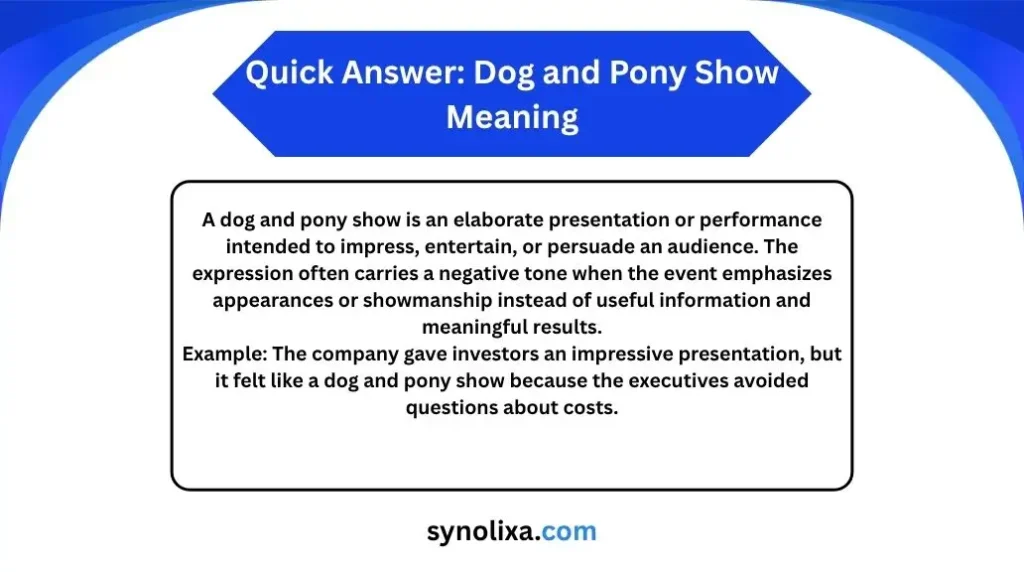
A dog and pony show is an elaborate presentation or performance intended to impress, entertain, or persuade an audience. The expression often carries a negative tone when the event emphasizes appearances or showmanship instead of useful information and meaningful results.
Example: The company gave investors an impressive presentation, but it felt like a dog and pony show because the executives avoided questions about costs.
Understanding the Basics
The phrase is an established English idiom that functions as a noun phrase. Although its wording mentions two animals, its figurative meaning usually relates to presentations, demonstrations, or carefully staged events.
People commonly use it when they believe an event has been designed to create a favorable impression rather than provide substantial information.
Definition and Grammatical Structure
| Form | Type | Meaning | Example | Correct/Incorrect |
|---|---|---|---|---|
| dog and pony show | Noun phrase and idiom | An elaborate display intended to impress | The manager arranged a dog and pony show for clients. | Correct |
| dog-and-pony show | Hyphenated compound form | An alternative written form of the expression | The event became a dog-and-pony show. | Correct in some style conventions |
| dog and pony | Incomplete idiom | Does not express the complete figurative meaning | The meeting was a dog and pony. | Usually incorrect |
| dog and pony shows | Plural noun phrase | More than one elaborate presentation | We attended two dog and pony shows. | Correct |
| dogs and ponies show | Altered expression | An unconventional variation of the idiom | They organized a dogs and ponies show. | Usually incorrect |
The standard wording remains unchanged when the expression is used in its singular form. To make it plural, add an s to the final noun: dog and pony shows.
Hyphenation varies across dictionaries and editorial styles, so follow the style guide used for your publication.
Why Is It an Idiom?
An idiom is an established expression whose meaning cannot always be understood by interpreting every word literally.
For example, “break the ice” usually means to make people feel more comfortable in a social situation. It does not normally describe physically breaking ice.
Similarly, the phrase discussed here usually refers to an elaborate or theatrical presentation rather than an event featuring animals.
Example:
“The marketing team put on a dog and pony show before launching the product.”
This sentence suggests that the team organized an impressive presentation to attract attention or create excitement.
It does not necessarily mean that the event was dishonest. The context and the speaker’s attitude determine the precise implication.
Correct Meanings and Uses
The expression has several related meanings. Understanding these uses will help you recognize it in different situations.
1. An Elaborate Presentation
The most common use describes a presentation that includes carefully prepared speeches, visual displays, demonstrations, or other impressive elements.
Example:
“The software company gave a dog and pony show to demonstrate its latest features.”
Sentence breakdown:
- The software company: The subject performing the action.
- Gave: The main verb.
- A dog and pony show: The noun phrase identifying the presentation.
- To demonstrate its latest features: The purpose of the presentation.
The expression suggests that the demonstration was carefully arranged to impress its audience.
However, it does not automatically mean the presentation was poor. A speaker’s choice of words may reveal skepticism that is not necessarily shared by everyone attending.
2. A Display That Emphasizes Appearance
Sometimes, the phrase criticizes an event for prioritizing appearance over substance.
A business might use attractive charts, polished speeches, and impressive demonstrations while failing to address important questions.
Example:
“The annual meeting felt like a dog and pony show because executives presented attractive charts but ignored the company’s financial problems.”
Here, the speaker believes the event emphasized presentation quality instead of meaningful discussion.
The criticism concerns the gap between what the audience saw and the information it actually received.
3. An Event Designed to Persuade
Companies and organizations often prepare presentations to encourage people to purchase products, support proposals, or approve plans.
The expression may describe these events when the presentation feels overly theatrical or carefully staged.
Example:
“The sales team organized a dog and pony show to convince the client to sign the contract.”
The sentence emphasizes the persuasive purpose of the event. Depending on the circumstances, the phrase may suggest that the team relied heavily on showmanship.
4. A Political or Public Relations Display
Politicians, public officials, and organizations sometimes arrange highly visible events to influence public opinion.
Critics may use this expression when they believe an event is designed to create a favorable impression without answering important questions.
Example:
“Opponents called the press conference a dog and pony show because officials avoided questions about the proposed policy.”
This sentence attributes the criticism to opponents. It does not establish that the press conference was necessarily misleading.
That distinction matters when writing objective news reports or discussing controversial events.
5. A Superficial Display of Effort
The phrase can also describe a situation in which people appear busy or productive without making meaningful progress.
Example:
“The committee’s weekly meetings became a dog and pony show, with long speeches but few completed projects.”
The speaker suggests that the committee focused on appearances rather than results.
In this context, the expression criticizes the difference between visible activity and actual achievement.
Test Tip: How to Recognize the Meaning
Ask yourself this question:
Is the speaker describing an elaborate presentation or performance that seems designed to impress people?
If the answer is yes, the expression may fit.
However, a detailed presentation is not automatically superficial. A well-organized meeting that provides reliable information, answers questions, and produces useful results does not necessarily deserve this label.
Case Study: An Example in the Workplace
Imagine that a technology company wants investors to support a new product.
The management team prepares a large conference room, displays colorful charts, demonstrates a polished prototype, and delivers enthusiastic speeches. The presentation looks impressive, but the executives provide little information about production costs, customer demand, or expected revenue.
After the meeting, an employee tells a colleague:
“That was quite a dog and pony show. The product looked great, but we still don’t know whether the business model will work.”
Why Does the Expression Fit?
The employee uses the idiom because the presentation emphasized the product’s appearance while leaving important financial questions unanswered.
The phrase communicates skepticism in a concise and memorable way.
However, it represents the employee’s judgment. Another attendee might consider the demonstration useful and believe that financial details should be discussed separately.
A More Professional Alternative
If the employee needs to raise the same concern in a formal setting, a neutral statement may be more effective:
“The presentation was visually impressive, but it did not provide enough information about projected costs, customer demand, or expected revenue.”
This wording identifies the problem without dismissing the entire event.
Example Email
Subject: Follow-Up on Today’s Presentation
Thank you for organizing today’s presentation. The product demonstration was engaging, but I would appreciate more detailed information about projected costs, customer demand, and expected revenue before we make a final decision.
This email communicates the concern professionally without using a potentially sarcastic expression.
The lesson is simple: use idioms when they suit your audience and purpose. When you need to maintain a diplomatic tone, direct and specific language is often the better choice.
Grammar Rules Explained
Although the expression has a figurative meaning, it follows ordinary English grammar rules for noun phrases.
Rule 1: Use It as a Noun Phrase
The idiom generally functions as a noun phrase within a sentence.
Correct: The director organized a dog and pony show.
Incorrect: The director dog and pony showed the presentation.
The second sentence incorrectly treats the entire expression as a verb.
You can use ordinary verbs with the phrase, including:
- Organize a dog and pony show.
- Put on a dog and pony show.
- Stage a dog and pony show.
- Turn something into a dog and pony show.
- Call something a dog and pony show.
Example: The marketing department put on an elaborate presentation for its new clients.
This sentence uses a neutral alternative, but the grammatical structure is similar.
Rule 2: Use Articles Correctly
In ordinary sentences, the singular countable noun show usually needs an article or another suitable determiner.
Correct: The company arranged a dog and pony show.
Correct: That dog and pony show lasted two hours.
Incorrect: The company arranged dog and pony show.
The incorrect example omits the article needed before the singular countable noun phrase.
Rule 3: Form the Plural Correctly
The usual plural form is dog and pony shows.
Only the final noun becomes plural.
Singular: The politician organized a dog and pony show.
Plural: The politicians organized several dog and pony shows.
Avoid changing the phrase to “dogs and ponies shows.” That is not the conventional plural form.
Rule 4: Understand Hyphenation
You may see both dog and pony show and dog-and-pony show in published writing.
The unhyphenated form is common when the phrase functions as a noun. Some dictionaries, publishers, or editors use hyphens to treat the expression as a compound unit.
For consistency, follow the style guide used by your publication or organization.
Hyphenation does not normally change the intended meaning.
Rule 5: Recognize Its Tone
The idiom often sounds informal, skeptical, or critical. It may suggest that a presentation is exaggerated, superficial, or unnecessarily theatrical.
Example: “The product launch was a dog and pony show.”
This statement can sound dismissive.
A more neutral alternative is:
“The product launch featured an elaborate presentation.”
Choose the version that best fits your intended tone.
Common Mistakes to Avoid
Writers sometimes misunderstand this expression because its literal wording sounds unusual. Others use it too broadly or confuse it with related phrases.
Mistake 1: Assuming It Always Involves Animals
Misunderstanding: The phrase always describes an actual performance featuring a dog and a pony.
Correct understanding: In modern American English, it often describes a figurative presentation intended to impress an audience.
Example: “The executives put on a dog and pony show for the board.”
Unless the surrounding context mentions performing animals, the sentence most likely refers to a business presentation.
Mistake 2: Changing the Established Wording
The conventional idiom retains the words dog and pony show.
Incorrect: The manager organized a dogs and ponies show.
Correct: The manager organized a dog and pony show.
Idioms usually preserve their established wording, even when individual words might seem unusual.
Mistake 3: Using It for Every Presentation
Not every presentation is superficial or theatrical.
A detailed scientific explanation, an effective training session, or a transparent financial report may be carefully prepared without being an elaborate display of appearances.
Use the expression when the context supports its connotation of showmanship, performance, or persuasion.
Mistake 4: Using It in an Inappropriately Formal Tone
Calling a colleague’s presentation a dog and pony show may sound insulting.
Potentially offensive: “Your presentation was just a dog and pony show.”
More diplomatic: “The presentation was engaging, but we need more supporting evidence.”
The second sentence communicates a concern without dismissing the entire effort.
Mistake 5: Confusing It With Similar Expressions
Several English phrases describe appearances, performance, or deception. However, their meanings differ slightly.
| Expression | Meaning | Example |
|---|---|---|
| Dog and pony show | An elaborate display intended to impress | The vendor arranged a dog and pony show. |
| Smoke and mirrors | Deceptive or misleading appearances | The proposal relied on smoke and mirrors. |
| Window dressing | Superficial changes intended to improve appearances | The new policy seemed like window dressing. |
| Showmanship | The skill of attracting and entertaining an audience | Her presentation showed excellent showmanship. |
| Grandstanding | Acting conspicuously to attract attention or approval | The politician was accused of grandstanding. |
| All show and no substance | An impressive appearance without meaningful value | The proposal was all show and no substance. |
| It’s / its | Contraction of “it is” / possessive form | It’s ready. The company changed its logo. |
| Your / you’re | Possessive form / contraction of “you are” | Your report is ready. You’re welcome. |
| There / their / they’re | Location / possession / contraction of “they are” | They’re putting their files there. |
The first six expressions relate to presentation, appearance, or behavior. They are not interchangeable in every situation.
The remaining examples illustrate common spelling and grammar confusions that can affect writing accuracy.
Why Do These Mistakes Happen?
Fast typing: Writers may type a familiar-looking phrase without checking whether it fits the sentence.
Autocorrect: Digital keyboards and editing tools may change words or fail to recognize the intended idiom.
Lack of knowledge: Someone who has never encountered the expression may interpret it literally.
Overgeneralization: A writer may assume that every presentation with impressive visuals deserves this label.
Tone awareness: Some people understand the definition but do not realize how critical or dismissive the expression can sound.
To avoid these mistakes, learn the phrase as a complete expression and consider your audience before using it.
Usage in Different Contexts
The central meaning remains similar across settings, but the tone and purpose can change.
1. Everyday Conversation
In everyday conversation, the expression often sounds humorous or sarcastic.
Examples:
- “We sat through a dog and pony show before they announced the actual decision.”
- “The event looked impressive, but the whole thing felt staged.”
- “I don’t want another elaborate presentation. I just want a clear explanation.”
The first example uses the idiom directly. The other two express similar frustration without repeating it.
2. Professional Writing
In business settings, the phrase may describe a sales pitch, investor presentation, product demonstration, or corporate meeting.
However, it can sound negative, so it may be inappropriate for formal reports or diplomatic emails.
Informal workplace example:
“The vendor’s presentation was a dog and pony show.”
Professional alternative:
“The vendor’s presentation emphasized visual demonstrations but did not provide sufficient technical details.”
The alternative is more specific and less judgmental.
3. Creative Writing
Writers can use the idiom to reveal a character’s attitude toward an event.
Example:
“Martin had attended enough product launches to recognize a dog and pony show when he saw one. The room was filled with bright screens and enthusiastic speeches, but nobody answered his questions about cost.”
The expression helps establish Martin’s skepticism without requiring a lengthy explanation.
In fiction, it can communicate humor, disappointment, distrust, or frustration.
4. Social Media and Texting
The phrase also works in informal online conversations because it communicates criticism in just a few words.
Examples:
- “That meeting was a complete dog and pony show.”
- “Lots of flashy slides, no actual answers. Total dog and pony show.”
- “I expected useful information, not another staged presentation.”
Use caution when posting publicly about an employer, client, or colleague. A sarcastic phrase can sound harsher in writing than it might in conversation.
5. Politics and Public Events
The expression frequently appears in political commentary when critics believe an event is designed to influence public opinion through appearance rather than substance.
Example:
“Opponents described the televised announcement as a dog and pony show.”
This wording makes it clear that the criticism comes from opponents rather than presenting their judgment as an established fact.
That distinction is important in objective reporting.
Why This Expression Matters
Understanding the idiom improves communication because it conveys a complex criticism in a short, recognizable phrase.
Clarity in Communication
The expression helps readers understand that the speaker is criticizing the nature of a presentation, particularly its emphasis on appearance or performance.
For example, saying “The meeting was a dog and pony show” communicates a more specific attitude than simply saying “The meeting was long.”
However, context matters. Readers may interpret the statement differently depending on their experiences and expectations.
Professionalism
Knowing when not to use an idiom is just as important as knowing its meaning.
In casual conversations, this phrase can sound natural and expressive. In a formal business report, a direct explanation may be more effective.
Compare these statements:
- Informal: “The review was a dog and pony show.”
- Formal: “The review emphasized presentation quality but did not adequately evaluate the project’s risks.”
The second version explains the concern more precisely.
Accuracy in Digital Communication
Online messages lack many of the tone cues available in face-to-face conversations. A sarcastic comment may be interpreted as a serious accusation.
When using the expression in an email, post, or message, consider whether the audience will understand your intended tone.
If the subject is sensitive, specific and neutral wording can help prevent misunderstandings.
A Useful Writing Principle
“Choose words that communicate both your meaning and your intended tone.”
This is a general writing principle, not a quotation attributed to a particular author.
Effective communication is not simply about using interesting expressions. It is about communicating accurately, respectfully, and clearly.
Special Exceptions and Edge Cases
Although the phrase is usually figurative, several situations require special attention.
Literal Animal Performances
In historical or descriptive contexts, the expression can refer to an actual traveling performance featuring trained animals.
Example:
“The local fair advertised a dog and pony show for families.”
Here, the surrounding context may suggest a literal animal performance rather than a metaphorical business presentation.
The Hyphenated Form
Some publications write the phrase as dog-and-pony show. Others prefer dog and pony show.
Both forms appear in English usage. Follow the preferred dictionary, editorial policy, or style guide for the text you are writing.
Do not assume that the presence or absence of hyphens changes the expression’s basic meaning.
A Product or Event Name
An organization could use Dog and Pony Show as the official name of a product, event, creative project, or performance.
In that case, capitalization may reflect the proper name rather than ordinary sentence style.
Example:
“The theater announced a new production titled Dog and Pony Show.”
The capitalization comes from the title, not from a special grammar rule.
Is It Always Negative?
No. The expression often carries a critical or dismissive tone, but context matters.
A speaker might use it humorously to describe an elaborate but entertaining event. Another speaker might use it to criticize an organization for prioritizing appearances over results.
If you intend to praise an event, expressions such as “impressive presentation,” “engaging demonstration,” or “polished performance” may communicate your meaning more accurately.
Quick Recap Checklist
Use this checklist before including the expression in your writing.
| Question | If Yes → Use |
|---|---|
| Is the subject an elaborate presentation or performance? | The idiom may fit. |
| Is the event intended to impress, entertain, or persuade an audience? | The idiom may fit. |
| Are you criticizing an emphasis on appearance over substance? | The idiom is often appropriate. |
| Are you writing a formal report that requires neutral wording? | Consider “elaborate presentation” or a more precise description. |
| Does the context clearly describe actual performing animals? | The literal meaning may apply. |
| Are you using the phrase as a noun? | Follow ordinary noun-phrase grammar. |
| Do you need the plural form? | Use “dog and pony shows.” |
Practice Examples
Example 1: “The executives prepared a dog and pony show for potential investors.”
Meaning: The executives prepared an elaborate presentation intended to impress or persuade investors.
Example 2: “The manager rejected another dog and pony show and requested the actual sales figures.”
Meaning: The manager wanted useful information instead of another elaborate display.
Example 3: “The county fair advertised a dog and pony show.”
Meaning: This could describe an actual animal performance. The surrounding context determines the intended interpretation.
Practice Answer Check
All three sentences can be correct. The intended meaning depends on context, which is why understanding idioms requires more than checking spelling alone.
FAQs
1. What does dog and pony show mean?
It means an elaborate presentation or performance designed to impress, entertain, or persuade an audience. The expression often suggests that appearances receive more attention than substance.
2. Is dog and pony show an idiom?
Yes. It is an established English idiom, particularly common in American English. It usually has a figurative meaning rather than referring to an actual animal performance.
3. Is the expression negative?
Often, yes. It frequently carries a critical or sarcastic tone, suggesting that an event is overly theatrical or superficial. However, the exact tone depends on the speaker and context.
4. Should the phrase be hyphenated?
Both dog and pony show and dog-and-pony show appear in English writing. Hyphenation depends on the dictionary or style guide being followed. Consistency is more important than switching between forms without a reason.
5. What is an example in business?
A company might organize an elaborate presentation for investors, using impressive slides and demonstrations while providing little information about costs or risks. An observer might describe this event as a dog and pony show.
6. What are some alternatives?
Depending on the context, alternatives include “elaborate presentation,” “staged performance,” “publicity display,” “showy demonstration,” and “superficial presentation.” More critical alternatives include “smoke and mirrors” and “all show and no substance,” although their meanings are not identical.
Conclusion
Dog and pony show is a useful American English idiom for describing an elaborate presentation or performance intended to impress, entertain, or persuade an audience. It commonly appears in business, politics, public relations, and everyday conversation.
The expression often carries a negative tone because it can suggest that an event focuses more on appearances than on meaningful information or results. However, context determines whether the phrase sounds critical, humorous, or simply descriptive.
Remember that the expression functions as a noun phrase. Its usual plural form is dog and pony shows, while hyphenation may vary according to the style guide you follow. Most importantly, do not use it for every presentation. Reserve it for situations in which its meaning and tone genuinely fit.
When you understand how this idiom works, you can recognize it in conversations, use it naturally in informal writing, and choose more neutral alternatives when professionalism matters.
Good writing does more than create an impression. It delivers meaning, clarity, and substance.

Hi, I am Ethan Parker. I work at Synolixa as a grammar and writing specialist, helping readers understand English grammar and improve their writing skills.

[…] practical examples, comparison tables, grammar rules, and answers to frequently asked questions. Dog and Pony Show | Backyard or Back Yard | Analog vs […]