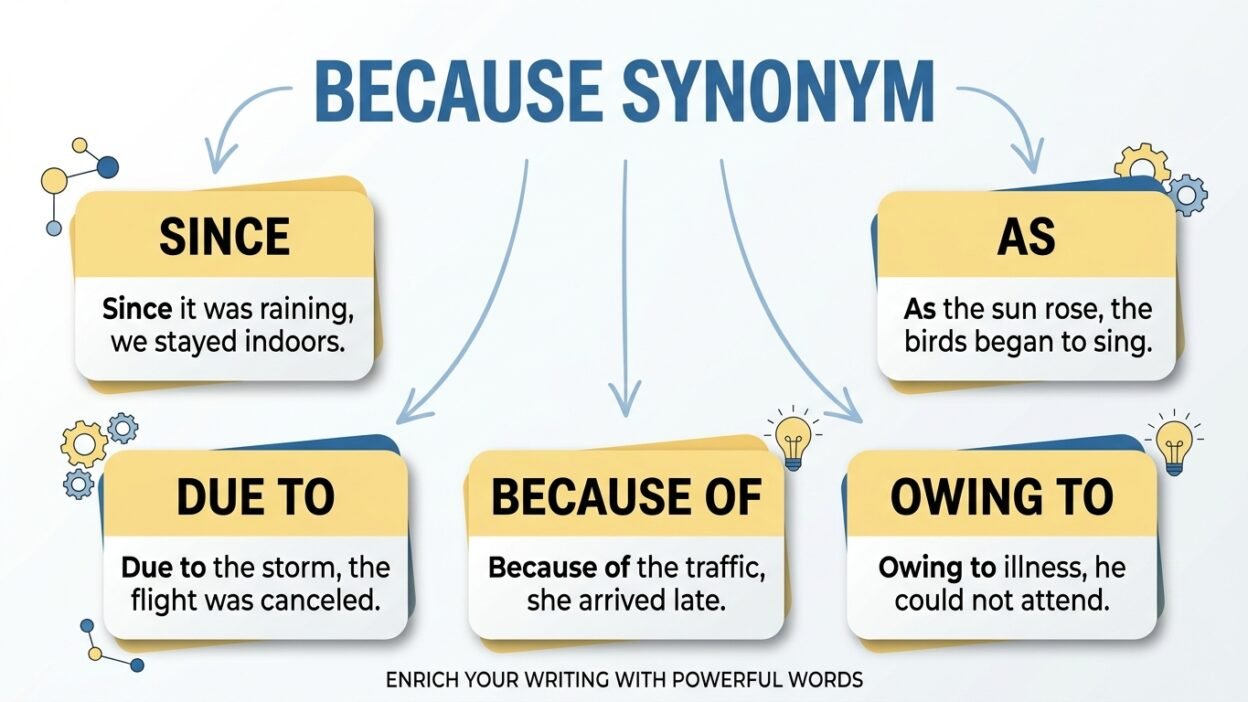
Have you ever searched for a because synonym because you keep using the word “because” again and again in your writing? You are not alone. “Because” is one of the most common words we use to explain a reason, but using the same word repeatedly can sometimes make your writing sound simple or repetitive.
Learning a useful because synonym can help you express reasons in different and more natural ways. For example, instead of saying, “I stayed home because it was raining,” you can say, “I stayed home since it was raining.”
People often search for a because synonym when writing essays, emails, articles, stories, or everyday conversations. However, not every synonym has the same meaning, grammar, or tone.
In this guide, you will discover 50 useful alternatives to “because,” along with simple meanings and natural examples to help you improve your English vocabulary.
Quick Definition
Because is a word used to give the reason why something happens. It usually connects an action or situation with its cause. For example, “She left early because she was tired.” A because synonym is another word or phrase that can express a reason, such as “since,” “as,” “because of,” or “due to.”
Because Synonyms List
Since
Meaning:
- “Since” can give the reason for something.
Examples:
- I stayed inside since it was cold.
- Since you are here, let’s start the meeting.
As
Meaning:
- “As” can explain why something happens.
Examples:
- As it was late, we went home.
- I wore a coat as the weather was cold.
For
Meaning:
- “For” can give a reason, especially in formal or literary writing.
Examples:
- I trusted him, for he was honest.
- She smiled, for the news was good.
Because of
Meaning:
- “Because of” gives the reason for an action or situation.
Examples:
- The game stopped because of rain.
- We were late because of traffic.
Due to
Meaning:
- “Due to” explains that something happened for a particular reason.
Examples:
- The flight was delayed due to fog.
- The shop closed due to repairs.
Owing to
Meaning:
- “Owing to” means something happened because of a particular cause.
Examples:
- The road closed owing to heavy snow.
- Owing to illness, she missed school.
On Account of
Meaning:
- “On account of” means because of something.
Examples:
- The match was canceled on account of rain.
- He stayed home on account of a fever.
Thanks to
Meaning:
- “Thanks to” shows that something happened because of a helpful or positive cause.
Examples:
- Thanks to your help, I finished early.
- We won thanks to our goalkeeper.
Given That
Meaning:
- “Given that” introduces a fact that explains a result.
Examples:
- Given that it was dark, we left early.
- Given that she was tired, she went to bed.
Seeing That
Meaning:
- “Seeing that” means because a certain fact is true.
Examples:
- Seeing that you are busy, I will call later.
- We stayed inside, seeing that it was raining.
Seeing As
Meaning:
- “Seeing as” is an informal way to introduce a reason.
Examples:
- Seeing as you are hungry, let’s eat.
- I will drive, seeing as you are tired.
Considering That
Meaning:
- “Considering that” gives a reason based on an important fact.
Examples:
- Considering that he was young, he did well.
- She did great considering that she had little time.
Inasmuch As
Meaning:
- “Inasmuch as” means because or since, but it is very formal.
Examples:
- The plan worked inasmuch as everyone helped.
- He was successful inasmuch as he followed the rules.
Now That
Meaning:
- “Now that” explains a reason connected to a new situation.
Examples:
- Now that school is over, we can relax.
- Now that you are ready, we can leave.
In View of
Meaning:
- “In view of” means because of a particular fact or situation.
Examples:
- In view of the storm, the event was canceled.
- In view of the high cost, we chose another plan.
In Light of
Meaning:
- “In light of” means because of new or important information.
Examples:
- In light of the news, we changed our plans.
- In light of the problem, the team met again.
By Reason of
Meaning:
- “By reason of” means because of something.
Examples:
- He was absent by reason of illness.
- The road was closed by reason of flooding.
By Virtue of
Meaning:
- “By virtue of” means because of a particular quality, position, or condition.
Examples:
- She won by virtue of her hard work.
- He leads the group by virtue of his experience.
On the Grounds That
Meaning:
- “On the grounds that” gives a specific reason for a decision.
Examples:
- The request was rejected on the grounds that it was unsafe.
- They refused the plan on the grounds that it cost too much.
For the Reason That
Meaning:
- “For the reason that” means because of a stated reason.
Examples:
- He left for the reason that he felt sick.
- The trip ended for the reason that money ran out.
Due to the Fact That
Meaning:
- “Due to the fact that” means because something is true.
Examples:
- The match stopped due to the fact that it was raining.
- She stayed home due to the fact that she was ill.
Owing to the Fact That
Meaning:
- “Owing to the fact that” gives a reason in formal writing.
Examples:
- The event changed owing to the fact that the hall was full.
- He missed the bus owing to the fact that he woke late.
As a Result of
Meaning:
- “As a result of” shows that something happened because of another thing.
Examples:
- The crops failed as a result of the drought.
- He was tired as a result of poor sleep.
As a Consequence of
Meaning:
- “As a consequence of” shows a result caused by something.
Examples:
- The road flooded as a consequence of heavy rain.
- She lost time as a consequence of the delay.
Resulting From
Meaning:
- “Resulting from” describes something caused by another event or action.
Examples:
- The damage resulted from strong winds.
- His tiredness resulted from a long journey.
Stemming From
Meaning:
- “Stemming from” means coming from a particular cause.
Examples:
- His fear stemmed from a bad experience.
- The problem stemmed from poor planning.
Arising From
Meaning:
- “Arising from” means caused by or connected to something.
Examples:
- The argument arose from a simple mistake.
- The costs arose from the repair work.
On the Basis That
Meaning:
- “On the basis that” gives a reason for a decision.
Examples:
- They rejected the offer on the basis that it was too expensive.
- She was chosen on the basis that she had more experience.
Insofar As
Meaning:
- “Insofar as” means to the extent that something explains a situation.
Examples:
- The plan worked insofar as everyone followed it.
- He was right insofar as the facts supported him.
Seeing As How
Meaning:
- “Seeing as how” is an informal phrase used to give a reason.
Examples:
- Seeing as how you are here, stay for dinner.
- We can walk, seeing as how the shop is nearby.
Given
Meaning:
- “Given” can introduce a fact that explains why something happened.
Examples:
- Given the weather, we stayed home.
- Given her experience, she handled it well.
Considering
Meaning:
- “Considering” can introduce a reason based on a situation.
Examples:
- Considering the traffic, we arrived early.
- He did well considering his limited time.
Through
Meaning:
- “Through” can show that something happened because of an action or quality.
Examples:
- She succeeded through hard work.
- He improved through regular practice.
By Means of
Meaning:
- “By means of” explains how something was achieved, sometimes showing the cause or method.
Examples:
- They solved the problem by means of teamwork.
- She learned English by means of daily practice.
As a Consequence
Meaning:
- “As a consequence” shows that something happened as the result of an earlier event.
Examples:
- He ignored the warning and, as a consequence, lost money.
- The store closed and, as a consequence, many workers left.
Consequently
Meaning:
- “Consequently” means as a result of something.
Examples:
- It rained heavily; consequently, the roads flooded.
- He missed the train and consequently arrived late.
Therefore
Meaning:
- “Therefore” introduces a result based on a reason or fact.
Examples:
- The road was closed; therefore, we turned back.
- She was sick; therefore, she stayed home.
Thus
Meaning:
- “Thus” means as a result or in this way.
Examples:
- He worked hard and thus improved quickly.
- The store was closed, thus we returned home.
Hence
Meaning:
- “Hence” means for this reason or as a result.
Examples:
- The road was unsafe; hence the delay.
- He was tired, hence his early bedtime.
Thereby
Meaning:
- “Thereby” means as a result of doing something.
Examples:
- She saved money, thereby reducing her debt.
- He followed the rules, thereby avoiding trouble.
As a Result
Meaning:
- “As a result” shows what happened because of something else.
Examples:
- The alarm failed. As a result, we woke late.
- He practiced daily. As a result, he improved.
For This Reason
Meaning:
- “For this reason” directly explains why something happens.
Examples:
- The road was dangerous. For this reason, we stayed home.
- She wanted to save money. For this reason, she cooked at home.
For That Reason
Meaning:
- “For that reason” refers to a previously mentioned cause.
Examples:
- He was very tired. For that reason, he went to bed early.
- The price was high. For that reason, we chose another product.
That Is Why
Meaning:
- “That is why” clearly connects a reason with its result.
Examples:
- I missed the bus. That is why I was late.
- She loves music. That is why she joined the band.
This Is Why
Meaning:
- “This is why” introduces the reason for a situation.
Examples:
- The road is closed. This is why we need another route.
- I practice every day. This is why my English is improving.
On This Account
Meaning:
- “On this account” means because of this reason.
Examples:
- He was sick and left early on this account.
- The machine was broken, and on this account, production stopped.
For That Cause
Meaning:
- “For that cause” means because of that particular reason.
Examples:
- The workers stopped for that cause.
- He changed his plan for that cause.
As a Direct Result of
Meaning:
- “As a direct result of” shows that one thing clearly caused another.
Examples:
- The road closed as a direct result of the storm.
- She won as a direct result of her preparation.
As a Consequence of This
Meaning:
- “As a consequence of this” means because of the situation just mentioned.
Examples:
- The team lost its captain. As a consequence of this, the game became harder.
- Prices increased. As a consequence of this, fewer people bought the product.
Because of This
Meaning:
- “Because of this” directly points to an earlier reason.
Examples:
- The weather was terrible. Because of this, we canceled the picnic.
- He forgot the address. Because of this, he arrived late.
Also read: Focus Synonyms
How to Use Because Synonyms – Complete Guide
Knowing a because synonym is useful, but the most important skill is knowing when to use it. Different alternatives have different grammar rules, levels of formality, and meanings.
For example, “because” is normally followed by a complete clause:
I stayed home because I was sick.
“Because of” is normally followed by a noun or noun phrase:
I stayed home because of my illness.
Both sentences give a reason, but their grammar is different.
1. Use “because” for clear and direct reasons
“Because” is simple, natural, and extremely common. It works well in everyday conversation, school writing, emails, and most general situations.
Example:
“I left early because I was tired.”
2. Use “since” and “as” for smoother writing
“Since” and “as” can make writing feel less repetitive. They are especially useful when the reason is already known or easy to understand.
Example:
“Since it was raining, we stayed inside.”
3. Use “because of” with nouns
This is one of the most important grammar differences to remember.
Correct:
“The match was canceled because of rain.”
Not:
“The match was canceled because of it was raining.”
For a complete clause, use because:
“The match was canceled because it was raining.”
4. Use “due to” in formal contexts
“Due to” is common in professional, academic, business, and official writing.
Example:
“The flight was delayed due to bad weather.”
In casual conversation, however, “because of” often sounds more natural.
5. Use “thanks to” for positive causes
“Thanks to” normally suggests that the cause produced a helpful or good result.
Example:
“Thanks to your advice, I passed the test.”
Using “thanks to” for a negative result can sound unusual or sarcastic.
6. Use “owing to” for a formal tone
“Owing to” is similar to “because of” and “due to.” It is more formal and is often found in announcements and written English.
Example:
“The event was postponed owing to heavy rain.”
7. Use “therefore,” “thus,” and “consequently” for results
These words do not always replace “because” directly. Instead, they usually introduce a result.
Compare:
“I stayed home because I was sick.”
with:
“I was sick. Therefore, I stayed home.”
The meaning is closely connected, but the sentence structure is different.
8. Match the tone to the situation
Some alternatives are casual:
- Seeing as
- Seeing as how
- That is why
- This is why
Some are neutral:
- Because
- Since
- As
- Because of
Some are formal:
- Due to
- Owing to
- In view of
- In light of
- Inasmuch as
- By reason of
Choosing the right expression helps your writing sound natural.
Mild vs. Strong Because Synonyms
Not every synonym has the same strength.
Neutral:
- because
- since
- as
Clear cause:
- because of
- due to
- owing to
- as a direct result of
Positive cause:
- thanks to
Formal cause:
- in view of
- in light of
- on the grounds that
- by virtue of
For everyday English, simple words are usually best. You do not need a complicated expression when “because” communicates the idea perfectly.
Six Useful Rules to Remember
- Use “because” before a complete sentence: “I left because I was tired.”
- Use “because of” before a noun: “I left because of my headache.”
- Use “since” when the reason is already clear: “Since it is late, let’s go.”
- Use “thanks to” for a helpful cause: “Thanks to you, we finished.”
- Use “due to” and “owing to” for a more formal style: “The delay was due to rain.”
- Use “therefore” and “consequently” to show a result: “It rained; therefore, we stayed home.”
Common Mistakes
1. Using “Because of” Before a Complete Clause
A common mistake is writing:
“I stayed home because of I was sick.”
The correct sentence is:
“I stayed home because I was sick.”
Or:
“I stayed home because of my illness.”
2. Treating Every Synonym as an Exact Replacement
Not every alternative can replace “because” grammatically. “Thanks to,” “due to,” and “therefore” have different structures and meanings.
Always check what comes after the expression.
3. Using Formal Words in Casual Conversation
Words such as “inasmuch as” and “by reason of” can sound too formal in everyday speech.
Instead of:
“I stayed home inasmuch as I was unwell.”
A natural speaker would usually say:
“I stayed home because I was sick.”
4. Using “Thanks to” for Every Cause
“Thanks to” usually suggests a positive cause.
Natural:
“Thanks to your help, I finished the work.”
For a negative cause, “because of” is usually better:
“The game stopped because of heavy rain.”
5. Changing the Meaning While Avoiding Repetition
Do not choose a synonym simply because you want to avoid repeating “because.” The new word must fit the meaning and grammar of the sentence.
Example Sentences Using Different Because Synonyms
- Since it was getting dark, we decided to leave.
- The flight was delayed due to bad weather.
- Because of the traffic, I arrived ten minutes late.
- Thanks to your help, I completed the project.
- As she was tired, she went to bed early.
- Owing to the storm, the school closed.
- Given that the shop was closed, we went somewhere else.
- He practiced every day; therefore, his skills improved.
- The road was flooded; consequently, the buses stopped running.
- In light of the new information, we changed our decision.
- Seeing that everyone was ready, the teacher began the lesson.
- I forgot my umbrella. That is why I got wet.
Because vs. Because of: What Is the Difference?
One of the most important distinctions for English learners is the difference between because and because of.
Because
Use because before a subject and verb.
Example:
We stayed home because it was raining.
Because of
Use because of before a noun, pronoun, or noun phrase.
Example:
We stayed home because of the rain.
Both expressions explain a reason, but their grammar is different.
Quick Comparison
| Expression | What follows it? | Example |
|---|---|---|
| Because | Subject + verb | I left because I was tired. |
| Because of | Noun/noun phrase | I left because of my tiredness. |
| Due to | Noun/noun phrase | The flight was delayed due to fog. |
| Since | Subject + verb | Since it was late, we left. |
| As | Subject + verb | As it was cold, I stayed inside. |
| Thanks to | Noun/noun phrase | Thanks to your help, I succeeded. |
Formal and Informal Because Synonyms
The best synonym depends on your audience.
Informal English
For conversations with friends and family, these are natural:
- because
- since
- as
- seeing as
- that is why
- this is why
General English
For everyday writing, these work well:
- because
- since
- as
- because of
- given that
- considering that
Formal English
For academic, professional, or official writing, consider:
- due to
- owing to
- in view of
- in light of
- on the grounds that
- by virtue of
- as a consequence of
However, formal does not always mean better. Clear and simple English is usually the strongest choice.
Best Because Synonyms for Essays
If you are writing an essay, you may want to avoid repeating “because” too often. Useful alternatives include:
- since
- as
- due to
- because of
- given that
- considering that
- in view of
- in light of
- as a result of
- owing to
For example:
Basic:
Students perform better because they get enough sleep.
Alternative:
Students perform better since they get enough sleep.
More formal:
Students may perform better due to adequate sleep.
Remember that changing the wording should not make your sentence harder to understand.
Best Because Synonyms for Speaking
In everyday speech, natural expressions are usually better than formal ones.
Good choices include:
- because
- since
- as
- because of
- that is why
- this is why
- seeing as
For example:
“I was late because the bus was slow.”
You could also say:
“I was late because of the slow bus.”
Or:
“The bus was slow. That is why I was late.”
All three are understandable, but the first is probably the most natural in casual conversation.
Best Because Synonyms for Academic Writing
Academic writing often benefits from precise cause-and-effect language. Depending on the sentence, you can use:
- due to
- owing to
- as a result of
- as a consequence of
- given that
- considering that
- in light of
- consequently
- therefore
- thus
For example:
“The results changed due to differences in temperature.”
Or:
“The temperature changed significantly; consequently, the results were different.”
These expressions can make academic writing more varied, but they should be used only when they fit naturally.
Frequently Asked Questions
What is the best synonym for “because”?
The best general synonym is since or as, depending on the sentence. However, “because” is often the clearest and most natural choice.
What is another word for because in formal English?
Common formal alternatives include due to, owing to, in view of, in light of, given that, and as a consequence of.
Can I use “since” instead of “because”?
Yes. “Since” can mean “because” when it introduces a reason.
Example:
Since it was raining, we stayed home.
Can “due to” replace “because”?
Sometimes, but not in exactly the same grammatical structure. “Due to” is normally followed by a noun or noun phrase.
Correct:
The delay was due to rain.
“Because” is normally followed by a clause:
The flight was delayed because it was raining.
What is the difference between “because” and “since”?
Both can give a reason. “Because” is usually more direct and clearly emphasizes the reason. “Since” can sound smoother when the reason is already known or obvious.
What is the difference between “because” and “because of”?
“Because” is followed by a clause, while “because of” is followed by a noun or noun phrase.
Because:
I stayed home because I was sick.
Because of:
I stayed home because of my illness.
Is “thanks to” a synonym for “because”?
“Thanks to” can express a cause, but it usually suggests that the cause is helpful or positive.
Example:
Thanks to your help, I passed the exam.
Is “therefore” a synonym for “because”?
Not exactly. “Because” introduces a reason, while “therefore” usually introduces a result.
Because:
I stayed home because I was sick.
Therefore:
I was sick; therefore, I stayed home.
What is a simple word for “because”?
Simple alternatives include since and as.
How can I avoid repeating “because”?
Change the structure of your sentence. You can use “since,” “as,” “because of,” “due to,” or another suitable cause-and-effect expression. Do not replace the word automatically; choose an expression that matches the grammar and tone.
Conclusion
Learning a because synonym can help you make your English more natural, flexible, and interesting. Words such as since, as, because of, due to, owing to, given that, and thanks to can all express reasons, but they do not work in exactly the same way. The key is to understand their grammar, tone, and meaning before using them. Start with simple alternatives and practice them in everyday sentences. With regular practice, you can avoid unnecessary repetition and communicate your ideas more clearly in both writing and speaking.

Hi, I am Clara Anderson. I work at Synolixa as a vocabulary writer, focusing on synonyms, word meanings, and easy-to-understand English learning content.

[…] Learning an appreciate synonym helps you avoid repetition and choose a word that matches your exact meaning and tone. Because Synonym […]