Have you ever written a word that sounds right but looks completely wrong when you read it again? This happens often with words that sound almost identical but have very different meanings. The confusion between calvary vs cavalry is a perfect example. Both words are pronounced similarly in many varieties of English, and they differ by only a few letters. However, using one instead of the other can change the meaning of an entire sentence.
The word calvary is connected to the crucifixion of Jesus Christ and can also describe a painful or difficult experience. In contrast, cavalry refers to soldiers who historically fought on horseback. Today, the word can also describe a mobile military force or a group called in to provide urgent help.
Understanding calvary vs cavalry is important for students, writers, bloggers, and anyone who wants to communicate clearly in English. A spelling mistake can confuse readers, especially when the two words appear in historical, religious, or military writing.
The good news is that the difference is easy to remember once you connect each word with its meaning. In this guide, you will learn their definitions, correct uses, grammar rules, common mistakes, practical examples, and simple ways to choose the right word every time. Happy Holiday or Happy Holidays | So Do I vs So Am I | Unorganized or Disorganized
Quick Answer: Calvary vs Cavalry
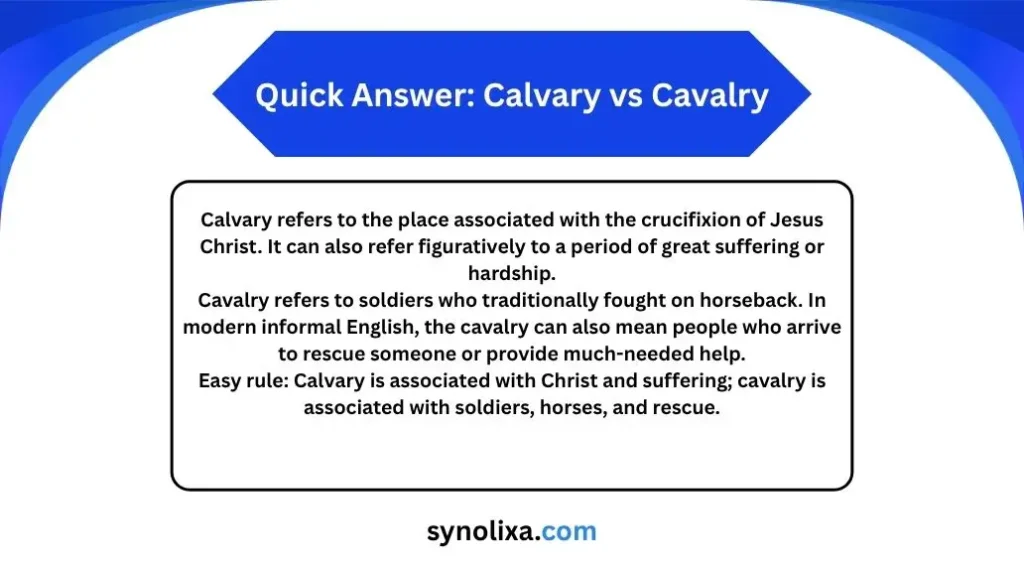
Calvary refers to the place associated with the crucifixion of Jesus Christ. It can also refer figuratively to a period of great suffering or hardship.
Cavalry refers to soldiers who traditionally fought on horseback. In modern informal English, the cavalry can also mean people who arrive to rescue someone or provide much-needed help.
Easy rule: Calvary is associated with Christ and suffering; cavalry is associated with soldiers, horses, and rescue.
Understanding the Basics of Calvary vs Cavalry
The main difference between calvary vs cavalry is their meaning, not their grammatical function. Both words are nouns, but they describe different things.
Although their spellings look similar, they belong to separate word families. Calvary is associated with Christian religious tradition, while cavalry is connected to military history.
Comparison Table
| Form | Type | Meaning | Example | Correct/Incorrect |
|---|---|---|---|---|
| Calvary | Proper noun; sometimes used figuratively | The place associated with Jesus’ crucifixion; a symbol of suffering | The painting showed Jesus on Calvary. | Correct |
| Cavalry | Common noun | Soldiers traditionally trained to fight on horseback | The cavalry crossed the field. | Correct |
| Calvary | Noun used in a military context by mistake | Incorrect substitute for cavalry | The calvary arrived on horseback. | Incorrect if military soldiers are intended |
| Cavalry | Noun used in a religious context by mistake | Incorrect substitute for Calvary | Jesus was crucified at Cavalry. | Incorrect if the biblical place is intended |
The last two examples are incorrect only when the writer intends the other word’s meaning. Both spellings are legitimate English words, so the correct choice depends on the context.
Why Are Calvary and Cavalry Confused?
There are three main reasons:
- Similar pronunciation: The words sound alike, particularly in quick conversation.
- Similar spelling: Both contain the letters c, a, l, v, and r, arranged in a slightly different order.
- Unfamiliar meanings: Some writers know one word but have rarely encountered the other.
The difference becomes easier to remember when you picture the concepts each word represents. Think of Calvary as a religious place and cavalry as a mounted military unit.
Correct Meanings and Uses of Calvary vs Cavalry
To use these words correctly, learn the meaning of each one separately. Understanding their definitions is more reliable than relying on pronunciation alone.
1. What Does Calvary Mean?
Calvary is the name traditionally given in Christian usage to the place where Jesus Christ was crucified. It is associated with the biblical account of his death and has an important place in Christian history and worship.
The name is related to the Latin word calvaria, meaning “skull.” The term is associated with the biblical name Golgotha, which is traditionally interpreted as “Place of a Skull.”
Because Calvary is a specific religious name, it is normally capitalized when referring to the biblical place.
Examples:
- The church displayed a painting of Jesus on Calvary.
- The sermon discussed the significance of Christ’s sacrifice at Calvary.
- The artist created a sculpture depicting the crucifixion at Calvary.
In each sentence, Calvary refers to the place associated with the crucifixion.
Sentence breakdown:
Example: The painting depicts the events at Calvary.
- The painting: The subject of the sentence.
- Depicts: The verb describing what the painting shows.
- The events at Calvary: The object phrase identifying the events represented.
The word Calvary identifies the religious setting.
2. Can Calvary Mean Suffering?
Yes. The word calvary can also be used figuratively to describe a period of severe suffering, hardship, or emotional difficulty.
In this figurative sense, the word refers to a painful experience rather than a physical location. It is often used in literary, religious, or expressive writing.
Examples:
- Recovering from the accident became a long calvary for the family.
- The novel describes the character’s calvary during years of hardship.
- She spoke about the emotional calvary she experienced during that difficult period.
This usage is understandable, but it is relatively literary. In everyday American English, phrases such as a painful ordeal, a difficult journey, or a period of suffering may sound more natural.
Sentence breakdown:
Example: The family endured a long calvary.
- The family: The subject.
- Endured: The verb showing that the family experienced something difficult.
- A long calvary: The noun phrase describing the hardship.
Here, calvary is used figuratively, not as the name of a location.
3. What Does Cavalry Mean?
Cavalry refers to a military unit traditionally made up of soldiers who fought on horseback. Before the widespread use of motorized vehicles, cavalry units were important because they could move quickly, scout enemy positions, and conduct attacks.
Historically, cavalry soldiers were trained to operate effectively with horses. Their mobility often gave them an advantage over slower military units.
Examples:
- The cavalry rode across the open field.
- The general ordered the cavalry to protect the supply route.
- The museum displayed uniforms and equipment used by cavalry soldiers.
- Historians studied the role of cavalry in nineteenth-century warfare.
In all these examples, cavalry refers to a military force.
Sentence breakdown:
Example: The cavalry advanced toward the enemy position.
- The cavalry: The subject, referring to the military unit.
- Advanced: The verb describing the unit’s movement.
- Toward the enemy position: The phrase explaining the direction.
The word cavalry is correct because the sentence describes soldiers and military movement.
4. What Does “Call in the Cavalry” Mean?
In modern informal English, “call in the cavalry” means to ask for help from people who can solve a difficult problem or rescue a situation.
The expression comes from the historical image of cavalry arriving to support troops in need. Today, it usually has a figurative meaning and does not involve horses or soldiers.
Examples:
- The project was behind schedule, so the manager called in the cavalry.
- When the computer system failed, the team called in the cavalry from the IT department.
- We were struggling to organize the event, so we called in the cavalry.
In these sentences, the cavalry means helpful people who arrive when assistance is needed.
Sentence breakdown:
Example: We called in the cavalry to finish the project.
- We: The subject.
- Called in: The phrasal verb meaning requested assistance.
- The cavalry: The people brought in to help.
- To finish the project: The purpose of requesting help.
This is a common expression in conversation and informal professional communication.
5. Can Cavalry Refer to Modern Military Forces?
Yes. Although cavalry originally referred to soldiers mounted on horses, the term has continued in military terminology. Some modern armed forces use cavalry for units that perform reconnaissance, surveillance, security, or other mobile operations.
These units may use armored vehicles rather than horses. The exact role depends on the country’s military organization.
Examples:
- The cavalry unit conducted a reconnaissance mission.
- The historian explained how traditional horse cavalry evolved into modern mechanized units.
- The military museum included exhibits on both mounted and armored cavalry.
The important point is that the word’s military meaning has developed over time. It does not always mean soldiers riding horses today.
Test Tip: How to Choose the Right Word
Ask yourself one simple question: What am I describing?
- If you mean the place associated with the crucifixion of Jesus, use Calvary.
- If you mean a difficult or painful experience in a literary sense, calvary may fit.
- If you mean mounted soldiers, a military unit, or people arriving to help, use cavalry.
Try replacing the word with a short definition. If soldiers or rescuers makes sense, choose cavalry. If the place of the crucifixion or a period of suffering makes sense, choose Calvary or its figurative form.
Calvary vs Cavalry: A Real-Life Case Study
Imagine that a student is preparing a history presentation about military forces in the nineteenth century. The student writes the following sentence:
The calvary played an important role in many historical battles.
The sentence contains a spelling error because the student is discussing mounted soldiers. The correct sentence is:
The cavalry played an important role in many historical battles.
Now imagine that the same student is writing about a painting of the crucifixion. The student writes:
The scene at Cavalry was deeply moving.
In this religious context, the correct sentence is:
The scene at Calvary was deeply moving.
A Workplace Example
Consider an office team facing a difficult deadline. One employee sends this message:
We have too much work left. Can someone call in the calvary?
The intended meaning is that the employee needs extra help. The correct message is:
We have too much work left. Can someone call in the cavalry?
The corrected version uses the familiar expression appropriately.
What Does This Case Study Teach Us?
These examples show why spelling must be connected to meaning. A spell-checking tool might not flag calvary because it is a correctly spelled word. However, it is still wrong when the writer intends cavalry.
Always review the full sentence, identify the intended meaning, and then confirm the spelling. Context is the key to choosing correctly between calvary vs cavalry.
Grammar Rules for Calvary vs Cavalry
Both words are nouns, so the main issue is vocabulary and spelling rather than a difference in grammatical structure.
Rule 1: Use Calvary for the Religious Place
When referring to the place associated with the crucifixion of Jesus Christ, use Calvary.
Correct:
- The church’s artwork depicts the crucifixion at Calvary.
- The speaker explained the religious importance of Calvary.
Incorrect for this intended meaning:
- The church’s artwork depicts the crucifixion at Cavalry.
The second sentence uses the name of a military unit instead of the religious place.
Rule 2: Use Cavalry for Military Units
When discussing soldiers traditionally mounted on horses or military units bearing the name, use cavalry.
Correct:
- The cavalry moved across the battlefield.
- The book describes the development of armored cavalry.
Incorrect for this intended meaning:
- The calvary moved across the battlefield.
Here, calvary does not name the military unit.
Rule 3: Use Cavalry in the Expression “Call in the Cavalry”
When referring figuratively to people who arrive to provide assistance, use cavalry.
Correct:
- We called in the cavalry to fix the technical problem.
Incorrect:
- We called in the calvary to fix the technical problem.
The expression is based on the military meaning of cavalry.
Rule 4: Capitalize Calvary When It Names the Biblical Place
Because the religious place is treated as a proper name, it is normally written with a capital C.
Correct:
- The painting represents Christ at Calvary.
When calvary is used as a general figurative noun meaning an ordeal, lowercase is appropriate in ordinary usage.
Example:
- The long recovery was a personal calvary.
Cavalry is usually lowercase when used as a general noun. Capitalization may vary when it appears in an official unit name, title, or the beginning of a sentence.
What Do Standard Dictionaries Say?
Standard references such as Merriam-Webster distinguish Calvary, the place associated with the crucifixion, from cavalry, the military term for mounted troops. These are separate words with separate definitions, even though their pronunciations are similar.
For accurate writing, consult a trusted dictionary when a word has a specialized religious, historical, or military meaning. A dictionary can confirm the spelling and definition, but the writer must still select the word that fits the sentence.
Common Calvary vs Cavalry Mistakes
The confusion between calvary vs cavalry often happens because the words look and sound alike. Many spelling mistakes begin with a small uncertainty that goes unnoticed during writing.
1. Confusing Similar Sounds
When people hear the words in conversation, they may not notice the difference between their middle syllables. If they have not learned the definitions, they may choose a spelling based on sound alone.
Solution: Connect each spelling with a mental image. Think of Calvary as the religious place and cavalry as soldiers or rescuers.
2. Typing Too Quickly
Fast typing can cause writers to reverse letters or select a familiar spelling without checking its meaning. A writer who intends cavalry may type calvary simply because the two words look similar.
Solution: Read the sentence once for meaning, not just spelling.
3. Relying Too Much on Autocorrect
Autocorrect may accept both words because both are legitimate English spellings. It may not recognize that the selected word is incorrect in the context.
Solution: Do not assume that a word is correct merely because a spelling tool accepts it.
4. Lack of Knowledge
Someone who has never encountered one of the words may not know that the other word exists or that their meanings are different.
Solution: Learn the definitions and practice using each word in a complete sentence.
5. Using the Wrong Word in an Expression
The familiar expression is call in the cavalry, not call in the calvary, when the intended meaning is to ask for assistance.
Solution: Memorize the entire expression rather than trying to spell it from its sound.
Similar Grammar and Spelling Confusions
| Confusing Words | Correct Difference | Example |
|---|---|---|
| It’s / Its | It’s means it is or it has; its shows possession. | It’s raining. The dog wagged its tail. |
| Your / You’re | Your shows possession; you’re means you are. | Your book is here. You’re welcome. |
| There / Their | There refers to a place or introduces a statement; their shows possession. | Put it there. Their house is large. |
| Principal / Principle | Principal can mean a school leader or something primary; principle means a rule or belief. | The principal explained the principle. |
| Affect / Effect | Affect is usually a verb meaning to influence; effect is usually a noun meaning a result. | The change affected us. The effect was clear. |
| Calvary / Cavalry | Calvary is religious; cavalry is military or figuratively helpful. | The painting showed Calvary. The cavalry arrived. |
The best way to avoid these errors is to learn each word’s meaning instead of relying on how it sounds.
Calvary vs Cavalry in Different Contexts
The correct word can become easier to identify when you consider the kind of writing you are doing.
1. Everyday Conversation
In everyday conversation, cavalry often appears in the expression call in the cavalry.
Examples:
- I need to call in the cavalry to help me move this furniture.
- We called in the cavalry when the event became too difficult to manage.
People may also use Calvary when discussing a church service, a religious painting, or a biblical story.
Example:
- The speaker discussed the meaning of Calvary during the service.
2. Professional Writing
In professional writing, choose the word that precisely matches the subject.
Examples:
- The historical report examined the role of cavalry in military campaigns.
- The project manager called in the cavalry to resolve the software issue.
The first sentence is a literal military use. The second is a figurative workplace expression.
In formal business writing, consider whether additional support, technical assistance, or an expert team would communicate the intended meaning more directly than the informal expression.
3. Creative Writing
Writers may use both words in stories, poems, historical novels, and other creative work.
Calvary may help establish a religious setting or symbolize suffering.
Example:
- The character described years of hardship as a personal calvary.
Cavalry may introduce a military scene or represent sudden assistance.
Example:
- Just as the defenders began to lose hope, the cavalry appeared on the horizon.
Writers should use each word intentionally because the difference affects the imagery and meaning of the passage.
4. Social Media and Texting
Short messages often contain spelling errors because people type quickly and rely on autocorrect.
Examples:
- Correct: Help! I need to call in the cavalry for this assignment.
- Incorrect for the intended meaning: Help! I need to call in the calvary for this assignment.
- Correct: The documentary discussed the significance of Calvary.
Even in informal writing, using the right word helps readers understand the message immediately.
5. Academic and Historical Writing
Academic writing requires particular care because Calvary and cavalry may appear in discussions of very different subjects.
Use Calvary when writing about Christian history, biblical narratives, religious art, or theological themes.
Use cavalry when discussing military organization, mounted warfare, historical battles, or the evolution of mobile military units.
For example:
- The essay examined the religious symbolism of Calvary.
- The research paper discussed the decline of traditional horse cavalry.
A clear distinction helps readers follow the subject without confusion.
Why the Difference Between Calvary and Cavalry Matters
It may seem like a small spelling difference, but the meaning of a sentence can change significantly when the wrong word appears.
Clarity in Communication
Correct spelling allows readers to understand the intended message without stopping to interpret an unusual word. If a history article uses calvary to describe mounted soldiers, readers may wonder whether the writer is referring to something religious or has made a mistake.
Professionalism
Spelling accuracy matters in essays, reports, presentations, articles, and workplace messages. A writer who uses words correctly shows care for the reader and the subject.
Accuracy in Digital Communication
Search engines, spell-checking software, and writing assistants can help identify possible errors, but they do not always understand the meaning of a complete sentence. Since both words are correctly spelled, an automated tool may not identify the wrong choice.
Proofreading remains important even when writing tools are available.
Respect for Specialized Meanings
Religious and historical subjects often use terms with precise meanings. Using Calvary and cavalry correctly helps preserve those distinctions.
A useful reminder is:
“Choose the word that matches your meaning, not just the sound.”
This simple principle applies to many commonly confused words in English.
Special Exceptions and Less Common Uses
Although the basic difference between calvary vs cavalry is straightforward, a few details deserve attention.
1. Figurative Calvary
The lowercase noun calvary can describe a difficult or painful experience. This figurative use draws on the suffering associated with the crucifixion.
Example:
- The long legal struggle became a calvary for the family.
This usage is possible, but it may sound formal, dramatic, or literary. In everyday US English, ordeal is often the more natural choice.
2. Modern Cavalry Units
The term cavalry does not always mean soldiers on horses. Some military organizations use the term for units that perform mobile reconnaissance or other specialized roles, including units equipped with vehicles.
Example:
- The article examined how cavalry changed with modern technology.
The word remains correct because military terminology has evolved.
3. Proper Names and Titles
Either spelling may appear in a book title, organization name, artwork title, or other proper name. In such cases, follow the official spelling of that name.
A title containing Cavalry does not make the word interchangeable with Calvary. The meaning still depends on the specific name and context.
4. Capitalization in Religious Writing
Use a capital C for Calvary when referring to the biblical place. When the word is used figuratively to describe hardship, lowercase is generally appropriate unless it begins a sentence or appears in a title.
5. Pronunciation Does Not Determine Spelling
Pronunciation can vary among speakers and accents. Even when two words sound alike, their spellings and definitions remain different. The safest approach is to learn the meaning of each word and check the context.
Quick Recap Checklist: Calvary vs Cavalry
Use this checklist whenever you are unsure which word belongs in your sentence.
| Question | If Yes → Use |
|---|---|
| Am I referring to the place associated with Jesus’ crucifixion? | Calvary |
| Am I referring to mounted soldiers in a historical battle? | Cavalry |
| Am I describing a modern military unit called cavalry? | Cavalry |
| Do I mean people arriving to provide urgent assistance? | Cavalry |
| Am I describing a painful experience in literary language? | Calvary |
| Am I using the familiar expression “call in the ___”? | Cavalry |
Three Practice Examples
Choose the correct word in each sentence before checking the answers.
1. The general ordered the ______ to advance across the field.
2. The painting depicted the crucifixion at ______.
3. We were struggling with the presentation, so we called in the ______.
Answers:
- Cavalry — The sentence refers to a military unit.
- Calvary — The sentence refers to the religious place.
- Cavalry — The expression refers to people who provide help.
A Simple Memory Trick
Remember these two associations:
- Calvary = Christ. Both begin with the letter C, and Calvary is associated with the crucifixion.
- Cavalry = soldiers. Think of cavalry troops moving across a battlefield or arriving to help.
This memory trick is not a formal grammar rule, but it makes the difference easier to remember.
FAQs
1. What is the main difference between Calvary and cavalry?
Calvary refers to the place associated with the crucifixion of Jesus Christ and can also describe suffering figuratively. Cavalry refers to soldiers traditionally mounted on horses or, informally, people who arrive to provide help.
2. Is it calvary or cavalry when asking for help?
Use cavalry. The expression call in the cavalry means to bring in people who can help solve a problem.
Example: We called in the cavalry to finish the project.
3. Is Calvary a religious word?
Yes. Calvary is a religious term associated with the crucifixion of Jesus Christ. It is traditionally used as the name of the place where the crucifixion occurred.
4. Does cavalry always mean soldiers riding horses?
No. Historically, cavalry referred to soldiers who fought on horseback. Today, some military organizations use the term for units that perform mobile operations using modern equipment and vehicles.
5. Can calvary mean suffering?
Yes. Calvary can be used figuratively to describe a period of severe hardship or suffering. This usage is relatively literary, and words such as ordeal may sound more natural in everyday American English.
6. Why do people confuse Calvary and cavalry?
People often confuse the words because their spellings are similar and their pronunciations can sound alike. Fast typing, autocorrect, and unfamiliarity with their meanings can also contribute to mistakes. Learning the definitions is the most reliable way to distinguish them.
Conclusion
Understanding calvary vs cavalry is simple once you remember that the two words have different meanings. Calvary refers to the place associated with the crucifixion of Jesus Christ. It can also describe a painful experience in figurative or literary writing. Cavalry, on the other hand, refers to soldiers traditionally mounted on horses, certain modern military units, or people who arrive to provide much-needed help.
Both words are correctly spelled, so a spelling checker may not catch every mistake. The key is to consider what your sentence means before choosing the word. If you are writing about religion or suffering, Calvary or its figurative form may be appropriate. If you are writing about soldiers, military history, or assistance, choose cavalry.
With a little practice, you can avoid this common confusion in essays, workplace messages, social media posts, and everyday conversations. Remember the meaning, check the context, and let the right word lead the way.

Hi, I am Noah Harrison. I work at Synolixa as an English language editor, reviewing and creating helpful content to make English learning easier and clearer.
[…] explore practical examples, and discover simple ways to avoid this common English mistake. Calvary vs Cavalry | Happy Holiday or Happy Holidays | So Do I vs So Am […]