
Have you ever looked at a group photo and wondered how to ask someone to identify themselves? Should you say “Which one is you?” or “Which one are you?” This common English grammar question can confuse students, English learners, and even people who use English every day. Understanding which one is you vs which one are you helps you choose the correct verb and communicate clearly in conversations, emails, and social media posts.
The confusion comes from the word “one.” Because “one” is singular, some people assume that the verb “is” must follow it. However, the correct verb depends on the grammatical structure of the question and the subject being identified. In standard American English, “Which one are you?” is the correct way to ask someone to identify themselves among several people, pictures, or choices.
Although people may understand “Which one is you?” in casual conversation, it is generally considered nonstandard in this context. Knowing the difference helps you avoid common subject-verb agreement mistakes and improve your written and spoken English.
In this guide, you will learn the meaning of both expressions, the grammar rules behind them, practical examples, common mistakes, and simple tips for remembering the correct form. Polite vs Courteous | Apposed vs Opposed | Damnit or Dammit
Quick Answer: Which One Is You vs Which One Are You?
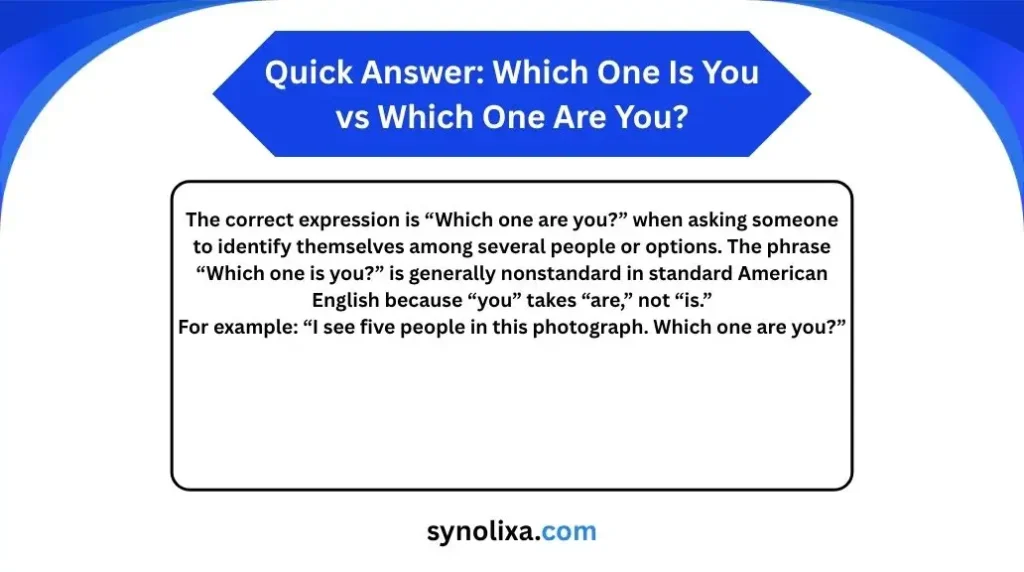
The correct expression is “Which one are you?” when asking someone to identify themselves among several people or options. The phrase “Which one is you?” is generally nonstandard in standard American English because “you” takes “are,” not “is.”
For example: “I see five people in this photograph. Which one are you?”
Understanding the Basics of Which One Is You vs Which One Are You
The difference between these expressions involves subject-verb agreement. In English, the verb “to be” changes according to its subject.
The standard forms are:
- I am
- You are
- He is
- She is
- It is
- We are
- They are
Because “you” takes “are,” the correct question is “Which one are you?” This remains true whether “you” refers to one person or several people.
Comparison Table: Which One Is You vs Which One Are You
| Form | Type | Meaning | Example | Correct/Incorrect |
|---|---|---|---|---|
| Which one are you? | Standard question | Asks someone to identify themselves | Which one are you in this picture? | Correct |
| Which one is you? | Nonstandard question | Attempts to ask someone to identify themselves | Which one is you in this picture? | Generally incorrect in standard English |
| Which one is he? | Standard question | Asks someone to identify a male person | Which one is he? | Correct |
| Which one is she? | Standard question | Asks someone to identify a female person | Which one is she? | Correct |
| Which one is it? | Standard question | Asks someone to identify an object or animal | Which one is it? | Correct |
| Which ones are yours? | Standard question | Asks which items belong to someone | Which ones are yours? | Correct |
Why Is Which One Are You Correct?
The expression “Which one are you?” follows standard English question formation. The question asks the listener to identify themselves, so the verb agrees with “you.”
Consider these examples:
- Statement: You are the person in the blue shirt.
- Question: Which person are you?
- Shorter question: Which one are you?
In each example, “you” takes the verb “are.”
The word “one” does not automatically require “is.” Instead, the verb depends on the subject and structure of the sentence.
Why Does Which One Is You Sound Understandable?
The expression “Which one is you?” may communicate the intended meaning because listeners can use the context to understand the question. However, a sentence can be understandable without following standard grammar.
When speaking in a formal setting, writing an email, completing schoolwork, or publishing an article, choose “Which one are you?”
Correct Meanings and Uses of Which One Is You vs Which One Are You
Understanding the difference between “which one is you” and “which one are you” becomes easier when you examine real situations.
1. Which One Are You? When Identifying Yourself
Use “Which one are you?” when someone needs to identify themselves among several people or choices.
Examples:
- I see several people in this photograph. Which one are you?
- There are six students in the picture. Which one are you?
- I found three profiles with similar names. Which one are you?
- Your team has several members. Which one are you?
In each example, the speaker asks the listener to identify themselves.
Sentence breakdown:
- “Which” asks the listener to choose.
- “One” refers to a particular person or option.
- “Are” agrees with “you.”
- “You” identifies the person being addressed.
Together, these words create a grammatically correct question.
2. Which One Is You vs Which One Are You in Photographs
Photographs are one of the most common situations in which people use this question.
Imagine that your friend shares a family picture containing ten people. You recognize a few faces but cannot identify your friend.
You could ask:
- Which one are you in this picture?
- Which person are you standing beside?
- Are you the person wearing the red shirt?
- Which person in the back row are you?
These questions sound natural in standard American English.
Avoid writing “Which one is you in this picture?” when you want to follow standard grammar. The correct choice is “Which one are you in this picture?”
3. Which One Are You When Choosing Between Options
The expression can also be used when discussing roles, accounts, teams, or categories.
Examples:
- There are four teams. Which one are you on?
- I have two accounts open. Which one are you using?
- We have several project groups. Which one are you part of?
- There are three available roles. Which one are you interested in?
These examples show that the question can be expanded to provide more information.
The correct verb still depends on the subject of the sentence. When the subject is “you,” use “are.”
4. When to Use Which One Is He or Which One Is She
The correct expression changes when you ask about someone else.
Examples:
- Which one is he?
- Which one is she?
- Which one is your brother?
- Which one is the new teacher?
In these examples, “he,” “she,” and the singular noun phrases take “is.”
Compare the following questions:
- Which one are you?
- Which one is he?
- Which one is she?
- Which one are they?
The verb changes according to the subject, not simply because the word “one” appears in the question.
5. When Which One Is You Is Confused with Which One Is It
When asking about a single object, “Which one is it?” is correct.
Examples:
- There are three keys on the table. Which one is it?
- I ordered two packages. Which one is it?
- Several books arrived today. Which one is it?
- I heard a strange sound. Which one is it?
In these sentences, “it” takes “is.”
This comparison helps explain why “Which one are you?” is correct while “Which one is you?” is generally nonstandard in standard English.
Test Tip: Replace the subject with a familiar pronoun. If the subject is “you,” use “are.” If the subject is “it,” use “is.”
Case Study: Which One Is You vs Which One Are You in Real Life
Imagine that Maya and Jordan are looking at an old school reunion photograph. Maya recognizes some people but cannot find Jordan.
Maya: I found this picture from your school reunion. There are so many people in it!
Jordan: Yes, that was a big event.
Maya: I recognize a few faces, but I cannot find you. Which one are you?
Jordan: I am standing in the back row, next to the person wearing a red jacket.
Maya: Oh, now I see you!
This is a natural example of the correct expression.
If Maya asked, “Which one is you?” Jordan would probably understand the intended meaning. However, the wording would sound nonstandard to many English speakers.
Workplace Example: Which One Are You?
Imagine a manager reviewing employee profiles.
Manager: I have several profiles open. Which one are you?
Employee: I am the profile with the blue background and my initials.
The question is direct, professional, and grammatically correct.
Email Example: Which One Are You?
When writing a professional email, you may prefer a more detailed question.
Example:
“Hi Alex,
I was looking through the event photos and noticed several people I did not recognize. Could you tell me which person you are in the group picture?
Thank you!”
This wording is clear and polite. It also avoids the nonstandard construction “Which one is you?”
Grammar Rules Behind Which One Is You vs Which One Are You
To understand why “Which one are you?” is correct, you need to know two important grammar rules: subject-verb agreement and question formation.
Rule 1: You Always Takes Are in Standard English
In the present tense, the verb “to be” follows these patterns:
- I am ready.
- You are ready.
- He is ready.
- She is ready.
- It is ready.
- We are ready.
- They are ready.
The same rule applies when forming questions.
Correct examples:
- Are you ready?
- Where are you?
- Who are you?
- Which one are you?
Nonstandard examples:
- Is you ready?
- Where is you?
- Which one is you?
This is the main reason “Which one are you?” is the standard form.
Rule 2: English Questions Often Change Word Order
In a statement, the subject commonly comes before the verb.
Example: “You are the person I met yesterday.”
When you form a yes-or-no question, the verb moves before the subject.
Example: “Are you the person I met yesterday?”
Questions beginning with “which” follow a related structure.
Example: “Which one are you?”
The question begins with “which one,” followed by the verb “are” and the subject “you.”
Rule 3: The Word One Does Not Always Determine the Verb
The word “one” is singular, but that does not mean every sentence containing it must use “is.”
Consider these examples:
- Which one is missing?
- Which one are you?
- Which one is your favorite?
- Which one are they choosing?
In “Which one is missing?” the missing item is the subject, so “is” is correct.
In “Which one are you?” the question asks the listener to identify themselves, and “you” takes “are.”
In “Which one are they choosing?” the subject is “they,” so “are” is appropriate.
The correct verb depends on the sentence’s grammatical structure.
Rule 4: Standard Grammar References and Usage
Standard American English grammar follows established rules for subject-verb agreement and interrogative word order. Reference works such as Merriam-Webster provide guidance on English usage, while standard grammar references explain the forms of “to be” and the structure of questions.
The relevant rule is simple: “you” takes “are” in standard English.
Therefore, when asking someone to identify themselves, use “Which one are you?”
Informal speech and regional dialects can differ from edited English, but the standard form is the best choice for schoolwork, business communication, and general publication.
Common Mistakes with Which One Is You vs Which One Are You
Many people make grammar mistakes because they focus on a single word rather than the complete sentence.
1. Assuming One Always Requires Is
Because “one” is singular, some writers believe that “is” must follow it.
Nonstandard: Which one is you?
Standard: Which one are you?
The verb must match the relevant grammatical subject and sentence structure.
2. Translating Directly from Another Language
Different languages use different question structures. Translating a sentence word for word may lead to an incorrect verb or unusual word order.
To improve, practice common English questions as complete phrases:
- Which one are you?
- Where are you?
- Who are you?
- What are you doing?
Repeated practice helps you recognize natural English patterns.
3. Typing Too Quickly
Fast typing can cause errors in text messages, emails, and social media comments.
A writer may type “Which one is you?” without noticing the subject-verb agreement problem.
A quick proofreading check can help you catch this mistake before sending your message.
4. Depending on Autocorrect
Autocorrect often detects spelling mistakes but may miss grammar problems. Every word in “Which one is you?” is spelled correctly, even though the sentence is generally nonstandard in standard English.
Read your writing carefully instead of relying entirely on automated corrections.
5. Not Understanding Subject-Verb Agreement
Some English learners know that “one” is singular but do not realize that “you” takes “are” even when referring to one person.
Reviewing the basic forms of “to be” can help prevent this and many related mistakes.
Comparison Table: Similar Grammar Confusions
| Common confusion | Correct form | Explanation |
|---|---|---|
| Which one is you? / Which one are you? | Which one are you? | “You” takes “are.” |
| It’s / Its | It’s = it is or it has; its = possessive | The apostrophe changes the meaning. |
| Your / You’re | Your = possessive; you’re = you are | Choose the form that matches the meaning. |
| There is / There are | There is one book; there are two books. | The verb agrees with the relevant noun phrase. |
| He don’t / He doesn’t | He doesn’t know. | “He” takes “does” in the present simple. |
| You was / You were | You were correct. | “You” takes “were” in the past tense. |
| Who is / Who are | Who is calling? Who are they? | The correct verb depends on the construction. |
Using Which One Is You vs Which One Are You in Different Contexts
The phrase “which one are you?” can be used in everyday conversation, professional writing, creative writing, and digital communication. The context may affect the tone, but it does not change the standard grammar rule.
1. Everyday Conversation
In casual conversation, people often use short and direct questions.
Examples:
- Which one are you in the family picture?
- Which one are you on the team?
- Which one are you talking about?
- Which one are you?
These questions sound natural when the choices are clear.
If the listener might not understand the context, add a few words. For example, “Which person are you in the photograph from last night’s event?” is more specific.
2. Professional Writing
Professional communication benefits from clear and grammatically correct sentences.
Examples:
- Could you confirm which person you are in the attached photograph?
- Please identify which profile is yours.
- Could you tell me which account you are using?
These alternatives may sound more precise than “Which one are you?” when the reader needs additional context.
Avoid “Which one is you?” in formal emails and reports because it does not follow standard English grammar.
3. Creative Writing
Creative writers may use nonstandard expressions to represent a character’s dialect, personality, or language-learning background.
For example, a fictional character might say “Which one is you?” to reflect a particular speech pattern.
That is a stylistic choice, not the standard grammatical form. In ordinary edited prose, “Which one are you?” remains the recommended expression.
4. Social Media and Texting
Short questions are common on social media, messaging apps, and online forums.
Examples:
- Which one are you in this photo?
- Which one are you? 😂
- I cannot recognize everyone here. Which one are you?
- Tag yourself! Which one are you?
Emojis can make the question more playful, but they do not change the grammar.
Even in casual digital communication, “Which one are you?” is clear and natural.
Why Understanding Which One Is You vs Which One Are You Matters
Learning the difference between these expressions can improve your writing and speaking skills.
1. Clarity in Communication
Correct grammar makes your meaning easier to understand. When you use the expected word order and verb form, readers can focus on your message rather than interpreting an unusual sentence.
“Which one are you?” clearly asks someone to identify themselves.
2. Professionalism
Correct grammar helps improve emails, applications, reports, presentations, and workplace messages.
A single error may not ruin a message, but consistent accuracy creates a more polished impression.
3. Accuracy in Digital Communication
People often read online messages quickly. Clear wording reduces confusion in text messages, workplace chats, online communities, and social media comments.
4. Stronger English Skills
Understanding why “Which one are you?” is correct can help you form other questions.
Examples:
- Where are you?
- Who are you?
- What are you looking for?
- Which team are you on?
Remember: “Clear words make clear communication.”
Correct grammar helps your intended meaning come through without unnecessary distractions.
Special Exceptions to Which One Is You vs Which One Are You
There is no standard grammatical exception that makes “Which one is you?” the preferred expression when asking someone to identify themselves. However, a few related situations are worth understanding.
1. Informal Speech and Dialects
English includes many dialects and informal speech patterns. Some speakers may use constructions that differ from standard edited English.
A nonstandard expression may still communicate a clear meaning in a particular conversation. However, in formal writing, school assignments, and professional communication, use “Which one are you?”
2. Questions About Objects
When the question refers to a single object, “is” may be correct.
Examples:
- Which one is yours?
- Which one is missing?
- Which one is the correct answer?
- Which one is your bag?
These sentences are grammatical because their structures differ from “Which one are you?”
3. Questions with Other Verbs
You can also use other verbs to make the question more specific.
Examples:
- Which one do you prefer?
- Which one did you choose?
- Which one are you using?
- Which one would you like?
These are all standard questions, but each asks for slightly different information.
4. Brand Names and Titles
A company, product, song, or creative work may intentionally use unusual grammar in its official name or title. When referring to a proper name, reproduce it as officially written.
This does not change the normal grammar rule for asking someone to identify themselves.
Quick Recap Checklist: Which One Is You vs Which One Are You
Use this checklist whenever you are unsure which expression to choose.
| Question | If Yes → Use |
|---|---|
| Are you asking someone to identify themselves? | Which one are you? |
| Is “you” the subject of the question? | Use “are.” |
| Are you asking about an object using “it”? | Which one is it? |
| Are you asking about a male person using “he”? | Which one is he? |
| Are you asking about a female person using “she”? | Which one is she? |
| Are you writing a school assignment or professional email? | Use the standard grammatical form. |
Practice Examples
Example 1: Identifying a Friend
You are looking at a group photo and want to identify your friend.
A. Which one is you?
B. Which one are you?
Correct answer: B. “Which one are you?” uses the correct verb form for “you.”
Example 2: Finding a Missing Key
You are looking for a missing key.
A. Which one is missing?
B. Which one are missing?
Correct answer: A. “Which one is missing?” is correct because “one” refers to a single item.
Example 3: Identifying Another Person
You want to identify a female friend in a photograph.
A. Which one is she?
B. Which one are she?
Correct answer: A. “Which one is she?” is correct because “she” takes “is.”
The main lesson is to identify the grammatical subject before choosing the verb.
FAQs
1. Is “which one are you?” grammatically correct?
Yes. “Which one are you?” is the standard grammatical expression used to ask someone to identify themselves among several people or options. The pronoun “you” takes “are” in standard English.
2. Is “which one is you?” ever correct?
In standard American English, “which one is you?” is generally considered nonstandard when asking someone to identify themselves. It may appear in informal speech, dialects, or creative dialogue, but “which one are you?” is the recommended form.
3. Why do we say “which one are you” instead of “which one is you”?
We use “are” because the subject is “you.” Standard English uses “are” with “you,” whether it refers to one person or several people.
4. Can I use “which one are you?” in formal writing?
Yes. It is grammatically correct. For greater clarity in a formal email, you can write, “Which person are you in the photograph?” or “Could you identify yourself in the attached image?”
5. Should I say “which one is he?” or “which one are he?”
Say “Which one is he?” The pronoun “he” takes “is” in standard English. “Which one are he?” is grammatically incorrect in standard American English.
6. Is “which one are you?” correct when talking to one person?
Yes. The pronoun “you” takes “are” even when it refers to a single person. For example, “Which one are you in this picture?” is correct when speaking to one person.
Conclusion
Understanding which one is you vs which one are you becomes easy when you remember one basic rule: in standard English, “you” takes the verb “are,” not “is.” Therefore, “Which one are you?” is the correct and natural way to ask someone to identify themselves among several people, pictures, or choices.
The confusion often comes from the word “one,” which is singular. However, the correct verb depends on the grammatical subject and sentence structure. When “you” is the subject, use “are.” When you ask about an object using “it,” a male person using “he,” or a female person using “she,” “is” may be correct.
Whether you are chatting with friends, writing an email, posting on social media, or completing a school assignment, choose the expression that follows standard English grammar.
Remember this simple rule: “Which one are you?” is correct because “you” takes “are.” Master this pattern, and you will be able to form clearer questions and avoid many common subject-verb agreement mistakes.

Hi, I am Noah Harrison. I work at Synolixa as an English language editor, reviewing and creating helpful content to make English learning easier and clearer.
[…] rules, differences, examples, common mistakes, and practical uses of unorganized and disorganized. Which One Is You vs Which One Are You | Polite vs Courteous | Apposed vs […]