Have you ever typed a sentence like “I mine as well go” and wondered if it looks right? 🤔 You are not alone. The phrases mine as well or might as well or mind as well sound very similar when spoken quickly, so it is easy to confuse them in texting, emails, and everyday conversations.
The good news is that the rule is simple. “Might as well” is the standard and correct expression when you mean that an action is reasonable because there is no better option. “Mine as well” and “mind as well” are usually spelling mistakes caused by hearing the phrase incorrectly or typing too quickly.
For example, if your friends are already ordering pizza, you might say, “I might as well get one too.” This means that getting pizza seems like a reasonable choice in the situation.
In this guide, we will explain mine as well or might as well or mind as well, show why “might as well” is correct, examine common mistakes, and provide simple examples you can remember. By the end, choosing the right expression should feel easy. ✅ To Fast or Too Fast | Input or Imput |Company-Wide or Companywide
Quick Answer: Mine as Well or Might as Well or Mind as Well
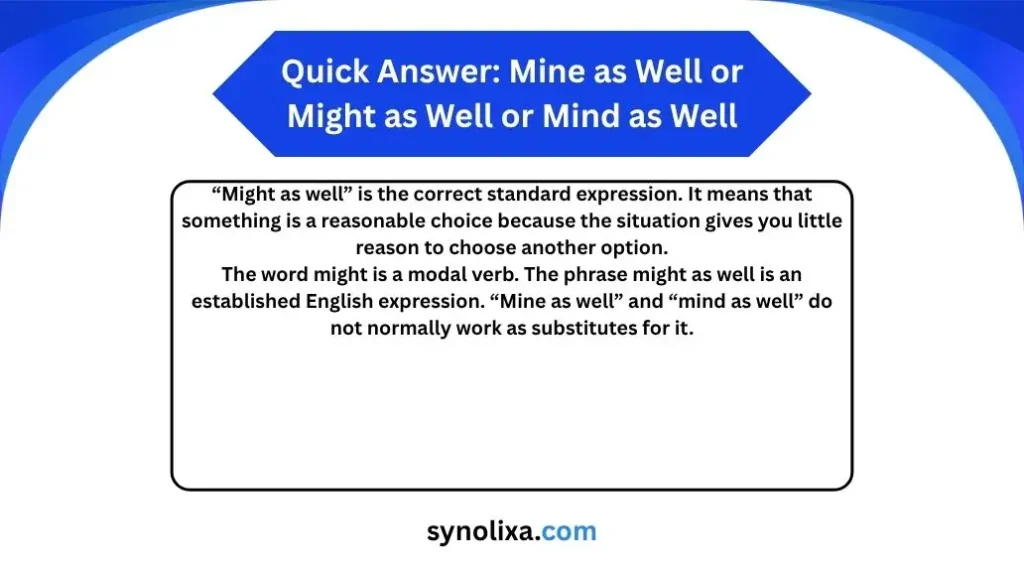
“Might as well” is the correct standard expression. It means that something is a reasonable choice because the situation gives you little reason to choose another option.
- ✅ I might as well go home.
- ❌ I mine as well go home.
- ❌ I mind as well go home.
The word might is a modal verb. The phrase might as well is an established English expression. “Mine as well” and “mind as well” do not normally work as substitutes for it.
Understanding the Basics: Mine as Well or Might as Well or Mind as Well
The biggest difference is that might as well is a standard grammatical expression, while mine as well and mind as well are generally incorrect when used with this meaning.
The phrase might as well often communicates the idea of:
“Since there is no strong reason not to do it, doing it seems reasonable.”
For example:
The movie starts in five minutes, so we might as well wait here.
The speaker is saying that waiting is the sensible choice because the movie will begin soon.
Comparison Table
| Form | Type | Meaning | Example | Correct/Incorrect |
|---|---|---|---|---|
| might as well | Modal expression | It is reasonable to do something | We might as well stay. | ✅ Correct |
| mine as well | Possessive pronoun + phrase | Not the standard expression intended here | I mine as well go. | ❌ Incorrect |
| mind as well | Noun/verb “mind” + phrase | Not the standard expression intended here | I mind as well go. | ❌ Incorrect |
Why Does “Might as Well” Sound Different?
In natural speech, might as well is often pronounced quickly. The sounds can blend together, especially in casual conversation.
“Might as well” may sound something like:
“might-uhs-well”
When someone hears this phrase without seeing it written, they may incorrectly connect the sound to another familiar word.
This is one reason people sometimes write:
- “mine as well”
- “mind as well”
The problem is not usually grammar knowledge alone. It can also be a sound-to-spelling problem.
Correct Meanings & Uses of “Might as Well”
1. When Something Is the Practical Choice
The most common use of might as well is to describe a practical decision.
Example:
We are already at the store, so we might as well buy some groceries.
Sentence breakdown
- We = subject
- are already at the store = situation
- so = connects the reason to the decision
- might as well buy = reasonable action
The speaker is saying that buying groceries makes sense because they are already at the store.
2. When There Is No Better Option
“Might as well” can also suggest that there is little benefit in choosing another option.
Example:
The bus is delayed, so we might as well walk.
The speaker has considered the situation and believes walking is a reasonable alternative.
3. When You Decide to Do Something Anyway
Sometimes might as well means that you have decided to do something because there is no strong reason to avoid it.
Example:
I am already awake, so I might as well finish my homework.
The person is already awake, so completing the homework seems reasonable.
4. When Accepting an Unavoidable Situation
The phrase can also show acceptance.
Example:
If we have to wait another hour, we might as well find a comfortable place to sit.
The speaker accepts the waiting and chooses a useful response.
5. When Making a Casual Suggestion
“Might as well” can sound like a relaxed suggestion.
Example:
We are all here, so we might as well start.
This does not necessarily mean the speaker is extremely enthusiastic. It simply means starting now seems reasonable.
6. When Talking About Time
You can use the expression when an activity takes advantage of available time.
Example:
We have thirty minutes before the meeting, so we might as well get some coffee.
The available time makes getting coffee a reasonable option.
7. With “Might as Well” + Base Verb
After might as well, use the base form of the verb.
Correct:
- I might as well go.
- She might as well stay.
- They might as well wait.
- We might as well leave.
Incorrect:
- ❌ I might as well going.
- ❌ She might as well stays.
- ❌ They might as well waited.
This happens because might is a modal verb. Modal verbs are followed by the base form of a verb.
8. “Might as Well” in Questions
The expression can appear in questions, especially when suggesting an option.
Example:
Might as well order now, right?
This is casual conversational English. The full version could be:
We might as well order now, right?
Test Tip: How to Remember “Might as Well”
Here is a simple test. 🧠
Ask yourself:
Am I saying that something is reasonable because there is little reason to choose another option?
If yes, use:
might as well
For example:
It is already late. I might as well go home.
If your sentence has this meaning, “might as well” is almost certainly the expression you need.
Easy Memory Trick
Think:
MIGHT = reasonable choice
If you can replace the phrase with something like “it would be reasonable to”, “might as well” probably fits.
We might as well leave.
≈
It would be reasonable for us to leave.
Why “Mine as Well” Is Usually Incorrect
The word mine is a possessive pronoun.
For example:
That book is mine.
Here, “mine” shows ownership.
Other examples include:
- This phone is mine.
- The blue jacket is mine.
- That seat is mine.
However, mine does not belong in the standard expression might as well.
Therefore:
❌ I mine as well leave.
is not correct when the intended meaning is:
✅ I might as well leave.
Why People Write “Mine as Well”
The mistake often comes from pronunciation.
When someone hears might as well quickly, the phrase may not sound exactly like it looks. A person may unconsciously turn the sound into mine as well.
This is especially common in:
- texting
- casual online conversations
- fast typing
- speech-to-text
- informal social media posts
Why “Mind as Well” Is Usually Incorrect
Mind is a real English word, but that does not make mind as well a correct replacement for might as well.
“Mind” can function as a noun or verb.
As a noun:
Your mind can focus on many things.
As a verb:
Do you mind waiting?
However, neither meaning creates the standard expression mind as well.
Therefore:
❌ We mind as well stay.
should be:
✅ We might as well stay.
A Useful Distinction
Compare these:
Do you mind waiting?
Here, mind is a verb meaning to object to or be bothered by something.
We might as well wait.
Here, might as well means waiting is a reasonable choice.
They have completely different grammatical functions.
Might as Well vs. Might Well
These expressions are not identical.
Might as well
Might as well suggests that an action is reasonable under the circumstances.
We might as well start now.
Might well
Might well generally means that something is quite possible or likely.
She might well win the competition.
In the first sentence, the speaker is making a practical choice.
In the second sentence, the speaker is discussing possibility.
This distinction is important because removing as can change the meaning.
Might as Well vs. Should
“Might as well” and “should” can sometimes express similar practical ideas, but they are not exactly the same.
Compare:
You should call your teacher.
This sounds like advice or a recommendation.
You might as well call your teacher.
This can suggest that calling is a sensible option, perhaps because there is little downside to doing so.
“Might as well” often sounds more casual and less forceful than “should.”
Case Study: A Workplace Conversation
Imagine that two coworkers are preparing a presentation.
The meeting starts in twenty minutes, and they have already finished most of their work.
One coworker says:
“We have already completed the main slides. We might as well review them one more time.”
This is a natural use of might as well.
The coworker is not giving a strict command. Instead, they are suggesting that another review is a sensible use of the remaining time.
Now imagine someone writes this in an email:
“We mine as well review the slides.”
That spelling is incorrect.
The professional version is:
“We might as well review the slides.”
Why the Correct Form Matters
A spelling mistake in a casual text may not cause a serious problem. However, the same mistake in a workplace email can make the writer appear less careful.
Correct grammar helps the reader focus on the message rather than the error.
Grammar Rules: Why “Might as Well” Is Correct
The key word is might.
Might is a modal auxiliary verb. Modal verbs include words such as:
- can
- could
- may
- might
- must
- shall
- should
- will
- would
A modal verb is normally followed by the base form of the main verb.
Examples:
- might go
- might stay
- might leave
- might wait
The expression might as well has developed into a common fixed construction.
For example:
We might as well leave.
The structure is:
Subject + might + as well + base verb
So:
I + might + as well + go.
This produces:
I might as well go.
Standard dictionaries such as Merriam-Webster recognize might as well as an established English expression. The expression is used to indicate that an action is advisable or reasonable under the circumstances.
This is why replacing might with mine or mind changes the construction and removes the intended grammatical meaning.
Common Mistakes
Why do people confuse mine as well or might as well or mind as well?
There are several common reasons.
1. Fast Typing
When people type quickly, they may write the first word that sounds right.
For example:
“I mine as well do it.”
The writer may know the phrase but type it incorrectly.
2. Pronunciation
English pronunciation does not always match spelling.
When might as well is spoken rapidly, the individual sounds can blend together.
3. Autocorrect
Autocorrect can sometimes suggest or preserve a word that looks familiar.
Because mine and mind are real English words, a keyboard may not always recognize the intended phrase.
4. Lack of Knowledge
Some writers may have heard the phrase many times without seeing it written.
They know the sound but not the spelling.
5. Confusing Real Words
“Mine” and “mind” are both legitimate English words. This makes the mistake less obvious than a completely unfamiliar spelling.
Similar Grammar Confusions
The mine as well or might as well or mind as well confusion is part of a larger pattern in English. People often confuse words that sound similar or appear similar.
| Confusion | Correct Form | Meaning |
|---|---|---|
| your / you’re | your / you’re | Possession / you are |
| its / it’s | its / it’s | Possession / it is |
| their / there / they’re | their / there / they’re | Possession / place / they are |
| to / too / two | to / too / two | Direction/infinitive / also/excessively / number |
| then / than | then / than | Time/order / comparison |
| affect / effect | affect / effect | Usually influence / result |
| might / mine / mind | might in “might as well” | Reasonable choice |
These errors are called commonly confused words because their sounds, spellings, or meanings can overlap.
Usage in Different Contexts
Everyday Conversation
“Might as well” is very common in casual speech.
Examples:
It is raining, so we might as well stay inside.
The store is close, so we might as well walk.
You are already here, so you might as well join us.
The phrase sounds natural and relaxed.
Professional Writing
“Might as well” is grammatically correct in professional writing, but the tone should match the situation.
Example:
Since the report is nearly complete, we might as well review the final section today.
This is acceptable in many workplace contexts.
However, in very formal writing, a more direct expression may sometimes be preferable.
For example:
Since the report is nearly complete, we should review the final section today.
The best choice depends on the intended tone.
Creative Writing
Writers can use might as well to show a character’s attitude.
Example:
The rain had already ruined the picnic, so they might as well head home.
Here, the expression can convey resignation or practical acceptance.
Social Media and Texting
“Might as well” is extremely natural in informal digital communication.
Examples:
Already awake. Might as well study. 📚
We are already downtown, so might as well grab lunch. 😄
In very casual texting, speakers sometimes leave out the subject:
Might as well go.
That is common informal English, although a complete sentence would be:
We might as well go.
Why It Matters
Using the correct expression matters because small grammar choices can affect clarity.
1. Clarity
The correct phrase makes your intended meaning immediately clear.
I might as well go.
is easy for readers to understand.
2. Professionalism
In school, work, or formal communication, accurate spelling creates a more polished impression.
3. Digital Communication
Text messages and social media posts are often written quickly. That makes commonly confused words especially easy to mix up.
4. Better Language Skills
Learning why might as well is correct helps you recognize similar patterns in other expressions.
A useful principle is:
Clear writing makes ideas easier to understand.
Grammar is not just about rules. It is also about making communication smoother.
Special Exception: Can “Mine” or “Mind” Ever Be Correct?
Yes, but this is an important distinction.
Mine and mind are real English words. They can appear near the words as well in completely different sentences.
For example:
The red bicycle is mine as well.
Here, mine is a possessive pronoun, and the sentence means that the red bicycle also belongs to the speaker.
However, this is very different from:
I might as well take the bicycle.
Likewise, mind can occur with “as well” in other grammatical constructions.
For example:
You might mind as well as anyone else.
This would require a different grammatical context, and it does not mean the common expression “might as well.”
So the simple rule remains:
If you mean “it is reasonable to do this,” use “might as well.”
Might as Well in Negative Sentences
You can also use the expression in negative constructions, although the exact structure depends on the meaning.
For example:
We might as well not go if the weather is getting worse.
Here, the speaker considers not going to be the reasonable option.
The structure is:
might as well + not + base verb
Examples:
- We might as well not wait.
- I might as well not bother.
- They might as well not come.
These sentences can sometimes express resignation or frustration, depending on context.
Might as Well in Past Contexts
“Might as well” is also used when talking about decisions in past situations.
For example:
Since we were already there, we figured we might as well stay for dinner.
The phrase still expresses the idea that staying was a reasonable choice under the circumstances.
Another example:
She had already driven that far, so she thought she might as well continue.
The meaning is practical rather than a simple statement of possibility.
Might as Well With “You”
“Might as well” can sometimes sound like advice when used with you.
For example:
You might as well ask.
This means asking seems reasonable because there is little reason not to ask.
Compare:
You should ask.
This is more direct.
You might as well ask.
This is more casual and can suggest, “There is nothing to lose by asking.”
Quick Recap Checklist
Use this checklist whenever you are unsure about mine as well or might as well or mind as well.
| Question | If Yes → Use |
|---|---|
| Do you mean “this is a reasonable thing to do”? | might as well |
| Are you making a practical suggestion? | might as well |
| Are you saying there is little reason not to do something? | might as well |
| Are you talking about ownership? | mine |
| Are you using “mind” as a verb or noun? | mind |
| Are you writing the fixed expression meaning “it is reasonable”? | might as well |
Practice Examples
1. The store closes soon, so I ___ leave now.
Correct answer:
might as well
2. This laptop is ___.
Correct answer:
mine
3. Do you ___ if I sit here?
Correct answer:
mind
Notice how the surrounding meaning determines the correct word.
Common Examples: Correct and Incorrect
Example 1
❌ I mine as well go.
✅ I might as well go.
Why? The speaker means going is a reasonable choice.
Example 2
❌ We mind as well stay.
✅ We might as well stay.
Why? The sentence expresses a practical decision.
Example 3
❌ She might as well goes.
✅ She might as well go.
Why? “Might” is a modal verb, so it takes the base verb go.
Example 4
❌ They might as well waited.
✅ They might as well wait.
Why? The base form follows “might.”
Example 5
✅ That seat is mine.
Here, mine is correct because the sentence expresses possession.
Example 6
✅ Do you mind waiting?
Here, mind is correct because it functions as a verb.
How to Avoid This Mistake Forever
The easiest way is to connect the expression with its meaning.
Do not memorize only the spelling.
Memorize:
MIGHT AS WELL = a reasonable choice
For example:
We have nothing else to do, so we might as well watch a movie.
Once you connect might as well with this meaning, it becomes much easier to remember.
A Three-Step Check
When writing the phrase, follow these steps:
- Identify the meaning.
Are you saying something is reasonable? - Choose “might.”
Use the modal verb might. - Use the base verb.
Write might as well + verb.
Example:
Reasonable choice → might → might as well go
That simple pattern can prevent the error.
FAQs
1. Is it “mine as well” or “might as well”?
“Might as well” is correct when you mean that something is a reasonable choice under the circumstances. “Mine as well” is usually a spelling mistake in this expression.
2. Is it “mind as well” or “might as well”?
“Might as well” is the standard expression. “Mind as well” is incorrect when you are trying to express the idea of doing something because it seems reasonable.
3. What does “might as well” mean?
“Might as well” means that an action seems reasonable because there is little reason to choose another option. For example, “It is already late, so we might as well go home.”
4. Is “might as well” grammatically correct?
Yes. “Might as well” is a standard English expression. It commonly appears before a base-form verb, as in “We might as well leave.”
5. Can “mine as well” ever be correct?
Yes, but only in a different grammatical context. Mine can be a possessive pronoun, so it may appear next to “as well” when discussing ownership. It is not a replacement for might as well.
6. Why do people say “mine as well” instead of “might as well”?
The mistake usually happens because might as well can sound different when spoken quickly. Fast typing, pronunciation, autocorrect, and unfamiliarity with the written phrase can also cause the error.
Conclusion
When choosing between mine as well or might as well or mind as well, the correct choice for the common expression is might as well. Use it when you mean that an action is reasonable, practical, or worth doing because there is little reason to choose another option.
For example:
We might as well leave now.
The words mine and mind are also correct English words, but they have different meanings. Mine usually expresses possession, while mind can refer to the brain or function as a verb. Neither replaces might in the standard expression might as well.
Remember the simple formula:
MIGHT AS WELL + BASE VERB
I might as well go.
We might as well stay.
They might as well wait.
So, whenever you mean “this is a reasonable thing to do,” choose might as well.
When in doubt, remember: If the choice makes sense, you might as well use “might.” ✅

Hi, I am Noah Harrison. I work at Synolixa as an English language editor, reviewing and creating helpful content to make English learning easier and clearer.
[…] Once you learn the simple rule, choosing between when I can or when can I becomes much easier. Mine as Well or Might as Well or Mind as Well | To Fast or Too Fast | Input or […]
[…] should you write its self or itself? In ordinary English, choose itself. When I Can or When Can I | Mine as Well or Might as Well or Mind as Well | To Fast or Too […]