Have you ever written a work email and stopped at the same small question: company-wide or companywide? 🤔 The difference looks tiny, but that hyphen can make you wonder whether one spelling is correct and the other is a mistake.
The good news is that both “company-wide” and “companywide” are accepted forms. They have the same basic meaning: something that affects, includes, or applies to an entire company. Cambridge Dictionary lists company-wide and also recognizes companywide as a form used in English.
So, why do writers hesitate? The answer is mainly style and word formation, not meaning. The hyphenated form can make the compound easier to read, especially when it appears before a noun. The closed form, companywide, is also well established in modern English.
In this guide, we will explain the difference between company-wide and companywide, show you when to use each form, discuss common mistakes, and give you practical examples for emails, reports, policies, social media, and everyday writing. Unselect or Deselect | Heard vs Herd vs Hurd | As Evidenced By or As Evident By
Quick Answer: Company-Wide or Companywide?
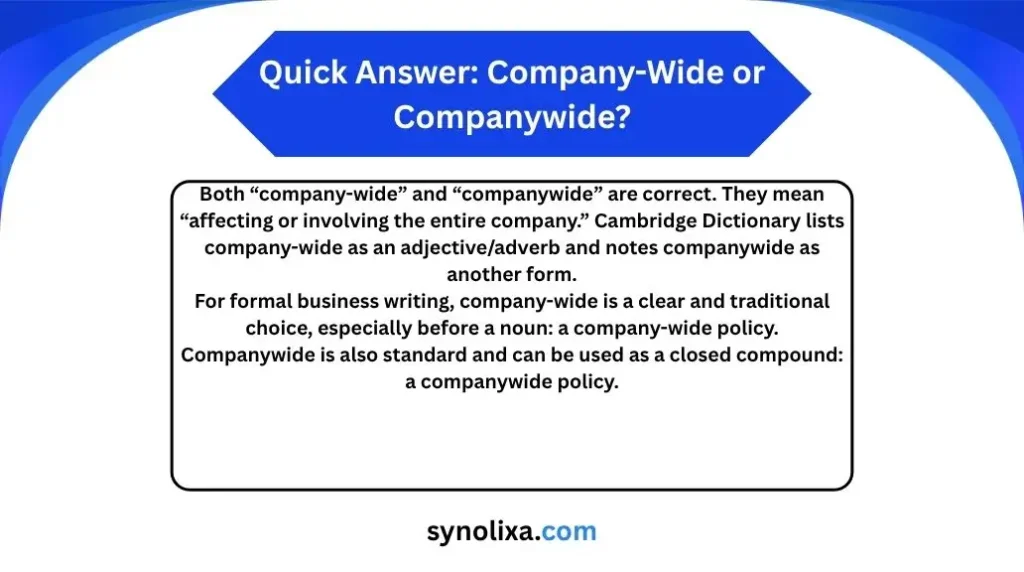
Both “company-wide” and “companywide” are correct. They mean “affecting or involving the entire company.” Cambridge Dictionary lists company-wide as an adjective/adverb and notes companywide as another form.
For formal business writing, company-wide is a clear and traditional choice, especially before a noun: a company-wide policy. Companywide is also standard and can be used as a closed compound: a companywide policy.
The important point is simple: do not treat companywide as a spelling error.
Understanding the Basics: Company-Wide vs. Companywide
The first thing to understand is that these two forms usually have the same meaning.
Both describe something that extends across an entire company.
For example:
- The CEO announced a company-wide policy.
- The CEO announced a companywide policy.
Both sentences tell us that the policy applies throughout the company.
The main difference is the form of the compound. One uses a hyphen, while the other is written as one word.
Comparison Table
| Form | Type | Meaning | Example | Correct/Incorrect |
|---|---|---|---|---|
| company-wide | Compound adjective/adverbial form | Affecting the entire company | We announced a company-wide policy. | ✅ Correct |
| companywide | Closed compound adjective/adverb | Affecting the entire company | We announced a companywide policy. | ✅ Correct |
| company wide | Open phrase | Usually not the preferred form for this meaning | We announced a company wide policy. | ⚠️ Avoid in formal writing |
| company-widely | Incorrect derived form | Not standard English | The policy applies company-widely. | ❌ Incorrect |
This distinction is important because English compounds can develop in different ways. Some remain hyphenated, while others become closed compounds over time.
For example, Merriam-Webster lists statewide as a single word and storewide as a single word. It also lists corporate-wide with a hyphen.
That shows why you should not assume that every word ending in -wide must follow exactly the same spelling pattern.
What Does “Company-Wide” Mean?
Company-wide means something applies to the whole company.
The word can describe:
- a policy
- an announcement
- a meeting
- a training program
- a change
- a rule
- a survey
- an initiative
- a benefit
- a system
- a decision
Example 1: Company-Wide Policy
The company introduced a company-wide remote-work policy.
Here, company-wide describes the noun policy.
The policy is not limited to one department. It applies throughout the company.
Example 2: Company-Wide Meeting
We are holding a company-wide meeting on Friday.
The meeting includes people from across the company.
Example 3: Company-Wide Announcement
The CEO sent a company-wide announcement.
The announcement was intended for the entire organization.
The core idea is always the same:
company-wide = involving or affecting the whole company.
Cambridge Dictionary gives the same basic meaning, defining the term as relating to or affecting the whole of a company.
What Does “Companywide” Mean?
Companywide has the same basic meaning as company-wide.
It means:
throughout the entire company
or:
affecting all parts of a company.
For example:
The new system will be used companywide.
This means the new system will be used throughout the company.
You can also use it before a noun:
The companywide training begins next Monday.
Here, companywide describes training.
This closed form is not simply a typo. It is an established English compound. Modern dictionaries and real-world usage recognize closed compounds ending in -wide, such as statewide and storewide.
So if your spell checker accepts companywide, that does not mean your software is making a mistake.
Company-Wide Before a Noun
One of the most useful ways to understand company-wide is to look at its position in a sentence.
When a compound modifier appears directly before a noun, a hyphen can help readers see that the words work together.
For example:
We created a company-wide training program.
The phrase company-wide modifies training program.
More examples:
- a company-wide meeting
- a company-wide policy
- a company-wide announcement
- a company-wide survey
- a company-wide initiative
- a company-wide change
- a company-wide benefit
- a company-wide strategy
The hyphen connects company and wide into one descriptive unit.
Why Does the Hyphen Help?
Hyphens often make compound modifiers easier to understand.
Compare:
a company-wide policy
with:
a company wide policy
The first version immediately shows that company-wide functions as one modifier.
This is a general English writing principle. Compound modifiers placed before nouns are often hyphenated when the hyphen improves clarity.
However, because companywide has become an established closed compound, the one-word form is also acceptable.
Companywide as a Closed Compound
The word companywide is a closed compound. That means the two elements are written together without a hyphen.
Examples include:
The new benefits are available companywide.
The companywide policy begins in January.
The survey was distributed companywide.
The change will be implemented companywide.
This form is especially convenient in modern digital writing because it is compact.
You may see companywide in:
- internal communications
- business websites
- employee handbooks
- marketing content
- news writing
- reports
- workplace software
- email messages
The important thing is not to confuse companywide with an incorrect spelling. It is a legitimate form.
Is “Company Wide” Correct?
This is where the answer becomes more useful.
Although company-wide and companywide are established forms, company wide is generally not the preferred spelling when the expression is being used as the compound meaning “throughout the company.”
For example:
We announced a company-wide training program. ✅
We announced a companywide training program. ✅
We announced a company wide training program. ⚠️ Avoid
The open form can appear in some writing, particularly where wide is functioning independently as an adjective or where a writer follows a particular house style. But if your intended meaning is the established compound “throughout the company,” the hyphenated or closed form is clearer.
Simple Rule
When you mean throughout the entire company, choose:
- company-wide ✅
- companywide ✅
Avoid:
- company wide ⚠️
This is especially helpful in professional writing.
Correct Meanings and Uses
1. Company-Wide Policy
A company-wide policy applies to the entire organization.
The company introduced a company-wide privacy policy.
Breakdown:
- company-wide = adjective
- policy = noun
- The adjective tells us the scope of the policy.
The policy is not limited to one office or department.
2. Companywide Announcement
A companywide announcement is sent to the entire company.
The CEO made a companywide announcement this morning.
Here, companywide modifies announcement.
The closed spelling is completely acceptable.
3. Company-Wide Meeting
A company-wide meeting includes employees from across the organization.
We have a company-wide meeting at 2 p.m.
This is a common phrase in workplace English.
4. Companywide Training
Companywide training is training provided throughout an organization.
The companywide training program begins next month.
This can involve every employee or every relevant employee, depending on the context.
5. A Change Implemented Companywide
The word can also describe the scope of an action.
The new security system was implemented companywide.
Here, companywide tells us where the implementation occurred.
A similar rewrite is:
The new security system was implemented throughout the company.
This alternative is useful when you want maximum clarity.
Test Tip: How to Check Your Usage
Here is a simple test. 🧠
Ask yourself:
Does the expression mean “throughout the entire company”?
If yes, company-wide or companywide will usually work.
For example:
The rule applies throughout the company.
You can rewrite it as:
The rule applies companywide.
Or:
The company-wide rule applies to every department.
If the meaning stays the same, you are probably using the term correctly.
Another Quick Test
Replace the expression with:
“throughout the company.”
If the sentence still makes sense, the compound is probably being used correctly.
Example:
The program operates companywide.
Replace it:
The program operates throughout the company.
The meaning remains clear.
Case Study: A Workplace Email
Imagine that a company is changing its cybersecurity policy.
An employee writes this email:
Subject: Company-Wide Security Update
Hi Team,
We are introducing a new security policy that will apply across all departments. The company-wide training session will take place next Tuesday. Please review the updated guidelines before the session.
Thank you.
The use of company-wide works well here because it appears before the noun training session.
Now imagine a different sentence:
The new security requirements will be applied companywide.
Here, companywide works naturally as a closed compound describing the scope of the action.
Both forms communicate the same basic idea.
Practical Lesson
If your workplace has a style guide, follow it.
If your company consistently uses company-wide, keep using it.
If its editorial style prefers companywide, use that form consistently.
Professional writing is not only about choosing a grammatically acceptable word. It is also about consistency.
Grammar Rules Behind Company-Wide and Companywide
The question is partly about compound words.
English often combines words to create a new meaning.
Consider:
- nationwide
- statewide
- worldwide
- storewide
- industry-wide
- corporate-wide
Some compounds are written as one word. Others retain a hyphen.
Merriam-Webster, for example, lists statewide as an adjective and adverb meaning throughout a state. It also lists storewide as an adjective.
Merriam-Webster also lists corporate-wide as an adjective meaning extending throughout or involving an entire corporation.
This is important because English spelling conventions are not always perfectly predictable.
What About Companywide?
Companywide follows the pattern of established closed compounds ending in -wide.
At the same time, company-wide remains a clear and widely recognized hyphenated form.
Therefore, the best practical rule is:
Both company-wide and companywide are correct; choose according to context, dictionary preference, and house style.
Do not claim that the hyphenated version is the only possible correct form.
Why Writers Get Confused
The confusion comes from the way English compounds develop.
Writers may see:
- worldwide
- nationwide
- statewide
- company-wide
- corporate-wide
- industry-wide
and wonder why some forms are closed while others retain a hyphen.
There is no universal rule saying every -wide word must be written in exactly the same way.
Dictionary entries matter.
Established compounds can become closed over time. Other combinations remain hyphenated because the hyphen helps readers recognize the compound.
That is why checking a reliable dictionary is better than relying only on intuition.
Common Mistakes With Company-Wide and Companywide
Mistake 1: Assuming Companywide Is Wrong
Some writers think the hyphen must always be present.
That is not true.
Companywide is an accepted form.
Mistake 2: Assuming Company-Wide Is Wrong
The opposite mistake also happens.
Some writers believe modern English must always close compounds into one word.
That is also incorrect.
Company-wide remains a valid and useful form.
Mistake 3: Writing “Company Wide” Automatically
This is the form most likely to cause trouble in formal business writing.
If you mean the established compound, choose:
company-wide
or:
companywide
Mistake 4: Mixing Styles
A report might say:
company-wide policy
on page one and:
companywide policy
on page five.
This is not necessarily a grammar error, but it can look inconsistent.
Pick a style and stay with it.
Why Do People Make These Mistakes?
Several everyday factors can cause spelling confusion.
Fast Typing
When people write quickly, they may not think about a tiny hyphen.
This is common in:
- emails
- workplace chats
- text messages
- notes
- online comments
Autocorrect
Autocorrect and spell-checking systems do not always agree about hyphenation.
One program may prefer companywide, while another may suggest company-wide.
That does not automatically mean one version is grammatically wrong.
Lack of Knowledge
Many people simply never learn how compound words work.
That is understandable because English contains many exceptions and evolving spelling patterns.
The best solution is to learn the accepted forms and follow a consistent style.
Similar Grammar and Spelling Confusions
The company-wide question belongs to a larger group of English problems involving word combinations and punctuation.
| Confusion | Correct Forms | Basic Difference |
|---|---|---|
| its / it’s | its, it’s | Possession vs. “it is” or “it has” |
| your / you’re | your, you’re | Possession vs. “you are” |
| their / they’re | their, they’re | Possession vs. “they are” |
| everyday / every day | everyday, every day | Adjective vs. time expression |
| setup / set up | setup, set up | Noun vs. verb |
| nationwide / nation-wide | nationwide | Established closed compound |
| company-wide / companywide | Both | Hyphenated vs. closed compound |
| workplace / work place | workplace | Established compound noun |
These examples show why English spelling cannot always be reduced to one simple rule.
Company-Wide in Everyday Conversation
In everyday conversation, people are more likely to focus on meaning than spelling.
For example:
“Is this a companywide event?”
That sounds natural.
You could also say:
“Is this a company-wide event?”
That is equally understandable.
In spoken English, listeners do not hear the hyphen or see whether the word is closed.
This means the distinction becomes important mainly in written communication.
Company-Wide in Professional Writing
Professional writing requires greater attention to consistency.
Use the form preferred by your organization’s style guide.
For example:
The company-wide compliance program begins Monday.
Or:
The companywide compliance program begins Monday.
Both can work.
Where You Might See the Term
- employee handbooks
- HR policies
- business reports
- annual reports
- internal emails
- company websites
- press releases
- presentations
- training documents
- executive communications
If your document is formal and your style guide has no specific rule, company-wide is a very clear choice before a noun.
Companywide in Creative Writing
Creative writers have more flexibility.
A writer might choose companywide because it looks compact:
The news spread companywide before lunch.
Another writer might choose company-wide for visual clarity:
A company-wide transformation was underway.
Neither choice changes the central meaning.
In creative writing, consistency with the author’s overall style is often more important than forcing every instance into one form.
Company-Wide in Social Media and Texting
Social media writing is usually less formal.
You might see:
Big companywide update coming tomorrow! 🎉
Or:
We have a company-wide event this Friday! 🙌
Both are easy to understand.
In short posts, companywide can look neat because it keeps the phrase compact.
In formal posts, however, many writers still prefer the familiar company-wide form.
Why This Small Difference Matters
You may wonder why a single hyphen deserves so much attention.
It matters because professional communication depends on clarity and consistency.
1. Clarity
A well-formed compound helps readers understand how words relate to one another.
2. Professionalism
Consistent spelling makes documents look carefully edited.
3. Digital Communication
Business communication now happens across:
- websites
- messaging platforms
- employee portals
- presentations
- social media
- online documents
Small inconsistencies can become visible across many channels.
4. Search and Editing
Consistent terminology can also help editors, content teams, and organizations maintain a uniform writing style.
A useful principle is:
Clear writing makes the reader’s job easier.
That is especially important in workplace communication.
Special Exception: Style Guides and House Style
There is no single universal rule requiring every organization to choose one form.
A company may have its own style guide.
For example, an editorial team might decide to use:
company-wide
in all formal documents.
Another team may prefer:
companywide
because it follows its dictionary and house style.
Neither choice automatically makes the other form incorrect.
Dictionary vs. House Style
A dictionary tells you what forms are recognized in English.
A house style tells you what form your organization wants you to use.
If the two differ in preference, follow the house style for that organization.
This is especially important for:
- corporate websites
- legal documents
- employee manuals
- press releases
- branded content
- public reports
What About “Corporate-Wide”?
Do not confuse company-wide with corporate-wide.
They are similar, but they are not identical words.
Company-wide means involving an entire company.
Corporate-wide can mean involving an entire corporation or corporate organization.
Merriam-Webster lists corporate-wide as an adjective meaning “extending throughout or involving an entire corporation.”
Examples:
The company-wide policy affects all employees.
The corporate-wide initiative affects all divisions of the corporation.
In many contexts, the terms may be close in meaning, but they should not be treated as exactly interchangeable in every sentence.
Quick Recap Checklist
Use this checklist whenever you are unsure.
| Question | If Yes → Use |
|---|---|
| Do you mean “throughout the entire company”? | company-wide / companywide |
| Is the term before a noun? | company-wide is a clear choice |
| Does your style guide prefer the closed form? | companywide |
| Are you writing formal business content? | Follow your house style; company-wide is a clear traditional choice |
| Are you tempted to write “company wide”? | Choose company-wide or companywide instead |
| Are you wondering whether companywide is a typo? | No, it is an accepted form |
Practice Example 1
The CEO announced a ________ policy.
Good answers:
The CEO announced a company-wide policy.
or:
The CEO announced a companywide policy.
Practice Example 2
The new system will be available ________.
Good answer:
The new system will be available companywide.
You can also rewrite it:
The new system will be available throughout the company.
Practice Example 3
We are holding a ________ meeting.
Good answers:
We are holding a company-wide meeting.
or:
We are holding a companywide meeting.
FAQs
1. Is “company-wide” correct?
Yes. Company-wide is a correct hyphenated form meaning something affects or involves the entire company.
Example:
The company announced a company-wide policy.
2. Is “companywide” one word?
Yes. Companywide is an established closed compound and has the same basic meaning as company-wide.
Example:
The new system will be implemented companywide.
3. Is company-wide better than companywide?
Not always. Both are accepted. The better choice depends on your organization’s style guide, dictionary preference, and context.
For formal writing, company-wide is a clear traditional choice, especially before a noun. Companywide is also standard.
4. Is “company wide” correct?
It is generally better to avoid company wide when you mean the established compound meaning “throughout the company.” Use company-wide or companywide instead.
5. Should I write “company-wide policy” or “companywide policy”?
Both are correct.
company-wide policy ✅
companywide policy ✅
Choose the form that matches your preferred style and use it consistently.
6. What is the easiest way to remember company-wide vs. companywide?
Remember this:
Both forms are correct. The difference is mainly spelling and style, not meaning.
If you want a clear traditional form before a noun, use company-wide.
If your style uses closed compounds, use companywide.
Conclusion
The answer is simpler than it first appears. Company-wide and companywide are both correct forms used to describe something that affects, includes, or applies throughout an entire company. Cambridge Dictionary recognizes both forms, and English usage supports the closed compound as well.
The hyphenated form, company-wide, is especially clear when it comes directly before a noun, as in company-wide policy, company-wide meeting, or company-wide announcement. The closed form, companywide, can also be used before nouns and is natural in expressions such as companywide training or the system was implemented companywide.
The form to avoid in most formal writing is company wide when you intend the established compound.
Most importantly, do not waste time thinking that one of the two accepted forms is automatically a spelling error. Check your dictionary, follow your organization’s style guide, and stay consistent.
When the whole company is involved, both “company-wide” and “companywide” can get the message across—choose your style, then write it consistently.

Hi, I am Ava Mitchell. I work at Synolixa as an English content writer, creating simple and useful resources about synonyms, vocabulary, and English usage.

[…] if you are deciding between input or imput, choose input in standard writing. Company-Wide or Companywide | Unselect or Deselect | Heard vs Herd vs […]
[…] talking about excessive speed, but use to fast only when fast functions as a verb. Input or Imput | Company-Wide or Companywide | Unselect or […]