Have you ever typed a sentence and suddenly wondered whether the correct word is “envolved or involved”? 🤔 You are not alone. These two spellings look similar, especially when you type quickly or hear the word in casual conversation. However, there is an important difference: involved is the standard English word, while envolved is generally a misspelling when you intend to use involved.
The word involved is the past tense and past participle of involve. It can mean participating in something, being connected to something, including someone or something, or dealing with something complicated. For example, you can say, “She was involved in the project.”
The confusion may also come from the word evolved, which is a completely different word. Evolved describes development or gradual change over time. So, when deciding between envolved or involved, it is important to first identify what you mean.
In this guide, you will learn the correct spelling, meaning, grammar rules, common mistakes, examples, and easy ways to remember the difference. ✨ Introduction to or Introduction of | Imitated vs Intimated | In the Street or On the Street
Quick Answer: Envolved or Involved?
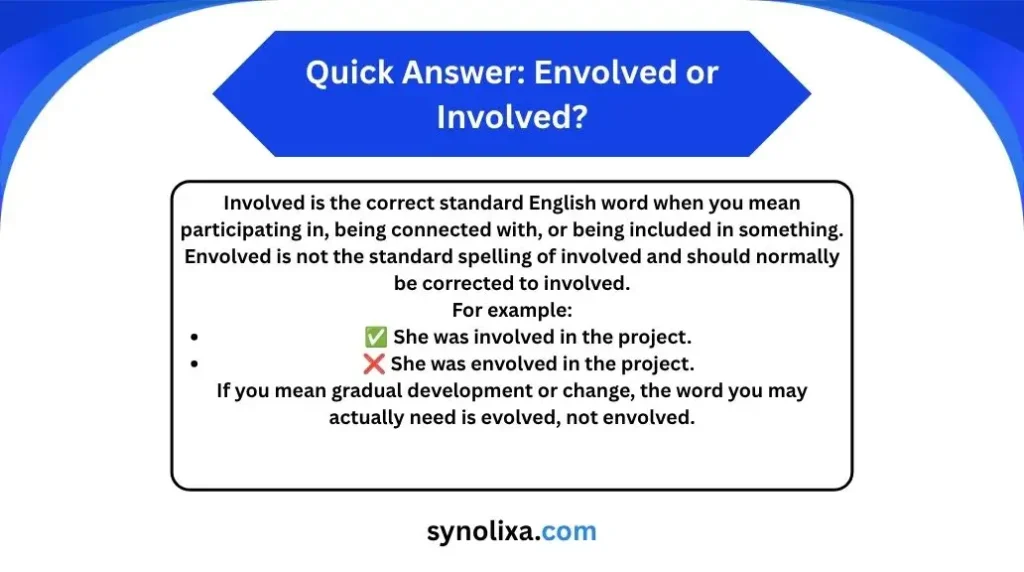
Involved is the correct standard English word when you mean participating in, being connected with, or being included in something. Envolved is not the standard spelling of involved and should normally be corrected to involved.
For example:
- ✅ She was involved in the project.
- ❌ She was envolved in the project.
If you mean gradual development or change, the word you may actually need is evolved, not envolved.
Understanding the Basics: Envolved or Involved
The easiest way to understand envolved or involved is to look at their forms and meanings.
| Form | Type | Meaning | Example | Correct/Incorrect |
|---|---|---|---|---|
| Involved | Past tense/past participle of involve; adjective | Participating, connected, included, or complicated | She was involved in the project. | ✅ Correct |
| Envolved | Nonstandard/misspelled form when intended as involved | Usually intended to mean involved | She was envolved in the project. | ❌ Incorrect |
| Evolved | Past tense/past participle of evolve | Developed or changed gradually | The plan evolved over time. | ✅ Correct, but different meaning |
The key point is simple:
Involve → involved
Not:
Envolve → envolved
Merriam-Webster lists involve as a verb and gives involved as its past-tense and past-participle form. Its meanings include engaging someone as a participant, including something as part of a whole, and affecting or connecting with something.
So if your sentence means “take part,” “include,” “connect,” or “engage,” choose involved.
Basic Word Formation
The correct word family looks like this:
- involve → present/base form
- involves → third-person singular
- involving → present participle
- involved → past tense/past participle
- involvement → noun
Examples:
- I involve my team in important decisions.
- She involves everyone in the discussion.
- They are involving several departments.
- He was involved in the meeting.
- Her involvement helped the project succeed.
Merriam-Webster also lists involvement as the noun referring to the state, act, or fact of being involved.
Correct Meanings and Uses of “Involved”
1. Involved Means Participating in Something
One of the most common meanings of involved is actively taking part in an activity, project, organization, or event.
For example:
“Maria is involved in the school project.”
Breakdown:
- Maria = subject
- is = linking verb
- involved = adjective/past participle describing her participation
- in the school project = the activity in which she participates
More examples:
- I am involved in community activities.
- They were involved in the event.
- He is involved in several school programs.
- Our team was involved in planning the event.
2. Involved Means Connected to Something
Involved can also describe a person or thing that is connected to a situation.
For example:
“Several departments were involved in the decision.”
This means several departments had a role or connection in making the decision.
Other examples:
- The manager was involved in the discussion.
- Many people were involved in the process.
- The company was involved in the negotiations.
This use is especially common in professional and academic writing.
3. Involved Can Mean Included
Another meaning is included as part of something.
For example:
“The price includes all the services involved.”
Here, involved refers to the services connected with or included in the situation.
You might also see:
- Everyone involved received an email.
- The people involved were asked to attend.
- The costs involved were higher than expected.
4. Involved Can Describe Something Complicated
The word involved can also describe something that is complicated, detailed, or difficult.
For example:
“The process is quite involved.”
This does not mean that someone is participating. Instead, it means the process has many details or steps.
Other examples:
- The repair required an involved procedure.
- The investigation was extremely involved.
- Writing the report was more involved than expected.
This is an important meaning because learners sometimes assume involved always means participation.
5. Involved Can Describe Emotional Connection
Involved can also describe emotional or personal connection.
For example:
- She became deeply involved in the story.
- He was emotionally involved in the situation.
- They became closely involved with the organization.
The exact meaning depends on context.
“Involved in” vs. “Involved with”
Both expressions are correct, but they are often used in slightly different situations.
Involved in
Involved in commonly refers to participation in an activity, process, project, event, or situation.
Examples:
- She is involved in the research project.
- He was involved in organizing the event.
- They are involved in community service.
Involved with
Involved with often emphasizes a relationship or connection with a person, organization, group, or activity.
Examples:
- She is involved with a local nonprofit.
- He became involved with the organization.
- They are involved with several community programs.
There can be overlap between the two expressions, so context matters.
Test Tip: How to Check “Envolved or Involved”
Here is a simple test. Ask yourself:
“Am I trying to say participate, connect, include, or engage?”
If the answer is yes, use involved.
For example:
She was ___ in the project.
You mean she participated in the project.
Therefore:
✅ She was involved in the project.
Never choose envolved simply because it seems to match the sound.
Another Easy Test
Try changing the sentence to the base verb.
If your sentence can use involve, the past form is involved.
For example:
- Present: The project involves several teams.
- Past: The project involved several teams.
- Participle: Several teams were involved.
That pattern makes the correct spelling easier to remember.
Case Study: A Workplace Email
Imagine that a manager wants to send an email about a new project.
A team member writes:
“I was envolved in preparing the presentation.”
The sentence contains a spelling error.
The corrected version is:
“I was involved in preparing the presentation.”
Why?
Because the base verb is involve:
involve → involved
The employee is saying that they participated in preparing the presentation.
Why the Correction Matters
In a casual text message, a typo may be understood immediately. But workplace communication often needs to be polished.
Compare:
❌ “I was envolved in the meeting.”
✅ “I was involved in the meeting.”
The second version is clearer and follows standard English spelling.
A More Professional Example
“Several members of the marketing team were involved in preparing the final proposal.”
This sentence clearly communicates that several team members participated in the work.
Grammar Rules: Why “Involved” Is Correct
The grammar rule is straightforward.
Involved comes from the verb involve.
Merriam-Webster gives the verb as involve and explicitly lists its forms as involved; involving. The dictionary defines involve in several ways, including engaging someone as a participant, including something as part of a whole, and connecting or relating something closely.
Therefore:
involve → involved
There is no standard English spelling rule that changes involve into envolve simply because another word may begin with en-.
English has many words beginning with en-, such as:
- encourage
- enlarge
- enable
- enrich
- enclose
But that does not mean en- can be added to every word.
The spelling of a word must be learned as part of its established word family.
Involved Is Also an Adjective
In some sentences, involved functions as an adjective.
Example:
“She is an involved parent.”
Here, involved describes the parent’s active participation.
Another example:
“This is an involved process.”
Here, involved describes something complicated or detailed.
So involved can appear in several grammatical roles depending on the sentence.
What About “Envolved”?
When someone writes envolved in English and intends to mean involved, it is normally a spelling mistake.
The form can occasionally appear in dictionary or multilingual sources as a form associated with another language or a rare historical/lexical entry, but that does not make it the standard English replacement for involved. For ordinary modern US English writing, use involved.
This distinction is important because seeing an unusual form somewhere online does not automatically mean it is appropriate in standard English.
For normal:
- school writing
- workplace emails
- essays
- reports
- websites
- social media
- everyday English
use involved when you mean participation or connection.
Common Mistakes With “Envolved or Involved”
Why do people make this mistake? There are several possible reasons.
1. Fast Typing ⌨️
When people type quickly, they may write the word based on what they hear rather than how it is spelled.
A small letter change can produce:
envolved ❌
instead of:
involved ✅
2. Pronunciation Confusion 🗣️
English spelling and pronunciation do not always match perfectly. In fast speech, unstressed sounds can be difficult to distinguish.
Someone may therefore remember the wrong initial spelling.
3. Confusion With “Evolved”
This is one of the most important sources of confusion.
Evolved is a real and correct English word.
It comes from evolve.
It means developed or changed gradually.
Example:
Technology has evolved rapidly.
Involved, on the other hand, comes from involve.
Example:
She was involved in the project.
Compare:
| Word | Base Verb | Meaning |
|---|---|---|
| Involved | involve | Participated, included, or connected |
| Evolved | evolve | Developed or changed gradually |
| Envolved | — | Not the standard form intended for involved |
4. Autocorrect 📱
Autocorrect can sometimes introduce unexpected spelling changes. It is useful, but it should not replace proofreading.
If a word looks unusual, check the complete sentence and confirm the intended meaning.
5. Lack of Vocabulary Knowledge
Learners may know the spoken form of a word but not its written form.
This is normal when building English vocabulary.
The solution is repeated exposure:
- Read the word.
- Write the word.
- Use the word in sentences.
- Check the word in a reliable dictionary.
Similar Grammar and Spelling Confusions
The envolved or involved problem belongs to a much larger group of English mistakes.
| Common Confusion | Correct Form | Main Difference |
|---|---|---|
| envolved / involved | involved | Standard spelling |
| your / you’re | your / you’re | Possession vs. “you are” |
| its / it’s | its / it’s | Possessive vs. “it is” |
| their / there / they’re | their / there / they’re | Possession, place, “they are” |
| affect / effect | affect / effect | Usually verb vs. noun |
| then / than | then / than | Time/order vs. comparison |
| to / too | to / too | Preposition/infinitive vs. also/excess |
| your / yore | your in modern everyday use | Possessive vs. archaic/literary word |
| evolved / involved | evolved / involved | Development vs. participation |
The best way to avoid these mistakes is to learn both the form and the meaning of each word.
Usage in Different Contexts
Everyday Conversation 🗣️
Involved is very common in ordinary speech.
Examples:
- Are you involved in the project?
- I don’t want to get involved.
- She is involved in several activities.
- He became involved with the group.
Notice the common phrase:
get involved
It means to begin participating or taking part.
Professional Writing 💼
In professional English, involved is frequently used.
Examples:
- The employees involved in the project will attend the meeting.
- Several departments were involved in the decision.
- Please contact everyone involved in the process.
- Our team was directly involved in the planning stage.
Using the standard spelling is especially important in resumes, reports, emails, proposals, and formal documents.
Creative Writing ✍️
Writers can use involved to describe participation, emotional connection, or complexity.
Examples:
- She became deeply involved in the mystery.
- The characters were involved in a complicated conflict.
- His explanation was more involved than expected.
Creative writing may be flexible in style, but standard spelling still helps readers understand the text.
Social Media and Texting 📱
Informal communication often contains typos.
Someone might accidentally write:
“I was envolved in this project.”
Readers may understand the intended meaning, but the standard spelling remains:
“I was involved in this project.”
Even in casual communication, learning the correct form helps build strong writing habits.
Why Correct Spelling Matters
A single spelling error may seem minor, but accurate word choice has several benefits.
1. Clarity in Communication
Correct spelling makes your meaning easier to understand.
Compare:
❌ I was envolved in the project.
✅ I was involved in the project.
The second sentence immediately looks familiar to an English reader.
2. Professionalism
Correct spelling creates a more polished impression.
This matters when writing:
- emails
- applications
- reports
- school assignments
- business documents
- website content
3. Digital Communication
Online writing moves quickly. People often type messages without reviewing them.
However, published content can remain online for a long time. A small spelling mistake can therefore be seen by many readers.
4. Confidence
Knowing the correct form makes writing easier.
When you understand that:
involve → involved
you do not need to hesitate every time you use the word.
A Useful Reminder
Clear words make clear communication.
Accuracy is not about using complicated English. It is about choosing the right word and spelling it correctly.
Special Exception: Can “Envolved” Ever Appear?
For standard modern US English, envolved should not be used as the spelling of involved.
However, you may occasionally encounter envolved in unusual contexts, such as multilingual dictionary resources, historical language material, names, user-generated text, or references to another lexical form. Such appearances do not establish envolved as the standard English past form of involve.
For ordinary English writing, the rule remains:
Involve → involved
Also be careful not to confuse it with:
Evolve → evolved
These are different words with different meanings.
Common Phrases With “Involved”
Learning common word combinations can help you remember the spelling naturally.
Get involved
Meaning: begin participating.
Example:
Students are encouraged to get involved in community activities.
Be involved in
Meaning: participate in or be connected with something.
Example:
She is involved in the research project.
Become involved
Meaning: start participating or becoming connected.
Example:
He became involved in the organization last year.
Deeply involved
Meaning: strongly connected or actively participating.
Example:
They are deeply involved in the project.
Directly involved
Meaning: having an immediate role or connection.
Example:
The engineers were directly involved in the design process.
Everyone involved
Meaning: all people connected with the situation.
Example:
Everyone involved received an update.
These phrases are useful because they show how involved naturally appears in real English.
Quick Recap Checklist
Use this checklist whenever you are unsure about envolved or involved.
| Question | If Yes → Use |
|---|---|
| Do you mean participating in something? | Involved |
| Do you mean being connected to something? | Involved |
| Do you mean being included in a situation? | Involved |
| Do you mean something is complicated or detailed? | Involved |
| Do you mean something developed gradually? | Evolved |
| Did you write “envolved” to mean “involved”? | Change it to involved |
Practice Example 1
❌ She was envolved in the discussion.
✅ She was involved in the discussion.
Practice Example 2
❌ The company has envolved in the new project.
If you mean participation:
✅ The company has been involved in the new project.
If you mean development:
✅ The company has evolved over time.
Notice how the intended meaning determines the correct word.
Practice Example 3
❌ Many students were envolved in the event.
✅ Many students were involved in the event.
FAQs About Envolved or Involved
1. Is “envolved” a correct English word?
Envolved is not the standard English form of involved. If you want to say that someone participated in, was connected to, or was included in something, use involved.
2. What is the correct spelling: envolved or involved?
The correct spelling is involved when you mean the past tense or past participle of involve.
Example:
She was involved in the project.
Merriam-Webster lists involved as a form of the verb involve.
3. What does “involved” mean?
Involved can mean participating in something, being connected with something, being included in a situation, or being complicated or detailed.
For example:
He was involved in the project.
Here, it means he participated in the project.
4. Is “evolved” the same as “involved”?
No. Evolved and involved have different meanings.
Evolved means developed or changed gradually.
Involved usually means participated, was connected, or was included.
Examples:
- Technology has evolved over time.
- She was involved in the project.
5. Why do people write “envolved”?
People may write envolved because of fast typing, pronunciation confusion, or confusion with evolved. The unusual spelling may also result from assuming that the word begins with en-.
The safest approach is to remember the word family:
involve → involved → involvement
6. Can I use “envolved” in formal writing?
No. If you intend to use the standard English word meaning “participated” or “was connected,” use involved.
For example:
✅ The team was involved in the project.
Avoid:
❌ The team was envolved in the project.
7. Can “involved” mean complicated?
Yes. Involved can describe something that is complicated, detailed, or requires many steps.
Example:
“The application process was quite involved.”
Here, involved does not mean that someone participated. It means the process was complex.
8. Is “involved” a verb or an adjective?
It can function in different ways depending on the sentence. It is the past tense and past participle form of involve, and it can also function adjectivally.
Examples:
- Verb form: The project involved several teams.
- Adjective: She is deeply involved in the project.
Conclusion
When choosing between envolved or involved, the correct standard English form is involved when you mean participating in, being connected with, or being included in something. The word comes from the verb involve, whose standard past tense and past participle is involved. Merriam-Webster confirms this word formation and lists several meanings for involve, including engaging someone as a participant and connecting something closely.
The spelling envolved is generally a mistake when it is intended to mean involved. The confusion can happen because of fast typing, pronunciation, autocorrect, or confusion with the completely different word evolved.
Remember this simple pattern:
Involve → Involved → Involvement
And remember the meaning:
Participate or connect = involved.
Develop or change = evolved.
Once you learn this small distinction, you can confidently choose the right word in conversations, schoolwork, professional emails, social media posts, and formal writing.
When in doubt, check the meaning first—and let the meaning guide the spelling. ✨

Hi, I am Ava Mitchell. I work at Synolixa as an English content writer, creating simple and useful resources about synonyms, vocabulary, and English usage.
[…] examine common mistakes, and give you simple tests for choosing the right form every time. Envolved or Involved: Which Is Correct | Introduction to or Introduction of | Imitated vs Intimated […]